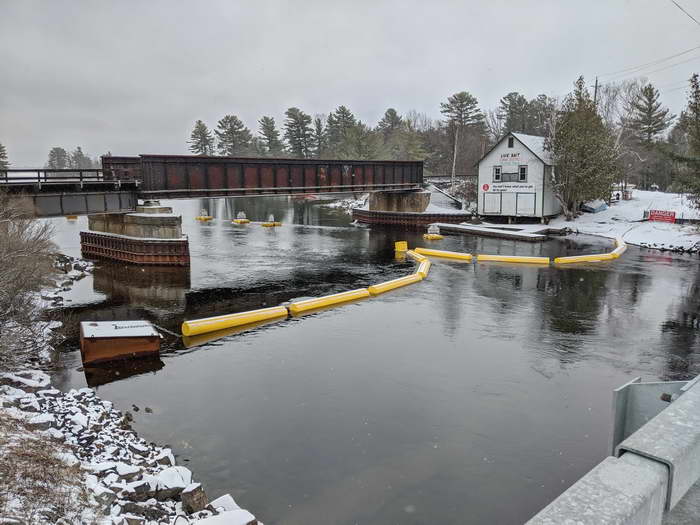
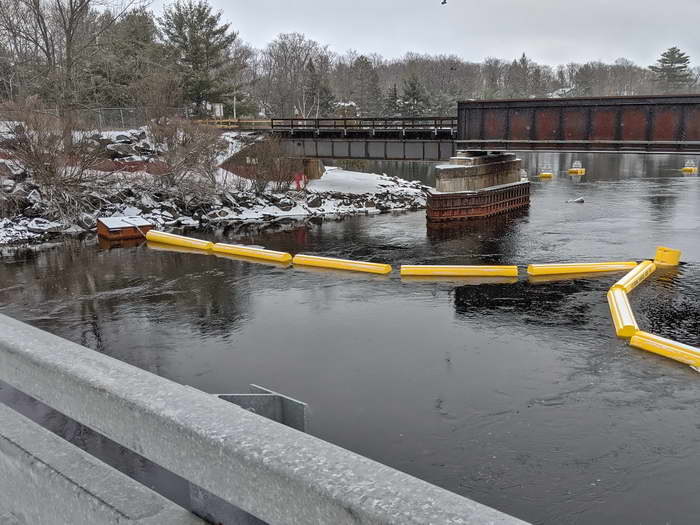
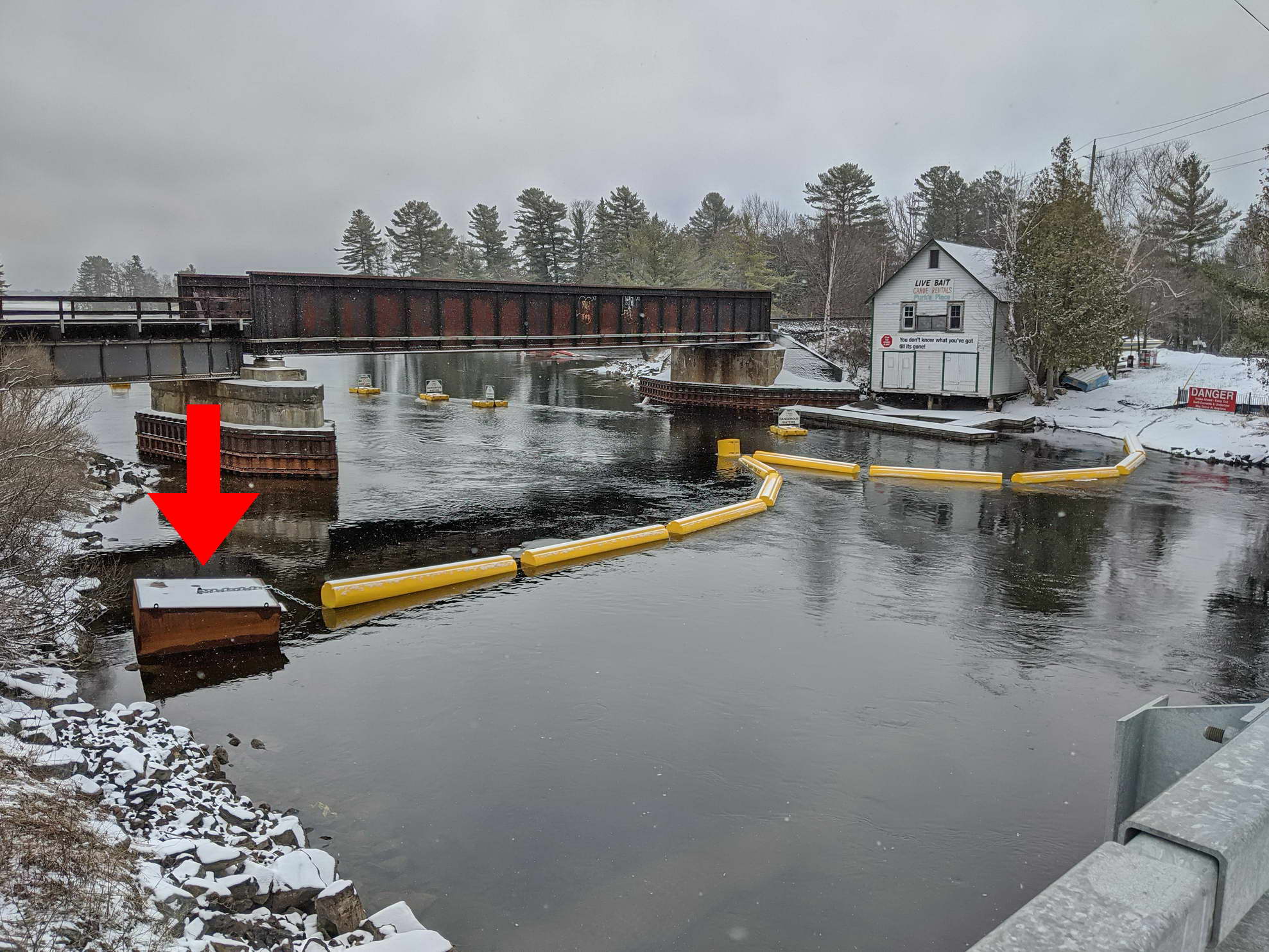
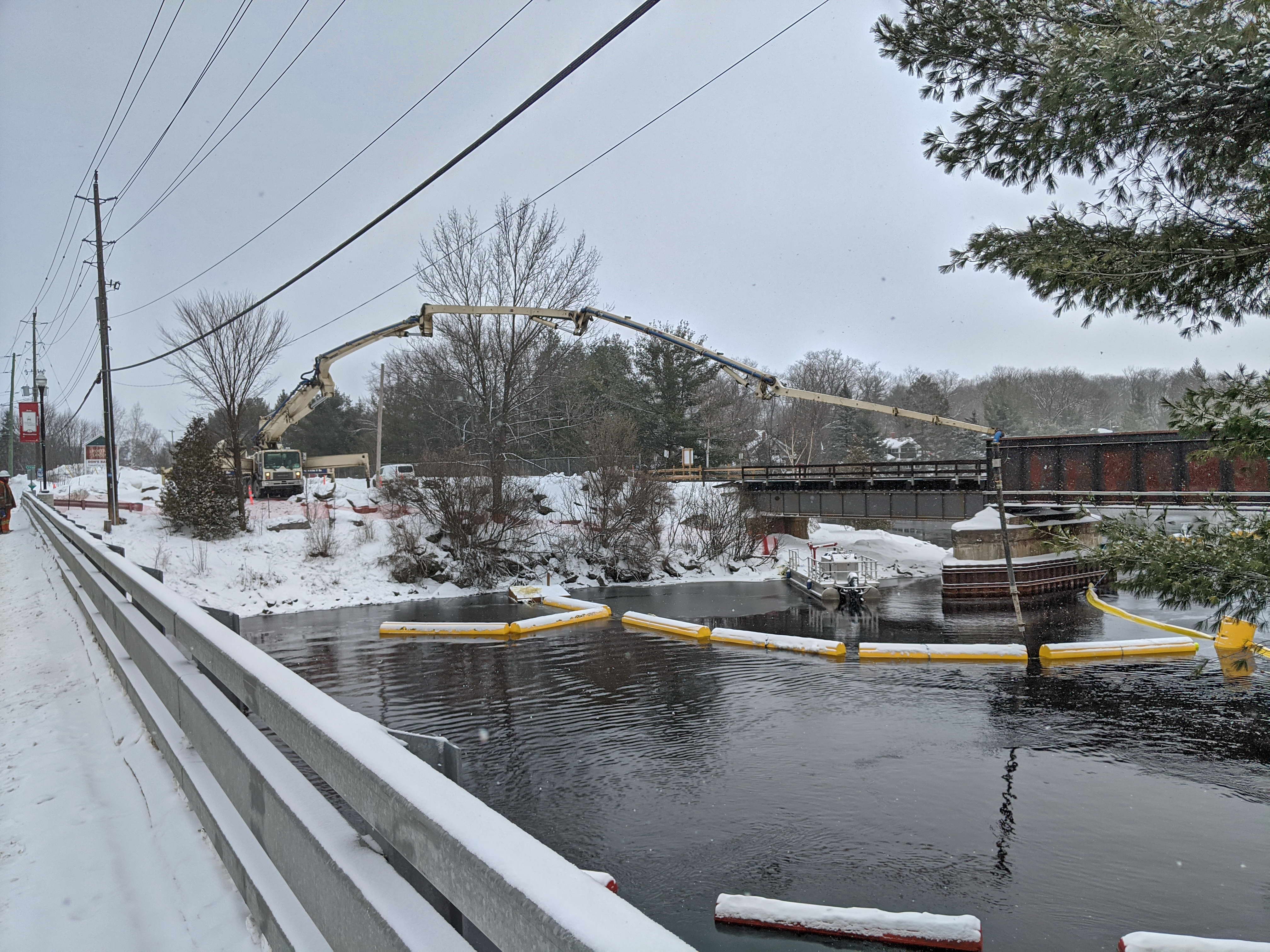
There has been a power station on the Mills Stream (also called Burgess Creek) in Bala since 1917. As you see in the photograph above, it is a simple structure. Recently, this power station has been operated by Algonquin Power & Utilities Corp.

Without any community consultation or incident, last year they decided to install a fence.

So as you see below, after almost a hundred years of peaceful operation, in just a few days, an ugly chain-link fence has been installed, complete with sharp wire tops.

This is one of the many concerns we have for the proposed power station at the Bala falls.

The simple natural beauty of the area could be completely ruined if some safety or insurance requirement resulted in a fence being required.

Not only has the proponent not provided any effort to show a correct rendering of the structure, we have no assurance of what fencing would be required, both on or around the structure, as well as along the north channel.

Tom Millar has written two excellent articles whcih have been published in the September 2, 2010 issue of Muskoka Today, read them here.

The first article notes that the Township of Muskoka Lakes paid for an 8-page lawyer’s opinion which appears to state that the Green Energy Act does reduce the Township’s ability to stop the proposed project to build a hydro-electric power station at the Bala falls.

  • However, this opinion does not apply to this project since the project requires land from the District Municipality of Muskoka, and the Green Energy Act does not provide any right of expropriation (as noted here).
  • But Tom Millar’s article goes further, and provides confirmation from the Director of the Environmental Assessment and Approvals Branch of Ontario’s Ministry of the Environment that being a waterpower project, it is separately regulated (a summary of the process is here).

So our misinformed politicians do seem to be mistakenly under the impression that they have no power to stop this proposed project.

But wait, there’s more…

Tom Millar’s second article notes that the Township council did not honour their committment (made in front of hundreds of people at the Town Hall meeting August 14, 2010) to make a statement that they do not support this proposed project. Instead, our politicians simply repeated what they already stated; that they want the province to decide what to do (by requesting that the project be elevated to requiring further study). Our elected politicians should be listening to their electorate and should represent their electorate’s views – and simply state that they do not support this proposed project.

On August 24, 2010 the Township of Muskoka Lakes council met to hear delegations and consider a resolution on the proposed project to build a power station at the north Bala falls.

Despite comittments made at the August 14, 2010 Town Hall meeting (see this article), the politicians did nothing (that is, they simply said what they said before – that the province should look real close at this).

The politicians are not standing up for Muskoka, but instead are hiding behind the province, hoping the province will protect Bala. The province is now only requiring the proponent to further investigate economic issues, and are ignoring all the others, such as safety, appearance, performance bond, fencing, traffic, noise, fish habitat, and water access.

Only locals understand how the area is used, and the importance of requiring that
all locations be considered to determine if there is a better place for a power station. The province’s process does not allow for a broader view of the proposed project, so only local politicians can ensure this happens.

We need politicans that appreciate that the province isn’t asking all the right questions of the proponent, and that can see that the information needed is not being provided by the proponent.

We need politicians that will withhold the District land to ensure that Bala’s interests are protected.

We need politicians that can keep a comittment. Clearly, there are opportunities for candidates that will show leadership.

This council meeting was widely covered by the media on August 24, 2010, for example (click to see the article):

SaveTheBalaFalls.com

Our comments (in blue) on the proponent’s August 20, 2010 letter to the editor (quoted verbatim) of the Weekender newspaper, which they entitle “Bala Falls Fact vs Fiction”…


The Bala Falls Small Hydro Project has become a bit of a celebrity over the last 3 years, attracting community and media attention. Like most celebrities (loved or hated), people seem to turn not to FACTS to form their opinions, but to RUMOUR and speculation, perpetrated on websites with other agendas, and biased media reports.

OK, let’s talk truth, the whole truth.

This phenomenon has resulted in a multitude of FICTIONAL descriptions of the project and unfounded fear fact. An example is that the north falls will “dry up to a trickle”. The FACT is that flows over the north falls will be identical to what has been experience all summer.

Not quite. For example, this past August weekend, due to the recent rain, water frequently ran over the top of the north dam. This would not happen if the proposed power station was in place.

And the proponent neglects to mention that so long as their proposed power station can handle it, the water through the south channel would be a maximum of 1 m3/s ALL YEAR. This photograph shows the south dam with a flow of 2 m3/s – half of this (that is, the 1 m3/s proposed) is indeed a trickle, which is all that would flow when it would be up to 80 m3/s without the proposed power station. This photograph shows the south channel with a flow of 2 m3/s – again, half of this would indeed be a trickle.

And just because the flow over the falls may be lower in the summer, this lower flow would not be acceptable year ’round – where’s the fiction in that. People do come to Bala in other seasons and the higher flow is important then too.

The latest FICTION is that if the Municipality reverses it’s previously passed resolutions to support the lease of a small portion of District land to SREL, that SREL will be forced to cancel the project. The FACT is that SREL’s original Option 1 Plan was located entirely on provincial crown land, and while it would result in a smaller project, it will also be significantly cheaper. The original resolutions were passed in 2008 to move the project 35 m away from the north falls, and create a sunset view deck and park atop of a buried powerhouse - in response to council suggestions. The land lease also provides a vehicle for the municipality to benefit from the project through associated lease payments.

First, the Township (see page 15 of the minutes) and District (see page 2 of the minutes) only agreed to consider (and subject to certain conditions) the use of District land for this purpose.

Second, the proponent’s proposed Option 1 would not fit on just the crown land (even though they keep telling us all they need for Option 1 is the land the Ministry of Natural Resources has agreed to provide) – see this drawing. And even if it did, there wouldn’t be room for the driveway and other site needs.

Third, nobody said that the proponent would be forced to do anything. We’re saying the proponent would not build their proposed Option 1, as it would:

  • Be so unprofitable, as it would generate little power due to;
    • The shallow intake (currently only 6′ deep, compared to the 45′ proposed for Option 2) – and excavating deeper would be very difficult because the intake would be directly adjacent to the north dam and the highway bridge.
    • The obstructed intake (due to the highway bridge supports), and also due to the required sharp change of direction of the water flow.
  • Be expensive and much more disruptive to build than Option 2, because the north dam and highway bridge would likely need to be completely rebuilt.
  • Be difficult to situate on the site, as there is no room for the driveway or for hoisting equipment.
  • Impinge on the District’s riparian rights, both due to the dangerously fast water exiting the tailrace just beyond the shoreline, and due to the need to anchor the safety boom.

SREL has bent over backwards trying to address the Municipality’s concerns including completing the requested Heritage Study and the recently initiated Economic Impact Study. We have also discussed the possibility of assisting the Township with its project initiatives such as a new snowmobile bridge.

The proponent is only trying unilaterally push ahead with their plan without accomodating the local needs. The proponent has not made any significant changes to the project to accomodate tourism or the local economy, or made any information available as requested.

The proponent just keeps repeating the evasive answers from their environmental screening report.

The truth is: the falls would become a trickle, we still don’t know anything about the appearance of the structure, the water intake through the north channel would become a threat to the long-time existing recreational activities upstream, we have no information on what organizations would have what responsibilities for rescues or emergencies, or even on what steps or time would be required to shut down the unattended power station in an emergency, and on and on (more detail here).

And this snowmobile bridge. Let the proposed hydro-electric power station project be judged on its own merits, trying to bribe us with a bridge is just trying to distract us from what is really going on.

We are now having our engineers clarify the misinterpretations brought up at the last council meeting. It would be irresponsible for the Township to reverse its position on the Option 2 Plan prior to obtaining the information they just recently requested. The question is NOT “Is the Township for or against the Project?”, but “Does the Township refer the Option 1 Plan (above ground facility abutted to the North Bala Falls) or the Option 2 Plan (buried house, 35 m away from falls, with a park atop and lease payments to the District)?”.

The proponent claims they are battling FICTION – yet the proponent continues to state the structure would be “buried”. This is simply not true:

  • The proposed concrete building would be at least 33′ wide and rise at least 18′ above the Moon River, this is not “buried”.
  • This is as tall as a two-storey house – built right at the shore, centred on Burgess Island, at the head of the Moon River, in full view of everyone on the water, on either shore, or viewing the falls from the shore’s main viewing area. How can this be called “buried”.

And about that “park atop”: Clear-cutting all the trees on Burgess Island and then building a powerhouse which would be a concrete cube with rocks piled up the side, with three 13′ x 13′ removable hatches on the top (through which one would hear the factory-like hum of machinery), and then planting some little shrubs to make a garden like those on Toronto condominium underground parking garages does not a park make.

Contrary to the FICTION being tossed around, the FACT is that the Option 1 Plan was feasible in 2005 when we first started this project, and is only more attractive with the Green Energy Act. I would suggest that a more constructive debate for the Township Council would be “how can we ensure that the lease payments for Option 2 Plan are used for the benefit of Bala instead of being spread throughout the District”.

It appears that the proponent is trying to get the Township to fight the District. More attempts at distraction. A posting concerning the Green Energy Act and Option 1 is here.

There are currently two important issues which we would like to clarify.

The Green Energy Act
As noted in the lawyer’s opinion here, the Green Energy Act has provisions which restrict municipalities from being able to stop the development of renewable energy sources.

  • However, these restrictions apply to land owned by a developer that wants to use their own land for renewable energy projects.
  • The restrictions do not apply to land owned by a municipality.
    • Therefore, if the municipality does not wish its land to be used for a renewable energy project, then the Green Energy Act has no power to require the municipality to allow a private developer to use the land for any particular purpose.

That is, if the District Municipality of Muskoka does not want its land used for a power station in Bala, then the District’s land will not be used for a power station in Bala. The Green Energy Act cannot force the District to use the District’s land for a power station.


The “Threat” of Option 1
In a recent Gravenhurst Banner article (here, and a pdf version is here), the proponent continues to state that if the District land is not provided so they can build their Option 2 power station, then the proponent will use just the land provided to them by the Ministry of Natural Resources to build their Option 1 power station.

For reference:

This is an idle threat, for many reasons.

  • Available Space. While the proponent claims they drew Option 1 as needing District land due to a surveying error, they would still need a driveway and room for hoisting equipment. That is, the MNR land is too small for a power station of any useful size.
  • Intake. For Option 1, the depth of the water at the intake is currently about 6′, which is less than 15% of the 45′ depth needed for Option 2.
    • To excavate the intake channel for Option 1 would require rebuilding both the north dam and the highway bridge (as the north dam and the supports for the highway bridge are directly adjacent to this intake channel, and excavating down 20′ or 40′ requires blasting, which would destroy the north dam and highway bridge supports).
    • The path of the intake water would also need to have a 45° bend which would significantly restrict the intake channel.
    • These problems could be avoided if the Option 1 power station’s capacity was as small as the previous power station (which was 0.3 MW), but the proponent would not find such a small station profitable (the capacity of the proposed Option 2 power station is 14 times greater than this – 4.3 MW).
  • Environmental Screening Report. The proponent would need to begin the entire environmental screening process again, and do much of the work and studies again (effect on fish spawning and entrainment, effect of directing the water at the south bank of the Moon River, traffic disruption, north channel obstruction during construction, building design, and on and on).
    • This would take more than a year, would cost more money for the studies, would result in a less-profitable power station, would again encounter significant opposition from the public, and may well not be allowed by the Ministry of the Environment anyways.
  • Riparian Rights. If the fast water exiting the Option 1 power station, along the shoreline of the District’s land would impact the safe access to the water from Burgess Island, or if the tailrace water exiting the power station would erode or make more dangerous the shore on the south side of the Moon River, and certainly, if the District did not allow the safety boom around the tailrace to be anchored on District land, then Option 1 could not be built.

In summary, if the proponent could not build their proposed Option 2, then they would not build Option 1.

As noted here, the water going over Niagara Falls is about 1/3 of that available.

That is, even with the United States and Canada having to share the water, the countries were still able to agree that a significant amount of water is needed over the falls to support tourism and the local economy.

We should insist on the same, for the same reason.

Wow, what a turnout, excellent interaction between the public and the politicians, great information exchange and question and answer session. The presentation is here.

The Gravenhurst Banner August 18, 2010 article covering the meeting is here (a pdf version is here).

The Muskoka Today August 19, 2010 newspaper published two articles, here and here.

A special meeting of the Township of Muskoka Lakes Council was held August 11, 2010, and this report was presented.

The report has three sections:

  • The last 11 pages is the proponent’s March 18, 2010 response to questions raised by the Township in their request to have this project elevated to require further study.
  • The 8 pages before that is a legal opinion sought by the Township concerning whether the province of Ontario’s Green Energy Act impacts the Township’s jurisdiction over this project.
  • The first 20 pages is a staff report to Township Council commenting on the proponent’s 11-page March 18, 2010 response.

The Gravenhurst Banner published this article (a pdf version is here) about the meeting.

  1. On May 5, 2010, we sent this letter to Transport Canada. They promptly responded that it would take “a couple weeks” for a full reply, but 12 weeks later we still have no reply. So we don’t know Transport Canada’s view of how the proponent has addressed the many safety issues raised.
  2. On June 30, 2010 Mitchell Shnier sent this letter to the Ministry of the Environment. As of July 27, 2010 (a month later) a reply has not been received. So we don’t know:
    • Who currently has this file (the initial and subsequent project evaluators have since been assigned to other responsibilities).
    • What questions the proponent was to answer after the recent 60-day period, or what information they provided.
    • When we can view the public file (we requested this in June also), even though we were previously told this would be possible.

The Gravenhurst Banner had an article (here) which noted that at least one of our Township councillors believes that municipal councillors have no ability to stop the proposed hydro-electric power station.

Mitchell Shnier posted the following reply …

It is a fact that both of the proposals for a hydro-electric generating station at the Bala falls would require the long-term use of land owned by the District of Muskoka. If the District doesn’t make the land available, the proposed project cannot proceed – it is that simple.

Our municipal politicans therefore have the power to stop this project, but have been passively allowing this ruinous project to proceed because our politicians have been manipulated by the proponent into believing that the best choice for Bala is to support the current proposal.

Our politicians should use their power to stop this project so that safer and less damaging options can be evaluated.

Time for Action
The October 25, 2010 municipal elections are quickly approaching and it is time for us to make it clear that we will only elect councillors who will protect Bala and the natural beauty of Muskoka.

It is time for action, please read our poster.


Muskoka Mirror Poll

The Muskoka Mirror newspaper is conducting an informal poll “Do you approve of the Bala Falls Hydro project?”. Please get everyone in your household to vote, as the paper will be publishing the results in their next issue. The Poll Question is about half-way down the centre of the page here.

Below is a summary of the last three updates to our web site SaveTheBalaFalls.com


Election Issue

Our elected local Mayors and Councillors have the power to save the Bala Falls by not allowing land owned by the District of Muskoka to be used for this proposed power station. But our politicians apparently believe they are acting in our best interests by “standing on the sidelines as spectators” watching the provincial government ruin Bala. We need to let our politicians know:

  • They were not elected to be spectators.
  • They were elected to represent us.
  • We do not want the proposed power station.
  • Our politicians need to actively work to save Bala’s natural beauty, history, and economy.
  • We will only vote for people who realize they have the power to save the Bala Falls and that they have the mandate to actively save the Bala Falls.

Lobbyist
The proponent has hired a well-connected Toronto- and Ottawa-based government lobbying firm to promote the proposed hydro-electric generating station at the Bala Falls. We need to respond to this highly-political move by making this a major election issue.


Further Study

Perhaps as a result of the huge public response that the proponent’s environmental screening report did not adequately address significant issues, on May 14, 2010 the Ministry of the Environment’s Environmental Assessment and Approvals Branch wrote this letter to those who requested that the project be elevated to require a individual environmental assessment.

The letter requires that the proponent conduct “further study with respect to navigtion matters and economic impacts” and to report back in 60 days (presumably by July 14, 2010).

The good news is that the Ministry of the Environment apparently agrees that the environmental screening report avoided responding to serious issues.

The bad news is that we don’t know exactly what information or level of detail is required from the proponent or whether we will have an opportunity to see this additional information. And over 7 months after the public comments on the environmental screening report have been provided to the Ministry of the Environment, we still don’t know whether they agree that this project requires an elevation to an individual environmental assessment.


This e-Newsletter

Sign yourself up for this e-Newsletter at SaveTheBalaFalls.com (click the link below Subscribe to Our e-Newsletter).

SaveTheBalaFalls.com

Perhaps as a result of the huge public response that the proponent’s environmental screening report did not adequately address significant issues, on May 14, 2010 the Ministry of the Environment’s Environmental Assessment and Approvals Branch wrote this letter to those who requested that the project be elevated to require a individual environmental assessment.

The letter requires that the proponent conduct “further study with respect to navigtion matters and economic impacts” and to report back in 60 days (presumably by July 14, 2010).

The good news is that the Ministry of the Environment apparently agrees that the environmental screening report avoided responding to serious issues.

The bad news is that we don’t know exactly what information or level of detail is required from the proponent or whether we will have an opportunity to see this additional information. And over 7 months after the public comments on the environmental screening report have been provided to the Ministry of the Environment, we still don’t know whether they agree that this project requires an elevation to an individual envrionmental assessment.

(And why is it not called the Environmental Assessment and Decisions Branch?)

Lloyd Alter, a Toronto Architect and the President of the Architectural Conservancy of Ontario wrote an excellent letter in January to Township of Muskoka Lakes mayor Karen Ellis.

The letter was also sent to Township Council members, and published in most of the Muskoka newsapapers.

As did many of you, by November 27, 2009, we provided a detailed response to the proponent’s environmental screening report.

On April 1, 2010, the proponent provided a reply (consisting of a main reply, plus a sound and vibration reply) to our response.

The proponent’s reply provided a useful answer to only one of our 69 questions. The remainder repeated statements we already questioned, answered questions we did not ask, was evasive, non-committal, and basically said, “let’s just get started and hope it all works out”.

As a result, on April 19, 2010 we sent this letter to the Ministry of the Environment.

The April 14, 2010 issue of the Gravenhurst Banner had an article which we felt was was misleading and lacked balance.

Our response is here.

<Here is the e-mail we sent to the Ministry of the Environment and the proponent at 5:03 pm November 27, 2009, click on the links below to see the documents>

Dear Sirs,

SaveTheBalaFalls.com is acting as a conduit for feedback from the community on the Environmental Screening Report for the proposed North Bala Small Hydro Project.

On behalf of the community, we are submitting two complementary documents which provide justification for our request to have this project elevated to an Individual Environmental Assessment:

  • A Technical Response examining the concerns raised and the information in the proponent’s environmental screening report.
  • A document examining the broader picture of the process, the site selection, and areas of environmental significance which require examination.

Please confirm your receipt of these.

Thank you.

Responding to the Environmental Screening Report for the Proposed Hydro-electric Generating Station at the Bala Falls


We are continuing our efforts on a number of fronts to have the review of the proposed power station at the Bala Falls elevated to an Individual Environmental Assessment. Over the past several months and years we’ve heard your passionate objections and thoughtful concerns regarding this project, and now is the time for you to be heard and only through our individual efforts will our concerns be heard.

THE BALA FALLS NEEDS YOUR HELP NOW!!

There are now only 20 more days to respond to the proponent’s environmental screening report (so far, the proponent has rejected extending this review period, even when directly asked by our Councillor Mary Grady at the last District Council meeting).

Please take the time to write a letter to the Director of the Environmental Assessment and Approvals Branch (details below) and let them know why the recently released Environmental Screening Report has not effectively mitigated your concerns regarding the project. We have summarized below the key areas of concern that we have identified so far, some of which will most certainly be also of critical concern to you.

There is information in our presentation which was made to District Council last week by Jeff Mole, Alice Murphy and Mitchell Shnier, as well as in this follow-up letter, and this additional detail. The proponent has posted their environmental screening report, and we have summarized some of our concerns on our web site, http://SaveTheBalaFalls.com

Please review the above information and the points at the end of this e-Newsletter (you can also e-mail questions to Hatch Energy, details below).

If you agree that the proponent has not successfully mitigated significant negative effects of their proposed hydro-electric power station, please note these concerns in a letter or e-mail addressed to:

Director of the Environmental Assessment and Approvals Branch
Ministry of the Environment
2 St. Clair Avenue West, Floor 12A
Toronto, ON  M4V 1L5
Phone: 416 314-8001 and 1 800 461-6290
Fax: 416 314-8452
E-mail: EAABGen@ene.gov.on.ca

Also send a copy to:
Trion Clarke
Hatch Energy
4342 Queen Street, Suite 500
Niagara Falls, ON  L2E 7J7
Phone: 905 374-0701, extension 5298
Fax: 905 374-1157
E-mail: TClarke@hatch.ca

Specific Important Information for your Letter

a. These letters/faxes/e-mails must be received at the Ministry of the Environment by November 27, 2009.

b. Ensure your letter notes this concerns the Bala Falls Power Station project.

c. Include your full contact information, as the Ministry of the Environment will acknowledge receipt your input and provide contact information should you have additional questions.

d. Please send a copy of all your correspondence to info@SaveTheBalaFalls.com

e. Mention this to your Muskoka neighbours to be sure they get involved too.


The only way to get the proposed project stopped is that it must first be examined in more detail due to concerns that the proponent’s proposed mitigation of the negative effects is not adequate. And the first step of this is to have the project elevated to an Individual Environmental Assessment. Therefore, your letter to the Ministry of the Environment could begin: “For the following reasons, I am submitting this request for an elevation.” Then summarize your concerns, and then describe each in more detail with reference to what  the proponent suggests and why this is not acceptable in this particular situation.

For example, you could choose one or two of the following issues that you feel comfortable writing about, read the corresponding additional detail (and referenced Sections of the environmental screening report) at the end of this e-Newsletter, and put your concerns into your own words (as simply copying and pasting text isn’t as effective).

1. Public Safety

a. For existing recreational activities, the proposed warning signs and safety booms would be dangerously inadequate.

b. The proposed design of the upstream safety boom is dangerous, and the correct redesign would be disruptive to the area’s existing marine navigation, economic, and recreational activities.

c. The power station’s water intake would create currents near the town docks that would be dangerous to boating, swimming and other existing recreational activities.

d. The proposed power station would destroy forever the centuries-old (and only safe) portage location for Lake Muskoka and the Moon River. The alternate portaging routes suggested are dangerous, unworkable, and don’t make sense.

2. Negative Economic Impacts

a. Our cherished Bala Falls would be just a trickle, and would no longer be a tourist attraction or a cause for people to return to Bala to experience the natural beauty of the Bala Falls and the solid bedrock of the Canadian Shield.

b. The loss of 500′ of scarce and easily accessible public shoreline – which is almost all there is in the area.

c. The negative and long-term effect on the tourism and economy of the area would be irreversible. The proponent has not done an economic study of this crucial issue.

d. Compensation, for either during construction or afterwards, has not been negotiated for the two immediately adjacent businesses.

3. Appearance

a. People are drawn to Bala to experience the natural beauty of the Bala Falls and the solid bedrock of the Canadian Shield, not to see artificial landscaping plunked down on a two-storey concrete industrial building.

b. The 81′-wide concrete intake (with safety fencing along the entire length) would ruin the small-town feel at Purk’s Place and the Stone Church.

c. The proponent has refused to provide even the most basic details of the appearance of this proposed industrial facility. This is inexcusable, given that it would be located at the best-known, and most visible and visited part of Bala.

4. Noise

a. The noise calculations need to include all the noise sources, and a vibration analysis is also required.

b. The noise calculations used the wrong background noise assumption.

5. Fish Habitat

a. The proposed power station would destroy significant fish spawning habitat and the report provides conflicting suggested alternative locations, and no indication that these would be acceptable.

b. The analysis of the impact of fish getting sucked into the power station needs a second opinion.

6. Construction

a. There isn’t enough detail provided on the disruptions that would occur during construction.

b. The proponent must post a performance bond so we have a guarantee that if construction begins, the project would be fully completed and the site fully restored.

c. Why is it that the wash sink in the proposed power station wouldn’t need to connect to the town sewer line.

7. Operation

a. More detail is needed concerning the testing for leaks and contaminents into the 288,000 litres per day of water which would be dumped into the Moon River after being used for cooling of equipment in the proposed power station.

b. More detail is needed on the proposed changes to the Muskoka River Water Management Plan and the proposed Best Management Zone. Does this mean the water flow through the station would be stopped and started more frequently during the summer months.


Here is additional detail on the issues summarized above, including references to the proponent’s text in their environmental screening report. Many of the issues below are described in Section 6 of the environmental screening report and other Sections are posted here.

1. Public Safety

a. Warning signs to not jump off the railway bridge are already ignored and youth jump into the north channel. The proposed power station’s water intake would make this extremely dangerous as the area below the railway bridge would be downstream of a safety boom and during the low water flow of the summer months, the flow into the water intake could vary widely, so that sometimes it would be found to be “safe” to jump and this would result in youth jumping at unsafe higher-flow times as well. In Table 6.1 the proponent notes “No mitigation measures possible to protect public safety”. The same youth would be tempted to jump off the lookout of the proposed power station into the turbulent tailrace water exiting the power station (I can imagine that being quite fun - but stupidly dangerous). The proponent’s only suggestion is that posted signs would discourage this (Section 6.3.1, Figure 6.5). Also moving the fast water which is currently from the! south channel 160′ closer (which is where the proposed tailrace would be) to the recreation area at the base of the north falls will create danger for this important public area (Section 6.2.2.3 and Figure 6.2b). They proposed safety booms and warning signs will not provide public safety (Section 6.3.2, Section 6.3.6.1 Appendix B Table B1 Effect 6.8).

b. The upstream safety boom proposed (Figure 6.5) does not facilitate “self-rescue”, due to the concave shape facing upstream. Firstly because being held by the current against the safety boom means that your boat would have the broad side towards the on-coming waves and current (which is extremely dangerous, especially considering that you’re being drawn into the most dangerous place on all of Lake Muskoka – the proposed power station’s water intake). Secondly, to pull your boat by hand along the safety boom would require you to be pulling against the current to get your boat towards the shore. The safety boom for this configuration should be a “V” shape, with the point far upstream, so that you’d be going downstream to travel along the safety boom to shore. But this would make it difficult for boaters leaving the town docks, and this would mean that the safety boom would be in the way of going across the diver’s point. The point is, ! there is no safe way to have fast water at the north channel. The fast water should stay at the south channel where it currently is.

c. While the proponent claims that the water speed at the town docks above the proposed water intake would be safe, their own water speed simulation (Section 6.2.3.1, 6.2.5.6, Figure 6.2c) shows that if one overshoots the dock, your boat would be pushed by the water to be held against the safety boom (they justify this water speed as being the same as during spring freshet – even though there wouldn’t likely be any boating at this dangerous time). If you were to panic and jump out (or tip out of your canoe or kayak), then you’d really be in trouble. They have no suggestion for how someone would be rescued, or what group should have responsibility for this (or what training or equipment they’d require). They have no information on how long it would take to get the power station shut down. Transport Canada asked for this information in an e-mail to the proponent dated March 12, 2009, who replied that this information would be provided in the environmental s! creening report but it is not (Appendix D22).

d. Currently, portaging between Lake Muskoka and the Moon River only requires walking directly across the road. However, the proposed portage routes are unworkable and dangerous, as they require walking along the road or narrow highway sidewalk - with a canoe! And for some reason the possible future snowmobile bridge (which would be parallel to the CPR bridge) is suggested even though it has nothing to do with getting to or from the Moon River (Section 6.3.6.1).

2. Negative Economic Impacts

a. The proponent hasn’t offered any justification nor had any community consultation on why the proposed 1 m3/s or 2 m3/s of flow over the north and south dams would be of any interest to potential tourists (Section 6.2.2.1, Section 6.3.5.1, Section 6.3.5.2, and Section 9.9).

b. Bala would be losing 500′ (!!) of publicly-accessible shoreline, but the proponent notes (Section 6.3.6.1) “However, there will be an abundance of shoreline in the vicinity of the project“. However, most of the rest of the accessible shoreline in Bala is private, so this loss of public shoreline would be an irreversible, completely negative, and an unmitigated disaster. This loss of shoreline, and the loss of the Bala Falls (they would only be a trickle) would permanently remove the main reasons people come to Bala and return year after year.

c. They somehow expect there to be a net positive long-term effect due to this project, because of one employee who would periodically visit the power station and the taxpayer’s money which would heavily subsidize them to produce electricity (Section 6.3.7 and Table 6.1). They have not done any economic impact study on the effect that the reduction in tourism would have on the area’s businesses.

d. They haven’t finalized any compensation for the disruption (either during construction, or in the after-math of it) with Purk’s Place or the business at the Stone Church (Section 6.3.1, Section 6.3.6.1 and Section 6.3.7.1).

3. Appearance

a. The proponent’s suggestion of artificial landscaping on top of their concrete power station wouldn’t be of interest to potential tourists as people can see that type of landscaping over the underground parking garages at condominiums in Toronto. People are drawn to Bala to experience the natural beauty of the Bala Falls and the solid bedrock of the Canadian Shield (Section 6.3.1).

b. Having an 81′-wide concrete water intake with fencing (even if a few bushes were planted in front) located directly adjacent to Purk’s Place and the Stone Church would forever ruin the small-town feel of an important part of Bala’s centre and feature attraction (Section 6.3.6.1 and Figure 6.3).

c. While the proponent has offered to landscape the project, we have no idea what would be under the landscaping, for example; where’s the front door, how would the huge intake and tailrace gates be hoisted, how would waste be stored and handled, where are the ventilation intakes and exhausts, where is the emergency back-up generator’s diesel engine exhaust, how would the huge 33′-wide, 18′-high steel gate and face of the power station looming over the Moon River be disguised, what could they do for the side of the power station facing the north falls other than pile up blasted rock, what would be the appearance of the 75′-long and 15′-high retaining wall (facing the Moon River) for the driveway. These details would be required before anyone else could get a building permit; we need to know these important details for this very visible and high-profile structure now as part of this part of the environmental screening report review process, not at some future detaile! d design stage (Section 6.3.5.3 and Figure 6.6).

4. Noise

a. Currently, the noise calculations (Appendix C1) only includes two noise sources (the generator cooling fan and the step-up transformer magnetostrictive noise). Missing is the noise from the turbine, generator, inverter electronics, and the transformer cooling fan. Also, there needs to be a vibration analysis included – for the locations on and beside the power station where the public will be expecting a “park-like setting” (Section 6.3.4).

b. The noise calculations (Appendix C1) assume the area is Class 1 or Class 2 (as defined in the Ministry of the Environment’s Sound Level Limits for Stationary Sources in Class 1 and 2 Areas (Urban), which is posted on their web site), which assumes that Bala has a background “urban hum” to mask the noise of the power station. Firstly, Bala doesn’t have an urban hum (which is defined as the “aggregate sound of many unidentifiable, mostly road traffic related noise sources”). Given that if this project proceeds, the falls would be reduced to a trickle, so there wouldn’t be any masking background sound from the falls. Table 7.1.

5. Fish Habitat

a. There is inconsistent information given on where the additional fish spawning areas proposed (to make up for the areas lost due to lack of water flow) would be, or even any confirmation that they would be adequate (Figure 5.3 and Figure 6.3) and acceptable to the Ministry of Natural Resources and Department of Fisheries and Oceans. This should be resolved before approval is given to proceed.

b. In Section 6.2.5.6 there are almost five pages on fish entrainment (that means fish getting sucked into the 45′-high, 31′-wide water intake). They provide much discussion on what fish are expected to do, for example “Fish would most likely utilize burst swimming capacity to escape entrainment”, “Small fish may not be able to attain sufficient swimming speeds to escape entrainment into the intake…”, “it is felt that small fish would be able to determine the changing flow velocity regime in order to avoid swimming into the higher velocity plumes. However, if for some reason they do enter the higher plume areas (e.g., while escaping predation), they may become entrained through the powerhouse (see mortality discussion below)”. And “trashracks do provide a visual cue to fish that they are entering the intake, and need to swim to escape”. Finally, they conclude “There is not predicted to be any difference in the ! number of fish that are lost to Lake Muskoka due to going through the powerhouse post-construction or going over the North Bala Dam under current conditions. Given this, no additional mitigation is proposed.” That is a really big logic jump there. Currently only the surface water at dams goes over the falls (and fish would just get thrown over the dam. But the power station’s water intake would be like a floor-to-ceiling vacuum cleaner sucking fish from every depth into it. It would be great if knowlegable people could check the references in this Section to see how relevant they are in this situation. Also this is the only place in the report where the water speed is examined for safety, they don’t look at what a safe water speed (at the safety boom, for example) would be for any type of boating activity, nor for swimming. Yet in Section 6.3.6.1 they conclude that the regatta could continue to run because the water speed at the town docks will not be increased.! They neglect to mention that a few feet from the town docks the water speed would certainly be increased (as they show in Figure 6.2c), and this would draw people to the extremely dangerous water intake.

6. Construction

a. They note possible short-term (and short-sighted) benefits of some construction work, but neglect to mention rock-drilling machines, the blasting cycle (stop all traffic, sound warning horns, detonate explosions), the construction crane with a 100′ boom, the water pumps running to keep the water out of the 270′-long coffer dam at the base of the north falls and the 160′-long cofferdam in the north channel, the 65′-long steel Bailey bridge (with 8½’-high sides and 90′ of approach ramps to the 4½’-high raised roadbed), the noise of the rock crusher, the 1,700 dump-truck loads of rock and 445 dump-truck loads of soil to be excavated and hauled (and the idling dump-trucks), and that all the trees west of the road and beside Purk’s Place would be cut down. What would 18 months of this (including an entire summer season) do to the area’s economy. And any delay would result in a second summer of this.

b. Normally, one withholds some of a contractor’s payments to ensure that the job is fully completed satisfactorily. Because in this case the proponent is getting other sources of funding, the District, the Township, the MNR, and we have no assurance that the job would be completed as proposed and the site fully restored. It should therefore be required that the proponent post a performance bond to ensure that the project would be finished completely as planned and the site fully restored as required – even if there was a dispute with the contractor, a change in the political or business environment, a technical problem encountered, or a problem within the proponent’s partnership (which has no operating history or other assets). The proponent states that site remediation would be the responsibility of the contractor (Section 10.2), but if the contractor encounters some business difficulty or disagreement with the proponent, it should be required that the ! proponent accept full responsibility. The proponent has only offered that they could and fully intend to finish the project, and that they have provided evidence of this to the MNR (Appendix D23). We feel it is absolutely necessary that the proponent guarantee (that means, with pledged collateral, not just evidence that they are high net-worth individuals that could personally raise the financing if all goes - and continues to go - well) that the project would be completely finished, to the satisfaction of the Township, District, and MNR.

c. They do not propose connecting to the town sewer line (which runs past the proposed site) for their wash sink even though this is required for all other buildings and residences.

7. Operation

a. The proponent does not provide any detail or efficiency of the method to be used to remove nutrients from the drain water from the wash sink, nor how effective their oil-water separator would be for any oil or other fluid leaks into the 288,000 litres per day of water they will use for cooling of the plant’s machinery (Section 6.2.2.4), that will then be dumped directly into the Moon River (that’s as much water as is used by 260 year-round homes). They don’t say whether it is a second oil-water separator or the same one that will deal with oil leaks into the main sump (Section 6.2.4.3). They don’t mention how oil leaks into the cooling water would be detected, nor how often they would check for this. This significant operational impact should be in Table 7.1 but isn’t.

b. They repeat several times that the power station would be a run-of-river operation (Section 6.1, Section 6.2.2.1, Section 6.2.5.4, Section 9.7), which means that the volume of water through the turbines would be the same as that which would have run over the dams. But they propose an amendment to the Muskoka River Water Management Plan which they call the Best Management Zone (Section 6.2.2.2, Section 9.9, and Figure 9.3). During the main summer recreation period (June to September) they would be able to stop the water flow through their turbine and let the water level of Lake Muskoka build up by 4 cm to 6 cm, and then let this water out through the turbine at a faster rate until the water level in Lake Muskoka drops the 4 cm or 6 cm. This “ponding operation” would enable them to run the power station intermittently when there wouldn’t be enough run-of-river flow to run the turbines (which require at least 14 m3/s – Section 6.2.2.1). Th! ey do not provide any other rationale for proposing this Best Management Zone. Note that even though Section 9 confirms they are required to provide “the rationale for the proposed amendment”, this does not appear in the document (other than “to provide some operational flexibility to the plant in order to deal with changing inflow rates” – but if that was the reason, why is the largest tolerance band needed when the water flow rates are the lowest when it should be the easiest to regulate the water level). Such ponding operation would be harmful to the fish (Section 5.2.8.5), would significantly add to the danger to nearby recreation since one wouldn’t know whether the plant is running or when it might start (can you imagine kids jumping from the railway bridge thinking the plant wasn’t running an hour ago and it was safe to jump then, or not being concerned about overshooting docking at the town docks upstream of the power station because last ti! me it wasn’t a problem).


If you have any questions or comments, please contact us at info@SaveTheBalaFalls.com


Update your personal settings: click on this link
Unsubscribe: click on this link
Contact us or Subscribe to this e-Newsletter: click on this link

The presentation is here.

In Section 6.3.6.1 of the environmental screening report the proponent offers that the possible future snowmobile bridge would help replace the portage path lost.

As you see, we can’t quite figure out how this snowmobile bridge could ever help one get to the Moon River.

As a result of our presentation to District Council on October 26, 2009, the proponent wrote a response letter to the District Chair and many others.

The proponent’s passion comes out in their letter’s extremely strong wording, no doubt because they are working really hard on this. But this is not because they’re doing a good job, it is because they are trying to solve an unsolvable problem - how to fit an industrial facility into a recreational area.

Our response is here.

Unfortunately, to follow some of the points gets into technical details, but the details are what matter in this project, and while we had to be brief and diplomatic in our response letter, we can add more detail here. For example:

  • In point 4, concerning the current portage route from beside Purk’s Place to the Moon River the proponent states: “Mr. Shnier conveniently overlooked mentioning that portagers currently must cross, and walk some distance along Muskoka Road 169″. We have included a diagram in our response letter that shows that the current portage does not ever walk along the road, it simply crosses it. Furthermore, the proponent whines that we haven’t considered the possible future snowmobile bridge as an option for portagers. This too is shown in our diagram to show that this is of no help to get to the Moon River. Both of these points demonstrate that the proponent does not understand the site (Section 6.3.6.1).
  • In point 6, the proponent states: “Mr. Shnier’s accusation that the noise specialists ignored the effects of the turbine, gearbox, generator and transformer cooling fan, is patently false”. If the proponent would read their own environmental screening report carefully, they would see that on pdf page 11 of Appendix C1, Table 3.1 notes that from the transformer, the noise calculations have only included the magnetostrictive noise (this is the ominous humming sound from larger transformers), and not the transformer cooling fan noise - which for a four-million-watt transformer could be significant.

Jeff Mole, with Mitchell Shnier and Alice Murphy made a presentation to the District Council on October 26, 2009.

The presentation is here.

Some Issues

Oct 1, 2009
  1. Would you let children play unattended on a high-rise apartment balcony – would you trust the waist-high railing as “safe enough”.
    • Well, the power station as currently planned by Swift River Energy Limited would have a waist-high railing around the public look-out which would be 18′ over the Moon River. That is 18′ over the dangerously turbulent water exiting the power station.
    • Have you noticed that teenagers jump off the railway bridge adjacent to the town docks (beside the Don’s Bakery parking lot). They shouldn’t, but they do, and they would probably also try to jump off the planned look-out. This is a serious new danger being added to a well-known tourist destination.
  2. Would you want to dock your boat just upstream of the intake to this planned power station. This intake will draw up to 80 m3/s of water, that is 80,000 litres per second, which is over 17,000 gallons per second, 80 metric tons per second, and 175,000 pounds per second of water into the power station. Considering this volume of water, that would be a transport-truck trailer (full-size – 53′) of water every 1.2 seconds, and (taking the trailer only), it would need to be moving at 58 km/h.
    • The water speed in the North Channel would be less (given that it is wider than a transport truck), but still, this is big dangerous stuff. You likely wouldn’t be able to free yourself from tons of water holding you against the “trash rack” grate over the water intake to the power station (which would be only 50 m downstream of the public docks).
    • And if your kayak was held against the safety booms by the flowing water, what could you do. Call for help? – what could passers-by do; attempt a rescue and risk dumping you out of your kayak?, put themselves at risk?, call the volunteer fire department? (what training and equipment do they have, how long would they need to arrive).

The only answer to the above serious safety issues is that the power station shouldn’t be so close to Bala’s falls, the main tourist feature in Bala. The power station should be farther away, in the South Channel.

A copy of our two-page August 2009 brochure is here (to read it in the right order, imagine it being folded like a “Z”, and starting with the first panel on the right).

Brent Fullard has forwarded these photographs, taken in 1910 and 1912 (click on the photographs for a larger image, then use your browser’s “back” button to return). These are scanned images of photographs taken of the original photographs which are in photo albums created by Minnie Kennedy (see below).


This photograph was taken in 1912, of Newton Thomas and his best friend Arthur Dempster.

Newton Thomas is Brent Fullard’s grandfather and knew Arthur Dempster (a prominent Bala cottager) as they both went to the University of Toronto. Newton Thomas often visited his brother Ezra Thomas who owned Norman Island in Lake Muskoka (in the Seven Sisters Islands) which was renamed by him as Tonnenheim Island (which is German for “Pine Home”). Newton Thomas graduated in 1916 from the University of Toronto as a medical doctor, after having his education interrupted by World War I. His graduating class from the University of Toronto included Norman Bethune (also famous in Muskoka, the Wikipedia article is here) and Frederick Banting.

Arthur Dempster later received his Ph.D. from the University of Chicago and worked on the Manhattan Project. The Wikipedia article summarizing this is here.


This photograph was taken in 1910, of Newton Thomas with Minnie Kennedy, who was from Windsor and the daughter of a Methodist Minister. The background appears to show the south side of the north falls as level ground, this was before the highway was built.


This is Minnie Kennedy with Arthur Dempster, the photograph was taken in 1912. The north falls are in the background, with a hoist mechanism to adjust the stop-logs.


This is the Moon River, as photographed in 1912.


Here you can see the page on which the photograph is mounted in Minnie Kennedy’s photo album, where she has written:

  • Above the photograph: “Muskoka, August 1912″
  • To the left: “Newton – ‘a name far sounded among man for noble deeds’”
  • Below: “At Bala”
  • To the right: “To you I dedicate the hour in idle rhyme”

This shows just the photograph from the above album page.


This is Brent Fullard’s Uncle Newton Thomas Jr. in a recreation of the previous photograph, 80 years later.

On June 12, 2009, Swift River Energy Limited (SREL) met with the Muskoka Lakes Association (MLA) to respond to questions concerning SREL’s plans to build a hydro-electric generating station at the Bala Falls. The MLA has posted these notes from the meeting.

We would like to respond to several of the points, as follows:

  1. We do not want the hydro-electric generating station built in the south channel. But, given SREL’s current plans that the generating station be built on public property and that there are serious public safety and economic concerns, there needs to be a fair, detailed, and transparent comparison of the possible alternatives, such as building the generating station in the south channel.
  2. SREL continues to claim that their Option 2 would be underground - yet all information from SREL indicates that the generating station will be 18′ above the Moon River.
  3. Anticipating that the Province of Ontario may insist that a generating station be built at Bala, months ago, we provided SREL with sketches describing a possible Option 4 which would be built at the north end of the Precambrian Shield parking lot. This truly would be a buried option, but SREL has not provided any response to this.
  4. We have declined to be involved with any landscaping decisions for SREL’s Option 2 as we first need to know what has been done to address our concerns about the proposed location for the power station. For example, the water intake to the power station would be a significant new danger, and alternatives such as locating the power station in the south channel could address this. We will not provide the appearance of community support for SREL’s Option 2 as SREL has not provided a detailed and fair evaluation of alternatives.

A sad, but beautifully-written commentary on how High Falls at Bracebridge has been ruined by their power stations. Written by Dick Smyth and published in the August 12, 2008 edition of the Bracebridge Examiner. A direct link to the article is here, and a pdf copy is here.

Jeff Mole and Alice Murphy presented this update to the District Council meeting on August 4, 2009.

This letter was submitted to many newspapers and MPPs.

The presentation to the general meeting of the Moon River Property Owners Association on June 6, 2009 is here.

SREL would like to convene a landscape advisory committee, which would include representation from cottagers, a municipal Councillor, and local full-time residents and businesses. This would be a good thing – at the right time.

However, there are several aspects of their currently-proposed Option 2 which simply don’t have a good answer and foisting the responsibility of the resulting controversial decisions onto the community appears to be the purpose of this committee.

For example:

  1. The height of the fence around the look-out 18′ above the Moon River and over the turbulent water exiting the power station:
    • If the fence is waist-height (similar to a bridge over a highway or the railing of an apartment balcony), then there will be the new danger of little kids climbing the fence or bigger kids trying to jump into the river (as already happens from the railway bridge over the North Channel). This is a recreational area, and just as nobody lets their little children play along a highway, such a low fence (no matter how “unclimbable”) would not be in keeping with the current children- and family-friendly nature of the area.
    • If the fence is higher, then it would be an isolating, unrecreational safety fence, completely changing the look and feel to both people near the falls, and viewing the site from the Moon River.
  2. The driveway. As shown here, SREL initially proposed the driveway be at the same grade as the top of the power station (with a 75′-long retaining wall along the Moon River, as shown here). More recently, SREL has provided this drawing which appears to show that instead the driveway leads to the side of the power station. This would reduce the height of the retaining wall and eliminate the need for their initial plan for a concrete stairwell 15′ down into the power station, but would result in the Power Station rising above the driveway, just as your garage does at home. The Power Station will already loom 18′ over the Moon River. With the driveway approaching the side of the Power Station, the project certainly should not be described as “buried in a park”, as SREL continues to maintain.
  3. “Grassed Driveway” – now there’s an oxymoron. Who in Muskoka has a grassed driveway, it just won’t happen, certainly not with a truck driving over it a few times per week.
  4. The Gate. As currently designed, the Power Station requires an 18′-high, 33′-wide steel gate above the Moon River (this can be lowered to block off the water from the Power Station when the turbine requires servicing). The plan is to have a false wall in front of this gate, and to put boards or something else onto this false wall to make it look less imposing. This would be like trying to hide a 33′-wide highway billboard at water level, facing all the boaters on the Moon River (it would also be a prime graffiti target). There just isn’t a way to make this look natural.

In summary, there are no good solutions to the above and other landscaping questions, because it is wrong to put the power station adjacent to a recreational area. The landscape advisory committee is a great idea whose time has not yet come, let’s agree on where the power station should go first.