Aug 252010
 

On August 24, 2010 the Township of Muskoka Lakes council met to hear delegations and consider a resolution on the proposed project to build a power station at the north Bala falls.

Despite comittments made at the August 14, 2010 Town Hall meeting (see this article), the politicians did nothing (that is, they simply said what they said before – that the province should look real close at this).

The politicians are not standing up for Muskoka, but instead are hiding behind the province, hoping the province will protect Bala. The province is now only requiring the proponent to further investigate economic issues, and are ignoring all the others, such as safety, appearance, performance bond, fencing, traffic, noise, fish habitat, and water access.

Only locals understand how the area is used, and the importance of requiring that
all locations be considered to determine if there is a better place for a power station. The province’s process does not allow for a broader view of the proposed project, so only local politicians can ensure this happens.

We need politicans that appreciate that the province isn’t asking all the right questions of the proponent, and that can see that the information needed is not being provided by the proponent.

We need politicians that will withhold the District land to ensure that Bala’s interests are protected.

We need politicians that can keep a comittment. Clearly, there are opportunities for candidates that will show leadership.

This council meeting was widely covered by the media on August 24, 2010, for example (click to see the article):

SaveTheBalaFalls.com

Aug 202010
 

Our comments (in blue) on the proponent’s August 20, 2010 letter to the editor (quoted verbatim) of the Weekender newspaper, which they entitle “Bala Falls Fact vs Fiction”…


The Bala Falls Small Hydro Project has become a bit of a celebrity over the last 3 years, attracting community and media attention. Like most celebrities (loved or hated), people seem to turn not to FACTS to form their opinions, but to RUMOUR and speculation, perpetrated on websites with other agendas, and biased media reports.

OK, let’s talk truth, the whole truth.

This phenomenon has resulted in a multitude of FICTIONAL descriptions of the project and unfounded fear fact. An example is that the north falls will “dry up to a trickle”. The FACT is that flows over the north falls will be identical to what has been experience all summer.

Not quite. For example, this past August weekend, due to the recent rain, water frequently ran over the top of the north dam. This would not happen if the proposed power station was in place.

And the proponent neglects to mention that so long as their proposed power station can handle it, the water through the south channel would be a maximum of 1 m3/s ALL YEAR. This photograph shows the south dam with a flow of 2 m3/s – half of this (that is, the 1 m3/s proposed) is indeed a trickle, which is all that would flow when it would be up to 80 m3/s without the proposed power station. This photograph shows the south channel with a flow of 2 m3/s – again, half of this would indeed be a trickle.

And just because the flow over the falls may be lower in the summer, this lower flow would not be acceptable year ’round – where’s the fiction in that. People do come to Bala in other seasons and the higher flow is important then too.

The latest FICTION is that if the Municipality reverses it’s previously passed resolutions to support the lease of a small portion of District land to SREL, that SREL will be forced to cancel the project. The FACT is that SREL’s original Option 1 Plan was located entirely on provincial crown land, and while it would result in a smaller project, it will also be significantly cheaper. The original resolutions were passed in 2008 to move the project 35 m away from the north falls, and create a sunset view deck and park atop of a buried powerhouse – in response to council suggestions. The land lease also provides a vehicle for the municipality to benefit from the project through associated lease payments.

First, the Township (see page 15 of the minutes) and District (see page 2 of the minutes) only agreed to consider (and subject to certain conditions) the use of District land for this purpose.

Second, the proponent’s proposed Option 1 would not fit on just the crown land (even though they keep telling us all they need for Option 1 is the land the Ministry of Natural Resources has agreed to provide) – see this drawing. And even if it did, there wouldn’t be room for the driveway and other site needs.

Third, nobody said that the proponent would be forced to do anything. We’re saying the proponent would not build their proposed Option 1, as it would:

  • Be so unprofitable, as it would generate little power due to;
    • The shallow intake (currently only 6′ deep, compared to the 45′ proposed for Option 2) – and excavating deeper would be very difficult because the intake would be directly adjacent to the north dam and the highway bridge.
    • The obstructed intake (due to the highway bridge supports), and also due to the required sharp change of direction of the water flow.
  • Be expensive and much more disruptive to build than Option 2, because the north dam and highway bridge would likely need to be completely rebuilt.
  • Be difficult to situate on the site, as there is no room for the driveway or for hoisting equipment.
  • Impinge on the District’s riparian rights, both due to the dangerously fast water exiting the tailrace just beyond the shoreline, and due to the need to anchor the safety boom.

SREL has bent over backwards trying to address the Municipality’s concerns including completing the requested Heritage Study and the recently initiated Economic Impact Study. We have also discussed the possibility of assisting the Township with its project initiatives such as a new snowmobile bridge.

The proponent is only trying unilaterally push ahead with their plan without accomodating the local needs. The proponent has not made any significant changes to the project to accomodate tourism or the local economy, or made any information available as requested.

The proponent just keeps repeating the evasive answers from their environmental screening report.

The truth is: the falls would become a trickle, we still don’t know anything about the appearance of the structure, the water intake through the north channel would become a threat to the long-time existing recreational activities upstream, we have no information on what organizations would have what responsibilities for rescues or emergencies, or even on what steps or time would be required to shut down the unattended power station in an emergency, and on and on (more detail here).

And this snowmobile bridge. Let the proposed hydro-electric power station project be judged on its own merits, trying to bribe us with a bridge is just trying to distract us from what is really going on.

We are now having our engineers clarify the misinterpretations brought up at the last council meeting. It would be irresponsible for the Township to reverse its position on the Option 2 Plan prior to obtaining the information they just recently requested. The question is NOT “Is the Township for or against the Project?”, but “Does the Township refer the Option 1 Plan (above ground facility abutted to the North Bala Falls) or the Option 2 Plan (buried house, 35 m away from falls, with a park atop and lease payments to the District)?”.

The proponent claims they are battling FICTION – yet the proponent continues to state the structure would be “buried”. This is simply not true:

  • The proposed concrete building would be at least 33′ wide and rise at least 18′ above the Moon River, this is not “buried”.
  • This is as tall as a two-storey house – built right at the shore, centred on Burgess Island, at the head of the Moon River, in full view of everyone on the water, on either shore, or viewing the falls from the shore’s main viewing area. How can this be called “buried”.

And about that “park atop”: Clear-cutting all the trees on Burgess Island and then building a powerhouse which would be a concrete cube with rocks piled up the side, with three 13′ x 13′ removable hatches on the top (through which one would hear the factory-like hum of machinery), and then planting some little shrubs to make a garden like those on Toronto condominium underground parking garages does not a park make.

Contrary to the FICTION being tossed around, the FACT is that the Option 1 Plan was feasible in 2005 when we first started this project, and is only more attractive with the Green Energy Act. I would suggest that a more constructive debate for the Township Council would be “how can we ensure that the lease payments for Option 2 Plan are used for the benefit of Bala instead of being spread throughout the District”.

It appears that the proponent is trying to get the Township to fight the District. More attempts at distraction. A posting concerning the Green Energy Act and Option 1 is here.
Aug 182010
 

There are currently two important issues which we would like to clarify.

The Green Energy Act
As noted in the lawyer’s opinion here, the Green Energy Act has provisions which restrict municipalities from being able to stop the development of renewable energy sources.

  • However, these restrictions apply to land owned by a developer that wants to use their own land for renewable energy projects.
  • The restrictions do not apply to land owned by a municipality.
    • Therefore, if the municipality does not wish its land to be used for a renewable energy project, then the Green Energy Act has no power to require the municipality to allow a private developer to use the land for any particular purpose.

That is, if the District Municipality of Muskoka does not want its land used for a power station in Bala, then the District’s land will not be used for a power station in Bala. The Green Energy Act cannot force the District to use the District’s land for a power station.


The “Threat” of Option 1
In a recent Gravenhurst Banner article (here, and a pdf version is here), the proponent continues to state that if the District land is not provided so they can build their Option 2 power station, then the proponent will use just the land provided to them by the Ministry of Natural Resources to build their Option 1 power station.

For reference:

This is an idle threat, for many reasons.

  • Available Space. While the proponent claims they drew Option 1 as needing District land due to a surveying error, they would still need a driveway, somewhere to anchor the tailrace safety boom, and room for hoisting equipment. That is, the MNR land is too small for a power station of any useful size.
  • Intake. For Option 1, the depth of the water at the intake is currently about 6′, which is less than 15% of the 45′ depth needed for Option 2.
    • The excavation would be substantial, difficult, and tricky:
      • The intake channel for the proposed Option 1 power station would need to be excavated 38′ down into bedrock. To ensure the intake channel is wide enough, the sides would need to be almost vertical (it would be about 43′ wide at the top, and 33′ wide at the bottom – more detail is here).
      • This 38′-deep intake channel would be less than a foot from the supports for the highway bridge and even closer to the concrete piers of the north dam.
      • This would require building a coffer dam to block half the north channel, and this would need to be completed before the north channel may be needed for flood control.
    • The path of the intake water would also need to have at least a 45° bend which would significantly restrict the intake channel.
    • These problems could be avoided if the Option 1 power station’s capacity was as small as the previous power station (which was 0.3 MW), but the proponent would not find such a small station profitable (the capacity of the proposed Option 2 power station is 14 times greater than this – 4.3 MW).
  • Tailrace. The discharge of the water from the tailrace would make it too dangerous for recreation at the base of the north falls, and for the homes and cottages downstream of the north falls to dock their boats (that is, Option 1 would impinge on the riparian rights of the downstream property owners, more detail here).
  • Environmental Screening Report. The proponent would need to begin the entire environmental screening process again, and do much of the work and studies again (effect on fish spawning and entrainment, effect of directing the water at the south bank of the Moon River, traffic disruption, north channel obstruction during construction, building design, and on and on).
    • This would take more than a year, would cost more money for the studies, would result in a less-profitable power station, would again encounter significant opposition from the public, and may well not be allowed by the Ministry of the Environment anyways.

In summary, if the proponent could not build their proposed Option 2, then they could not, or would not, build Option 1.

Aug 182010
 

As detailed here, at least 50% of the flow of the Niagara River must go over the Niagara Falls during the days from April through October.

That is, even with the United States and Canada having to share the water, the countries were still able to agree that a significant amount of water is needed over the falls to support tourism and the local economy.

But the Bala proponent would only allow 6% throughout most of the year. We should insist on much more, as the flow over the falls is what brings people to Bala.

Aug 162010
 

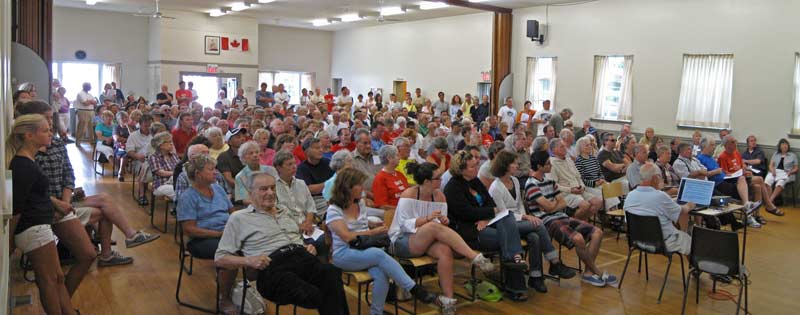
Wow, what a turnout, excellent interaction between the public and the politicians, great information exchange and question and answer session. The presentation is here.

The Gravenhurst Banner August 18, 2010 article covering the meeting is here (a pdf version is here).

The Muskoka Today August 19, 2010 newspaper published two articles, here and here.

Aug 112010
 

A special meeting of the Township of Muskoka Lakes Council was held August 11, 2010, and this report was presented.

The report has three sections:

  • The last 11 pages is the proponent’s March 18, 2010 response to questions raised by the Township in their request to have this project elevated to require further study.
  • The 8 pages before that is a legal opinion sought by the Township concerning whether the province of Ontario’s Green Energy Act impacts the Township’s jurisdiction over this project.
  • The first 20 pages is a staff report to Township Council commenting on the proponent’s 11-page March 18, 2010 response.

The Gravenhurst Banner published this article (a pdf version is here) about the meeting.

Aug 092010
 

On August 6, 2010 Barrie’s A-Channel news featured a story on our Bala falls. The introduction is at 00:38 to 00:58, our segment is at 11:20 to 13:44, and it is followed by an interview with Ontario’s Minister of Tourism, Michael Chan. Sadly the video player does not seem to allow skipping ahead through this hour-long news broadcast.

If clicking the box below doesn’t start the video, perhaps this link will.

Aug 032010
 

Brad Burgess was interviewed by the CBC noon radio show Ontario Today. You can listen to it by clicking this link, and scrolling down to Save Bala Falls, July 13.

Brad had much more to say but was cut from 8 minutes to 4 minutes at the last moment when the proponent changed their minds and decided to spin more blather. Imagine Swift River Energy Ltd. saying that the Bala Falls is not a natural falls; do they think some corporation built them?

Aug 012010
 

Are you ready to take the challenge?

Here are 20 reasons why the hydro-electric power station as currently proposed for the Bala Falls is a mistake – can you make it 50?