Feb 112015
 

Here are some updates on the proposed project to build a hydro-electric generating station at the Bala falls.

Status
There are still many significant unaddressed issues which could prevent the proponent from receiving the approvals or financing they would need to start construction, for example:

  • While Transport Canada has provided an approval, it isn’t clear what this is for, as Transport Canada did not assess boating safety in the Mill Stream or Moon River (which would be negatively impacted by the proposed project). Also, there are public safety and land ownership issues for the alternative portage routes proposed by the proponent.
  • While the Ministry of the Environment has provided their approval, the proponent’s plans include work not covered by this approval.
  • The Ministry of Natural Resources has apparently still not provided required approvals.
  • The Wahta Mohawks have apparently not been consulted on the negative impacts of the currently proposed project, both for proposed actions by the proponent and for actions by the MNR.

We will therefore be making a short presentation to the Township of Muskoka Lakes Council this Friday February 13, 2015 at 9:45 am, in the Council Chambers in Port Carling. Please attend if convenient (apparently the proponent had requested to present, but today they decided they would not).
 

Tom Adams
Tom Adams is a knowledgable and deservedly well-respected energy critic, and is frequently quoted in the press and interviewed on television about Ontario’s energy pricing and provincial energy policies. He is a tireless researcher and recently co-authored with Ross McKitrick the report What Goes Up … Ontario’s Soaring Electricty Prices and How to Get Them Down, which was well-received and widely reported a few months ago (such as here, here, and here). Tom’s web site is here, and you can follow him on twitter here.

Tom has been concerned about the proposed Bala project for some time and he plans on visiting Bala this Thursday February 12, 2015. To show support for Peggy, he plans on camping out overnight, even though the forecast is for an overnight low of -26°C. Come out in the afternoon to say hello and see the progress of the Quinzhee construction, meet his dog, or join the get-together at the Bala Falls Pub starting at 5:00 pm.
 

The proponent’s string of broken promises and commitments they wouldn’t keep
For ten years the proponent has been saying they would:

  • Be “Creating opportunities for recreation”. But in fact they would be making nearby recreation too dangerous to continue.
  • Build a “a low-profile power house … Its roof will be below road level”. But in fact their recent drawings show it would be 28′ above road level.
  • Be “creating an excellent vantage point for visitors “. But in fact there would be no vantage point, and their 56′-wide building would block the view down the Moon River.

Many more examples of the proponent reneging on commitments are noted here.

This entire process was started by the Ontario Ministry of Natural Resource’s 2005 request for proposals, which reserved the right to “disqualify any Applicant whose Proposal contains … materially inaccurate or misleading information”. The proponent’s intention to not fulfill these fundamental obligations of their proposal are certainly material. The proponent should therefore be disqualified from being able to further pursue this opportunity.

Of course the proponent could claim the process is now far past the proposal stage. But here we are, ten years after the proponent submitted their proposal, and only months away from when they claim they would start construction, and only now are a few drawings being provided, so there was no earlier time that it could have been known that the proponent would not meet their commitments.
 

Township of Muskoka Lakes Community Input Session
The last of the Township’s four Community Input Sessions will be this Saturday morning February 14, 2015 at 10:00 am at the Torrance Community Centre. Please attend if you are able, as this is where the Township would like to receive input for their Strategic Plan.

For example, looking at the Township’s survey here, you may feel there is a lack of attention to issues relevant to seasonal residents (who provide a significant majority of the tax revenue to the Township), such as promoting tourism, protecting natural resources, and protecting heritage sites – which are all important to the long-term viability of the area’s economy.

Attend and ensure our elected representatives hear your concerns.
 

A Valentine’s Day card to the Bala Falls
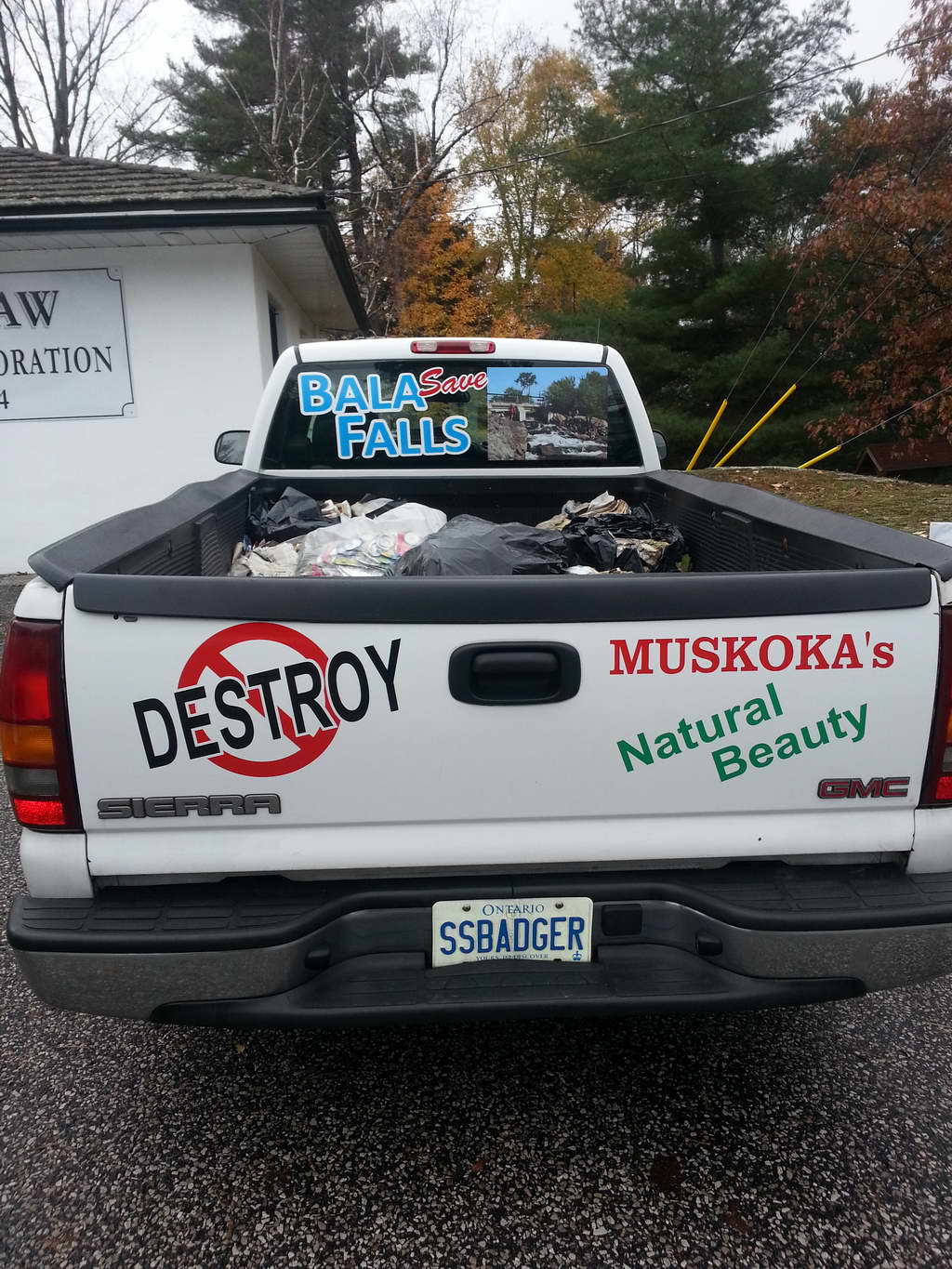
Long-time supporter Brian Munro (perhaps you’ve seen his truck in town) has shared with us his beautiful Valentine’s Day card to the Bala Falls and made a great poster showing the message from PaddleShack, as photographed by John Wright.

SaveTheBalaFalls.com
Feb 052015
 

Firstly, we note that the MNR’s 2004/2005 site release and the proponent’s responding “Option 1” proposal were for construction only on the Crown land directly south of the Bala north dam, and this is the same site for the proponent’s current Alternative 1A proposal.

What the proponent has been promising for ten years …

In the cover letter for their 2004 Statement of Qualifications, the proponent said the hydro-electric generating stations they would build would be: “non-offensive plants in park-like settings”.

  • But we now see the entire site would be concrete, nothing “park-like” about that.

In their 2005 Proposal (that will take a minute or longer to download), the proponent said: “Swift River is aware that the Bala site has substantial beauty … and is a tourist gem for the people of Ontario. This is clearly recognized in our proposal” and “Our proposal incorporates the safe public use and enjoyment of the site, attractive landscaping …”.

  • Not quite. There would be no landscaping, given the entire site would be their concrete and steel building. This would not recognize that Bala is a tourist gem.
  • It appears there would not even be a public look-out, so therefore no public use or enjoyment of the site either.

In their 2005 Proposal, the proponent also stated they would be: “Creating opportunities for recreation”, “Community sensitive green space planning” and “Respecting our cultural heritage”. And that their proposed project: “will not generally diminish the public’s enjoyment of the area for swimming, boating, fishing, picnicking and hiking.”

  • The proposed generating station would make the existing wading, swimming, and scuba diving at the base of the usually-serene Bala north falls too dangerous to continue. This would destroy recreation, not create it.
  • The entire site would be concrete, there would be no “green space”.
  • The proponent has been trying to pressure the municipality into allowing use of the Township’s Portage Landing area to the south of the proposed construction site. The proponent would cut down all the trees, dump it full of blasted rock, and drive heavy construction equipment through it for two years. This would not respect the cultural heritage.

In their 2005 Proposal, the proponent also stated they would be: “installing a low-profile power house built mostly underground (bunker-type). Its roof will be below road level and only some 5 ft above ground level, creating an excellent vantage point for visitors …”

  • The proponent’s proposal would actually rise 28′ above the road and the tailrace gates would be 32′ above the Moon River. There is nothing “low-profile” about it.
  • Worse than that, there would be no “vantage point”. The 56′-wide industrial building would obstruct the view from the road and there would be no public look-out for visitors.

In their 2005 Proposal, the proponent also stated they would provide: “sensitive development of the site, proper and full consultation in the community”.

  • In the ten years the proponent has been pursuing this opportunity, they have held only two public meetings, both for proposals they have since abandoned. This is not consultation.

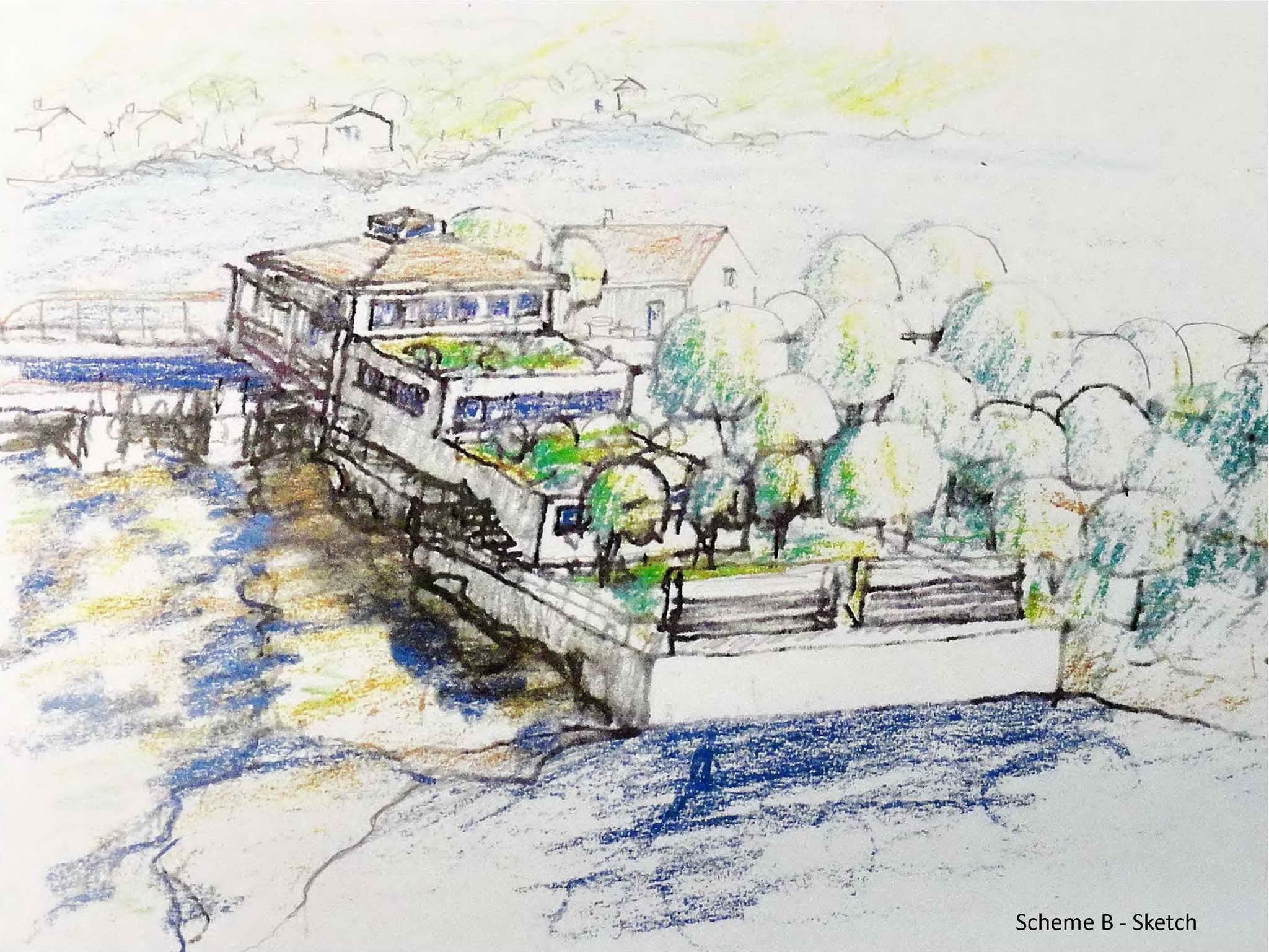
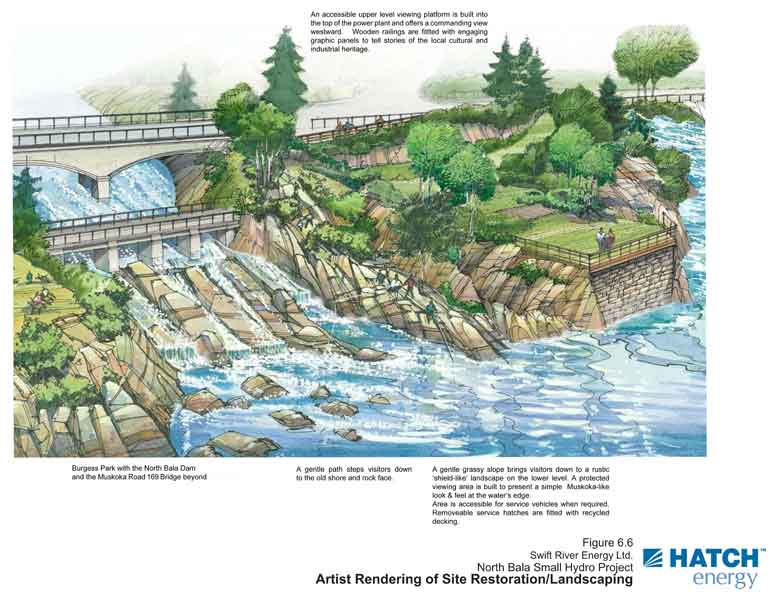
In their 2009 Environmental Screening/Review report, the proponent provided the following rendering (click on any of these figures for a larger view). Looks pretty, but is complete fiction and could not actually be a generating station. The proponent is deceiving rather than informing. For example, where are the tailrace gates (hydro-electric generating stations require these so they can be lowered to seal the tailrace when the equipment requires servicing), where are the ventilation openings, the powerhouse needs to be taller or longer for all the required equipment, where’s the door for people to get in, where’s the exhaust for the emergency diesel generator – and on and on. It was irresponsible for the proponent to even provide this lie, yet they would never acknowledge that this fantasy could not actually be built.

In their 2012 Addendum, the proponent states: “The footprint and elevation of the Alternative 1A plan presented in this Addendum illustrates the largest building size required for both configurations. Therefore, this size may indeed be reduced following detailed design prior to construction”. However, as noted here, the proponent’s current drawings show their Alternative 1A proposed generating station has a footprint 48% larger than what their 2012 Addendum said was already the “largest building size”.

  • The proponent should be required to keep the commitments made in the environmental assessment process.

In 2014 the proponent released some renderings, including the following. Some observations:

  • Beautiful trees are shown, but several are growing out of the concrete, yet another example of wishful thinking rather than reality.
  • What looks like horizontal blinds above the tailrace would be huge steel gates (there would also be a hoisting mechanism – a big steel structure over the gates, with an electric motor and gearbox in a large enclosure). These gates would be at least 10′-high and a total of 56′ wide.
  • There would be no public look-out, but there would need to be lots of fencing to keep people from getting onto the station or near the tailrace gates.

What the proponent is actually planning …

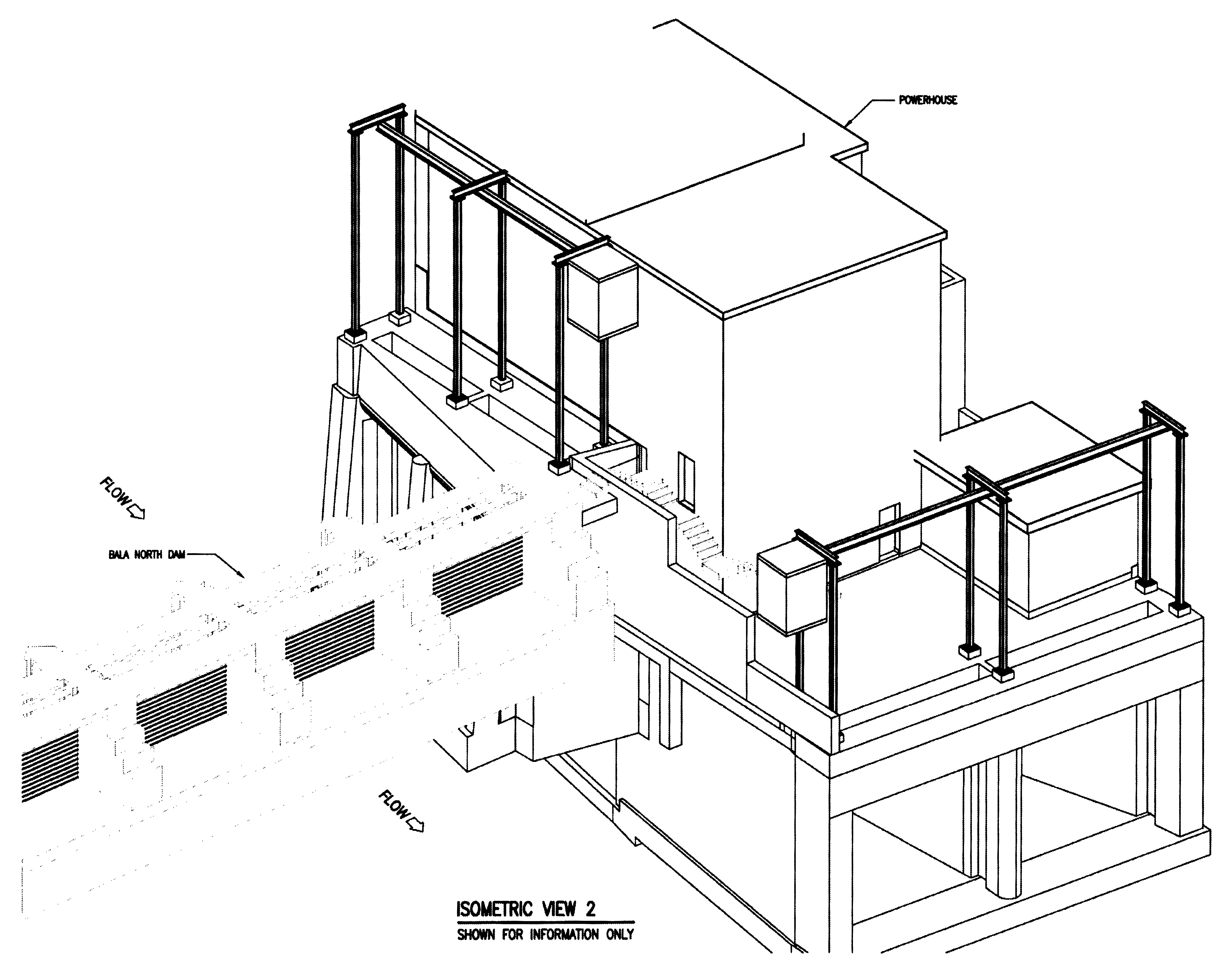
Below is a very preliminary drawing from the proponent. It is a view from above the Bala north falls, looking down and to the south. It shows many of the main components of their proposed generating station:

  • The Bala north dam extends to the left (the concrete part is too light to see, but the wood stop-logs in each sluice show clearly). The water intake to the proposed generating station would be just behind (upstream of) and to the right of the Bala north dam. The intake would have huge steel gates that can be lowered to cover the intake, and the steel gate hoisting structure above the intake would be 30′-high x 42′-wide. The proposed powerhouse building would be 28′ above Muskoka Road 169 and be 56′ wide. So this building is all one would see when driving west on Bala Falls Road approaching Muskoka Road 169.
  • To the right would be the tailrace (from which the water would flow into the Moon River) and the 10′-high x 56′-wide tailrace gate hoist mechanism would be above that. The top of the tailrace gate hoist mechanism would be 32′ above the Moon River.
  • One can just imagine how much fun kids would have trying to climb onto platform above the tailrace – which would be completely dangerous, so there would need to be ugly fencing everywhere. And you can be sure that if the fencing wasn’t effective, the proponent would need to install barbed-wire fencing.
  • This steel and poured-concrete building would fill the entire site, so there would be no landscaping possible.

That is, the proponent would not be keeping any of their committments for which they were selected and for which they received environmental approval: The powerhouse would not be below road level, rather it would be 28′ above it. There would be no public look-out, rather the building would block the view. The development wouldn’t be sensitive to the site, or respect that it is a tourist gem. This is just an

In summary …

Over the ten years the proponent has been pursuing this opportunity, they have been making promises about safety, in-water recreation, the building’s size and appearance, landscaping, and a public look-out. They do not appear to be planning on keeping any of these promises. They have not provided any credible drawings or renderings. This is dishonourable conduct and the province should not be dealing with such proponents.

Feb 032015
 

Summary
Our understanding of the current status of the proposed project to build a hydro-electric generating station at the Bala Falls is that the proponent still does not have all the approvals they would need to start work. Also, we have sent letters to the government noting several important issues concerning approvals the proponent has already received, and we await responses.
 

Detail
The proponent still needs the Plans and Specifications for both their proposed construction sequence and final works to be approved by the Ministry of Natural Resources and Forestry. While both parties originally expected this process could be done in 60 days, it has now been over nine months. You can see some reasons for the delay here, as the work could damage the Bala north dam. There are other concerns, such as the risk of flooding Lake Muskoka.

Also, the proponent’s proposed construction sequence would not be according to their environmental approvals. We continue to wait for a response from the Ministry of the Environment and Climate Change about this.
 

The importance of maintaining portages
This article shows that developers at other hydro-electric generating stations in Muskoka were required to maintain existing portages. However, so far, this has not been required for the proposed Bala project. Worse still is that Transport Canada has accepted alternate portages in Bala which would be too dangerous and would trespass over private property. We continue to wait for a response from the Minister of Transport on this issue.
 

MP Tony Clement, we’re not happy
Transportation safety is a main mandate of Transport Canada, yet they have not even sent an e-mail in reply acknowledging our many concerns of public safety and land ownership. So we asked our MP Tony Clement to facilitate a meeting so we could discuss this directly with Transport Canada. After much prodding all MP Clement would do was report that he “Suggested a meeting. Thus far they have declined.”

Rather than simply defending government agencies from having to respond to the public, elected politicians should be strongly advocating for the public’s concerns, especially when a government agency is not fulfilling its mandate.

MP Clement rightly notes the province is a key decision maker for this issue, but boating safety is a federal responsibility and we have boating safety questions. In this election year, we continue to look for MP Clement to follow through on his statement “I’m not happy till my constituents are happy.” MP Clement, your constituents are not happy. Transport Canada’s approval has created confusion, which is unacceptable for serious issues of public safety and trespassing. We look forward to your standing up for Muskoka on this issue.
 

Excellent interview
Last week Allan Turnbull was interviewed on Hunters Bay Radio. He provided a clear explanation of what is wrong with Ontario’s provincial energy policy, and how it is bad for Ontario’s economy and for all of Ontario’s electricity consumers (note that at 8:17 even Arlo the station’s dog understands Allan and gets upset about the Global Adjustment). The proposed hydro-electric generating station at the Bala falls is just one example of good intentions gone wrong. Listen to the interview using the bottom link here.
 

Township of Muskoka Lakes Board and Committee Appointments
As noted here, the Township of Muskoka Lakes has openings on several Boards and Committees for citizen members. Applications from those wishing to be considered will be accepted until 4:00 pm on February 4, 2015. We realize this is short notice, but the detail of these appointments, such as the Committee mandate, composition, and term was only posted on Friday. Being involved with government is the best way to better understand the process and help shape outcomes.
 

Township of Muskoka Lakes Community Input Sessions
The Township of Muksoka Lakes would like to hear from you, and has scheduled four Community Input Sessions, in Port Carling, Windermere, Torrance – and there will even be a GTA session on Monday February 9, 2015 at 7:00 pm at the Hilton Garden Inn at 3201 Highway 7. More detail is here.

Township of Muskoka Lakes Community  Strategic Plan
Using input from the above Community Input Sessions, the Township of Muskoka Lakes is updating its strategic plan. A two-page summary of the process is here. The process includes an on-line survey, which you can access here.

Jan 312015
 

Here is an aerial photograph of the Bala north dam and north falls (click on it for a larger view). North is to the left, and the water from Lake Muskoka flows west through the Bala north channel, first under the Canadian Pacific Railway bridge and then under the Muskoka Road 169 bridge, the over the stop-logs of the Bala north dam, and down the Bala north falls to the Moon River.

To the right of the Bala north dam is the 71′-wide parcel of Crown land which the proponent proposes to excavate to build their proposed generating station. To the right of that is “Portage Landing”, owned by the Township of Muskoka Lakes and designated under Part IV of the Ontario Heritage Act as a cultural heritage site.

The proposed station’s intake would be 40′-wide, between the Bala north dam and almost to the Muskoka Road 169 bridge. The water would exit the proposed station’s tailrace south of the Bala north dam.

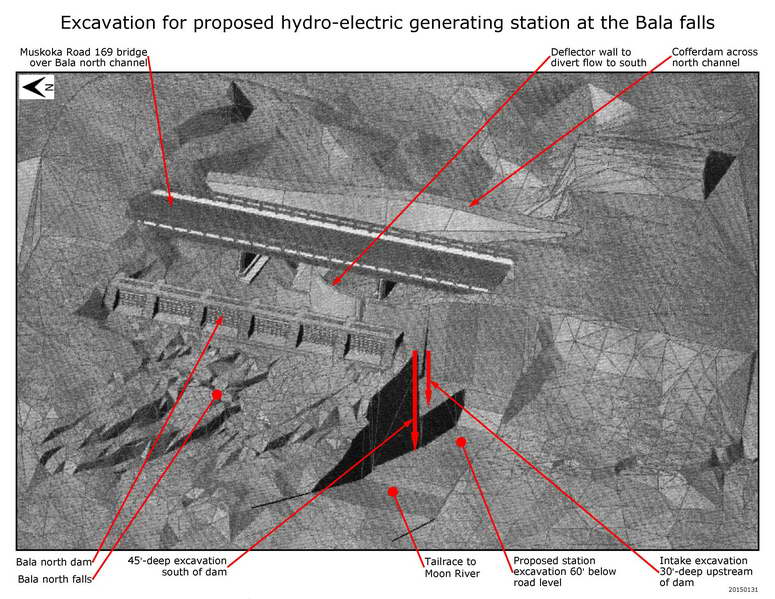
The three-dimensional rendering below was provided by the proponent and is from a similar vantage point (click on it for a larger view). As above, north is to the left, and the Muskoka Road 169 bridge is just upstream of the Bala north dam. The rendering has been marked-up to highlight that the proponent would need to excavate:

  • A 30′-deep intake, just upstream of the Bala north dam. This excavation would be closer than directly adjacent to the dam – the proponent would even cut off the upsteam nosing from the dam’s south pier, so that the intake to their proposed generating station could be as wide as possible.
  • 45′ down, directly south of the Bala north dam, for the proposed generating station.

The Bala north dam, which is over 100 years old, would then be perched at the edge of a 30′- to 45′-high cliff. Major repairs would be required if:

  • This blasting and excavation affects the bonding of the dam to the bedrock below it (the Bala north dam is a concrete gravity dam, and depends on the weight of the concrete piers and their bonding to the bedrock below to withstand the horizontal force of the water).
  • The dewatering of the excavation lowered the water table such that the 150′-long Bala north dam tilted and therefore cracks formed in it.
  • Removing the concrete wing wall (which prevents water from infiltrating the shore where the old generating station’s intake used to be) affects the stability of the Bala north dam.
  • Removing the upstream nosing from the Bala north dam’s south pier (proponent plans to do this to increase the width of the proposed intake) affects the Bala north dam (the nosing was added for a reason).
  • The deflector wall (required to more evenly direct the water into the proposed intake) causes horizontal forces for which the Bala north dam (and also the piers supporting the Muskoka Road 169 bridge) were not designed.

Have these risks been analysed. Who has checked the information from the proponent (this is an unusually complex situation), the MNR used to have significant in-house technical resources, but now relies more on outside consultants. What assurance does the MNR have that the public would be indemnified from any damages caused by the proponent, for example through poor planning, rushing, or unexpected situations. If there was a “high flow event” and the upstream cofferdam had to be quickly removed, how long would it take to be sure that the Bala north dam could handle the flow.

This would not be not routine construction, this is work that could both encounter significant additional construction difficulties and damage existing infrastructure. The impacts on the MNR, the public, and the proponent and their investors could therefore be substantial.

These are big risks and the MNR’s process is too secret to know whether the public’s interest is being adequately protected.

Jan 282015
 

The quick answer is because if you ignore all the important details of the local economy and public safety, it would be the most desirable to develop.

Many wonder why would the Ministry of Natural Resources select Bala for a proposed hydro-electric generating station, given the many issues of public safety and  negative impact to the area’s economy. One answer is this 57-page report entitled Evaluation of Small Hydro Potential for Selected Dams owned by the Crown, for which the MNR commissioned Acres International, and which was completed in May 2000.

This analysis considered ten potential sites in Muskoka, and estimated the profitability of the five most suitable for development for generation of electrical power.

And as shown on page 8 (detailed analysis begins on page 27), the site that would produce the highest profits would be at the Bala falls. It is important to note that this analysis only estimated the costs of construction and expected revenue from the generation of electricity – aspects not considered include: negative economic impacts, disruption to in-water recreational activities, risks to public safety, or existing land uses such as portaging.

Interestingly, the conceptual drawing on page 35 (which, strangely, does not show the Muskoka Road 169 bypass which was built 35 years prior) of this report is the same drawing as the Bala proponent provided in their 2004 Statement of Qualifications. Perhaps not surprising then is that in this Statement of Qualifications, the proponent’s proposed development partner is the same Acres International (later bought by Hatch Ltd., who later did all of the environmental assessment work).

This unbalanced view of the situation continued as the Bala proponent was required by the Ministry of the Environment to provide an Economic Impact Study. As noted here, the report (also 57 pages) did not survey tourists as to why they visit or how much they spend, did not ask local businesses about any possible negative economic impacts. Clearly, not looking at the negative impacts could only produce a useless report, yet this was accepted by the Ministry of the Environment.

This misleading and simplistic view of hydro-electric power generation continued as the MNR commissioned a very detailed study completed in April 2012. This 63-page report is entitled Economic Impact of Waterpower Projects on Crown Lands in Ontario. While some type of  “purpose-built model” was developed, the assumptions were not disclosed. And again negative impacts were not considered. We therefore sent this letter to the MNR, and received this response. Remarkably, the MNR simply replies that providing a balanced view of the economic impact was “beyond the scope of this project”. This is beyond silly. The entire process claims to be logical, but in a classic government example of “form, not function”, has become a farce of ignoring any sound reasons why it should not proceed.

The MNR believes that the rules that apply to everyone else do not apply to them, for example:

  • When it was found that the proposed generating station would not comply with the requirement of Section 3 of the Public Lands Act (which requires at least 25% of the shoreline frontage of water bodies to be reserved for public access), the MNR provided a calculation which did not follow their policy (PL 3.02.01) written specifically for this calculation.
  • When the MNR asked for and received written historical proof that the Bala Portage has always been south of the Bala north falls, the MNR simply ignored this because the Ontario Office of the Surveyor General has no records of any portage routes in Bala (when clearly there would have been at least one somewhere).
  • The MNR accepted the alternate portage routes suggested by the proponent even though Transport Canada’s approval did not consider the land ownership or public safety concerns of these.
  • Even though the proposed generating station would create treacherously turbulent water just a few feet from a very popular in-water recreational area, the MNR simply says it would be the proponent’s responsibility “to ensure appropriate public safety measures”. The proponent just says they have “no plans for fencing”, but without asking their lawyers or insurance company what the required safety measures would be, that is a meaningless and misleading statement.


Jan 272015
 

As shown below, portaging has been included in the plans and designs for other hydro-electric generating stations in Muskoka.  

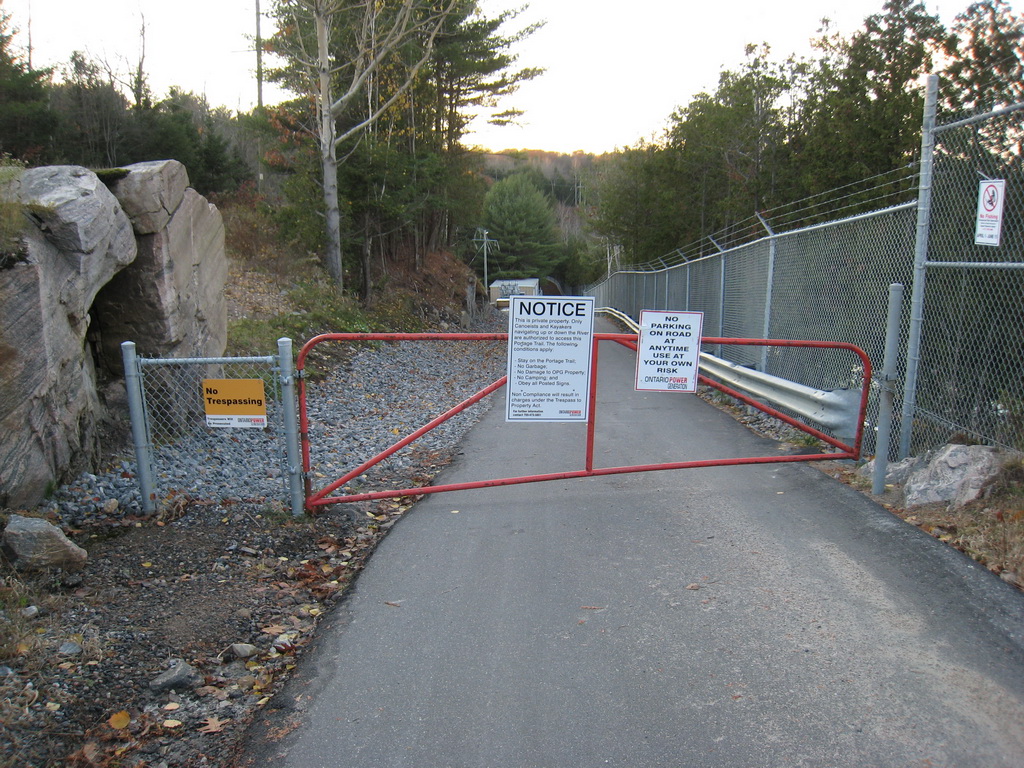
Ontario Power Generation’s South Falls generating station is near Highway 11, between Gravenhurst and Bracebridge. As shown below, there is a path down to the generating station. Even though there is a “No Trespassing” sign and a gate …

… there is this sign.

Clearly, it is accepted that portages must be maintained.

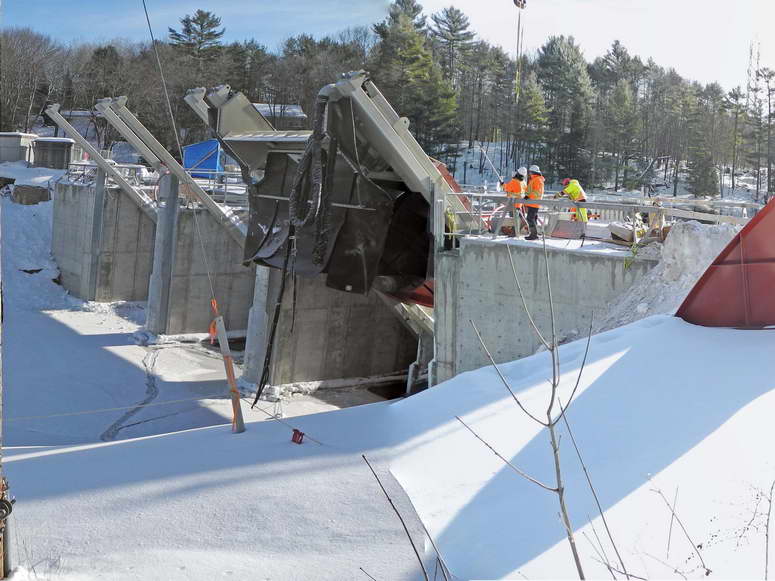
As another example, Wasdell Falls is between Orillia and Gravenhurst, and the Ontario Ministry of Natural Resources and Forestry site there is currently being rebuilt with a hydro-electric generating station (this photograph was taken in January 2015).

And even while it is still a construction site, this sign has been installed.

Clearly, it is accepted that maintaining the ability to portage is required.

The proponent’s plans for the proposed hydro-electric generating station at the Bala Falls would permanently obstruct and eliminate the historic Bala Portage. The Bala proponent has suggested two alternate portage routes, but as presented here (additional detail here), both are unacceptable as they would be dangerous or trespass over private property.

It is therefore unprecedented that the Bala proponent’s plans would not allow the existing portage route and would not provide a safe alternate route over public property.

Jan 142015
 

For a proposed project which the proponent has had ten years to think about, the proposed hydro-electric generating station at the Bala falls is currently in a bizarre state of confusion, for example:

  1. The proponent’s application to Transport Canada stated in-water construction work would begin within a time window when such work is not allowed by the Ministry of Natural Resources (MNR). That is, the proponent would be doing in-water construction work for which they do not have approval from the Ministry of the Environment.
     
  2. The MNR believes that the approval Transport Canada provided earlier this year included assessing impacts to marine navigation for the Mill Stream and Moon River, but the current rules are that Transport Canada would not have done this safety assessment.
     
  3. The proponent has reneged on important and fundamental commitments they made in the competitive process through which they were selected by the MNR. This “materially inaccurate or misleading information” from the proponent enables the province to cancel this mess without cost or liability.
     
  4. The proponent provided incorrect information, as they stated their new 2012 plans would be a positive impact to the Bala Portage, when in fact they would permanently eliminate and obstruct it. Such negative impacts require consultation with First Nations, but due to the incorrect information from the proponent this has not yet occurred. So far the Canadian federal and Ontario provincial governments have not met with the Wahta Mohawks to begin this required consultation process. The Wahta have therefore sent this August 24, 2014 letter and this November 12, 2014 letter.
     
  5. The proponent’s construction plans have more than a one in four chance of flooding Lake Muskoka. While the proponent says they could remove their upstream cofferdam in such an emergency, this is not a credible claim. How would they ever get insurance for such a high risk to private property and public infrastructure.
     
  6. Commercial operation of the proposed hydro-electric generating station would not be permitted until:
    • Amendments to the Muskoka River Water Management Plan are approved (this would be a lengthy and difficult process, and it appears this 699-page document has never been amended before, and the committees involved list 35 people, some of whom have passed away or no longer hold the office or position they did nine years ago when this document was approved).
    • The proponent signs the MNR’s maintenance agreement for the Bala dams. The proponent would then be financially responsible for all minor maintenance of both Bala dams – but it has not yet been agreed what constitutes “major” and “minor” maintenance, and the proponent “negotiating” this when they would already be in construction would be a completely weak negotiating position.
       
  7. From the MNR, the proponent still needs; Plans and Specifications approval, a Work Permit, a Lease to Construct, and a Waterpower Lease Agreement – the latter two are legal agreements which would take months to finalize.

All of the above will result in delays, extra costs, and significant risks.

If the proponent would provide sound information to refute any of this, maybe we’d have to “agree to disagree”. But the proponent simply does not offer any believable information to justify their actions. For a company hoping to right now be getting final approvals, raising construction financing, and preparing to begin construction, this is bizarre.

So as a service to those in the investor community that may be considering getting involved with this proposed project, we offer this Guest Editorial.

Jan 132015
 

Transport Canada has a responsibility under the Navigation Protection Act to regulate works that could affect marine navigation in bodies of water such as Lake Muskoka. Transport Canada considers portaging an aspect of marine navigation, so also considers impacts to portages.

As part of the proposed project would directly impact both in-water marine navigation in Lake Muskoka and also portaging, the proponent submitted an application and received approval from Transport Canada.

However, Transport Canada’s approval apparently relied too much on information from  the proponent and therefore has created much confusion, for example:

  • The approval accepted both alternate portage routes suggested by the proponent, but these trespass over private property and require travel in the Mill Stream, which YMCA Camp Pine Crest confirms is too dangerous for canoeing.
  • The proposed generating station would operate at full capacity an average of 21 days each summer, and would also begin operation at about noon on about of summer days, both of which would create dangers to marine navigation in the Moon River.

The proponent never “opted-in” to request Transport Canada assess marine navigation impacts for the Mill Stream and Moon River, so Transport Canada’s assessment would only have been for Lake Muskoka, which is the only “scheduled waterway” involved.

But the Ontario Ministry of Natural Resources and Forestry apparently believes that Transport Canada’s approval applies to all waters and all portages. Such ambiguity and confusion is unacceptable for issues of public safety and trespassing:

Transport Canada’s Service Charter shows they pledge to treat individuals with respect and courtesy, provide accurate and timely service, and clearly explain decisions. They clearly have not done any of this.

We have therefore sent this January 13, 2015 letter to the Minister of Transport.

Jan 072015
 

Editor’s note: This guest editorial is provided for the benefit of the investor community.

The Quick Take

This proposed development project has unusual and unaddressed risks, such as:

  • The developer provided conflicting information to different government agencies, which then relied on this information in providing subsequent approvals. The result has to be something signficant, such as an approval is cancelled, or the construction schedule is significantly extended.
     
  • The Crown refuses to acknowledge that the developer provided incorrect and misleading information and as a result First Nations were not notified or consulted on this important land issue.
     
  • The developer’s construction plans have more than a one in four chance of causing flooding of Lake Muskoka, and the proposed contingency plans are unworkable.
     
  • Transport Canada’s approval did not consider some important land ownership and public safety issues, and their only guidance so far is that affected people should directly sue the developer.

These are all issues which should be of concern to potential investors. Also of concern is that the developer has not refuted these.


The Concerns

In my past experience investigating potential development-based investments, I have found that it is usually difficult to learn about the risks of technical projects. Therefore, as a service to other potential investors in this planned project to build a hydro station in Bala, Ontario, I offer the following.

Current risks for the proposed construction of a hydro station in Bala, Ontario

1) Investor risk: Before proposed construction

  1. As noted here, the developer made commitments to the Ministry of the Environment which are different and conflict with information submitted to Transport Canada. This is a concern, as follows:
    • The developer’s written information to Transport Canada states that they plan work for which they do not have approval from the Ministry of the Environment. At the very least, this would result in delays while it all gets sorted out, but it also reflects on the credibility of the developer and raises more serious questions.
    • For example, delaying the start of work by the six weeks required may result in there not being enough time for the work which would need to be completed before the next spring freshet, as their upstream cofferdam must be removed by then. Therefore, work would need to be delayed until after the spring freshet, and some work may need to be repeated, such as rebuilding the upstream cofferdam. The result would be many months of delay to the schedule, and additional costs.
    • But perhaps the bigger concerns are that the developer may be trying to avoid earlier commitments without being caught, or they are demonstrating they are poor at scheduling work or that they do not have the people with the required skills and abilities to get this work done efficiently.
       
  2. The Wahta Mohawks have given notice that the “Crown’s Duty to Consult has not been fulfilled”. It appears that the Crown has not responded to these concerns, as that the Crown often so chooses to do. Such actions by the Crown require that if the First Nations are serious, they need to initiate legal action.
    It should be noted that a remarkably similar situation has recently ocurred: In both cases the main decision-maker is the same person – Anthony Zwig, who is the President of Swift River Energy Limited (the Bala developer), and who is also the President and CEO of Horizon Wind Inc. (the developer for a proposed project to install approximately  20 wind turbines in Thunder Bay).
    • After years of community opposition, as reported here, in March 2014 the Fort Williams First Nations filed an injunction against the Ministry of the Environment due to their lack of consultation. As reported here, the judge heard the case in June 2014 and in July 2014 decided an injunction would be premature. However, in August 2014 the Ontario Power Authority terminated the developer’s Feed-In Tariff program contract due to project delays. Without a contract to get paid for power produced, this had the effect of cancelling the proposed wind turbine project (it is not clear whether the developer is still appealing this).
    • The summary is, after years of effort and slow progress getting approvals, this same developer has recently had a proposed project cancelled when the local First Nations claim to have unaddressed issues. If any of this is applicable to the similar Bala situation, it would be of concern to potential investors.

Potential investors would typically want these issues resolved before they invest.

2) Investor risk: During proposed construction

  1. Historical data shows there is more than a one in four chance that a high-flow event would occur and the result would be the developer’s construction plans would cause flooding in one of two ways:
    • The developer claims that to avoid flooding Lake Muskoka they would quickly remove their upstream cofferdam. But this would flood the construction site, which would likely cause a year delay (as many construction stages cannot be done during certain time periods).
    • For many reasons, it is instead more likely the developer would have to let Lake Muskoka flood, and this would likely result in legal action (you can be sure that among the 3,400 private property owners on Lake Muskoka there are many very good lawyers and others with the means to pursue collecting on their losses and damages – and the publically-available flow data would later show whether the developer’s plans directly resulted in the flooding).

    It is most unusual for a developer to not have acknowledged or addressed this major risk with their proposed start of construction only months away.

  2. Most every aspect of the proposed construction site would result in difficulties and therefore additional time and cost required:
    • The site is very small, is surrounded by water, highway, or designated heritage lands – and the entire site would need to be excavated, leaving no room for materials or equipment storage.
    • All equipment and materials storage would need to be stored either across a one-lane temporary construction bridge or across a highway with a complicated access.
    • The majority of the local population do not want this proposed project, making for a more difficult work environment.
    • Traffic managment and flagmen would be required for all site entrances.
    • The highway guardrail would need to be removed for some construction stages, but this would likely endanger the public.
       
  3. All of the above increase the likelihood of delays, and delays would be a problem as:
    • The upstream cofferdam must be removed for at least April and May.
    • In-water work is not allowed from April 15 to July 1.
    • Work in the winter may be too difficult and slow (for example, after construction began, the developer for the Wasdell Falls hydro-electric project, which is 40 km south, decided not to work through the winter).

    The result is that any delays would quickly multiply and may become a year of delays – and the resulting extra costs would also quickly multiply.

The potential flooding risk appears to be significant and should be addressed before investors commit. It would be helpful to see a detailed schedule to see how likely it would be that the upstream cofferdam would need to be reinstalled after the spring freshet. Other construction risks would be factored into the return expected from this investment opportunity.

3) Investor risk: During proposed operation

  1. The MNR apparently believes that marine navigation on the Moon River and the riparian rights of downstream property owners would not be affected because Transport Canada has provided approval under the Navigation Protection Act.
  2. Also, the developer would permanently obstruct and eliminate a historic portage and the alternate routes suggested have significant land ownership and safety concerns.

Transport Canada has apparently not assessed either of these issues because the developer did not “opt-in” under the NPA, as the Moon River and Mill Stream are “non-scheduled waterways”. Transport Canada states it would be up to individuals affected to resolve this through the Courts.

The result may be lawsuits, with a result that the proposed generating station may not be allowed to operate in the summer. This would certainly significantly affect the on-going profitability of the proposed project.

Potential investors would typically want these unknowns to be resolved before they invest.

Background context

While investors in development projects will be flexible about when operations and payments to them begin, investors will need credible information that:

  1. They will not lose any money (that is, the project would always be worth at least what they invested in it). In the Bala situation there would no guaranteed value to any of the money that would be invested, as the MNR will always own the land and the government could cancel all permits and approvals without compensation.
     
  2. Additional investment will not be required, for example, for cost overruns due to unexpected construction or technical difficulties. This is a concern because as detailed above, there are many risks, several of which the developer should have addressed already, but has not.
     
  3. They won’t have any liability for losses, for example to pay to make the site safe if the project must be stopped and abandoned, or the project is sued due to being found to have caused flooding, or there is a fatality when someone gets caught in the intake or tailrace (while insurance covers this risk for every other hydro station, this site is unusual being very close to both in-water recreational areas and private residences).

The problem in this situation is that Swift River Energy Limited and its parent company do not have staff with experience and history with hydro-electric power  development. They use contractors, so do not have company history and knowledge with hydro-electric power development. The contract project manager does not appear to have experience with managing an entire hydro-electric development project of this size through to commercial operation. The fact that the developer has been pursuing this project for ten years and does not have all required approvals, and as listed above, there are significant outstanding issues does not provide comfort.

Projects such as this are typically built through the creation of a partnership:

  • The developer becomes the General Partner, and contributes the opportunity, their expertise and industry experience and contracts, years of planning and approvals, the detailed design, and day-to-day management of the project.
  • The investors become Limited Partners and contribute most of the funds – often 85% in return for ownership of 50% of the project and therefore they would receive 50% of the profits from operations.

This arrangement has proven to work very well for experienced developers and for projects which do not have cost overruns. The weakness of this leveraging is how to handle cost overruns.

Potential investors would feel they have already taken their risk by investing their money and would expect the developer to pay any cost overruns, as the developer would be responsible for all of the project planning and management, contractor selection, and detailed design. This can quickly become a big problem. For example, if the proposed Bala hydro station is expected to cost $30M to build, then the developer might contribute 15% of this, which would be $4.5M. If the developer values their contribution of the opportunity, design and approval work at $2.5M, then they may only contribute an additional $2M of cash to the partnership. If there is a 5% cost overrun then an additional ($30M x 5% =) $1.5M of cash would be needed.

Typically, when addtional cash is required, the project is already delayed, so the investors would be losing confidence and may decide to not contribute addtional cash. The developer may offer to contribute the cash required in return for increased ownership of the partnership and a priority on receiving payments (which would permanently reduce or even eliminate any profits from their investment). If neither party contributes the required funds then the project would likely go bankrupt and be abandoned, with resulting years of lawsuits on outstanding debts or costs to make the site safe (as the developer’s signed Lease to Contruct with the MNR requires).

Summary

The overall summary is that for me, and at the current time (January 2015), this proposed project has too many significant and unaddressed risks.

Jan 062015
 

Section 5.2.7.1 of the proponent’s 2009 Environmental Screening/Review report concerns “In-stream Construction” and states that: “MNR’s Parry Sound District timing restrictions for in-stream construction activities state that no in-water work shall be conducted from April 1 to July 15” and “Therefore, in-water works (e.g., installation and removal of cofferdam and working platform, removal of rock plugs, intake approach channel excavation) are scheduled between July 16 and March 31.”

Section 5.2.1.1 of the proponent’s 2012 Addendum confirmed this: “As per the ES/RR, MNR’s timing restrictions regarding in-water work will be followed during installation and removal of the cofferdam and the cofferdam will be completely removed from the water.”

However the proponent’s construction plans submitted to Transport Canada state: “Installation of the upstream cofferdam will commence on June 1, 2015”. The proponent does not have permission to begin in-water construction work on this date:

  • Firstly, it just doesn’t make any sense that the proponent is trying to perform construction for which they do not have approval.
  • The proponent cannot simply delay the proposed project by a one and a half months because they must entirely remove the upstream cofferdam before the end of next March to allow for the spring freshet. Given the difficulty and delays of working in the winter, it may not be possible to get all the work needed completed by the end of next March.

We brought this plan for unapproved work to the attention of the MNR, and we hope the MNR will consider this in their on-going review of the proponent’s Plans and Specifications, as is required under the Lakes and Rivers Improvement Act.

We also note that the proponent’s construction plans submitted to Transport Canada state they would begin installation of their downstream cofferdam in September 2014, which has not happened. Given it could not be installed before April 1 as too many issues are currently outstanding, the installation of the downstream cofferdam  could also not begin until July 15. This would be almost a year delay to a project that hasn’t started yet.

Construction plans that do not make sense, and schedule problems and delays before a proposed project even gets started should all be of concern to potential investors.