Jan 042015
 

We’ve all heard about the huge costs the province felt they had to (and did) pay to cancel the construction of the Mississauga and Oakville generating stations which were to be powered by natural gas. A question then is would the province have to pay to cancel the proposed hydro-electric generating station at the Bala Falls.

This process began in 2004 when the Ontario Ministry of Natural Resources began a Competitive Site Release process. The first step of this was to qualify potential bidders and this was followed by soliciting proposals by issuing a Request for Proposal (RFP) to them.

The MNR sent the proponent the RFP along with a letter dated March 7, 2005 which stated that the proponent had met the first “qualification” step. Excerpts from this RFP are at the bottom of this article.

Examining the MNR’s RFP, the proponent’s subsequent July 5, 2005 proposal, and the current situation, we note the following:

  1. The RFP required that proponent issue a Notice of Commencement within six months of award (that is, their being awarded “Applicant of Record” status, and so they are called the proponent).
    • The MNR notified the proponent of this award in a letter dated August 9, 2005 which also noted the proponent had up to 12 months to issue the Notice of Commencement (which informs the public of the beginning the environmental assessment process). The proponent did issue a Notice of Commencement on March 8, 2006, but this stated “Public Information Centres will be scheduled to be held in Bala and Toronto during the summer of 2006”. There never was a Public Information Centre held in Toronto, and there was no Public Information Centre held in the summer of 2006. So this was an unfulfilled and meaningless Notice of Commencement.
    • Another Notice of Commencement was issued on August 8, 2007, which was 24 months after award.

    So this certainly did not meet the RFP requirements. 

  2. The RFP required that the proponent issue their Environmental Screening/Review report and issue their Notice of Completion within two years of award. The proponent accepted this, as their 2005 proposal stated: “It is noted that the EA must be completed within 2 years of selection”.
    • However the Notice of Completion was issued on October 9, 2009, which was more than four years after award and more than two years after the Notice of Completion.

    So this certainly did not meet the RFP requirements. 

  3. The RFP required that the proponent consider public access for traditional uses, yet their current plans would permanently obstruct and eliminate the Bala Portage, which is certainly a traditional use.
    • We note the proponent accepted this obligation as their 2005 proposal stated: “… these restrictions will not generally diminish the public’s enjoyment of the area for swimming, boating, fishing, picnicking and hiking”.

    So this certainly did not meet the RFP requirements and the proponent’s proposal commitments. 

  4. The proponent’s 2005 proposal stated that: “Swift River is aware that the Bala site has substantial beauty for the local population, both permanent and summer residents, and is a tourist gem for the people of Ontario. This is clearly recognized in our proposal”. Certainly one example is that the proponent’s 2005 proposal stated their design would be: “a low-profile power house built mostly underground (bunker-type). Its roof will be below road level and only some 5 ft above ground level, creating an excellent vantage point for visitors to view the surrounding lake, falls and parkland.” Clearly these statements by the proponent would therefore have been an important factor in their being selected through the MNR’s competitive process.
    However, the proponent’s drawings submitted to Transport Canada in 2014 show that in fact their design would be more than:
    • 28′ above the road level (not below it).
    • 10′ to 40′ above ground level, and the structure would be more than 55′ above the Moon River.
    • 52′ wide, and obstruct the view down the river, and not provide any look-out or viewing platform.

    We note the MNR’s RFP reserved the right to “disqualify any Applicant whose Proposal contains … materially inaccurate or misleading information”, and this certainly is significant inaccurate and misleading information (the proponent’s design reneges on many other commitments in their proposal, as shown here).

    Of course, the proponent would claim the project is now far past the RFP part of the process. But the proponent chose to not conform to their own proposal for known-crucial aspects – for the same site as their original proposal. And the proponent chose to delay divulging this crucial information for so long – in fact they still have not made these dimensions public. So the proponent will have to deal with the situation they knowingly created.

In summary, the proponent has not met the reasonable and clearly stated requirements of this competitive site release process and therefore the MNR would be justified in exercising their right to cancel this process without any liability to pay or otherwise compensate the proponent for their expenses or other costs.


Excerpts from the RFP which the MNR sent to the proponent on March 7, 2005 (blue emphasis added) …

v. Site Release RFP Incorporated into Proposal
All of the provisions of the RFP are deemed to be accepted by each Applicant and incorporated into each Applicant’s Proposal.

D. Work Plan
The operator must be willing to submit Notice of Commencement within six months of award; commence an Environmental Assessment within two years of award; …

Category 2: Technical and Feasibility of Project …

The items listed below must be addressed: …

Recognition of the ‘technical’ issues. Plan to address the technical issues and the approach to deal with these issues.

The applicant will need to consider the need for scenic flows, public access for traditional uses and continuity of business in the local area.

4. The applicant will be responsible for:

c) Indemnifying the Crown against all claims, actions and/or obligations that may arise as a consequence of the operation of the dam structure

d) Operations and maintenance of the dam structure will be carried out according to current and future provincial standards. … The onus is on the applicant to examine the structures and determine the extent of repairs necessary to meet dam safety and discharge criteria consistent with the dam operational plan, any and all legal requirements and direction by the Ministry.

APPLICANT COSTS
Liability for Expenses Incurred by Applicant

The MNR shall not be liable to pay any Applicant costs under any circumstances. In particular, the MNR will not reimburse the Applicant in any manner whatsoever in the event of rejection of any or all Proposals or submissions, or in the event of the cancellation of this Site Release RFP. By submitting a Proposal in response to this Site Release RFP, the Applicant irrevocably and unconditionally waives any claims against the MNR relating to the Applicant’s costs.

2.0 General Terms
i. Reserved Rights of the MNR
The MNR reserves the right to: …

g. disqualify any Applicant whose Proposal contains material misrepresentations or any other materially inaccurate or misleading information;
j. cancel this RFP process at any stage;

… and the MNR shall not be liable for any expenses, costs, losses or any direct or indirect damages incurred or suffered by any Applicant or any third party resulting from the MNR exercising any of its express or implied rights under this RFP.

APPENDICES TO ‘SCHEDULE A’
Appendix A: Statutory Declaration

I, •
OF THE •
IN THE •
SOLEMNLY DECLARE THAT …

2. All statements, specifications, data, confirmations, and information that have been set out in the Proposal, including, without limitation, the Technical and Financial Questionnaires, are complete and accurate in all material respects.

Jan 032015
 

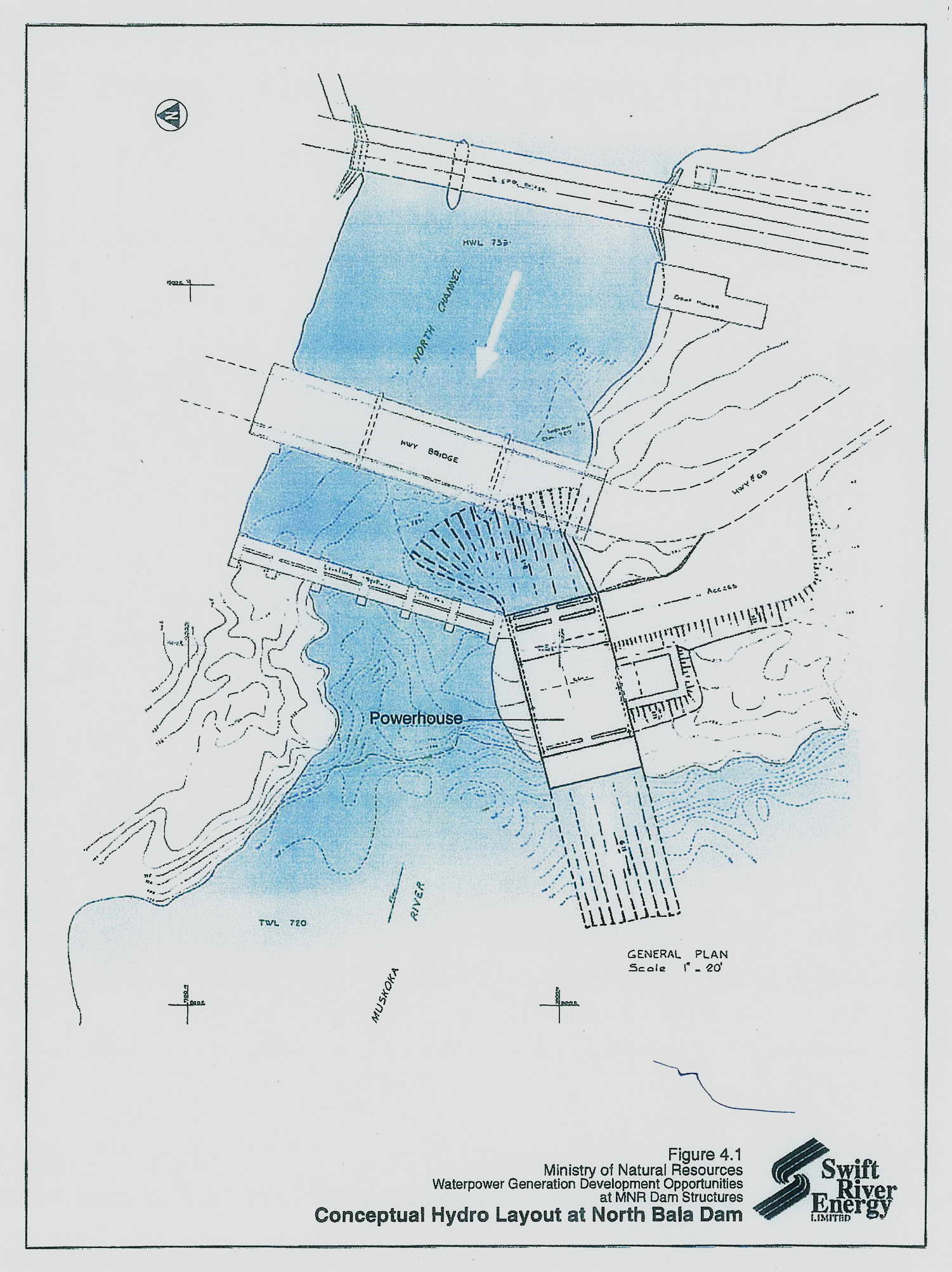
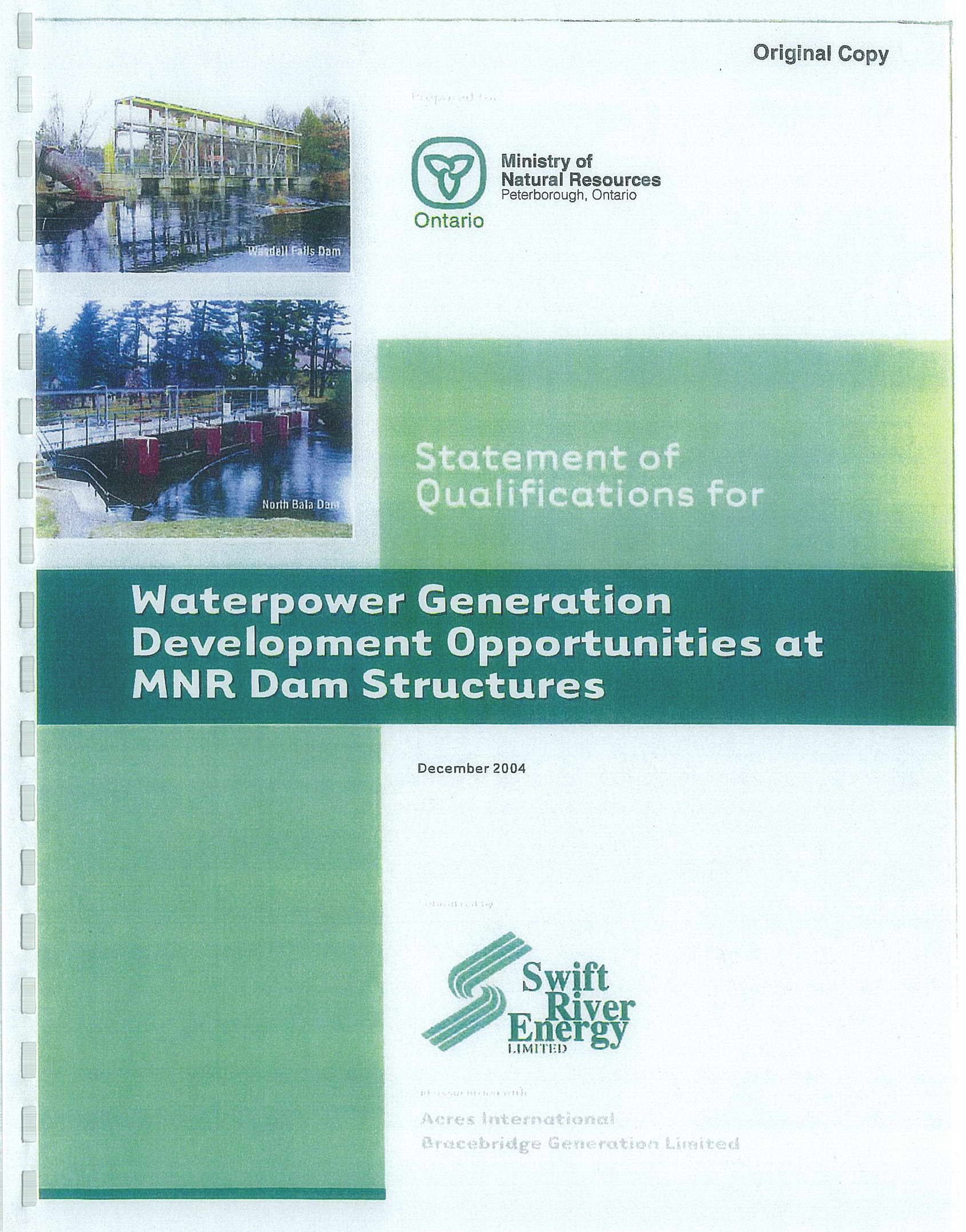
The Ministry of Natural Resources started this entire process by issuing a Request for Qualifications for Waterpower Generation Development Opportunities at MNR Dam Structures, on November 10, 2004. As a result, the proponent submitted a Statement of Qualifications the following month (click on all these images for a larger view).

As shown below, Figure 4.1 of this document suggested a possible layout.

What is surprising is this drawing does not show the Muskoka Road 169 highway bypass that was completed in 1965, 40 years prior! It also shows that the proponent was planning on building a substantial part of the project on land not owned by the MNR. Apparently neither of these major problems were of concern to the MNR, as on March 7, 2005 the MNR mailed a letter to the proponent informing them that they “met the qualification threshold”.

As a result, in July 2005 the proponent submitted their proposal.

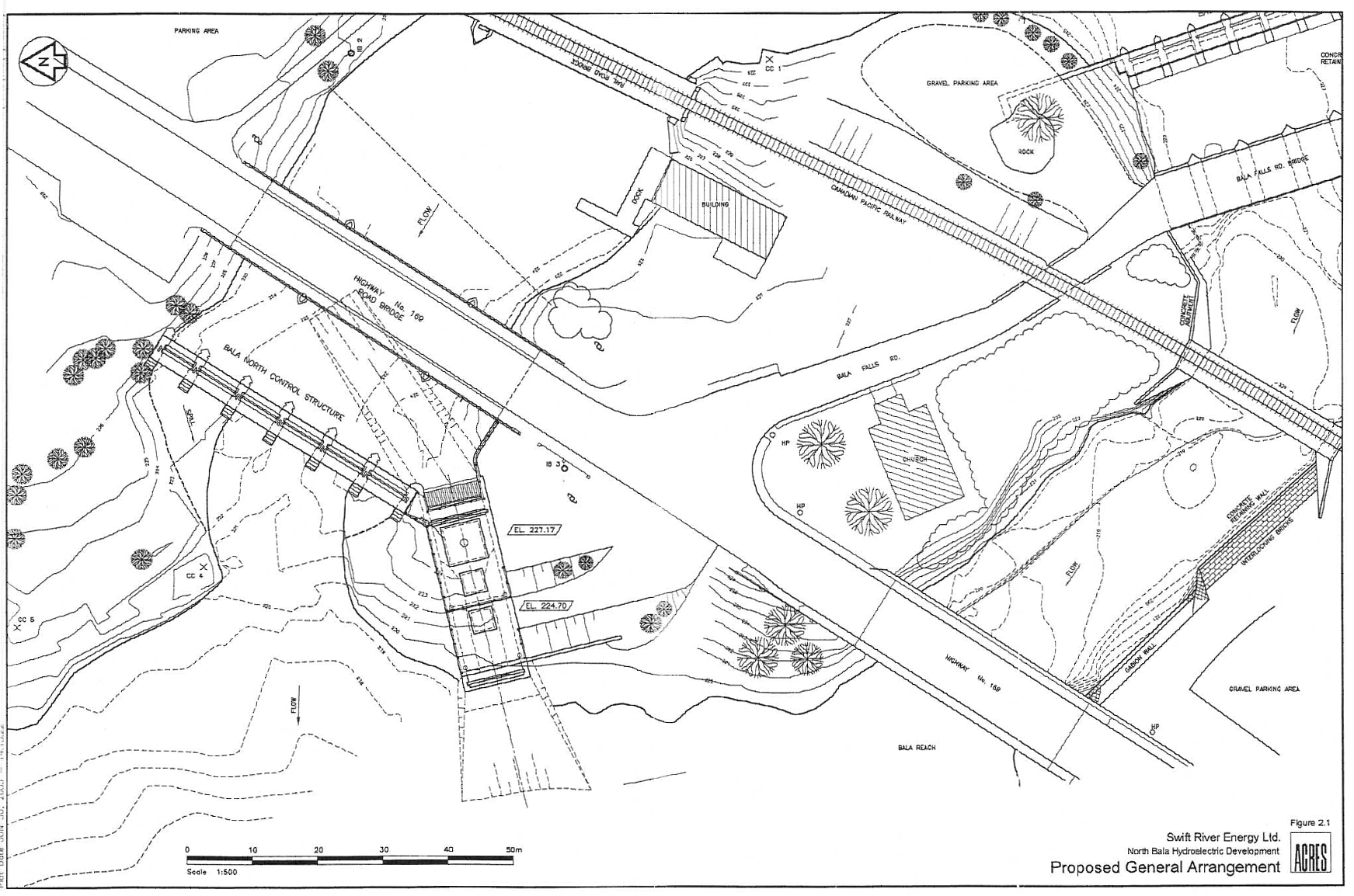
As shown below, Figure 2.1 of this proposal included an updated drawing of the proposed project.

While the drawing does properly show the Muskoka Road 169 highway bypass, it still shows the proponent would build on land to which they had no rights. That the MNR did not object to this and on August 9, 2005 send a letter to the proponent notifying them that they had been awarded Applicant of Record status, shows that the MNR did not know where the property boundary to the Crown land was either.

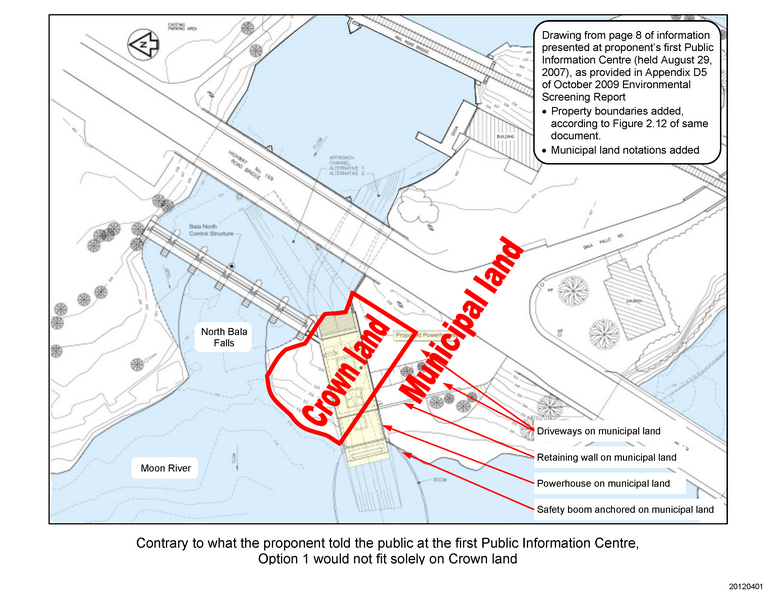
The drawing below shows the Crown land property boundaries.

Apparently, the MNR did not know the property boundaries of the land they were releasing.

Jan 022015
 

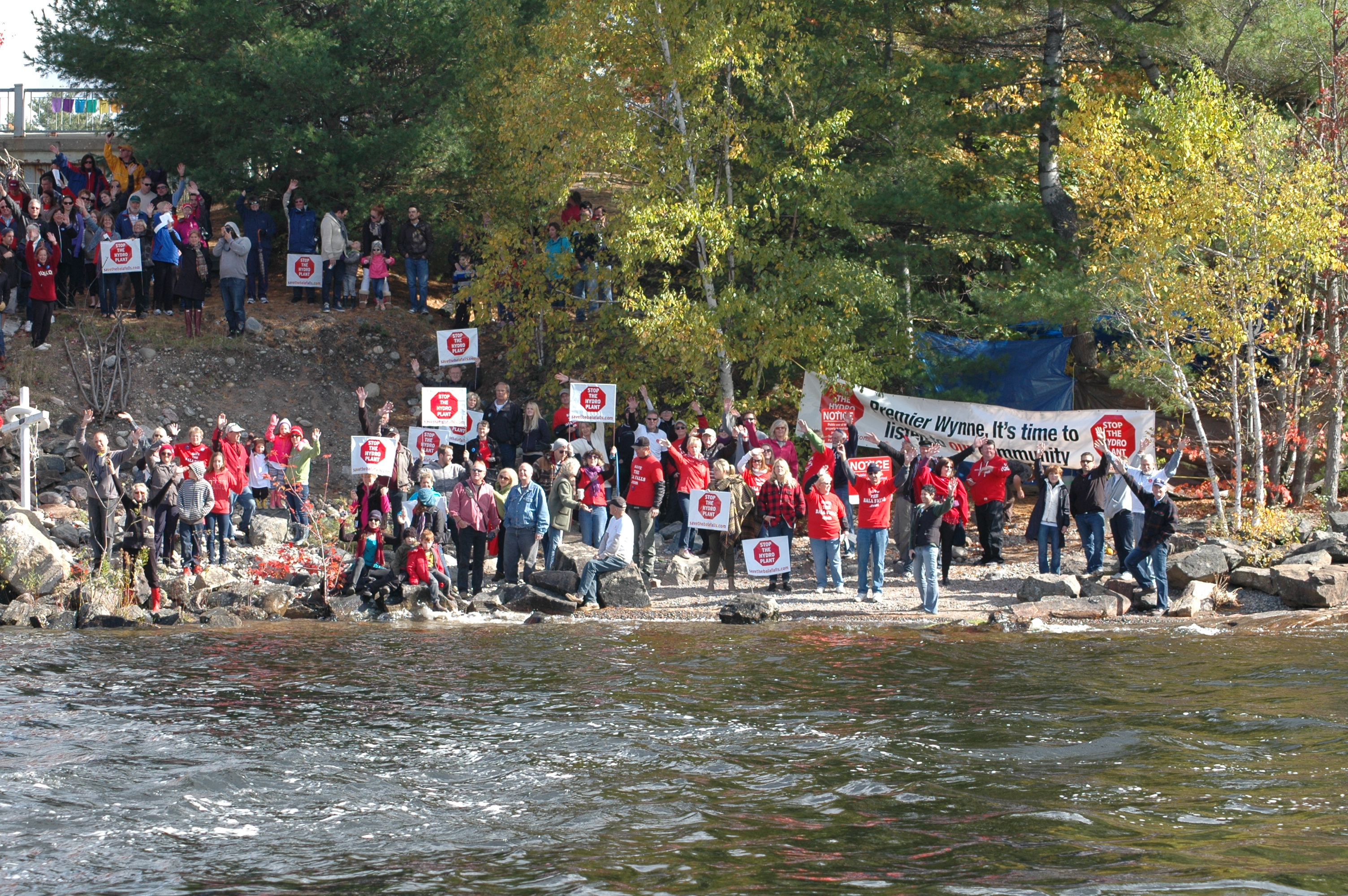
Above is one photograph of the Thanksgiving 2014 Rally at the Bala Falls, which was reported by MooseFM and the Gravenhurst Banner.
 

Other recent articles are (newest at the bottom) …

  1. The October 1, 2014 issue of What’s Up Muskoka had an article covering Peggy Peterson.
     
  2. An October 11, 2014 article and video segment by CBC Sudbury (click for a translation).
     
  3. CBC Ontario Morning‘s Wei Chen interviewed Allan Turnbull on October 14, 2014 (to listen, click the triangle at the left end of the player below) …


  4. On October 16, 2014 Allan Turnbull was interviewed by James Carroll on Hunters Bay Radio’s Green Tapestry show (which is usually hosted by Peggy Peterson who at the time was on day 45 of camping at the proposed construction site). Each of the two segments below is about ten minutes in length …


  5. An October 2014 blog entry by John Wright about Peggy Peterson, the Muskoka Lorax protecting our trees is here.
     
  6. Long-time supporter Kim Ward of the Bala Bay Inn has this one-minute announcement on MooseFM (October 23, 2014) …


  7. On October 23, 2014 Peggy Peterson was interviewed by James Carroll on Hunters Bay Radio, click here to hear (to start the audio, click the triangle at the top-left or the bottom-right).
     
  8. On October 30, 2014, Peggy Peterson was able to host her own Green Tapestry show on Hunters Bay Radio, and she interviewed Allan Turnbull …


  9. On December 30, 2014, Peggy Peterson was interviewed by MooseFM …


  10. Peggy Peterson and this proposed project was front page news in the January 2, 2015 issue of the Globe and Mail. Two page article here, and text version here.
     
  11. On January 29, 2015, James Carroll interviewed Allan Turnbull on Hunters Bay Radio’s Green Tapestry show. Allan clearly explains how the proposed hydro-electric generating station at the Bala falls is an example of Ontario’s misguided energy policy which costs all consumers and businesses in Ontario just to pay disproportionate profits to developers to create generating capacity that isn’t needed.


  12. On February 12, 2015 MooseFM interviewed well-known energy critic Tom Adams. Read and listen to the interview here.
Dec 302014
 

The proponent’s construction plans show they would build a rock-fill cofferdam across the entire Bala north channel and this would be in place and block the flow of all water through the Bala north channel from June through March. Therefore, during this 10-month period, all water flow through Bala would need to go through the Bala south channel, which has a maximum capacity of 252 m³/s (cubic metres per second – for comparison, one cubic metre would fill three or four bathtubs).

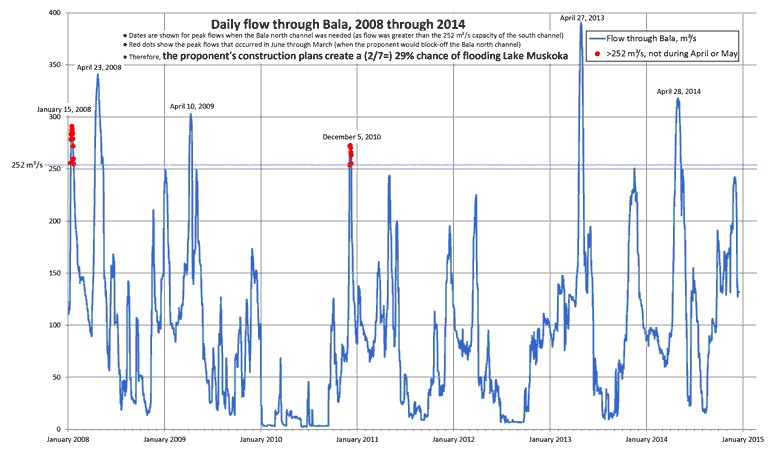
The graph below (click on it for a larger view) shows the water flow through Bala each day for the last seven years. As expected, the peak flows are often in the spring, for example, on April 23, 2008 and April 10, 2009. But some years there are peak flows during the months of June through March, and these days are highlighted in red. These are days when solely the Bala south channel could not have handled all the flow through Bala, and flow through the Bala north channel was also required. But the proponent’s construction plans would have the Bala north channel blocked off during these months, so there would be flooding throughout Lake Muskoka.

That is, twice in the last seven years, the proponent’s construction plans would have caused flooding in Lake Muskoka. This is a (2/7=) 29% probability of flooding, which is the same result as our earlier analysis of the 45 years of flow data from 1966 through 2010.

The proponent claims that in such an emergency flooding situation they could and would quickly remove their cofferdam. But this claim is simply not credible, for example:

  1. As the high-flow event would likely be due to heavy rains, it would be dangerous to be operating the required construction equipment so close to the flooding waters.
     
  2. The necessary equipment and personnel may not be on-site when needed.
     
  3. Due to the blasting and excavation within inches of both the Bala north dam and the Muskoka Road 169 bridge over the Bala north channel, careful inspection of these structures would be required before it could be approved they would be ready to handle the force of the water. This inspection could not be done during a storm and would require more than a few days to arrange and analyse the results.
     
  4. Section 5.2.7.1 of the proponent’s 2009 Environmental Screening/Review report stated that the MNR does not allow in-water construction work from April 1 to July 15, so removing the cofferdam during this time period would be harmful to the fish habitat.
     
  5. The cofferdam would basically be tons of rocks, dirt, and plastic sheeting, and all of this would be washed down into the Moon River. This would be an environmental disaster as it would destroy the fish habitat.
     
  6. But a bigger environmental concern is that the construction site area which would be flooded may have construction equipment, gasoline containers, gasoline-powered electrical generators and many other items with fuel and lubricants that would be washed into and pollute Moon River – from which many people fish and get their drinking water.
     
  7. The proponent removing the upstream cofferdam would flood their construction site and this would;
    • Destroy much of their completed work.
    • Threaten the District’s Muskoka Road 169 bridge and the MNR’s Bala north dam.
    • Delay the project by a year (as some of the construction stages can only be done at certain times of the year), and therefore cost millions of dollars.

    The proponent would clearly not want this, so would likely instead; hope the rain stops soon, let Lake Muskoka flood until then, and see if private property owners try to sue them and then claim the flooding was an “Act of God” and a natural disaster. But the MNRF would have the responsibility to operate the dams and maintain water levels during the proposed construction, so the proponent may claim to have no liability even though their poor planning was the cause.

    A big question is how insurance companies would treat such a situation.

  8. But the biggest concern of all is that the cofferdam would be needed to prevent water bypassing the Bala north dam, through the 60′-wide excavation required for the proposed generating station. That is, removing the cofferdam during some construction stages would result in the uncontrolled flow of much of Lake Muskoka into the Moon River. The water level in Lake Muskoka would drop by 10′ and the Moon River would be flooded like never before. This proponent with no assets, no operations, and no employees would not have insurance adequate to cover this. This would be a widespread financial and environmental disaster. So again, the proponent would not remove their cofferdam during such a construction stage.

Under the Navigation Protection Act, Transport Canada has a responsibility to assess the impacts of construction works in scheduled waterways, such as Lake Muskoka. So far their only action has been to secretly approve this proposed work despite this too-high risk of flooding.

Under the Lake and Rivers Improvement Act, the Ontario Ministry of Natural Resources and Forestry has a responsibility to assess the Plans and Specifications of this proposed project, which should include protecting the public from such risky plans by proponents. But the MNRF so far appears to accept the proponent’s unworkable emergency plans.

Dec 282014
 

As we have noted over the years, other than during the few weeks of spring freshet, the proponent would divert 94% of the water through their proposed generating station, leaving only a trickle of 6% to go over the Bala falls.

A few months ago the proponent released an updated Scenic Flow Plan which would allow a slightly increased trickle on a few additional weekends. The graphs below illustrate the proponent’s current plan.

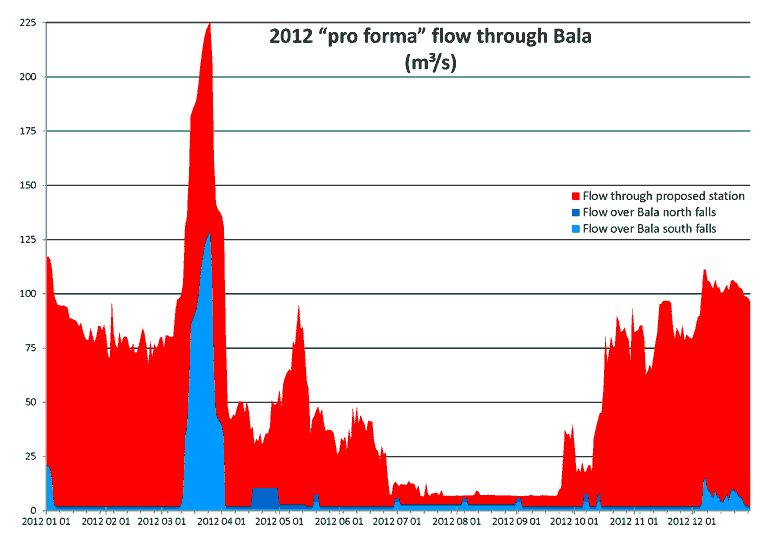
For these graphs, we’ve used the actual 2012 daily average water flow data through Bala, from Environment Canada’s Water Office. While the Mill Stream generating station can pass up to 4 m³/s (cubic metres of water per second) of flow, it isn’t known when or if this would be operating, so for simplicity we’ve assumed there would be no flow through the Mill Stream generating station.

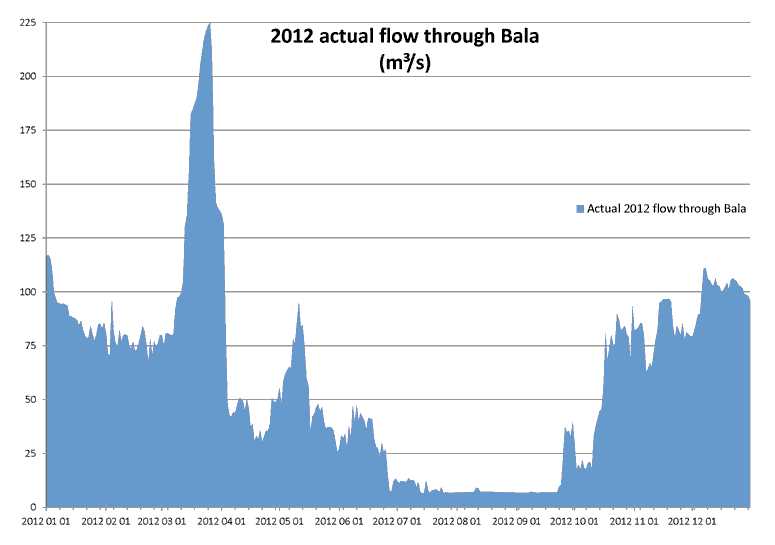
The blue area in the graph below (click on the graphs for a larger view) shows the actual flow through Bala throughout the year. We can see that in 2012 the highest flow was on March 26, when there was 225 m³/s of water flowing through Bala. As expected, the minimum flow was in the summer, with a flow of about 7 m³/s from mid-July to late September. The Water Office does not record the flow separately for the Bala north and south falls, though generally, the Ministry of Natural Resources and Forestry sets the stop-logs so most of the flow is over the south falls.

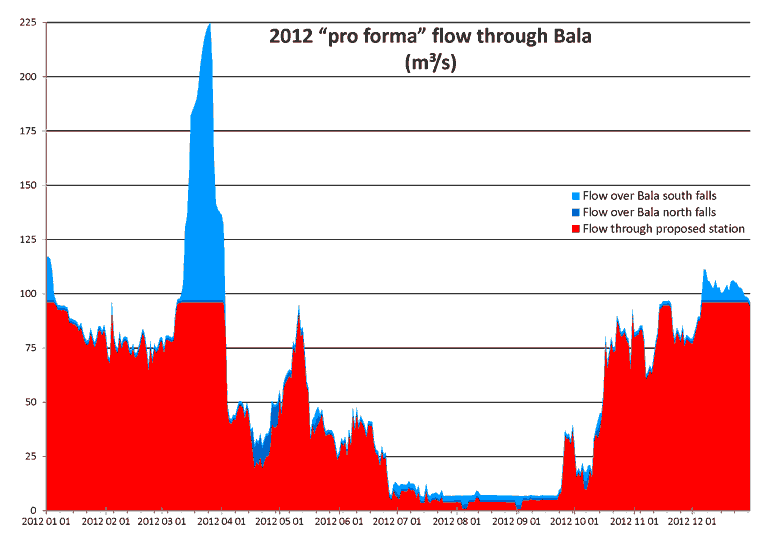
The “pro forma” graph below shows the same total flow through Bala (for example, still a peak flow of 225 m³/s on March 26, 2012, and a minimum flow of 7 m³/s from mid-July to late September), but this shows that except for the trickle of flows allowed over the Bala north falls (in dark blue) and Bala south falls (in light blue), most of the flow would be through the proposed generating station (in red), up to the proposed station’s capacity of 96 m³/s.

As shown, in 2012 the only noticable flow would have been over the Bala south falls, and this only for three weeks in the spring, when the proposed station couldn’t have handled all the flow. The south falls would also have some flow for a few weeks in the winter. Throughout the entire year, the north falls would have continued to be the same trickle as throughout the rest of the year (with a slightly increased trickle for two weeks in April for Walleye spawning).

The graph below is the same data as above, but puts the flows over the Bala north and south falls at the bottom of the graph. This better shows:

  • The flow would be a miniscule trickle of 1 m³/s over each of the Bala north and south falls throughout most of the year.
  • During the summer, there would instead be an increased trickle of 2 m³/s over the Bala south falls.
  • There would be an increased flow for two weeks in April for the Walleye spawning, and an increased trickle for two weeks after that for egg incubation.
  • For a few weekends after that, there would be an increased trickle.

But overall, as the red area shows, only 6% would go over the falls.

Other falls where tourism is important require much more flow over the falls. For example, by international agreement, 50% of the flow of the Niagara River must go over the Niagara Falls during tourism times and seasons.

The proponent claims their plan for Bala would allow the same flow throughout the year as flows during the summer, but as shown here, this is a lie. The Bala proponent is just being greedy.

Dec 232014
 

Here is our understanding of the current status of the proposed project to construct a hydro-electric generating station at the Bala Falls.

Summary

  1. The proponent still requires several approvals before they could begin construction.
     
  2. Their plans have too high a risk of flooding Lake Muskoka during the proposed construction.
     
  3. There are significant unaddressed marine navigation, public safety, and land ownership issues. Please e-mail your elected government officials to ask that approvals therefore not be provided for this proposed project until these issues are openly addressed and resolved.


Detail

Current approval status

Provincial – approval not yet provided
The Ministry of Natural Resources and Forestry has not provided Plans and Specifications approval, which is required under the Lakes and Rivers Improvement Act. This approval, and the subsequent Work Permit, and the subsequent Lease to Construct, is required before the proponent could begin construction.

Municipal – approval postponed
The District Municipality of Muskoka’s Engineering & Public Works Committee passed a resolution on May 21, 2014 to provide the proponent with the required Driveway Entrance permits as of October 20, 2014. However, as shown here (the mark-ups are the amendments passed at the subsequent District Council meeting on June 16, 2014), these permits are subject to several conditions, such as the proponent first providing a performance bond and insurance coverage.

At the December 17, 2014 Engineering & Public Works committee meeting, the proponent requested that some of these conditions be removed and that other conditions be clarified. Also, it may not be clear whether the conditions would need to be met before installing construction fencing. As a result, District staff will prepare a report with recommendations to be considered at a future meeting of the Engineering & Public Works committee, which may then pass resolutions to be considered at a subsequent District Council meeting. So until the proponent either meets all the conditions or District Council passes a resolution to remove conditions, the proponent cannot begin construction.

Federal – confusion
On June 25, 2014, Transport Canada provided approval under the new Navigation Protection Act (NPA), which had just come into force a few months prior. However, as the proponent did not formally “opt-in” to have their entire proposed project assessed, it appears that this approval does not cover impacts to marine navigation on the Moon River or the Mill Stream as these are considered “non-scheduled waterways” under the NPA (scheduled waterways are listed in the Schedule to the Act, all other lakes and rivers are non-scheduled).

We have sent several letters to Transport Canada. For example, marine navigation concerns were detailed in this February 7, 2014 letter for the Moon River, and in this August 12, 2014 letter for the Mill Stream. Transport Canada has not responded to or even acknowledged these concerns, even after we asked MP Tony Clement to advocate on our behalf and request that Transport Canada meet with us to discuss the issues.

While this is rude and annoying, Transport Canada is just following-through on their plans to no longer provide marine safety assessments for non-scheduled waterways. Instead individual citizens or other affected parties would need to initiate (and pay for) a lawsuit if they feel a proponent’s in-water works are affecting their safe marine navigation (makes one wonder what we’re paying taxes for).

For example, Transport Canada’s Navigation Protection Act FAQ states that navigation protection for such non-scheduled waterways is now through the Courts as would be any Common Law issue directly between two parties. As a result, this CBC article notes it is expected there will be many such Court challenges.

  • This article confirms that since the proponent did not opt-in, Transport Canada did not provide the certainty of approval to protect them from such litigation (which should be cause for concern to any potential investors in the proponent’s proposed project).
  • Continuing with the legal observations, this document notes the difficulty of obtaining Court orders before harm has occurred, so the end result could be that if the proposed generating station is constructed then it may not be permitted to operate during the summer due to the danger it would create in the main boating season. This too would be cause for concern to potential investors.

 
Risk of flooding Lake Muskoka
The proponent’s construction plans show they would build a rock-fill cofferdam across the entire Bala north channel and this would be in place and block the flow of all water through the Bala north channel from June through March. Therefore, during this 10-month period, all water flow through Bala would need to go through the Bala south channel, which has a maximum capacity of 252 m³/s (one cubic metre would fill about four bathtubs).

Environment Canada’s Water Office collects and makes available historical water flow data, and this has been analysed to determine whether the water flow through Bala from June through March has ever been greater than the capacity of solely the Bala south channel. Such a high-flow event could happen if there was an unusually early and rapid spring thaw, or particularly heavy and prolonged rain storms.

Examining the actual flow data through Bala for the years 1966 through 2010 shows that the Bala south channel could not have handled the required flow through Bala in the months of June through March a total of 13 times in this 45-year period. This means there is a (13/45=) 29% chance that the proponent’s construction plans would cause flooding of Lake Muskoka.

  • We show this graphically in this article.
  • The most recent flow data has been analysed and this graph summarizes the results, which confirm that there continues to be more than a one in four chance that the proponent’s construction plans would flood Lake Muskoka.

Transport Canada considers this proposed upstream cofferdam to in Lake Muskoka, which is a scheduled waterway and so they should have assessed the possible impacts. We included this flooding concern as item 3) of this November 24, 2014 letter to MP Tony Clement asking his assistance in requesting a meeting with Transport Canada so that we can discuss this and other issues. Unfortunately MP Clement reports that “Transport Canada has declined the meeting”.

The proponent claims that in such an emergency flooding situation they could and would quickly remove their cofferdam. This is simply not credible, for example:

  1. As the high-flow event would likely be due to heavy rains, it would be dangerous to be operating the required construction equipment so close to the flooding waters.
     
  2. The necessary equipment and personnel may not be on‐site when needed.
     
  3. The cofferdam would basically be tons of rocks, dirt, and plastic sheeting, and all of this would be washed down into the Moon River. This would be an environmental disaster as it would destroy the fish habitat.
     
  4. The proponent removing the upstream cofferdam would flood their construction site and this would; destroy much of their completed work, threaten the District’s Muskoka Road 169 bridge and the MNR’s Bala north dam, delay the project by a year (as some of the construction stages can only be done at certain times of the year), and therefore cost millions of dollars. The proponent would clearly not want this, so would likely instead; hope the rain stops, let Lake Muskoka flood, and hope to save themselves time and money by trying to sort it all out in Court, no doubt claiming the flooding was an act of god and a natural disaster (but we’d know it was caused by the proponent’s poor planning). A big question is how insurance companies would treat such a situation.
     
  5. But the biggest concern of all is that the cofferdam would be needed to prevent water bypassing the Bala north dam, through the 60′-wide excavation required for the proposed generating station. That is, removing the cofferdam during some construction stages would result in the uncontrolled flow of much of Lake Muskoka into the Moon River. The water level in Lake Muskoka would drop by 10′ and the Moon River would be flooded like never before. This proponent with no assets, no operations, and no employees would not have insurance adequate to cover this. This would be a widespread financial and environmental disaster. So again, the proponent would not remove their cofferdam during such a construction stage.

The public deserves, but has yet to receive, detailed information on how the proponent would manage this risk to private and public infrastructure, and to the environment.


Presentation to Township Council
On December 16, 2014, we had an opportunity to provide this presentation to the Township of Muskoka Lakes’ Committee of the Whole. This summarized some unaddressed marine navigation, public safety, and land ownership concerns – and notes that these could become the municipality’s problem.

As a result of the several delegations that day on the topic of the proposed hydro-electric generating station at the Bala Falls, the Chief Accounting Officer was asked that recommendations for next steps be included in a staff report to be presented and considered at a future meeting. We provided the following as input to this report:

Hello Mr. Harris,

The summary of my delegation to Township Council on December 16, 2014 is that as a result of the recently-adopted Navigation Protection Act, which excludes the Moon River and Mill Stream from Transport Canada’s responsibility, the federal government may be downloading risks and responsibilities to the municipality.

As a result, our suggested Ask is that the Township write a letter to Transport Canada concerning the impacts of the proposed hydro-electric generating station at the Bala falls and asking the following:

  1. Whether Transport Canada has done an assessment of the impacts to marine navigation on the Moon River and Mill Stream, and if so, the detailed results of this, including responding to the questions raised in the attached letters dated February 7, 2014 and August 12, 2014. This response should specifically address canoe navigation:
    • In the Mill Stream, given the velocity of the water below the Muskoka Road 169 bridge.
    • Approaching the Town Docks in the Moon River, given that the proposed generating station would operate at full capacity an average of 21 days each summer.
       
  2. How the proposed construction plans are acceptable given the high risk of flooding Lake Muskoka, for the reasons detailed in the attached letter dated November 24, 2014.
     
  3. How the proponent’s suggested alternate Portage Route #1 could be an identified portage route, given the encroachment and land ownership issue of the boardwalk leading to the Town Docks on the Moon River.

Transport Canada’s responses should be made available to the public for comment, and subsequently; the risks to, responsibilities of, and additional information needed by, the Township of Muskoka Lakes determined.

Until the risks to the Township are known, we request that the Township of Muskoka Lakes not facilitate the construction of the proposed hydro-electric generating station at the Bala falls. For example, the Township should not provide the Driveway Entrance permit from Bala Falls Road to the Crown land beside Purk’s Place.

Thank you, and please let me know if you have any questions.

We look forward to reading this staff report.


The Bala Portage
Cartographer David Thompson’s 1837 hand-written maps and journal document that the Bala Portage has always been south of the Bala north falls. In fact the proponent’s own 2009 Environmental Screening/Review report and their own Land Use History report both confirm this. Unfortunately, the proponent’s current Alternative 1A plan (which was first proposed in their 2012 Addendum), would permanently obstruct and eliminate the Bala Portage.

As portages are apparently considered part of marine navigation, the proponent suggested two alternate portage routes in their application to Transport Canada for approval under the NPA. Both suggested routes have significant land ownership and public safety issues, as we detailed in our August 12, 2014 and November 24, 2014 letters to Transport Canada.

An additional issue is that Portage Street is not even public property. As shown by this official Parcel Register, Portage Street is currently owned by the Estate of Thomas Burgess (Portage Street is PIN 48154-0626, as is shown on this Property Index Map).

That is, while Transport Canada apparently claims to have accepted these alternate portage routes, they clearly have not adequately assessed the marine navigation, public safety, and land ownership implications. Their approval seems to be irresponsibly based on incomplete information provided by the proponent.

It therefore appears that Transport Canada’s refusal to accept public input has resulted in important issues remaining unaddressed. Also Transport Canada is downloading risks and responsibilities to the municipality and public, but has not provided any notification or information to understand and assess this. Until the resulting risks to the municipality are understood, we hope the Township and District will not provide any approvals or otherwise facilitate this proposed project.


District Councillor Conflict of Interest
Muskoka has a two-tier municipal government. The District Municipality of Muskoka is the upper-tier, and its responsibilities include determining the conditions which the proponent would need to meet for the Driveway Entrance permits needed to begin construction of their proposed hydro-electric generating station. The lower tier is comprised of the following:

  • Town of Bracebridge
  • Town of Gravenhurst
  • Town of Huntsville
  • Township of Georgian Bay
  • Township of Lake of Bays
  • Township of Muskoka Lakes

Of interest is that the Towns of Bracebridge and Huntsville together own more than 76% of Lakeland Holding Ltd., which in turn owns Bracebridge Generation. The proponent has stated that Bracebridge Generation would be the operator of the proposed hydro-electric generating station at the Bala Falls.

Therefore, the Towns of Bracebridge and Huntsville would financially benefit from the operation of the proposed Bala generating station, and as the MNR would be providing an initial 40-year land lease, this benefit would be substantial. Also of interest is that as shown on page 21 of the Lakeland Holding Ltd. Annual Report, in 2013 the Towns of Bracebridge and Huntsville received over $750,000 in dividends as a result of their share ownership of Lakeland Holding Ltd., so this is a significant business and motivator for them.

The concern is that two of the members of the District’s Engineering & Public Works Committee are District Councillors of the Towns of Bracebridge and Huntsville. Also, the Deputy Chair of the District is a District Councillor of the Town of Bracebridge. Clearly these Councillors are conflicted and should be required to excuse themselves from discussion of or voting on matters concerning the proposed Bala generating station.


What you can do
There’s much to be concerned about and the next step is to politely and clearly contact your government representatives so they know that the outstanding issues, such as public safety, marine navigation, and risk of flooding Lake Muskoka need to be openly addressed, communicated, and resolved before any approvals or permits are granted.

  • The Township of Muskoka Lakes Mayor and Councillors are listed here.
  • The District Municipality of Muskoka Chair and Councillors are listed here.
  • Parry Sound – Muskoka MPP Norm Miller is here, and you can find other provincial MPPs here.
  • Parry Sound – Muskoka MP Tony Clement is here, and you can find other federal MPs by constituency/name, or determine your constituency (electoral district) by Postal Code.
  • Other government contacts are listed here.

As always, for more information, visit us at SaveTheBalaFalls.com, and if you have any questions or comments, e-mail us at info@SaveTheBalaFalls.com. Let your family, friends, and neighbours know they can sign themselves up to received these e-Newsletters at the top-right at SaveTheBalaFalls.com.

SaveTheBalaFalls.com
Dec 212014
 

Summary
The proponent was selected through a competitive process, based on statements which they appear to be intending on not honouring. For example, in 2005 the proponent stated that their proposed generating station would:

  • Rise only 5' above the ground.
  • Not be above the road (so the view down the Moon River would be preserved).
  • Not affect the swimming and boating in the area.

These were important commitments, which the proponent should be obligated to honour. But the most recent information from the proponent is that the proposed generating station would be 30' above the water, and 21' above the road. And would be so dangerous that Margaret Burgess Park would need to be fenced-off because they would make swimming too dangerous.

Detail
In 2004, the Ministry of Natural Resources began a process to enable construction of  a hydro-electric generating station at the Bala falls by making available a small parcel of Crown land directly south of the Bala north falls. The basic arrangement (as specified in this MNR Policy and Procedure) was that due to the expected desirability of the site, a competitive process would be used to select an Applicant of Record (that is, a proponent).

The evaluation of the proposals would use a point system that considered several factors including the types and magnitude of potential impacts of the proposed project and the mitigation strategies for these potential impacts.

The selected proponent would then be eligible to receive the “Feed In Tariff” subsidized rate for power generated and be obligated to operate and perform minor maintenance on the Bala north and south dams.

Based on their proposal (dated July 5, 2005), the proponent, Swift River Energy Limited, was selected by the MNR. You can read the part of their proposal which they made public here (it will take minute or so to download).

Of interest is that the proponent states that the Crown land site made available by the MNR in 2004 is the same as that for the proponent’s current proposal (which they refer to as Alternative 1A). For example, the proponent’s 2012 Addendum to their 2009 Environmental Screening / Review Report (ES/RR) states:

  • In Section 2.1, Project Location: “The ES/RR investigated several alternative locations for the Project, including, but not limited to … the original Alternative 1 location that would be located entirely on Crown lands. Note that this was the original project layout provided to MNR in 2005 for its Waterpower Site Release Program and presented at the first Public Information Centre in August 2007.”
  • In Section 3: “The Alternative 1A project location was included in the ES/RR under a similar layout named Alternative 1. This was the project location that was used in the initial MNR Waterpower Crown Land Site Release process in 2005 and was presented to the public at the first Public Information Centre in August 2007”.

That is, the proponent confirms the site location for their original 2005 proposal is the same as that for their current Alternative 1A proposal. Despite this, the proponent appears to have forgotten about the commitments they made. Below we have highlighted in bold some quotes from the proponent’s original 2005 proposal:

  1. Cover letter: Swift River is aware that the Bala site has substantial beauty for the local population, both permanent and summer residents, and is a tourist gem for the people of Ontario. This is clearly recognized in our proposal.”
    • It was recognized that the Bala site had important tourism and aesthetic requirements, and the proponent committed to addressing these.
       
  2. Cover letter: Our proposal incorporates the safe public use and enjoyment of the site, attractive landscaping, a public educational component, and the funding of local school scholarships in the environmental sciences.”
    • In fact, the proponent’s current Alternative 1A proposal is not safe, and as a result the proponent has determined they would need to fence off Margaret Burgess Park. This completely contradicts their claims on which they were awarded Applicant of Record status.
       
  3. Figure 2.2.1: “The power facility would be operated as a ‘run-of-river’ power plant …”:
    • It would not. The treacherously turbulent water from the proposed generating station would begin at about noon on more than of all summer days, just when people would be in the water just a few feet away.
       
  4. Figure 2.3: A large fold-out page with photographs of people and nature, and captions such as:
    • “Preserving our scenic legacy”; If the “legacy” is the Bala #2 generating station that used to be on the site from 1924 to 1972, this was 16' x 16', but the proposed station would be more than 50' wide x 100' long, there’s nothing even close to scenic or legacy about that.
    • “Creating opportunities for recreation …”; The proposed generating station would have more than 10 times the flow of the previous station. The only thing that would be created are new dangers.
    • “Green power, green space, in harmony”; This would be a poured-concrete bunker, there would be nothing harmonious about it.
    • “Community sensitive green space planning”; The proponent plans on taking 94% of the flow over the Bala falls, they have not shown any sensitivity to the community.
    • “Respecting our cultural heritage”; The proponent was the only objector to the Township of Muskoka Lakes notice to designate the adjacent Portage Landing site under the Ontario Heritage Act, that isn’t respecting anything.
       
  5. Section 2.2.4: “Our intention is to harmonize the architecture of the new facility with the natural environment of the site by installing a low-profile power house built mostly underground (bunker-type). Its roof will be below road level and only some 5 ft above ground level, creating an excellent vantage point for visitors to view the surrounding …”.
    • The most recent drawings from the proponent show the proposed generating station would be 30' above the water and 21' above the road. This would obstruct the view down the Moon River, which would eliminate a main reason those passing through stop and stay a while.
       
  6. Section 2.2.4: “Obviously for reasons of public safety, there will be some safety restrictions placed on public access near specific areas at the intake, powerhouse and dam. However, these restrictions will not generally diminish the public’s enjoyment of the area for swimming, boating, fishing, picnicking and hiking.”
    • In fact, in-water recreation would no longer be safe either at the base of the north falls, or for Scuba diving from Diver’s Point.
       
  7. Section 2.2.4: “One part of our community relations program will be the sponsorship of local sports teams and other community service projects. Another is the establishment of an annual scholarship program that through the auspices of the local Board of Education, will enable deserving college or university students to pursue their studies.”.
    • We’ve never heard the proponent offer this in the nine years since they submitted this proposal.
       
  8. Section 2.2.4: “In summary, new technology, sensitive development of the site, proper and full consultation in the community will contribute …”.
    • In the nine years the proponent has been pursuing this opportunity, they have held only two public meetings, both for proposals which they have now abandoned. This is not “full consultation”.

The proponent was selected based on the statements in their 2005 proposal. They should not be permitted to substantially change their proposal without additional study and public consultations.

The proponent was allowed to submit their 2005 proposal as a result of their submitting a Statement of Qualifications in 2004, the cover letter for this states: “We have a vision by which the sites can, in a manner compatible with sustainable environmental and aesthetic interests, produce electricity through nonpolluting waterpower in clean, nonoffensive plants in park-like settings.” The proponent’s current plans are that their poured-concrete building would be within a foot of the property line on all sides, rising 20' above the road. This would be offensive, not “park-like”.

In addition, Section 2.1 of the proponent’s 2012 Addendum states: “The footprint and elevation of the Alternative 1A plan presented in this Addendum illustrates the largest building size required for both configurations. Therefore, this size may indeed be reduced following detailed design prior to construction”. However, as noted here, the proponent’s current drawings show their Alternative 1A proposed generating station has a footprint 48% larger than what their 2012 Addendum said was already the “largest building size”.

  • This was a commitment the proponent made as part of their 2012 environmental approval, and they should not be allowed to unilaterally decide they no longer will be bound by their commitment.
Dec 192014
 

The construction of the proposed hydro-electric generating station at the Bala Falls would require completely blocking-off the Bala north channel with a cofferdam. The proponent has stated this would be for the months of June through February. During these nine months all the flow through Bala could only pass through the Bala south channel, which has a maximum capacity of 252 m³/s.

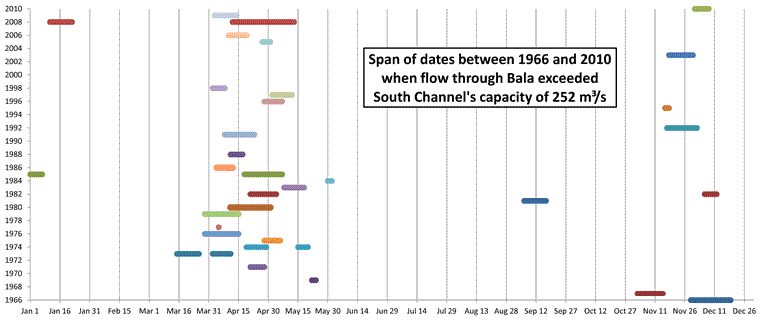
The graph below (click on it for a larger view) shows the span of dates each year during which the flow through Bala was more than 252 m³/s. Therefore on the highlighted dates below, flow through the Bala north channel was needed to avoid flooding Lake Muskoka.

As expected, during spring freshet the Bala north channel is almost always needed. But what is important is that during the months of June through February (inclusive), flow through the Bala north channel was needed in 10 of the 45 years to avoid flooding Lake Muskoka.

That is, the proponent’s construction plans would create a (10/45=) 22.5% chance of flooding Lake Muskoka.

This is more than a 1 in 5 chance of flooding, which is far too risky (a 1 in 50 chance would be better design practice). We have therefore sent this letter to the MNR.

Nov 162014
 
  1. Just this one proposed project would receive a subsidy from us Ontario taxpayers of over $100,000,000 over the initial 40-year contract as it would receive up about 17 ¢/kW•h whether the power is needed or not (Ontario Power Generation’s stations receive about 4 ¢/kW•h).
     
  2. It would ruin the local economy as the very popular wading at the base of the Bala falls would become so dangerous that the proponent would need to install fencing to keep everyone out of the water (the Bala falls are unique in that they are accessible, are important to the area’s economy, have free local parking, stores, restaurants, washrooms, viewing benches, and you can climb down the rocks on them).
     
  3. Both Bala falls would become a trickle, leaving dry rocks instead of the area’s main tourist attraction (50% of the flow of the Niagara River is reserved to go over the Niagara Falls, but the Bala proponent would allow only 6%).
     
  4. The proposed station would obstruct the Bala Portage, which is proven to have been created and used by the First Nations of the area (according to the maps and hand-written diary of cartographer David Thompson in 1837).
     
  5. Transport Canada rushed-through their approval, refusing to allow public input and accepting incorrect information from the proponent.
     
  6. The provincial government refuses to respond to letters and phone calls from the nearby Wahta Mohawks who sent notice that the Crown’s Duty to Consult has not been fulfilled as the proponent stated in their environmental assessment that the change to their current plan would be positive for the Bala Portage, even though it actually would completely obstruct and eliminate it.
     
  7. For over 75 days Peggy Peterson has been camped-out at the site to bring a human side to this issue and to ensure that the proponent and MNR don’t do anything without authorization.
     
  8. The recent Tom Adams / Ross McKitrick study on Ontario’s power generation concludes with a recommendation: “No new hydro developments”.