Oct 012014
 

The proponent offers that instead of using Margaret Burgess Park for construction purposes, they would rather:

  1. Cut down all the trees on the Township land south of the proposed construction site, dump blast rock into it, store construction materials in it, and drive construction vehicles all over it.
  2. Occupy the south half of the Don’s Bakery parking lot so it could not be used for public parking, these would be the people that are important to the area’s economy as such visitors are what brings money into the area’s stores and restaurants.
  3. Occupy the Precambrian Shield parking lot so it could not be used by the Farmers’ Market, Cranberry Festival, or for public parking – again, all important to the area’s economy.
  4. Widen the Muskoka Road 169 shoulder at and south of the proposed construction site. This would require a retaining wall to be built and this would have a 10′ drop, so there would need to be a high fence. So people driving by on Muskoka Road 169 would just see a fence, not the view down the Moon River which encourages people to stop.

And in addition to these four construction locations, the proponent would also be using both the area beside Purk’s Place and Diver’s Point (in addition to the proposed actual construction site) for construction purposes. They want to occupy seven important Bala sites for up to two years!

So, yes of course Margaret Burgess Park is very beautiful. But better the proponent occupy the one site rather than sprawl all over Bala (occupying a total seven sites within 150 m of the Bala falls). Mayoralty candidate Furniss and his slate’s idea of having Margaret Burgess Park open is meaningless if visitors have nowhere to park, or they don’t even visit because Bala is a noisy and muddy construction zone for two years.
Sep 302014
 

As you can hear for yourself (click the player below) …

 
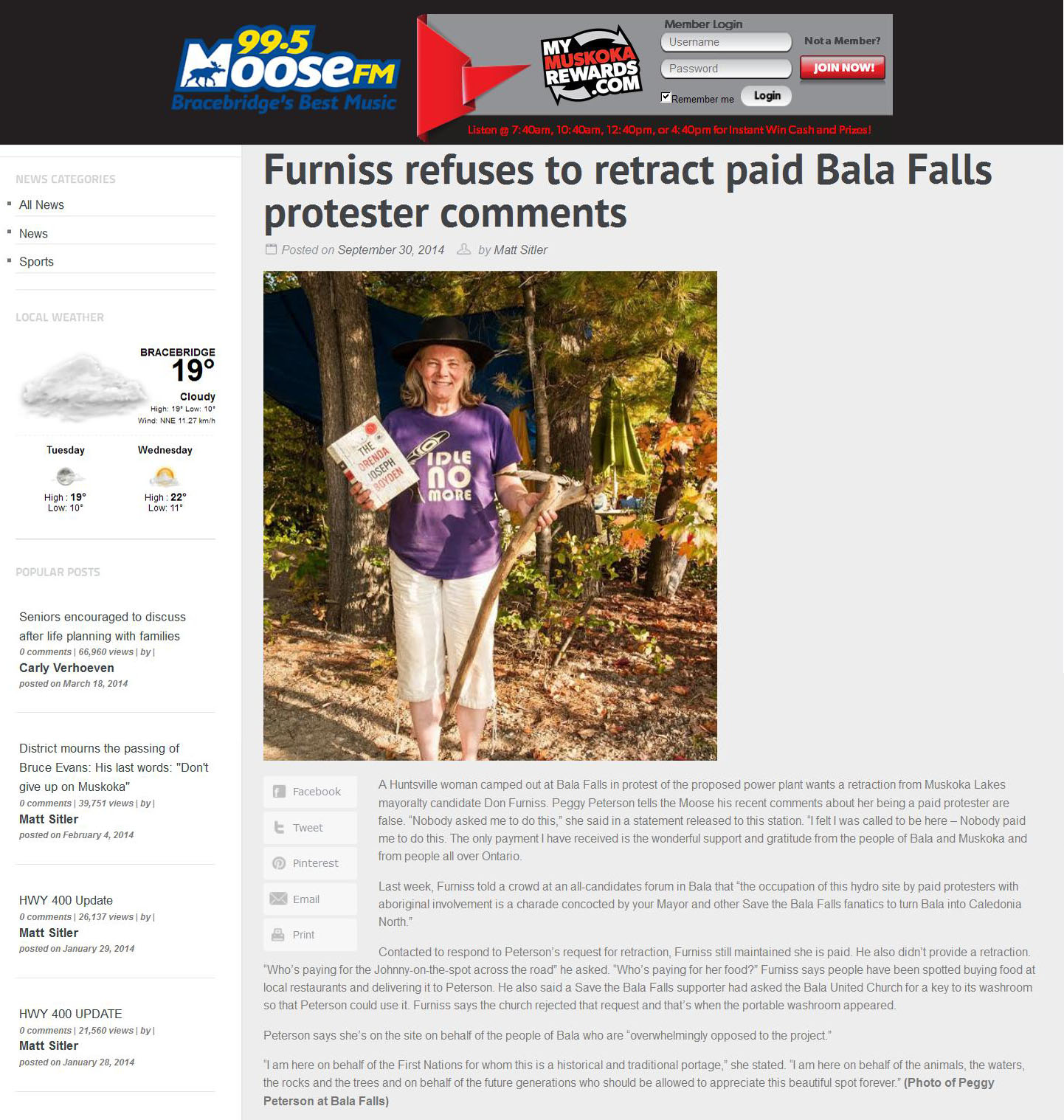
… at the All-Candidates meeting at the Bala Community Centre on September 22, 2014, Township of Muskoka Lakes Councillor and Mayoralty candidate Don Furniss said:

The occupation of this hydro site by paid protesters with Aboriginal involvement is a charade, concocted by your Mayor and other Save the Bala Falls fanatics to turn Bala into Caledonia North. This nonsense has to stop.

As confirmed by Peggy’s signed letter of September 29, 2014 which was sent to the local media, she is not being paid (indeed, I don’t think anybody could be paid enough to camp out for a month if they didn’t really want to), and Mayor Murphy had nothing to do with this, and SaveTheBalaFalls didn’t either. Furniss sees conspiracy where there is none, and does not believe that people are passionate about their belief that the proposed hydro-electric generating station at the Bala falls is simply wrong.

Remarkably, as the MooseFM article below reports (click on it for a larger view, or click here for a text version), Furniss seems be forgetting that his web site says he believes in the principles of “morality and proper manners”.

Confronted by the facts, MooseFM reports that Don retracts to “Who’s paying for the Johnny-on-the-spot across the road” – sorry Don, its been donated by G.B. Services Muskoka (call George Becker at 705 762-2170 if you need one).

So then Don asks “Who’s paying for her food”. Yes Don, people are bringing her food, lots of people are, not just “Save the Bala Falls fanatics”. There’s not much else possible when she’s always on the site. And people bring her coffee too. And Bill Purkis gives her an ice cream cone sometimes. And neighbours welcome her to use their showers and washrooms. And children in the neighbourhood bring her firewood, and have painted the murals – using washable paint I hear you’ll be happy to know. This is the “divided community” you were so worried about. We’re all doing just fine here.

What worries us most is that Furniss’ comments were part of his prepared speech. He didn’t just mis-speak, he intended to make these accusations without knowing them to be true. This is not someone I want making decisions for, and representing the residents of the Township of Muskoka Lakes.

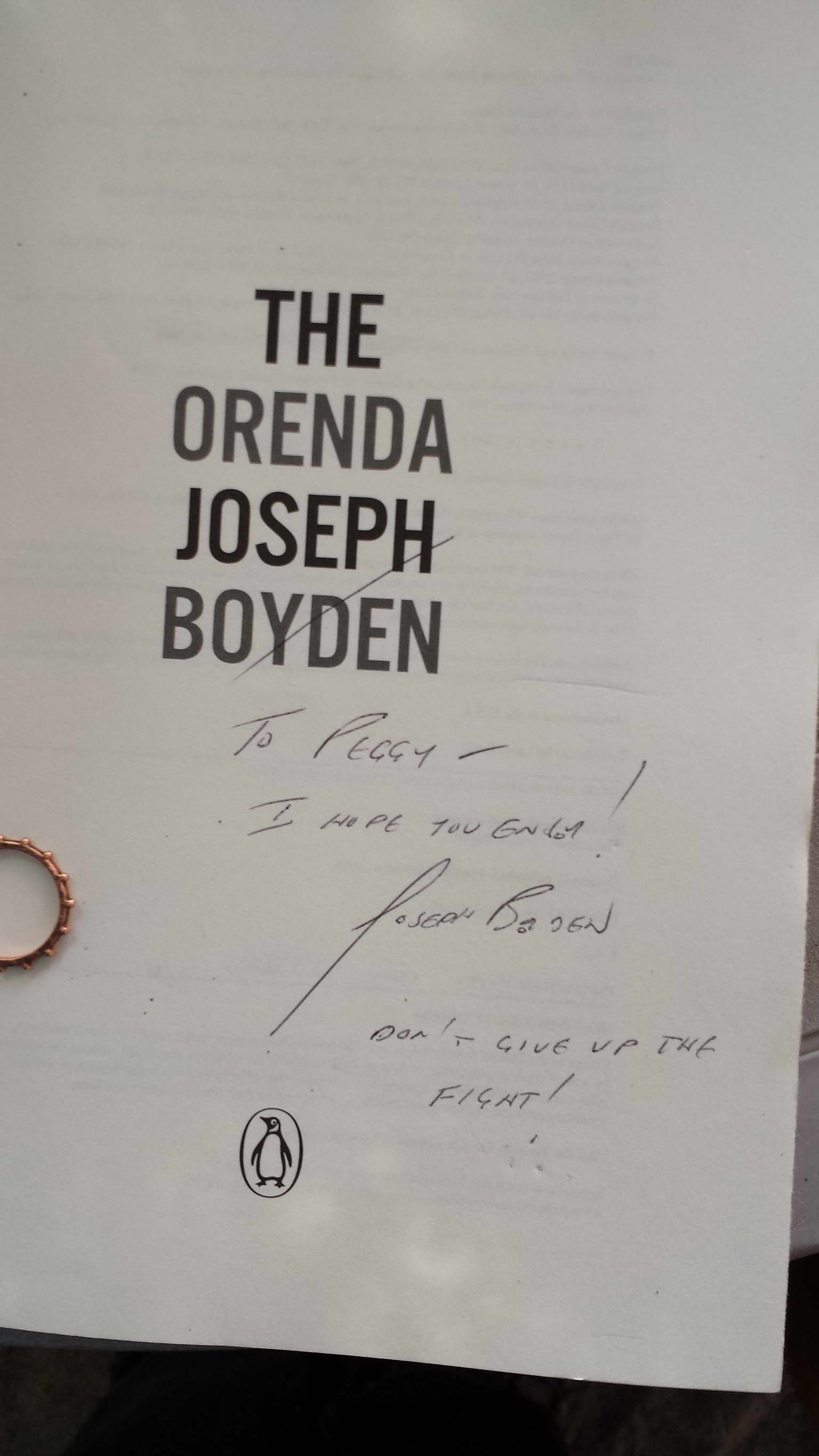
In MooseFM’s article above, Peggy is proudly holding a copy of The Orenda, which won the CBC’s Canada Reads contest this year. This is because this is a signed copy, given to her by the book’s author Joseph Boyden, as we can see below.

Boyden writes:

To Peggy – I hope you enjoy!   Joseph Boyden   Don’t give up the fight!

Sep 302014
 

Exhibit 1: In 2010, the proponent convened a “Flow Distribution Committee”, with complete control over the members, agenda, number of meetings, and mandate. The presentations made, information discussed, and minutes of these meetings have never been made public.

Exhibit 2: As shown here (it is a large file, may take a minute to download), as part of the proponent’s environmental approval, in 2011 the Ministry of the Environment stated the proponent “has committed to forming a Public Advisory Committee during the detailed design phase to allow the public to provide input for the final appearance of the landscaping and other aesthetic elements of the Project.”

However, as noted in this September 17, 2014 issue of What’s Up Muskoka about this Public Advisory Committee, the proponent is keeping the meetings, members, agenda, mandate, and everything else secret. This is not fulfilling the Ministry of the Environment’s requirements.

Exhibit 3: As shown in this video below (click to start it, or click here to see it on Youtube) of photographs taken September 16, 2014, the proponent meets privately with elected officials.

The proponent for the proposed hydro-electric generating station at the Bala falls rudely demonstrates a lack of professionalism and respect for the community (that would be the third photograph in this video). It is also wrong that these elected officials – that have, and would continue to make official decisions on this developer’s proposed project – are socializing with and meeting informally with the developer.

Exhibit 4: The proponent continues to avoid the public and privately meet, listen to the proponent’s architect in this segment of MooseFM interview of October 16, 2014 (click on the triangle at the left end of the player below).


then we met with some potential new Council members

Observations
This is a proponent that would receive a $100,000,000 subsidy from the taxpayers of Ontario, this is a proposed project that would be on public land, and use public water.

It is unacceptable that there be secret meetings which claim to represent the public.

It is known that Councillors Don Furniss and Gault McTaggart and candidate Greg Knight have met privately with the proponent. This is wrong, instead we must work to keep government open and transparent, we don’t want elected officials holding secret meetings, and we don’t want to deal with proponents that work this way either.

Sep 162014
 

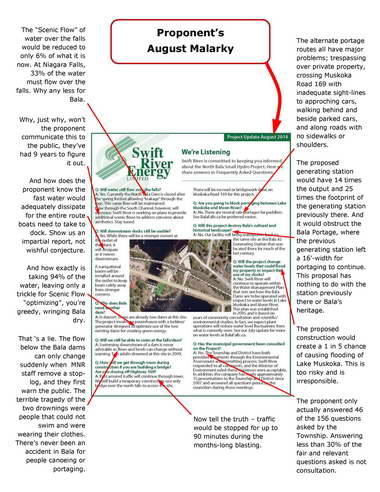
The proponent is providing incorrect and misleading information to the public. They are making up answers to things they don’t know. This is a terrible way to run a business, makes a mockery of what should be a transparent process for works on public property, and is an insult to the taxpayers of Ontario.

Some examples are in the table below.

Did you know …
But …
Did you know that the Bracebridge Falls hydro-electric generating station, and the two stations upstream of it all have barbed-wire fencing. When we ask the proponent if the proposed Bala hydro-electric generating station would have barbed-wire fencing they say they have no plans for it.
The proponent has been asked if Margaret Burgess Park would be fenced-off during operation to prevent people from entering the water. The proponent responds they don’t plan on it.
The above two responses are completely insulting and meaningless. The proponent has had nine years to figure this out. The only real answer is for the proponent to ask their lawyer and insurance company what study or report is needed to determine whether and where and what type of fencing would be required, and the proponent should get answers from a qualified, impartial, and authoritative organization.Before that, they should not be misleading the public by making up fake answers about things they don’t know.
The proponent claims there are safer portage routes as alternatives to the Bala Portage. It is clear the proponent, and even their “portaging expert” have never actually portaged any of these routes, as they didn’t realize the problem of trying to paddle upstream on Burgess Creek under Muskoka Road 169, nor of walking in a lane of traffic on River Street or Portage Street, nor of crossing Muskoka Road 169 south of the curve so approaching cars can’t be seen in advance. And they didn’t consider that the suggested portage route along Portage Street requires trespassing on private property.
The proponent and MNR claim there would be no impact on marine navigation downstream of their proposed generating station. Transport Canada has not yet determined this. In any case, the proponent has not considered the route boats need to use when docking, nor the safe water speeds for the different types of boats. Wishful conjecture is not a replacement for getting the facts.
The proponent claims their current proposal would have a “positive impact to portage”. The proponent’s current proposal would actually obstruct and eliminate the Bala Portage. The proponent has provided incorrect information to the public.
The proponent claims that after their proposed generating station is built, the summer flow over the Bala falls would remain the same – 1 m³/s over each of the falls. As shown in the video in this article, the existing flow over the Bala north falls – even in August – is much more than a trickle of 1 m³/s. The proponent is trying to use this lie to justify allowing only 1 m³/s of flow over both Bala falls throughout the year (except times during the spring freshet when their proposed generating station couldn’t handle the remainder of the flow).
The proponent claims the Bala #2 generating station that used to be on the Crown land site south of the Bala north falls would have obstructed Bala Portage. The red lines on the figure in this article, are from an official survey from 1924, and this shows that there was a 16′-width on the Crown land for the Bala Portage to continue past the Bala #2 generating station. Furthermore, the old photograph in that same article shows a well-worn path along this route beside the Bala #2 generating station, showing indeed people did walk and portage past the Bala #2 generating station. Also the first and last old photographs in this article, show canoes pulled-up on the shore beside the Bala north falls, further showing that this was the where people canoed and portaged.


Sep 102014
 

Click at the right to view the video, or you can see it at http://youtu.be/7F9xrLgW6LE

Thanks to John Wright of North 45 Communications, here is a flying drone’s view of the Bala falls. We’re over the Moon River, looking east over Burgess Island and upstream towards Bala Bay on Lake Muskoka. In front of us to the left is the Bala north falls and upstream of that, the Bala north channel. To the south, that is, to the right of the Bala north falls, is Burgess Island, and to right of that, is the Bala south channel, and upstream of that is the Bala south dam.

All the water from Lake Muskoka and the 5000 km² watershed upstream, which extends to Algonquin Park, flows through the Bala falls, to the Moon River, which is below us. From here the water flows west to Georgian Bay and to Lake Huron. The traditional and historic Bala Portage is directly in the centre in front of us, on Burgess Island, just south of the Bala north falls. Before railroads and highways, travel by water was essential for trade and for the First Nations that lived here first. And the Bala Portage connected people in the area to the horizon and beyond to the Great Lakes and to the rest of the world.

People are drawn to the Bala falls. The Bala falls are accessible, beautiful, natural, and unique. The Bala falls drive the area’s economy. But a proponent and the provincial government wish to build a hydro-electric generating station right on the Bala Portage. This would both obstruct the Bala Portage and take 94% of the water from the falls, leaving only a trickle for what is called Scenic Flow. People won’t come to Bala to see the dry rocks where the falls used to be.

We’re now farther east, over Bala Bay, looking south over the upstream safety boom for the Bala south dam and downstream of that is the Bala south dam and then the Bala south channel and the Moon River. To the right is the Canadian Pacific Railway, and past that is Muskoka Road 169.

We’re farther north, still over Bala Bay and looking south. Here we can see the Bala south dam ahead of us, then to the right is Diver’s Point, and to the right of that is the Bala north channel. In the distance ahead of us is the Kee to Bala.

We’re farther south now, to our right is the Kee to Bala. And ahead of us, courtesy of the hard-working and early-rising staff at PaddleShack, are 38 of their Kayaks, carefully arranged by size, Save Bala Falls.

For more information, please visit us at SaveTheBalaFalls.com

Sep 102014
 

Click at the right to view the video, or you can see it at http://youtu.be/fRvYBwYsACM

It is August 19, 2014, a typical summer day at the Bala north falls. I don’t believe it has rained any significant amount in the past few days, so this is a typical flow of water down the Bala north falls.

As we pan across the six sluices of the Bala north dam, we see that there is water going over some of stop-logs and between some stop-logs. This is an attractive flow of water. This is what draws people to Bala and these visitors drive the area’s economy.

The Bala falls are beautiful, and they are accessible. They can be seen from and are right beside Muskoka Road 169 and there is free parking right across the road. The Bala north falls can be viewed from Margaret Burgess Park, which has picnic tables and park benches. Visitors can climb down the rocks to the water. Nearby there are restaurants, stores and public washrooms. Other falls in Ontario just don’t have all this, the Bala falls are unique.

The water levels and flow requirements in Muskoka are specified in the Muskoka River Water Management Plan, which was approved in 2006. And Table 5.2 of this states that the existing minimum flow over each of the Bala north and south falls is 3 m³/s – this is in addition to the 4 m³/s through the Burgess Creek generating station.

While the Muskoka River Water Management Plan will accept flows as little as 1 m³/s for each of the Bala falls, it does not present any justification for this major reduction, perhaps it was just to pander to and appease the proponent.

The proponent repeatedly claims that throughout the summer, there is currently only 1 m³/s of leakage flow between the stop-logs of each of the Bala dams. This would be just be a trickle, about a bathtub per second. Clearly this isn’t what we’re seeing here.

The proponent further claims that the only reduction we’d see is that the summer flow of 1 m³/s would occur throughout the rest of the year, so long as their proposed generating station could handle the rest of the flow.

As is common in the industry, the proponent would add stop-logs and use a 10-ton hydraulic jack to compress the stop-logs to reduce the flow we’re seeing today to just a trickle of 1 m³/s.

So despite the proponent’s claims that there wouldn’t be any visible reduction in flow, there would actually be two reductions:

  • Firstly, all what we’re seeing today would be reduced to a trickle of only 1 m³/s because the proponent keeps telling us the current flow is already only 1 m³/s. Clearly, the reality is that the proponent is making incorrect statements to the public – this is much more than 1 m³/s.
  • Secondly, except during spring freshet when their generating station couldn’t handle any more water, the summer trickle of 1 m³/s would be all we’d see throughout the year. People won’t come to Bala to look at dry rocks where the falls used to be.

And did you know, that by international agreement with the United States, 1/3 of the flow – that’s 33% – of the flow of the Niagara River must go over the Niagara Falls as Scenic Flow to draw people to Niagara Falls because it is important to their economy as well. But the Bala proponent would allow only 6% to flow over the Bala falls. The Bala proponent is being too greedy and wants to wring Bala dry.

Help Save the Bala Falls, for more information visit SaveTheBalaFalls.com

Sep 082014
 

Summary

  1. After years of the proponent and the Ontario Ministry of Natural Resources referring to the Bala Portage as the “alleged portage” or the “purported portage”, we find that the proponent’s own study confirms that the traditional and historic Bala Portage has always been south of the Bala north falls.
  2. However, the study’s authors conclude an incorrect route for the original Bala Portage.
  3. But the important point is that the Bala Portage has always been south of what is now called the Bala north falls, and that due to the provincial government’s actions (their construction of the highway bypass in 1965), the only available route for the Bala Portage now is over the Crown land, which would be obstructed by the proponent’s current Alternative 1A plans.

Detail
For the Township of Muskoka Lakes’ 2013 Judicial Review hearing, the proponent commissioned a study to determine the location of the original Bala Portage. The study found that the exact route of the Bala Portage would have changed over time, for example, due to the construction of the railway in 1907 and of the highway bypass in 1965.

This 98-page study was written by two well-respected Ph.D.s, and can be viewed by clicking on the image below (it is a 6 Mbyte file, so will take some time to download).

After years of the proponent and the Ontario Ministry of Natural Resources referring to the Bala Portage as the “alleged portage” or the “purported portage” and denying its existence, we find in this study that the proponent themselves confirm that the Bala Portage has always been south of the Bala north falls.

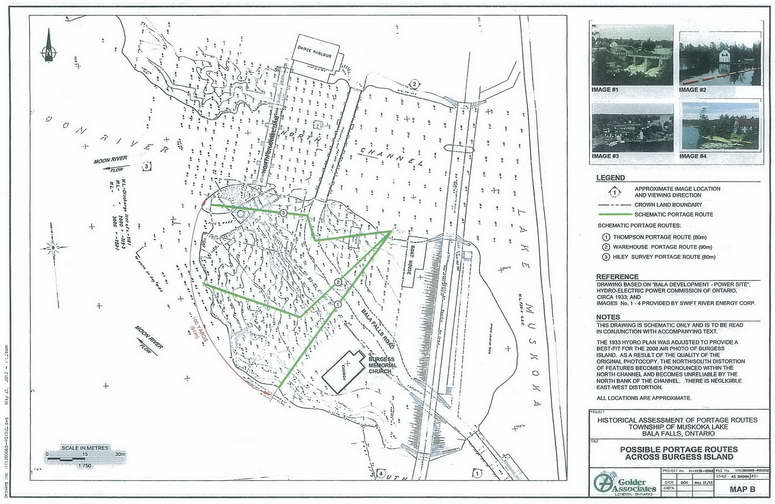
The study concludes that over time, there were three different portage routes south of the Bala north falls, as shown by the green linies in their Map B (reproduced below, click on it for a larger view, which includes added comments).

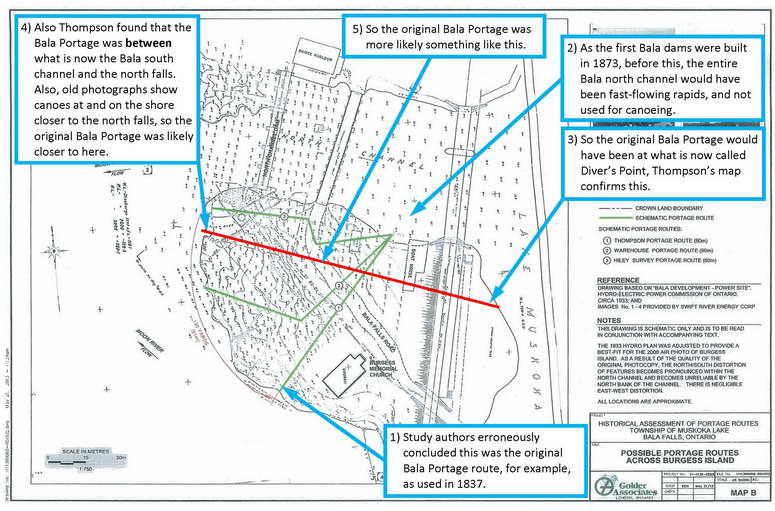
As summarized in our commented version of their Map B, the study’s authors erred in their determining the exact route of the original Bala Portage, as follows:

  1. The Bala dams were first built in 1873. Before this, the full length of the Bala north channel would have been a fast-flowing rapids, definately not suitable for canoeing. So the original Bala Portage would not have ended in the Bala north channel, instead it would have ended at what is now called Diver’s Point. This is confirmed by cartographer and explorer David Thompson’s own 1837 map, the relevant section is here.
  2. The proponent’s study carefully recites the relevant sections of Thompson’s journal as included in Mitchell Shnier’s letter to the Ministy of the Environment (bottom of page 8) and in his Affidavit (paragraphs 28 to 30). But inexplicably, the proponent’s study ignores Thompson’s subsequent sentence where after camping the night, Thompson finds that the Bala Portage is actually not the Bala south channel, but is between the Bala north falls and the Bala south channel.

Therefore, rather than the proponent’s study’s conclusion that the original Bala Portage’s route was the green line with the , the original Bala Portage was more likely the red line as shown in the marked-up Map B. This is confirmed by the photographs in this article, which all show canoes at and on the shore, directly south of the Bala north falls.

In any case, it is clear that the Bala Portage has always been south of the Bala north falls.

Conclusion

  1. The proponent’s own study confirms that the traditional and historic Bala Portage has always been south of the Bala north falls.
  2. The study authors failed to use all the information available to them and as a result erred in the exact route of the original Bala Portage.
  3. Due to the provincial government’s actions (their construction of the highway bypass in 1965), the only available route for the Bala Portage now is over the Crown land, which would be obstructed by the proponent’s current Alternative 1A plans.
Sep 022014
 

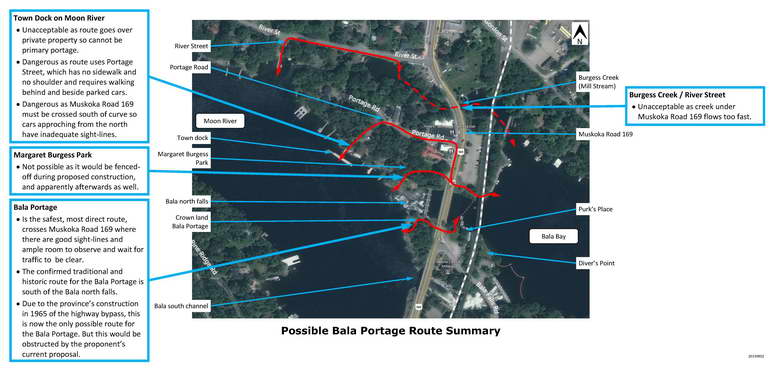
Some claim that there are other acceptable portage routes through Bala. However there are many other issues to consider than simply if you can currently get from here to there.

We detail these concerns here, and present a quick summary below (click on it for a larger view).

Aug 272014
 

The proponent presented their current proposal, which they refer to as Alternative 1A, in their 2012 Addendum.

Table 6.1 of this 147-page document is a “Comparison of Potential Effects between Alternative 2D and Alternative 1A During Operations Phase”. That is, in this table they detail the changes that their current proposal would have from their previous Option 2 proposal. A section of page 2 of this table is presented below (click on it for a larger view, or click here to see the entire table)

That is, compared to their previous Option 2 proposal (which was presented in 2009 in their 620-page Environmental Screening Report), the proponent says the “Net Effect of Alternative 1A” would be a “Positive impact to portage”.

However, as shown here, while the proponent’s Option 2 would not have obstructed the Bala Portage, the proponent’s current Alternative 1A would obstruct the Bala Portage. So the proponent’s statement in their Addendum that there would be a net positive impact to the portage is incorrect.