Jul 312018
 

Summary
The proponent has been using every means available to them (including delay, threatening legal action, appeals, and abusing the process), trying to prevent us from receiving copies of their communications with the MNRF. Recent decisions require that these documents be disclosed to us.

Detail
Ontario’s Freedom of Information and Protection of Privacy Act allows the public to request copies of government documents, such as the Ministry of Natural Resources and Forestry’s e-mail communications with the proponent.

We have been submitted these requests for many years and some examples of what we have learned is that the:

  • Proponent’s construction plans would risk flooding Lake Muskoka and risk damaging the District Municipality of Muskoka’s bridge over the Bala north channel.
  • Proponent was providing conflicting information to different approval agencies.
  • Proposed generating station would make the water dangerous outside of the proposed downstream safety boom.
  • May not be able to locate warning signs in the locations needed to adequately warn the public of the extreme dangers their proposed project would create.

The legislation allows the proponent to object to the release of these documents, and this results in the case being transferred from the Ministry to the Office of the Information and Privacy Commissioner of Ontario, who begins with a Mediation process and if this does not resolve the objection, then an Adjudication process is started. The proponent has been abusing this process by delaying Mediation, threatening legal action, and objecting to Adjudication orders.

The Adjudication alone can take more than a year, and begins with the Adjudicator providing a Notice of Inquiry and requesting representations from the parties (often there are at least three parties – the proponent, the Ministry, and us – but lately the proponent has been conscripting three of their sub-contractors to also object, so there have been six parties, making for a complex process). Representations are quasi-legal documents responding to questions concerning whether specific documents should be released or are exempted from being released, typically citing previous decisions to justify arguments made.

So you can see some of the time and attention to detail involved, here are just some of the documents from one of the four Adjudications so far:

  1. The Adjudication process begins with the Adjudicator sending one or more parties to the appeal a Notice of Inquiry. This is a detailed 41-page document describing the issues that must be addressed in the representations.
     
  2. The proponent then provided 55 pages of representations, and the MNRF provided six pages of representations.
     
  3. We then responded to these with 75 pages, comprising:
    1. A cover letter describing the files comprising my response.
    2. Our representations, which is a 21-page document.
    3. The Appendices to which my representations referred, totalling 41 pages.
    4. While the Freedom of Information and Protection of Privacy Act allows exemptions so particular types of documents will not be released (such as documents which were marked as confidential if it can be shown their release would cause harm such as loss of trade secrets), there is a “public interest override” provision where documents which would benefit the broad public interest can be disclosed even if they are found to be confidential. We therefore provided a seven-page document with examples showing that information previously received through the Freedom of Information process were of broad public benefit.
    5. Representations should be limited to 20 pages, but the proponent had additional information to present, so they provided “supplementary representations”, to which we provided a five-page response document.
       
  4. After waiting 14 months, the Adjudicator issued a 56-page Order dismissing all of the proponent’s representations either as having no merit, or being subject to the public interest override. The Order required all records at issue to be released.
     
  5. The proponent then submitted a Request for Reconsideration, claiming eight grounds where the Adjudicator erred. After several more weeks the Adjudicator released a 29-page document dismissing all grounds and ordering that all records at issue be released.

It has now been more than three years since the initiating Freedom of Information request was submitted, and while some documents have been released, we await these last documents which have been ordered to be released.

Jul 312018
 

Summary
The proponent continues to refuse to show how, or if, they could safely operate their proposed hydro-electric generating station at the Bala falls, as they won’t answer the concerns in our letter. And Township of Muskoka Lakes Mayor Don Furniss defends the proponent, even though the proposed project would endanger people using both of the adjacent Township’s municipal docks.

Detail
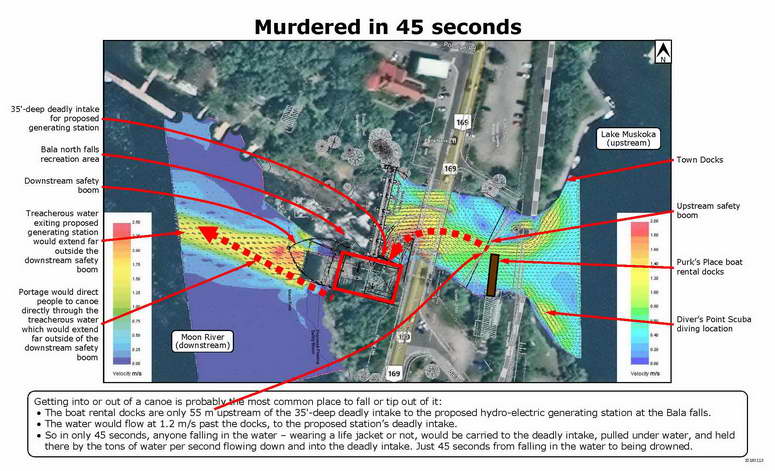
As shown in the composite figure below (click on it for a larger view), the proposed hydro-electric generating station at the Bala falls would make the water dangerous for users of the municipal docks both upstream and downstream of the proposed project.

As such public safety concerns should be of concern to the municipality, I contacted the Mayor of the Township of Muskoka Lakes, Don Furniss, asking if he believed the proponent’s safety plan should be disclosed to the public now, so that those that understand the area can provide comment as this could impact design requirements. The Mayor’s reply e-mails stated he was satisfied that the proponent would need to have operating procedures in place before commercial production of power is permitted, and that he was satisfied with that. I stated the concern is whether the public would be adequately warned and informed of the extreme dangers the proposed project would create. The Mayor then offered to arrange that we all meet with the proponent, and this meeting was on June 26, 2018 in the Mayor’s office. Frank Belerique represented the proponent, and by speakerphone was Stefan Kohnen of KGS Group, representing the proponent’s construction manager.

At the meeting we noted that:

  1. It would be unprecedented to build a hydro-electric generating station in the middle of a popular in-water recreational area, and as close to public and private docks. In response and as justification, the proponent cited other generating stations such as at Bracebridge Falls and the London Street generating station in Peterborough.
    • The Bracebridge Falls generating station has a 110′-long concrete breakwater directing the dangerous water away from the municipal docks, and the public beach is 1,000′ downstream.
    • In Peterborough, there is no in-water recreation far upstream or downstream.
    • We were therefore quite alarmed that the proponent does not understand these crucial differences. Or perhaps we shouldn’t be surprised, as the proponent has no public safety expertise nor have they sought this.
       
  2. The calculation used by both Transport Canada and the Ministry of Natural Resources and Forestry for the minimum distance upstream of a hazard that a safety boom is to be located shows that the operation of the proposed project requires the current upstream safety boom to be located farther upstream.
    • We were very surprised that the Mayor defended the proponent’s claim that there was no need for this.
       
  3. The proposed project would create dangerously fast and turbulent water outside of the proponent’s proposed downstream safety boom (as shown in the above composite graphic).
    • In response the proponent offered to review the information used to create the above composite graphic, and respond within two weeks.

As follow-up to the meeting, we sent the proponent this letter, which gives several examples that the proponent does not understand and appreciate that due to the approvals currently in place it would not be possible to safely operate their proposed project.

Instead of any answers to these and other questions detailed in our letter, the proponent replied that they will finalize and release their safety plan “after substantial completion of the power plant”. And the proponent reneged on their commitment to respond to our concerns that the treacherously-turbulent water created by their proposed generating station would extend outside of their proposed downstream safety boom. Why does the proponent refuse to show they could operate their proposed project safely.

So nobody knows if it would be possible to safely operate this industrial facility in the middle of a popular in-water recreational area, yet rather than showing any caution on behalf of the Township of Muskoka Lakes, the Mayor blindly defended this private developer who has demonstrated they do not understand the unique and extreme dangers the proposed project would create.

Jul 142018
 

On July 13, 2018 the Ontario PC government announced the cancellation of 758 renewable energy contracts. This will save Ontarians an average of $1 million per cancellation.

We need to remind the Ontario government they can save much more – $100 million – with just one more cancellation, by following-through on Premier Doug Ford’s commitment to stop the proposed hydro-electric generating station at the Bala falls. Even if there were cancellation costs, they would not include the approval costs or lost future profits, so there would be a huge savings no matter what the proponent claims (detail here).

We also need to ask our MPP Norm Miller why he has not replied to the many e-mails he has received about this. Why is Norm Miller not supporting his leader Doug Ford’s commitment to save $100 million.

Come out to the Bala north bridge tomorrow, Sunday July 15, 2018 at 1:00 pm to show your support.

E-mail:
    Doug.Ford@pc.ola.org (apparently isn’t monitored)
    Doug@fordnation.ca
    Norm.Miller@pc.ola.org

Social media:
    @FordNation
    @NormMillerPC
    #DougFord
    #NormMiller

Jul 142018
 

The main reason for Ontario’s high cost of electricity is the massive subsidies the previous provincial Liberal government offered to private renewable energy developers.

For the proposed Bala hydro-electric generating station alone, Ontarians would pay the Bala private developer a subsidy of more than $100,000,000 over the 40-year contract (details here).

The proponent’s contract states that if the proposed project is stopped, the developer cannot claim the profits expected for future operation of the proposed project.

This is confirmed by the legal opinion here (copy here), and is in the legislation passed to cancel the proposed White Pines wind turbine project (in Schedule 2, Section 6, link here, copy here).

Therefore, the PC government keeping Doug Ford’s election promise to stop the Bala project would be a huge net saving of taxpayer dollars.

Jul 102018
 

Summary

The proposed hydro-electric generating station at the Bala falls would produce less than 8% of its rated output when this power would be needed the most – in the summer – making it almost a useless source of energy.

The only reason the developer is proceeding with this proposed project is because Ontarians would be forced to pay them a $100,000,000 subsidy for the power that would be produced in the spring and fall – when the power isn’t needed and is available at far lower cost from other existing sources.

Detail

On July 10, 2018, Bracebridge Generation (@BracebridgeGen) sent the following three tweets …

1/3 A period of below-average precipitation in the region has resulted in low flows through rivers, streams & lakes in the Seguin River watershed. Evaporation rates with this hot weather is slowly taking its toll on water levels. Dams are fully logged in & outflows…

2/3 outflows have been reduced to minimum. Some lakes in the system will begin to have below average water levels if precipitation accumulations don’t increase. The 14-day forecast suggests continued high temperatures with some precipitation.

3/3 Lower precipitation amounts under these dry conditions however, tend to be absorbed by vegetation and soils and don’t add any significant contributions to the watershed.

This reminds us that rivers in Muskoka have little flow in the summer. This is significant because the less flow, the less output from hydro-electric generating stations.

The graph above (click on any of these graphics for a larger view) shows the temperature in Toronto from June 10, to July 10, 2018, with temperatures above 30 °C on more than of the days. As we all know; it gets hot in the summer, it doesn’t rain much, and as noted above, water evaporates, further reducing the water in Muskoka’s lakes and rivers.

The graph above shows the temperature for the 2½ days from midnight July 8 to noon July 10, 2018. On July 9, 2018 the temperature was above 30 °C from 9:00 am to 9:00 pm, as often happens in the summer. This is when Ontario needs the most electrical power, due to air conditioners. To encourage power generation during peak-demand times, the Bala proponent would be paid 17.685 ¢/kW•h for power produced every weekday afternoon.

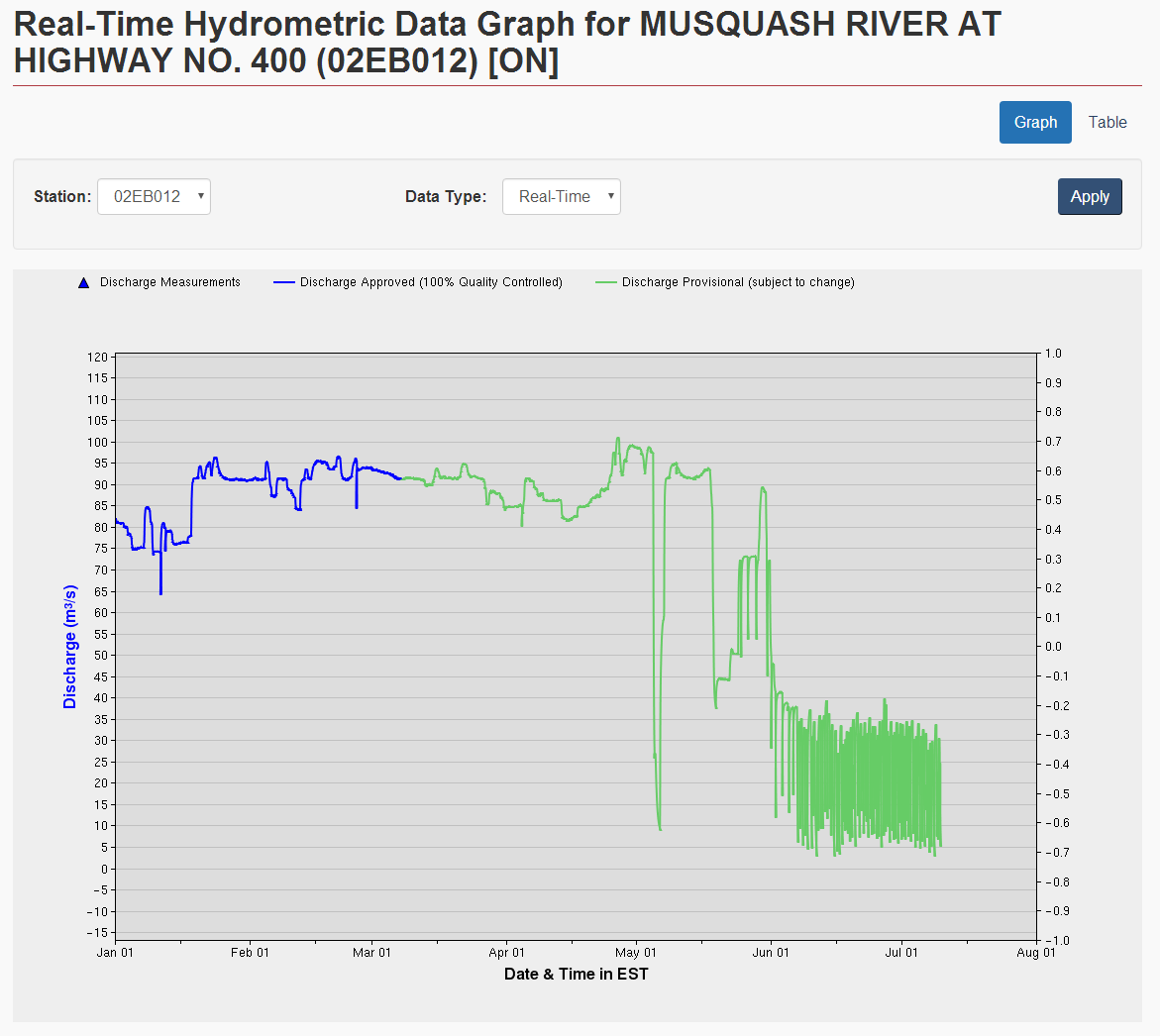
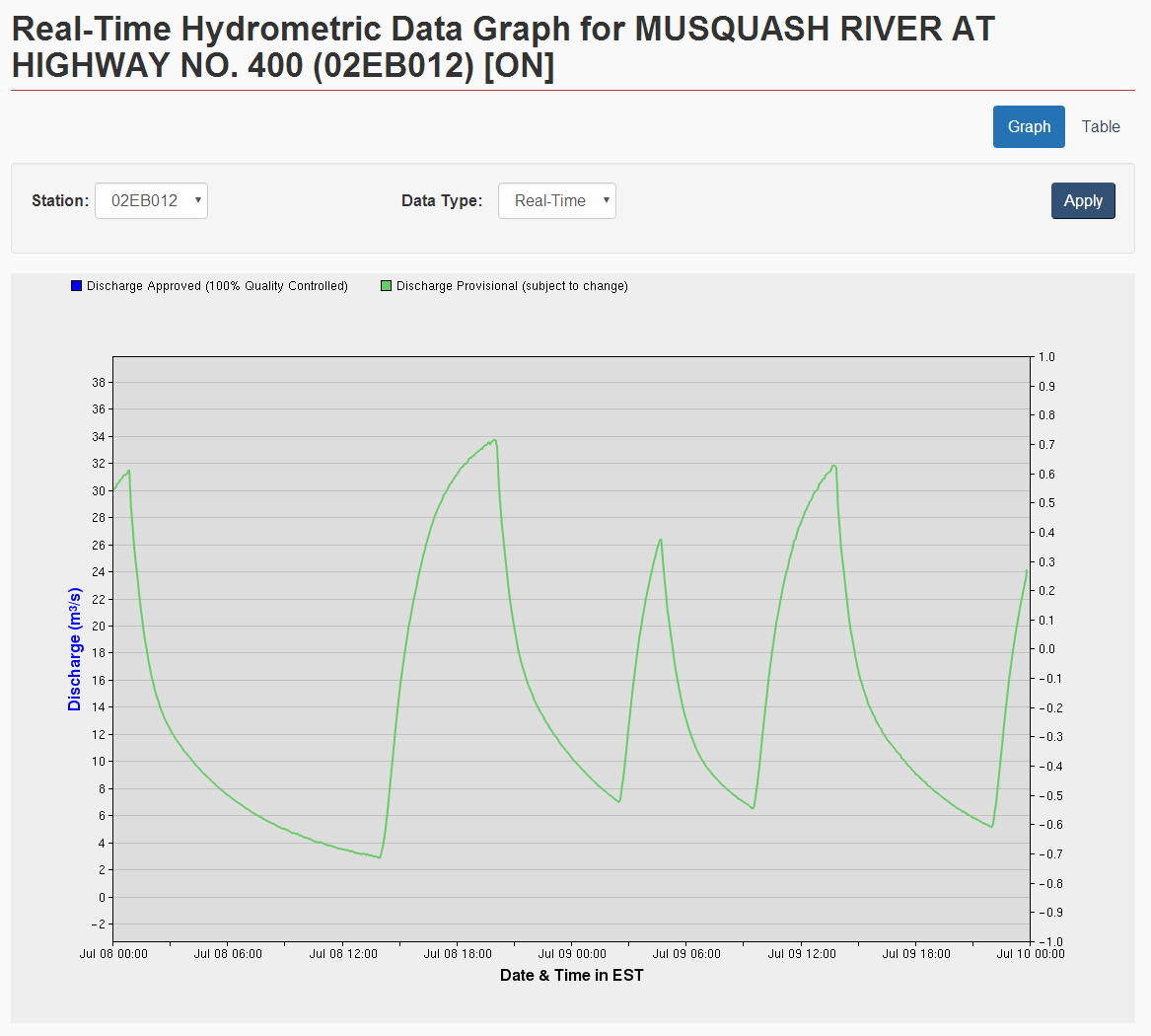
The graph above shows the rate of flow of water in the Moon River from January 1 to July 9, 2018. It shows a flow of about 90 m³/s from January 20 to May 20, 2018, when the proposed hydro-electric generating station at the Bala falls would run at full capacity. But starting in June, the flow cycles between about 5 and 30 m³/s, the next graph shows this in more detail.

The graph above shows the times that Ontario Power Generation was able to operate their two hydro-electric generating stations on the Moon River. These are the Ragged Rapids and Big Eddy stations, which need a minimum flow of 26 m³/s to operate. The graph shows that on July 9, 2018 these stations operated; from 2:30 am to 4:30 am, from 9:30 am to 1:30 pm, and for another 90 minutes beginning at 10:30 pm.

As turbines are not efficient at low flows, this means that these generating stations operated at less than 25% of their generation capacity for 7½ hours in a 24-hour day. This is a capacity factor of less than (7½ / 24) x 25% =  8%, which would never justify construction except that the proposed generating station would operate at full capacity at other times of the year, such as spring and fall. Unfortunately Ontario has a surplus of electrical power during the spring and fall, as people are not usually using their furnaces or air conditioners at these times.

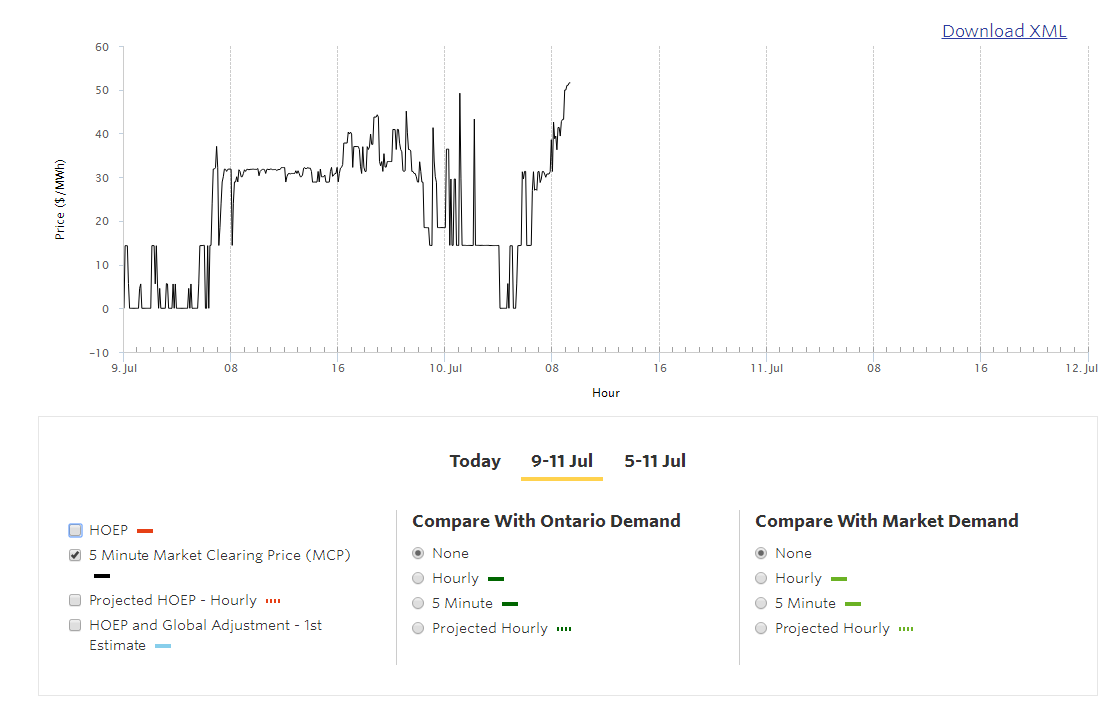
The graph above shows that on July 9, 2018 Ontarians paid an average of less than 4 ¢/kW•h for electricity, yet the Bala proponent would have been paid 17.685 ¢/kW•h. This huge and unnecessary subsidy would total more than $100,000,000 over the 40-year contract for this unnecessary generating station.

That is, Ontarians would be forced to pay this private developer a subsidy of over $100,000,000 (details here) for power that; would not be available when it is needed, would be mostly generated when it is not needed, and would be available from other sources at far lower cost.

On July 10, 2018 the Ontario PC government confirmed they will stop the proposed – and destructive – White Pines wind turbine project (CBC website here, copy here). We look forward to the PCs keeping their commitment to stopping the too-dangerous, unnecessary, and unjustifiably-expensive proposed hydro-electric generating station at the Bala falls.

Jul 042018
 

Premier Ford,

Stopping the proposed hydro-electric generating station at the Bala falls is a win – win, as it will save Ontarians:

  • $100,000,000, which is the subsidy Ontario would be committed to pay this private developer for power that isn’t needed, and that can be obtained less expensively elsewhere (such as the two hydro-electric generating stations downstream).
     
  • Lives, as the proponent refuses to show how, or if, they could safely operate this dangerous industrial facility in the middle of a popular in-water recreational area.
Jul 032018
 

Considering the 20 questions below,  it is clear the previous provincial Liberal government interfered with the environmental assessment process and prevented the Ministry of the Environment from the subsequent enforcement required to protect the public and the environment.

These unaddressed concerns show that now-Premier Doug Ford was right when he visited Bala on February 27, 2018, summarizing that: “This project stinks of political interest and insider deals” and that it is a “big scam” (video and more complete transcript here).

Public safety risks

  1. Why hasn’t the Ministry of the Environment required the Bala proponent to show they could safely operate this proposed industrial facility, especially because all we now know is that they could not.
     
  2. Why has the Ministry of the Environment accepted that the minimum flow through the proposed generating station would be significantly greater than committed for their environmental approval, even though this flow is what would make this industrial facility deadly dangerous to the public.
     
  3. Why has the MNRF accepted that the proposed generating station would start without warning even though the MNRF’s Public Safety Measures Plan for the Bala Dams requires such warning before increases in flow.
     
  4. Why doesn’t the MNRF require the upstream safety boom to be relocated farther upstream, as required by Transport Canada’s calculation used for the MNRF’s Public Safety Measures Plan for the Bala Dams.
     
  5. Why has the Ministry of the Environment accepted that the proposed generating stations would create dangerously fast flows outside of the proposed downstream safety boom.
     
  6. Why hasn’t the Ministry of the Environment required the proponent to get expert input on public safety for in-water recreation, as it would be unprecedented to construct a hydro-electric generating station in the middle of a popular in-water recreational area.
     
  7. Why is the Ministry of the Environment allowing the proponent to construct a portage just inches from the treacherously fast and turbulent water which would exit the proponent’s proposed generating station.

Unjustified favouritism

  1. Why is the proponent being allowed to make the public shoreline in Bala deadly dangerous even though their proposal said they: “will not generally diminish the public’s enjoyment of the area for swimming, boating …”.
     
  2. Why did the previous Liberal government give a “sweetheart deal” to the Bala proponent as Ontarians would have to pay for all major maintenance and repair of both Bala dams even though the deal at the nearby Wilson’s Falls generating station development requires that proponent to pay for all maintenance and repair of that dam.
     
  3. Why did the Ministry of the Environment accept a flawed Economic Impact Study which claimed a net benefit without considering negative impacts.
     
  4. Why has the Ministry of the Environment accepted that the proposed generating station would rise three storeys above the road even through the proponent committed for their environmental approval their building would not rise above the road.
     
  5. Why did the Ministry of the Environment accept that the footprint of the proposed generating station would be 50% larger than committed for their environmental assessment.
     
  6. Why did the Ministry of Energy accept that the proposed project would be finished later than required by their FIT contract, even though the proponent has already been given a four-year extension to this deadline.
     
  7. Why did the Ministry of Energy accept that the proponent stated for their environmental approval that the proposed generating station would have a lower capacity than required by their FIT contract.
     
  8. Why should Ontarians pay the Bala proponent more than 17 ¢/kW•h for power even when it isn’t needed, when it would cost less than 4 ¢/kW•h for power from the two OPG hydro-electric generating stations just downstream.

Environmental risks

  1. Why did the previous Liberal government accept a deficient Environmental Site Assessment that did not investigate whether the PCBs expected to be found at the abandoned Bala #2 Generating Station had been removed.
     
  2. Why did the Ministry of the Environment permit the proponent to put three huge overseas shipping containers directly into the Moon River without first testing the concentration of the manufacturer-applied insecticide, which is known to be harmful to fish.
     
  3. Why has the Ministry of the Environment allowed the proponent to dump blasted rock directly into the Moon River, even though the proponent’s environmental approval does not allow this.
     
  4. Why did the Ministry of the Environment allow the proponent to continue working even though their water treatment system did not have the components or capacity required by their Environmental Compliance Approval.
     
  5. Why did the Ministry of the Environment ignore the unauthorized spill of untreated water from the proponent’s deficient water treatment system. 
Jun 202018
 

Ontario's new government
The Ministry of the Environment and Climate Change has not fulfilled their mandate of protecting human life, as they have not required that the proponent show they could adequately warn and inform the public of the extreme dangers that would be created by the proposed hydro-electric generating station at the Bala falls.

It is clear to us the MOECC has not taken action due to political interference by the previous Liberal government.

We now need to encourage the new PC government to let the MOECC fully do their job by requiring that the proponent stop work until they can show they would meet the public safety and other commitments made for their environmental approvals.

What you can do to help:

  1. Share great Facebook posts such as this with your friends and family, tagged with #NormMiller, #DougFord, and #FordNation
     
  2. E-mail our MPP Norm Miller (at Norm.Miller@pc.ola.org), asking for a reply on what he is doing to save $100,000,000 and protect the public, as detailed in this letter.
     
  3. E-mail Premier-designate Doug Ford (at Doug@FordNation.ca, maybe also Doug.Ford@OntarioPC.com) asking if they need more reasons than are in the article here (https://savethebalafalls.com/?p=8806) to stop the proposed project until the proponent shows they have fulfilled all their commitments made for their environmental approvals.
Jun 172018
 

Summary
While we look forward to your keeping your commitment that your new government will stop construction of the proposed hydro-electric generating station at the Bala falls, all Ontarians will be comforted to know this can be done by simply requiring the proponent to fulfill the commitments they made for their FIT contract and environmental approval.

Please reply, do you need more reasons than this to stop the proposed project until the proponent shows they would fulfill all of the contractual and environmental commitments below.
 

Detail
When you visited Bala on February 27, 2018 (Facebook video here, copy here) you committed that if the Progressive Conservative Party of Ontario forms the next provincial government, you would stop the proposed project to build a hydro-electric generating station at the Bala falls.

We are well aware that Ontarians are rightfully outraged that the Liberal’s poor planning of stopping the proposed Oakville and Mississauga generating stations resulted in Ontario paying cancellation costs of more than a billion dollars.

For the proposed Bala project, there need not be any cancellation costs as all the provincial government has to do is require the proponent to abide by the commitments made for the approvals they have received. For example:

  1. The proponent’s Feed-In Tariff contract requires:
    1. The proposed project be in commercial operation by May 11, 2019.
      • The proponent’s own internal report (North Bala G.S. Project Outline and Update, March 13, 2014) by the design consultant WSP shows they would not be in commercial operation until many months after the deadline.
         
    2. The generating capacity of the proposed project must be at least 4.5 MW.
      • The proponent’s own internal report (North Bala G.S. Project Outline and Update, March 13, 2014) states the generating capacity would be less than this, and since then there have been at least three design changes which would further reduce the generating capacity.
         
  2. For their environmental approval, the proponent stated:
    1. Their proposed project would make the water in the Moon River dangerous for less than 34′ downstream from their proposed generating station. 
      • They have since shown their proposed project would make the water downstream of their proposed project treacherously-fast and -turbulent more than double this distance, and extending outside of their proposed downstream safety boom.
         
    2. Their proposed project would make the water in the Bala north channel dangerous only up to the current upstream safety boom.
      • But the Point of No Return calculation used by Transport Canada and the Ontario Ministry of Natural Resources and Forestry shows the operation of the proposed Bala project requires that this upstream safety boom be relocated farther upstream. This would prevent the only boat rental in the area from renting boats, which would have a significant negative impact on the boat rental and the area’s economy.
         
    3. The minimum flow through their proposed project would be between 14 and 20 m3/s.
      • But the proponent has since stated the minimum flow would be between 26 and 30 m3/s, which is three times the flow which caused the 2008 drowning of a 16-year-old boy at the nearby Wilson’s Falls hydro-electric generating station.
         
    4. The height of the generating station would not be above road level (so the view down the Moon River would not be obstructed by this concrete industrial facility).
      • The proponent has since shown their proposed generating station would rise three storeys above road level.
         
    5. The width of the generating station would be 33′ to 40′ wide, and the footprint would be 400 m2.
      • The proponent has since shown their proposed generating station would be more than 60′ wide, and the footprint would be more than 600 m2.
         
    6. They would not dump sediment into the Moon River, would treat all water pumped from the proposed construction site, and there were no hazardous materials in the excavated material.
      • The proponent did directly dump blasted rock into the Moon River, their water treatment system did not have the capacity or components required, and they did not adequately test for hazardous materials.
         
  3. The Environmental Assessment Act states that the Ministry of the Environment and Climate Change has responsibility for human life, and the 2017 decision by the Environmental Review Tribunal cancelling the proposed Fairview wind turbine project near Collingwood, ON confirms both this.
    1. The MOECC must therefore seek expert input when they do not have expertise required.
      • The MOECC does not have expertise, and did not seek the expert input required to assess public safety (Transport Canada’s mandate and expertise only concerns boating, not public safety for in-water recreation). The MOECC has therefore not fulfilled its obligation to protect human life.
         
    2. The MNRF’s Public Safety Measures Plan for the Bala Dams requires that those recreating in the Moon River be warned before flow is increased.
      • However the proposed generating station would not have a local Operator and it would be remotely- and automatically-operated. It would therefore not be possible to adequately warn those that could be drowned of the start-up of the proposed generating station.
Jun 152018
 

Congratulations Premier-designate Doug Ford
As you can see for yourself (on Facebook here, copy here), a few months ago Doug Ford committed that if elected, the Progressive Conservative Party of Ontario would stop the proposed project to build a hydro-electric generating station at the Bala falls.

  • This would save us taxpayers more than $100,000,000, for power we don’t need and could get less expensively elsewhere.
  • This would ensure that unsuspecting tourists would not be drowned, as the proponent refuses to show how, or if, they could operate their proposed project safely.

Our Parry Sound – Muskoka MPP has been PC Norm Miller for the past 17 years, who for the past 15 years has served in a Liberal government, so was not able to impact this proposed project. But now he can.

Contact MPP Norm Miller’s office (Bracebridge: 705 645-8538, Toronto: 416 325-1012, e-mail: Norm.Miller@pc.ola.org, Twitter: @normmillerpc, Facebook: @norm.miller.psm) and ask him to reply with how he is ensuring the PCs will follow-through to save Ontarians $100,000,000 and protect the public.