Jan 122018
 

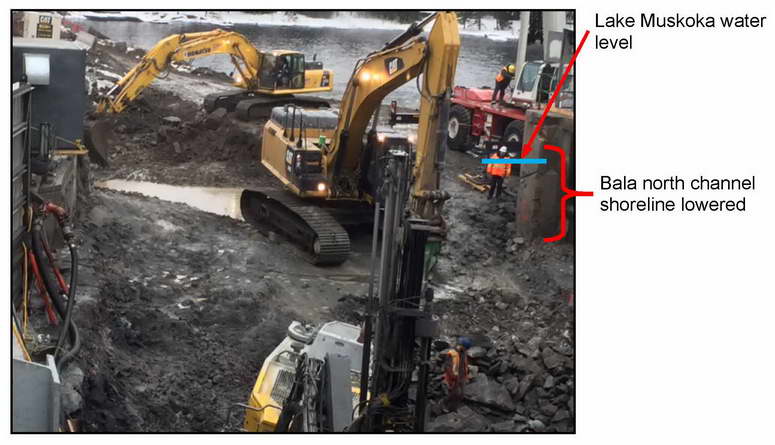
As we have been noting for years (some articles here and here), the proponent’s obstruction of the Bala north channel during their proposed construction risks flooding Lake Muskoka, as flow through the Bala north channel is often required even outside of the March to May spring freshet. This flooding would be due to a rain storm and/or melting snow in the watershed upstream of Bala.

The Ministry of Natural Resources and Forestry has therefore required that the proponent’s upstream cofferdam can be removed on 24 hours notice. This requires that not only could the cofferdam be removed, but also that the water would then flow through the Bala north dam without the flow bypassing the north dam or damaging the Bala north dam (as the proponent would be making structural changes to it).

The proponent has variously stated they would prevent flow bypassing the Bala north dam by using an intermediate cofferdam, or by piling sand bags there, or by not excavating the land downstream. They have also committed they would not obstruct flow through the Bala north channel.

As shown by the photograph below (taken January 11, 2018, click on it for a larger view) we now see the proponent is not honouring these commitments and could not remove their upstream cofferdam, as the resulting flow would bypass the Bala north dam which would cause environmental damage.

On these issues, we have also previously sent this letter and this letter to the proponent, they have not responded to these.

The proponent’s decision to not comply with the MNRF’s approval risks flooding Lake Muskoka. We look to the MNRF to protect the public’s interests by enforcing the conditions of the approval granted to the proponent. We have therefore sent this letter to the Ministry of Natural Resources and Forestry.

Dec 162017
 

Why is the District catering to the proponent, who is working without a required permit

As we noted in our November 22, 2017 delegation to the District Municipality of Muskoka’s Engineering and Public Works Committee meeting (copy here), while the proponent has received some permits from the District, the proponent changed their work without submitting the required information to the District.

The proponent was therefore working without the required permits from the District.

Anybody building a house would be required to have a Building Permit for the work they’re actually doing, yet the District:

  • Did not require the proponent to have the required permits.
  • Has allowed the proponent to continue working without all required permits for over a month.

While the District is being very secretive about what the permit conditions are and which were or are still not being met, we do know that the proponent still does not have a permit for their suspended dewatering pipe (photograph here).

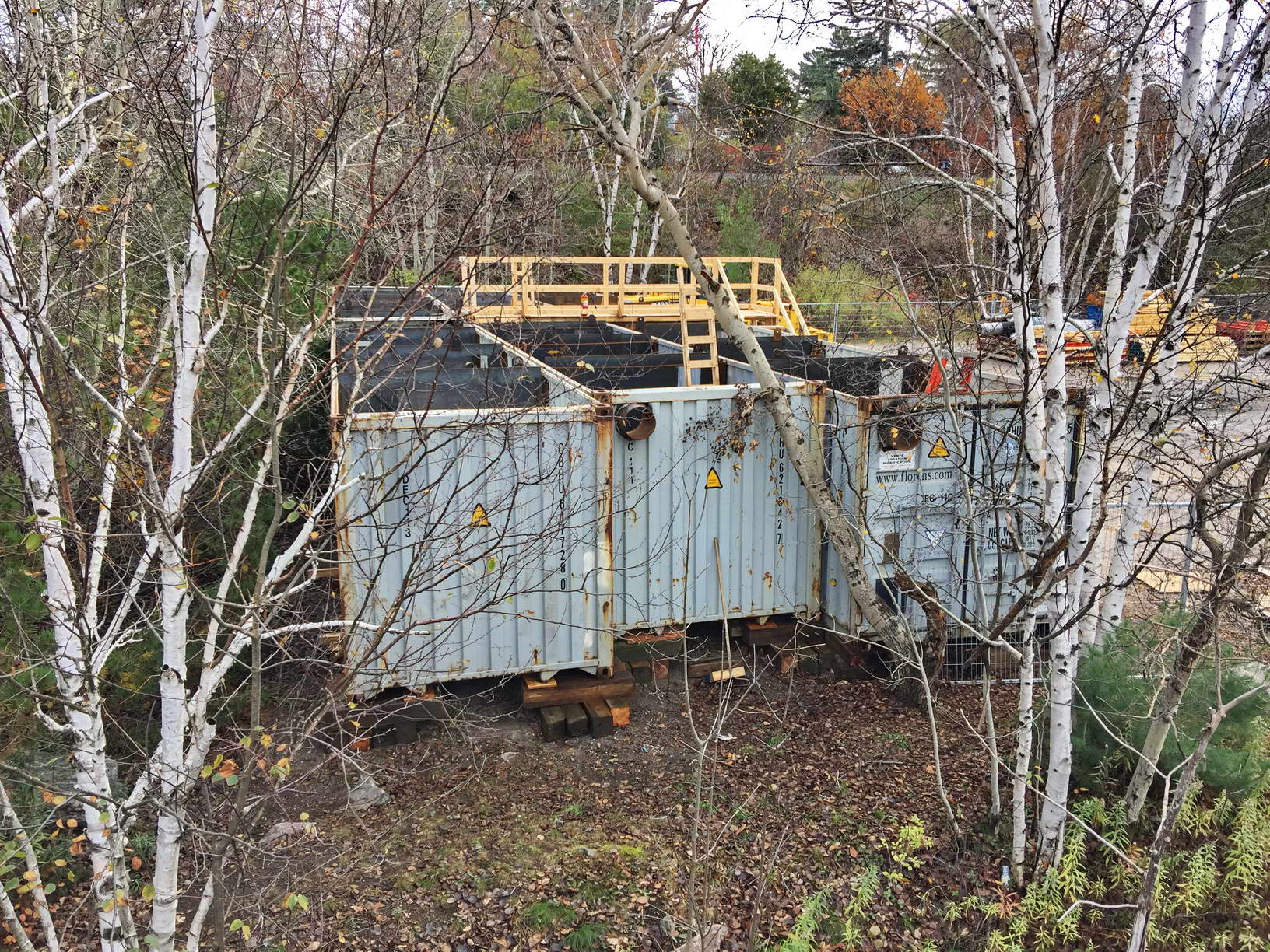
The proponent has shown they have no regard for the environment. For example, while they decided to not use their insecticide-treated shipping containers as settling tanks, they have now placed three of these shipping containers directly into the Moon River, apparently as their downstream cofferdam. They have done this without testing to confirm whether the insecticide (which is known to be harmful to fish) is at a safe level, and without confirming there would be no invasive species introduced to the Moon River or other environmental damage.

The proponent still does not know whether their planned excavation work would release PCBs directly to the Moon River, and whether these PCBs would be pumped through their dewatering pipe.

After allowing the proponent to continue working without a permit for this dewatering pipe for over a month, the District apparently intends to approve issuing the required License of Occupation for this dewatering pipe, as noted on page 3 of the Agenda for the next District Council meeting (copy here). While such an unusual permit requirement would normally be first discussed at a meeting of the District’s Engineering and Public Works Committee, the District apparently intends to bypass this opportunity for technical review and public comment, by allowing this issue to instead proceed directly to the next District Council meeting.

If you are concerned; that the District is allowing work to proceed without the required permit, and that the District is bypassing that the Engineering and Public Works Committee first review this unusual permit application, you can e-mail District Council asking that:

  1. The proponent be required to stop using this dewatering pipe until they have a permit to do so.
  2. This permit request first be reviewed at a meeting of the Engineering and Public Works Committee at which the public has an opportunity to;
    • Learn about the many risks of this request.
    • Provide comment, to be considered as part of the Committee developing a recommendation on whether this request should be approved.

As District Council will be considering this permit request at their meeting this Monday December 18, 2017 at 7:00 pm, you should send an e-mail expressing your concerns before that. You can e-mail individual Councillors using their e-mail adddresses in the link here, or e-mail them all using this link.

It would be very helpful if you could attend this District Council meeting, which will be at 7:00 pm, this Monday December 18, 2017, at 70 Pine Street, Bracebridge. You can watch the live webcast of the District Council meeting using the link here.
Dec 062017
 

As a result of our November 23, 2017 letter to the Ministry of the Environment and Climate Change (posted here), the MOECC sent us this December 1, 2017 letter in reply.

  • The MOECC’s reply letter contains environmentally-significant factual errors – for example that the proponent’s current non-compliant water treatment system is equivalent to what was approved and that it has adequate capacity. Given this non-compliant water treatment system overflowed for days, it clearly is not equivalent and it does not have adequate capacity.
     
  • The MOECC’s reply letter is very troubling as it claims that if the proponent’s work releases polychlorinated biphenyls (PCBs), the proponent could and would clean it up. It is not possible to “clean up” PCBs released to a river.
     
  • But the biggest concern is that the proponent’s work should be treated as a brownfields redevelopment, as it is the site of an abandoned waterfront industrial facility. The MOECC has procedures for brownfields redevelopment here, yet they are not requiring the proponent to follow these requirements.

That is, instead of fulfulling their mandate of protecting the environment, the MOECC is catering to an irresponsible developer that is months behind schedule.

We have therefore sent this letter to the Minister of the MOECC, and we await their reply.

Nov 242017
 

As described here, the proponent received an Environmental Compliance Approval (ECA) for the pumping of water from their proposed construction site, however:

  • For at least four days last week, they spilled untreated water into the Precambrian Shield parking lot. This is in contravention of the Environmental Protection Act.
     
  • They did not immediately report this unauthorized spill to the MOECC, which is in contravention of their approval.
     
  • They have not complied with their ECA as they did not install the required equipment.
     
  • The equipment they did install has inadequate capacity, as a result for for days last week it overflowed, yet the proponent continued running their pumps, causing untreated water to be dumped into the Precambrian Shield parking lot.
     
  • They are required to test the discharge water daily, but are not doing this.

It is very disappointing that rather then requiring the proponent to comply with their ECA, the MOECC apparently provided informal approval for the proponent’s deficient water treatment system, with the result that untreated water was pumped into the Precambrian Shield parking lot last week.

Of even bigger concern is that even though the proponent’s Environmental Site Assessment noted there may be polychlorinated biphenyls (PCBs) buried within their proposed construction site, the proponent has no evidence that the site is safe. As a result, their work could release PCBs directly to the Moon River.

As a result, we have sent this November 23, 2017 letter to the Ministry of the Environment and Climate Change, and await a response.

Nov 182017
 

On November 13, 2017 the proponent sent us this letter, which they copied to:

  • The Mayor, Chief Administrative Officer, and all Councillors of the Township of Muskoka Lakes.
  • The Chair, and the Commissioner of Engineering and Public Works of the District Municipality of Muskoka.
  • The person at the Ministry of the Environment and Climate Change (MOECC) that investigates environmental concerns at contruction sites.
  • The people at the Ministry of Natural Resources and Forestry (MNRF) that are responsible for that Ministry’s decisions concerning this proposed project.

In this letter they:

  • Repeat their invitation that we join their non-existent Construction Committee.
     
  • Claim their project is not providing any economic benefits to Bala because of: “actions to intimidate and bully local business owners if they choose to work with us”.
     
  • Note our web site: “currently contains an article with a headline that suggests our project may be putting toxic contaminants into the Moon River” and they: “request that you correct the article speculating about emissions on your website”.
     
  • Claim their actions: “are in full compliance with the multitude of environmental regulations”.

In response, we sent this letter to the same recipients, plus the Minister of the MOECC, Minister of the MNRF, MPP Norm Miller, and the MOECC’s Director.

Our letter notes that:

  • No correction is required to the information on SaveTheBalaFalls.com, as the proponent had brought contaminated shipping containers to Bala and intended to flush water pumped from their proposed construction site through these contaminated shipping containers and into the Moon River.
     
  • The proponent is not complying with their Environmental Compliance Approval (ECA, which specifies the conditions for their pumping of water from their proposed construction site), as they do not have the specified equipment installed, and their water treatment system is dumping untreated water into the Precambrian Shield parking lot.
     
  • The proponent’s 2013 Environmental Site Assessment was deficient as it did not investigate in the locations needed to determine if electrical equipment containing polychlorinated biphenyls (PCBs) was left buried when the Bala #2 Generating Station was demolished in 1972 within their proposed construction site. We ask what evidence the proponent has that there are no PCBs within their proposed construction site.
     
  • The 200′-long pipe the proponent has suspended above the Bala south channel was not tested for leaks, and asks if this design was approved by a Professional Engineer. We also ask if the electrical cable which is installed along this pipe has been approved by the Electrical Safety Authority.
     
  • The proponent’s work is infringing on the District Municipality of Muskoka’s property rights in several ways, we ask why the proponent has not requested permission for these encroachments.

We look forward to the proponent’s response.

Nov 172017
 

Our previous article described that the proponent must treat and test the water pumped from their proposed construction before it can be discharged to the Moon River.

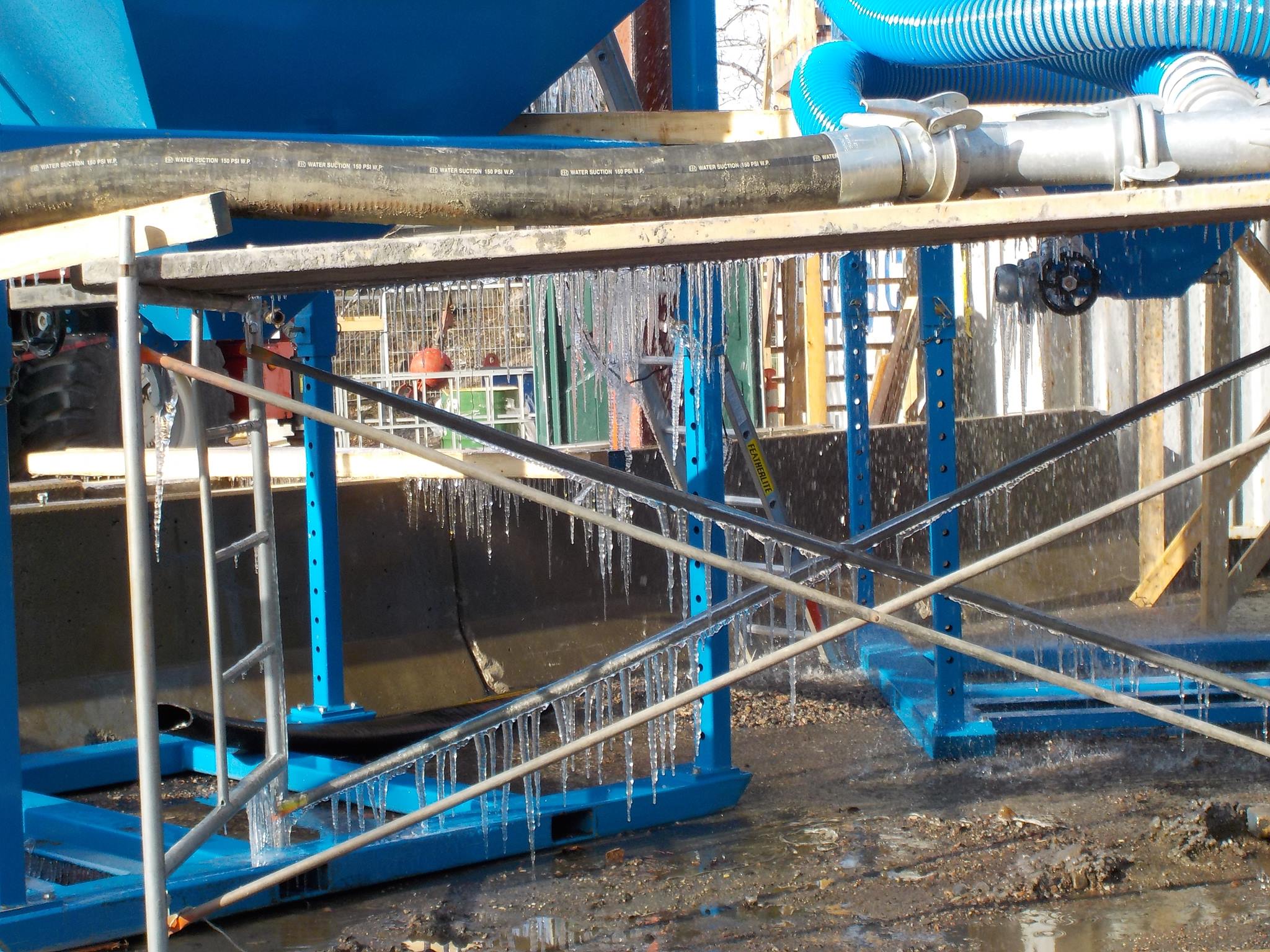
The major problem and unacceptable situation is that the proponent’s water treatment system is gushing untreated water all over the Precambrian Shield parking lot. Julie Cousineau’s photograph below, taken on Friday November 17, 2017, shows the untreated water has been pouring for so long that it has formed icicles.

Or you can watch videos of this water:

  1. November 13, 2017: The storage container overflows here.
  2. November 16, 2017: The lamella tanks overflow here.
  3. November 17, 2017: The lamella tanks overflow here.
  4. November 17, 2017: Same day as above, but the icicles show that the overflow has been continuing for some time.
  5. November 17, 2017: Same day as above, but another view.

This dumping of untreated water into the Precambrian Shield parking lot (and from there, it runs into the Moon River) is an unauthorized spill according to the Environmental  Protection Act, and has been reported to the MOECC’s Spills Action Centre, which results in the MOECC’s Barrie District Office investigating. This has also been reported to CTV Barrie, and the Township of Muskoka Lakes fire department. So far, there has been too little response to this unauthorized spill.

Even though the proponent has known about this spill of untreated water in contravention of their ECA since November 13, 2017, as of at least November 17, 2017 they had still not reported this to the Ministry of the Environment and Climate Change, which is also in contravention of their ECA.

The likely cause is that ground water is leaking into the proponent’s cofferdammed area faster than can be treated by these tanks, so the tanks are overflowing (similar to pouring water too quickly into a coffee filter). The proponent must therefore slow down or stop their pumping, even this affects their planned work. It is unacceptable to simply allow this untreated water to pour into the Precambrian Shield parking lot.

This demonstrates the proponent’s complete lack of respect for other’s property rights, and for their environmental commitments and obligations. It also shows the proponent’s continued lack of communication with the public.

Nov 172017
 

The proponent for the proposed hydro-electric generating station at the Bala falls is required to treat and test the water they would need to pump from their proposed excavation. Their requirements for this are specified in the Environmental Compliance Approval (ECA), which the Ministry of the Environment and Climate Change issued to them on October 20, 2017. You can view a copy of this ECA here.

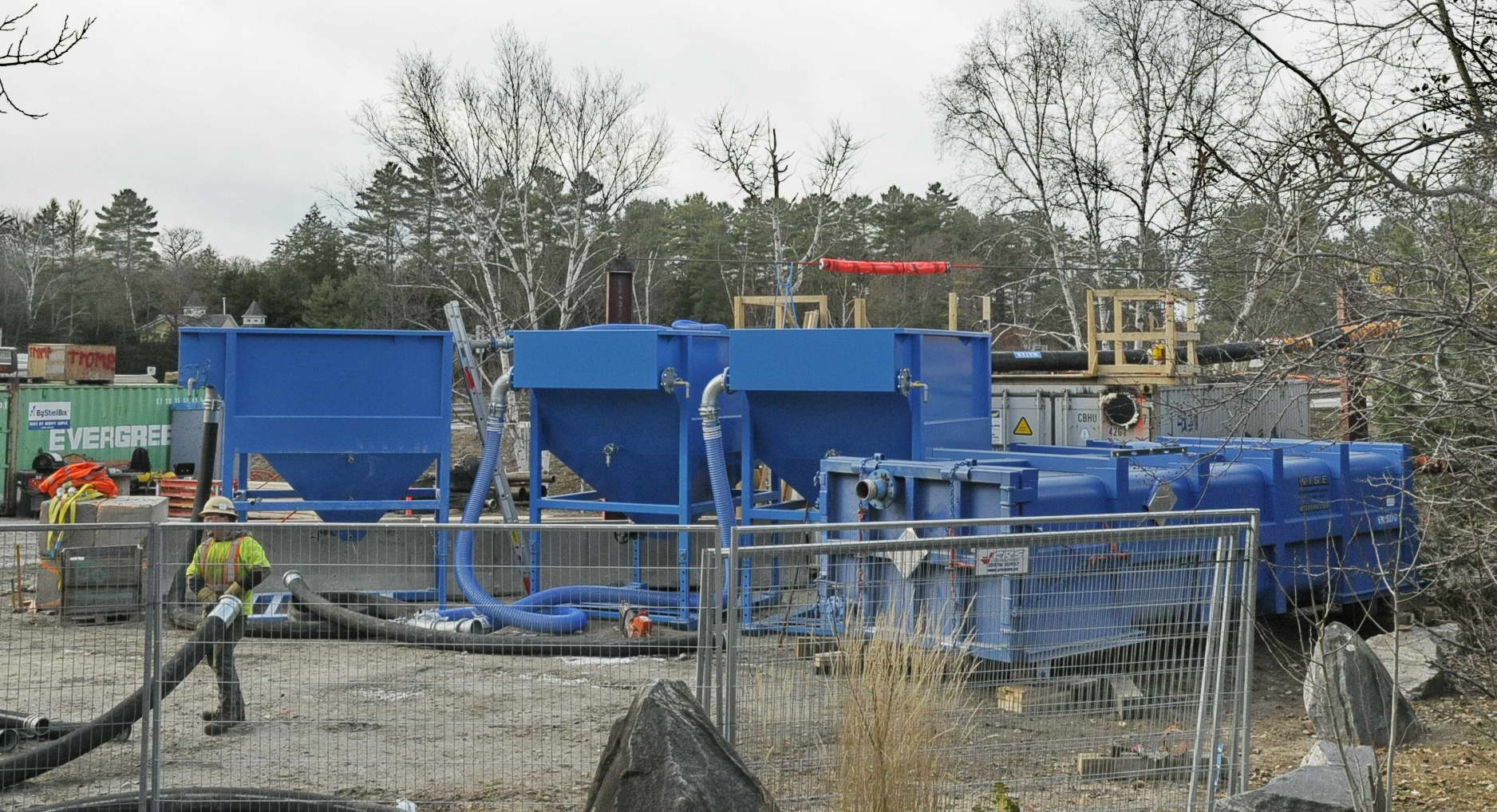
The proponent’s ECA specified that they are to use settling tanks, followed by a: “Proprietary Wastewater Treatment Plant”. Perhaps as a result of our publicizing that their proposed settling tanks were contaminated with insecticides, the proponent abandoned their settling tanks, and their entire water treatment system is as shown in the photograph below (click on it for a larger view). This is all at the north end of the Precambrian Shield parking lot, which is land actually owned by the Ministry of Natural Resources, but since 1970 the Township of Muskoka Lakes has a License of Occupation to use this land as a parking lot. In July 2016 the Township leased this land (along with the Township’s Portage Landing and south half of the Don’s Bakery parking lot) to the proponent to facilitate the proposed construction.

In the photograph above, the pipe bringing the pumped water from the proponent’s excavation is the black pipe at the upper right (on top of the proponent’s abandoned gray shipping container). This black pipe is then (behind the taller blue tanks) split into three hoses, each feeding into the back of one of these taller blue tanks. These taller tanks are lamella clarifiers, which have a series of angled plates to cause particulate matter (sand, silt …) to settle to the bottom of the tank.

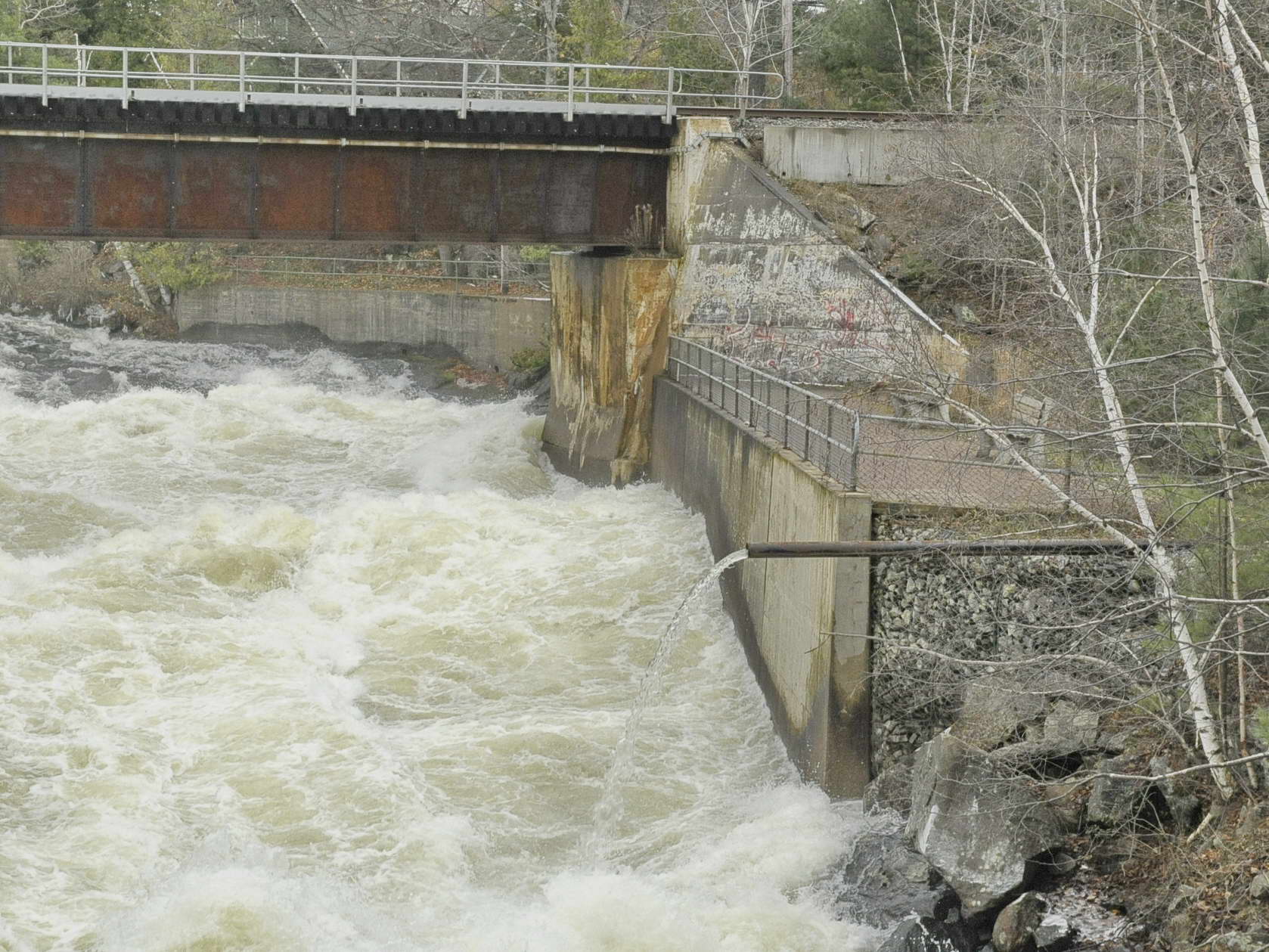
The output hoses (at the left of each of the taller tanks) are then combined into one pipe, which (after this photograph was taken) has been connected to the large blue rectangular tank on the right. This tank apparently has some filter material in it, and the water is discharged from the back of this blue tank, directly into the Bala south channel, through the pipe shown below.

That is how it is supposed to work, our next article shows that is actually happening.

Nov 122017
 

While we are pleased to see that four of the proponent’s six insecticide-treated shipping containers (as reported here) are no longer in Bala, the proponent is still taking unacceptable environmental risks, for example:

  1. Two of their six shipping containers are still in the Precambrian Shield parking lot, perhaps because the proponent pumped water into them, so this water may now be contaminated with insecticides and leaking into the Precambrian Shield parking lot.
    We request these remaining shipping containers to be properly disposed of.
     
  2. The proponent has still not properly tested whether their proposed excavation site is contaminated with polychlorinated biphenyls (PCBs), so their planned work could release this toxic chemical to the Moon River, causing irreparable environmental damage.
    We request an independent Qualified Person to plan and supervise the proper excavation of this Brownfield site, to ensure that harmful substances are not released to the environment.
     
  3. The proponent’s 2013 Environmental Site Assessment (ESA) found the levels of Zinc in the ground water to be 26.6, 12.6, and 1,040 μg/L (millionths of a gram of Zinc per litre of water) for each of the three exploratory boreholes they drilled. As the last value is above the limit allowed by the Ministry of the Environment and Climate Change (MOECC), the ESA suggested retesting. In response to our continued requests for this retesting, the MOECC recently reported that the proponent did retesting in October 2016, and they found that the levels of Zinc in all three boreholes are now “undetectable”, having spontaneously dropped to less than 5 μg/L.
    1. This is extremely unlikely. We have asked the MOECC Director, Central Region (whom we have met) to confirm she has personally seen these test results, but the MOECC refuses to provide this.
    2. As shown in the graphic in this article, the proponent’s testing was inadequate, so would more than likely have greater levels of contaminants, including PCBs.

    We request the laboratory test results be disclosed to the public.
     

  4. The proponent would pump water from their proposed excavations through a plastic pipe suspended above the Bala south channel. They joined the many sections of this plastic pipe on-site, and each of these this pipe sections joined required a multi-step procedure to be carefully followed, or there could be leaks. As anyone that does technical work knows, testing is crucial, yet the proponent has not done any pressure testing, which is the accepted method. Other unaddressed concerns are:
    1. This plastic pipe is suspended from a cable, so would flex due to wind. It is not known if this pipe could tolerate flexing in colder weather.
    2. While the pipe has some insulation, to prevent freezing in colder weather, the pipe would need to be drained, but this would dump untreated water onto the Township’s Portage Landing, which is not allowed.

    We request to see:

    1. Drawings sealed by a Professional Engineer licensed to practice in Ontario confirming the installed pipe is suitable for the flexing and temperatures that would be encountered.
    2. Witnessed pressure test results showing there are no leaks in the installed pipe.
    3. Plans confirming the water in the pipe would not be dumped onto Portage Landing when pumping is stopped.
       
  5. The proponent has not shown any concern for the environment, instead their priority is working quickly. The workers are on-site six and seven days a week, which means they are too likely to be taking short-cuts, such as creating this mess on November 8, 2017. While they claim this grout and oil are bio-degradable, their silt fence did not prevent it from getting out to the Moon River.
    The company providing environmental liability insurance to the proponent should be notified of the above.
Nov 112017
 

PCBs
The Bala #2 Generating Station was south of the Bala north falls from 1924 until it was demolished in 1972:

  • In 1972 polychlorinated biphenyls (PCBs) were still legal and were widely used in electrical equipment, such as the “step-up” electrical transformer which the Bala #2 Generating Station would have required.
  • It is not known what equipment was left buried at the site, but it would certainly have been less expensive and easier to leave the transformer at the bottom of the station and cover it over with dirt.
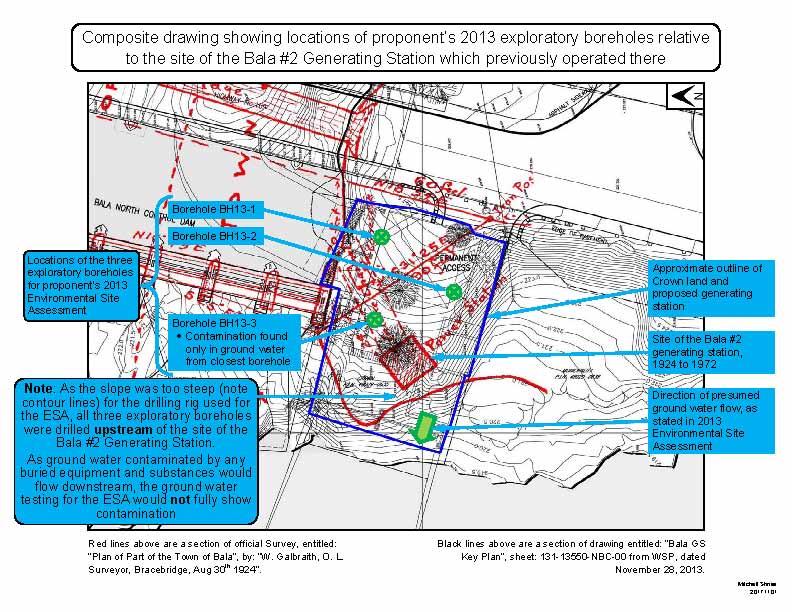
  • In 2013, the proponent did complete a Phase II Environmental Site Assessment (ESA), which should have identified the locations and concentrations of any contaminants. But as shown in the graphic below (click on it for a larger view), all three of their exploratory boreholes were upstream of the likely source of the contamination. Therefore, this ESA was inadequate and should not have been relied on by the MOECC during their assessment of the proponent’s application for Environmental Compliance Approval.

In fact, the proponent’s own ESA reports that PCBs are an expected concern for abandoned generating stations, yet the work for the ESA made no effort to locate the exact site of the Bala #2 Generating Station.

The proponent’s current pre-construction work could therefore release PCBs into the Moon River and contaminate the surrounding land. To protect those on the Moon River and downstream of it, the proposed construction site should therefore be immediately considered a waterfront brownfield site, and the MOECC should require that work be stopped until this issue is resolved. More detail is here.
 

Insecticides
The Ministry of the Environment and Climate Change requires that water from excavations be pumped through settling tanks so that sediments (being harmful to fish and their habitat) can settle out before this water is released to a water body such as the Moon River.

While the proponent’s approval states these settling tanks be “Aquatech Models or approved equivalent” (a typical Aquatech model is here), instead they plan on using these old rusty used overseas shipping containers, which are currently at the north end of the Precambrian Shield parking lot.

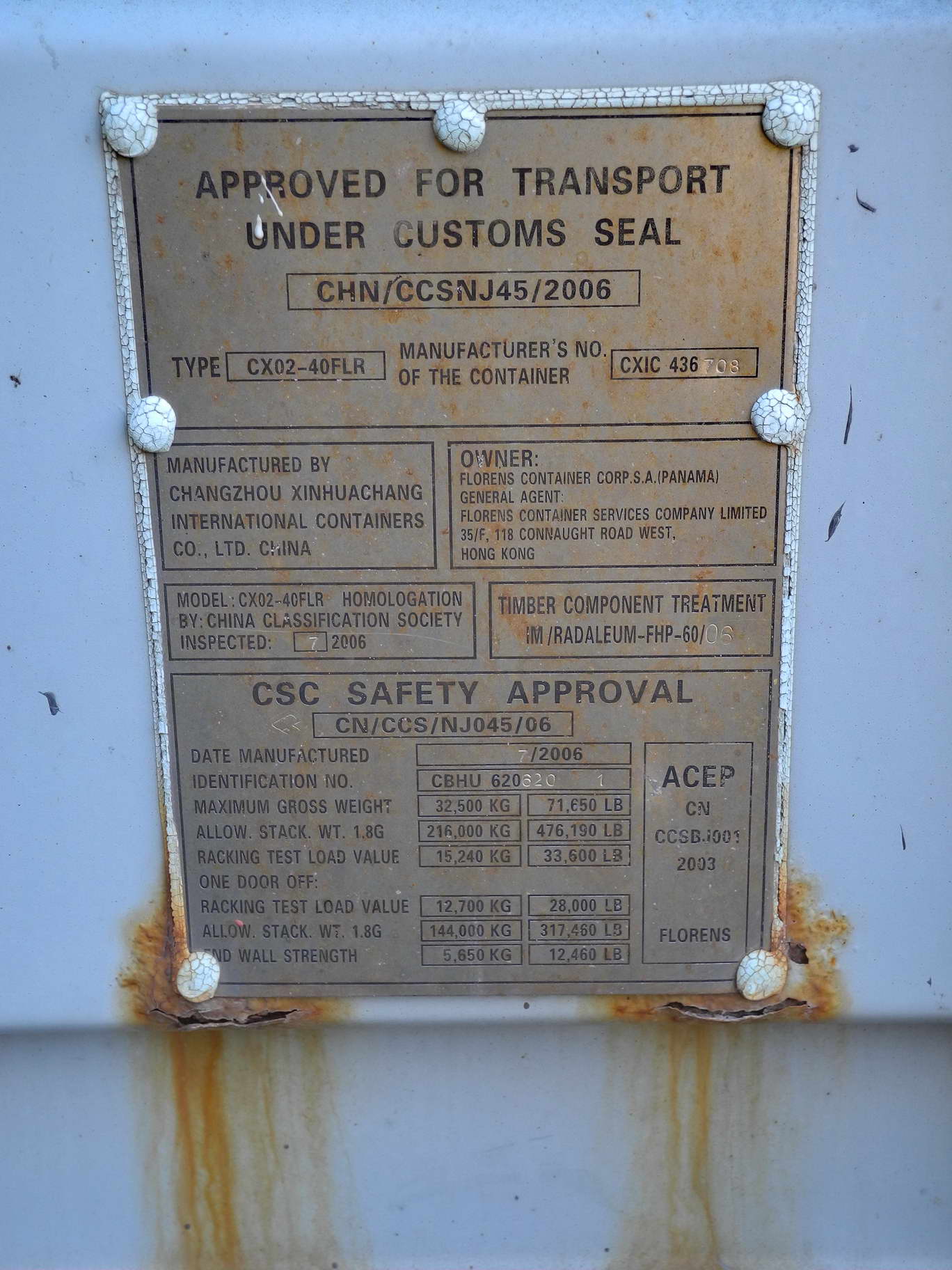
Shipping container manufacturers treat the wood floors of their shipping containers with insecticide to prevent live foreign insects from arriving in such overseas shipping containers.

The photograph below is of the metal data plate riveted to one of the shipping containers currently in the Precambrian Shield parking lot. It states that the wood floor was treated with the chemical Radaleum-FHP-60.

Other shipping containers show their floors were treated with Talileum 300. These are broad-spectrum insecticides known to be harmful to fish. More detail is here

So not only could the water pumped from the proposed construction site be contaminated with PCBs, oils, and greases, but this water would flush out insecticides from these used shipping containers and this doubly-contaminated water would be pumped directly into the Moon River.

Clearly, this is unacceptable. We have therefore:

  • Submitted a Review request to the Environmental Commissioner of Ontario, so the MOECC will investigate.
  • Submitted a request for a hearing by the Environmental Review Tribunal.
Nov 052017
 

The current status
Despite our many meetings with, and letters to, the Ministry of the Environment and Climate Change (MOECC), on October 20, 2017 they issued an Environmental Compliance Approval (ECA) to the proponent. This was the last provincial approval the proponent needs for their proposed construction.

However, this last provincial approval was based on incorrect and incomplete information from the proponent, with the result that there are unacceptable risks that the proponent's work will cause irreparable harm to the environment, as summarized below.

We have therefore:

  • Submitted a request to the Environmental Commissioner of Ontario that the issuing of this approval be Reviewed. Unfortunately this only results in the MOECC being asked to review its own decision, but it does provide greater exposure and high-level attention to the unacceptable situation that issuing this approval has created. A copy of our request is here.
     
  • Also submitted a request for a hearing by the Environmental Review Tribunal.
     

Pumping PCBs into the Moon River
The Bala #2 Generating Station was south of the Bala north falls from 1924 until it was demolished in 1972:

  • While polychlorinated biphenyls (PCBs) have long been known to be toxic, in 1972 they were still legal and widely used in electrical equipment – such as what could have been left buried when the Bala #2 Generating Station was demolished.
     
  • In 2013, the proponent did complete a Phase II Environmental Site Assessment (ESA), which should have identified the locations and concentrations of any underground contaminants. But the work for this ESA only investigated upstream of the likely source of contamination. Therefore, this ESA was inadequate and should not have been relied on by the MOECC during their assessment of the proponent's ECA application.

In fact, the proponent's own ESA reports that PCBs are an expected concern for abandoned generating stations, yet the work for the ESA made no effort to even locate the exact site of the Bala #2 Generating Station.

The proponent's current pre-construction work could therefore release PCBs into the Moon River and contaminate the surrounding land. To protect those on the Moon River and downstream of it, the proponent's ECA should be revoked. More detail is here.
 

Pumping insecticides into the Moon River
The Ministry of the Environment and Climate Change requires that water from excavations be pumped through settling tanks so that sediments (being harmful to fish and their habitat) can settle out before this water is released to a water body such as the Moon River.

Rather than using "real" settling tanks, the proponent is trying to save money by instead buying used overseas shipping containers – six of these are currently at the north end of the Precambrian Shield parking lot.

  • The serious environmental problem is that shipping container manufacturers treat the wood floors of their shipping containers with insecticide to prevent live foreign insects from arriving with the shipment. The active ingredient in the insecticides used is Cypermethrin, which is known to be harmful to fish.
    The proponent's current work would result in these insecticides being flushed out of the shipping containers and directly into the Moon River.
     
  • Another major problem is that the shipping containers would leak contaminated water into the Precambrian Shield parking lot and onto land owned by the District Municipality of Muskoka.

We have therefore requested that the proponent not be allowed to use these shipping containers, which should be immediately removed from the Precambrian Shield parking lot. More detail is here.
 

SaveTheBalaFalls.com radio interview
As a result of seeing the destruction of Bala during this year's Cranberry Festival, Toronto radio station AM640 host Kelly Cutrara inrterviewed SaveTheBalaFalls.com on October 16, 2017. You can listen to the interview here.