Jan 272018
 

Anyone can come to Bala and park for free, and sit in the park and have a picnic lunch for free – there are even three sets of public washrooms available for free.

You can climb on the rocks and wade in the water for free, as these people below are at the base of the Bala north falls. This is what creates world-class, unique, and classic Canadian memories.
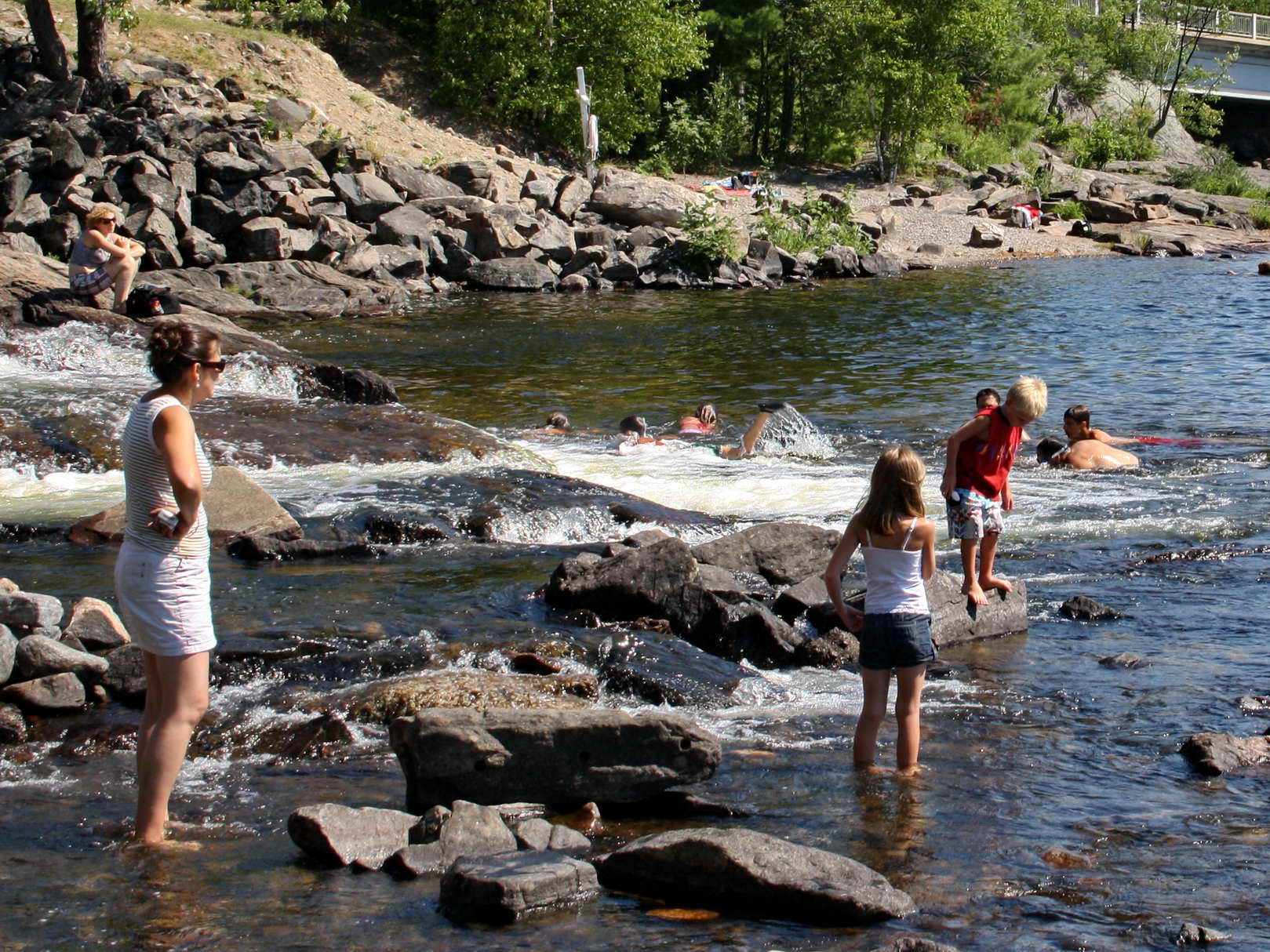
You can go fishing for free. And if you don’t have a fishing license, you can get that at the nearby bait shop, where you can also rent a canoe or kayak. And there are restaurants, stores, and shops – tourism is an important part of Bala’s economy.

But all this would be ruined by the proposed hydro-electric generating station at the Bala falls. The bait shop’s docks would be too dangerous to use. The fast water from Lake Muskoka would be brought hundreds of feet closer to the above popular in-water recreational area, making it too dangerous to use. The accessible and public shoreline seen here would either be used, or be made too dangerous to use, by the proposed generating station. 94% of the water from both falls would be diverted into the proposed generating station, drying-up both falls – tourists won’t come to see the dry rocks where the falls used to be.

The proponent said they would not impact the existing in-water recreation, but they lied.

The proponent said their generating station would not be higher than the level of the road, but they lied, as it would actually tower three storeys above the road and six storeys above the Moon River.

Instead of Bala being for everyone, the proposed project would make Bala for no one.
Jan 142018
 

Proponent is now risking flooding Lake Muskoka
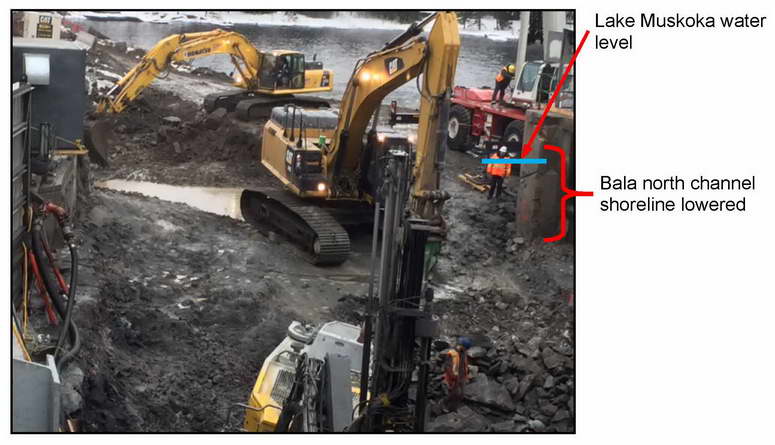
The proponent’s current construction activities include their upstream cofferdam obstructing the flow of water from Lake Muskoka through the Bala north channel. To ensure this would not result in flooding Lake Muskoka, the proponent’s approval from the Ministry of Natural Resources and Forestry requires that the upstream cofferdam can be removed on 24 hours notice.

The proponent has apparently decided to renege on this commitment and to not comply with this Condition of their approval, as they have excavated beside the Bala north channel when they had said they would not at this early stage of work. Therefore, the proponent could not now remove their upstream cofferdam, and this risks flooding the thousands of private properties on Lake Muskoka if there was a rain storm or temperatures high enough to melt the ice and snow upstream in the next few weeks.

More detail is in our article entitled: Proponent’s big lie #8: their non-compliance risks flooding Lake Muskoka, which you can read here.
 

Bureaucrats misleading politicians
In our democratic society, our elected provincial politicians are supposed to make decisions representing our concerns.

A problem is that while we can write letters to and e-mail our elected politicians all we want, our elected politicians usually do not see or reply to these communications: instead government bureaucrats do all the communications work for the elected politicians.

Government bureaucrats also convey our concerns to the elected politicians, and this is the problem: the bureaucrats are not disclosing to the politicians that:

  • The proponent would deceive the public as treacherously turbulent water would extend outside of their safety boom.
  • The public could not be adequately warned of the dangers.
  • While it would be unprecedented to build such a dangerous industrial facility as close to docks and in-water recreation, the proponent has not been able to show how, or if, they could operate safely.

While we have detailed our concerns to the government in hundreds of letters, the bureaucrats have summarized all this to elected politicians with the vague seven-word statement that the public’s concerns are that: “the project is in an unsafe location”.

More detail is in our article entitled: Our politicians are failing us because the bureaucrats are misleading them, which you can read here.
 

Murdered in 45 seconds
SaveTheBalaFalls.com realizes that we must be credible, factual, and professional in the hope that our concerns will be accepted by government decision-makers. We realize that some may initially think that the title of our next article is exaggerated, but we believe that after reading the article most will agree the title is well-justified. We look forward to reading your comments, which can be submitted below the article.

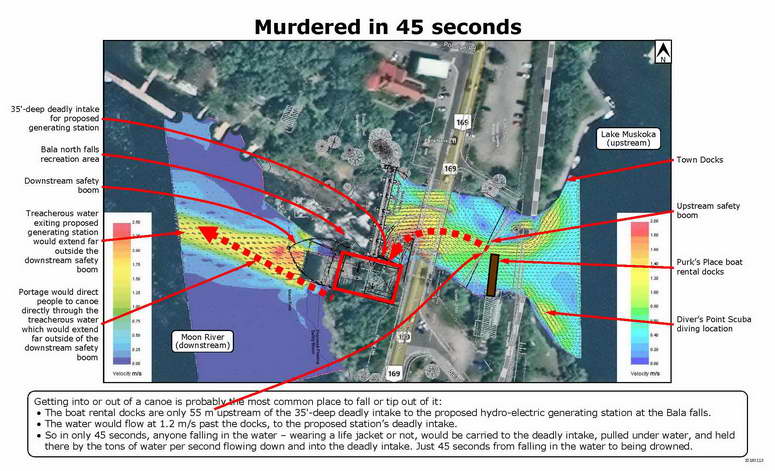
We chose that title as the fact is, if someone tipping out of a canoe at Purk’s Place docks ends up inside the upstream safety boom, within 45 seconds the current would quickly carry them downstream to the proposed hydro-electric generating station’s intake, where they would be pulled under water, and – whether wearing a life jacket or not – would be held under water by the hundred tons per second of water rushing past them, and they would drown.

More detail is in our article entitled: Murdered in 45 seconds, which you can read here. As for all our articles, you can submit comments below the article (the comments are shown after we review them to ensure they aren’t spam).

Jan 132018
 

One of the drivers of Bala’s economy is that visitors to Bala can rent canoes and kayaks at Purk’s Place.

The most likely time for anyone to fall or tip out of a canoe or kayak is at the docks when when they are getting into or out of it. In Bala, this would be right at the upstream safety boom and the intake for the proposed hydro-electric generating station would be just 55 m downstream.

The proponent’s own flow simulation shows that the water would be flowing at about 1.2 m/s from the docks to their proposed intake. And every second, tons of water would be flowing into their 35′-deep intake.

At 1.2 m/s it would take only 45 seconds for someone falling in the water at the upstream safety boom to be carried by the current to the proposed intake. And with tons of water being drawn down and in to the proposed intake every second, anyone – regardless of swimming ability or whether they’re wearing a life jacket or not – would be held underwater against the intake trash rack, and they would drown. There would not be an Operator in the proposed generating station, and it would not have an “emergency stop” button on the outside either.

Just 45 seconds from falling in the water to being drowned. That would not be an accident, that would be the Ministry of the Environment and Climate Change not realizing that their mandate of protecting the environment includes protecting human life (click on the graphic below for a larger view).

Transport Canada and the MNRF have a “Point of No Return” calculation for how far upstream from a hazard the upstream safety boom should be. Based on this calculation, in early 2011 the MNRF’s Public Safety Measures Plan for the Bala recommended that the upstream safety boom in the Bala north channel be relocated farther upstream, which Transport Canada approved in late 2011 and which was subsequently done.

As detailed here, the Point of No Return calculation shows that the construction of the proposed generating station requires that the upstream safety boom be relocated still farther upstream.

However, even though the Point of No Return calculation in the Public Safety Measures Plan for the Bala dams does not take into account the increased dangers due to the construction of the proposed hydro-electric generating station at the Bala falls, both Transport Canada and the MNRF have stated the upstream safety would not need to be relocated farther upstream. So they are both complicit in there not being enough time for someone somehow being downstream of the upstream safety boom to rescue themselves. So “Murdered in 45 seconds” is their decision.

You might think the upstream safety boom would be helpful to a canoe or kayak, to keep it from entering the danger area. What actually happens is due to the current, your canoe/kayak ends up parallel along the safety boom and tips slightly sideways as the downstream side rides up onto the safety boom due to the current. You can’t paddle on the downstream side because the 16″-diameter safety boom is there and that side is high. And if you paddle on the upstream side you just turn yourself into the safety boom and don’t go anywhere. As you realize how precarious your situation is, what would happen if you tip – and all you can see the the danger downstream as you’re above the safety boom – panic is likely.

You might think, anyone falling in the water should just hang on to the safety boom. There are many problems:

  • The safety boom is designed for high visibility and to prevent large boats from travelling over them. It is not designed for people to hang on to them.
  • For example, the safety boom is required to extend at least 12″ above the water. As a result, the floats are at least 16″ in diameter, so holding on to one would be like hugging a sideways barrel way above you while having to keep your face above water. And the safety boom is made of slippery plastic and there’s nothing to hold on to. Children’s and many adult’s arms would not be long enough to wrap around the safety boom if they could even get close enough, as they’d be fighting the current.
  • The safety boom is so high, that combined with the current, it would cause a canoe or kayak to capsize. This was the cause of the drowning of 19-year-old Victoria Cunningham at the Isle-Maligne hydro-electric generating station near Alma, Quebec in 2008. The canoe she was in was capsized by the upstream safety boom and the current, and she was unable to hang on to the safety boom.
  • The safety boom is supposed to be a last line of defence, warning signs are supposed to be upstream of a safety boom, but due to land ownership restrictions in Bala, adequate warning signage could not be installed.

So far we know that the:

  • Treacherously turbulent water would extend far outside of the downstream safety boom, deceiving people into thinking the water there would be safe: when it actually would be deadly.
  • Proponent refuses to disclose how, or if, they could operate their proposed generating station safely, even though it would be unprecedented to build a hydro-electric generating station as close to docks and in-water recreation.
  • Proponent has stated they would not warn the public before starting operation (even though the MNRF requires them to provide such warning), and such warning would be unreliable anyways as the frequent trains passing by would mask the sound.
  • Currently, there is almost no flow in the Bala north channel during the summer, so falling out of a canoe there (or holding the Bala regatta just upstream of it, or Scuba diving off Diver’s Point) is safe. As the proposed generating station would change all this, so most flow would be through the Bala north channel, the proponent has not figured out how, or if, their proposed project could be operated safely.
  • Proponent would build a portage right beside their proposed generating station, encouraging people to canoe through the treacherously turbulent water which would extend outside of the downstream safety boom.

It is as if the government is saying to the proponent: “If you want to be stupid enough to build it, we’ll be stupid enough to approve it”.

Jan 132018
 

In our democracy, the people’s interest is supposed to be represented by our elected politicians. But it appears this has not happened for the proposed Bala project due to scheming by unelected government bureaucrats.

The provincial politicians we elect rely on full-time government employees, called bureaucrats, to summarize and present complicated and technical issues.

While the politicians we elect have the responsibility and authority to make most decisions, the politicians don’t have the time to make all the decisions, so they delegate the authority to make particular decisions to particular bureaucratic positions. Other decisions are made by politicians, but based reports from the bureaucratic staff, and possibly other input as well such as from the public.

While we can send all the letters and e-mails we’d like to our elected politicians, but the fact is the politicians don’t see most of our attempts at communicating. Instead the bureaucrats read and reply to almost all our letters and e-mails, and the politicians are shielded from all direct knowledge of what is happening.

This can be very efficient, but it can also enable bureaucrats to completely take control of a situation, as has apparently happened for the proposed project to build a hydro-electric generating station at the Bala falls. It is almost impossible to directly meet an elected Minister, all of our requests have been ignored or denied.

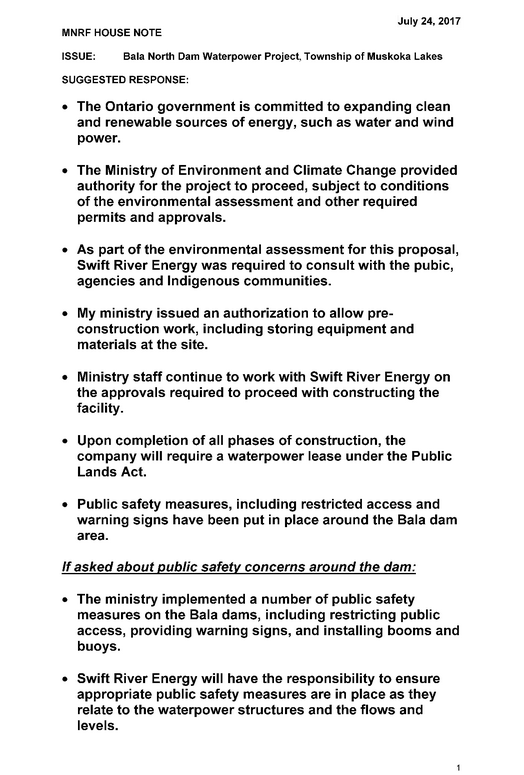
One of the main ways for politicians, and their political staff, to learn about particular issues, campaigns, or problems is through the House Note. These are documents written by provincial government bureaucrats, and are updated every few weeks or months as developments occur. House Notes provide carefully-worded answers to expected questions, background, status, issues, and expected next steps.

The two main Ministries involved with the proposed Bala project are the Ministry of Natural Resources and Forestry (MNRF) and the Ministry of the Environment and Climate Change (MOECC). An MNRF House Note is below (click on it to read the full document).

Of particular interest is page 4 where the Minister and other political staff are being informed by the bureaucrats about the “Opposition to the Project”, which is: “Save the Bala Falls (STBF) is a local group lobbying to prevent the construction of the hydroelectric generating station, mainly on the grounds that: … the project is in an unsafe location”.

This is very telling. All of our facts and analysis showing that people would drown, that the proponent has not shown how, or if they could operate the proposed project safely, that the visiting public could not be adequately warned of the extreme dangers the proposed project would create, and that it would be unprecedented to build such a dangerous industrial facility as close to docks and in-water recreation, are summarized to the politicians by the vague statement that: “the project is in an unsafe location”.

This vague statement would not convey to a busy politician what the bureaucrats are hiding from them. And this seems to be a major reason why the public interest is not being considered.

Jan 122018
 

As we have been noting for years (some articles here and here), the proponent’s obstruction of the Bala north channel during their proposed construction risks flooding Lake Muskoka, as flow through the Bala north channel is often required even outside of the March to May spring freshet. This flooding would be due to a rain storm and/or melting snow in the watershed upstream of Bala.

The Ministry of Natural Resources and Forestry has therefore required that the proponent’s upstream cofferdam can be removed on 24 hours notice. This requires that not only could the cofferdam be removed, but also that the water would then flow through the Bala north dam without the flow bypassing the north dam or damaging the Bala north dam (as the proponent would be making structural changes to it).

The proponent has variously stated they would prevent flow bypassing the Bala north dam by using an intermediate cofferdam, or by piling sand bags there, or by not excavating the land downstream. They have also committed they would not obstruct flow through the Bala north channel.

As shown by the photograph below (taken January 11, 2018, click on it for a larger view) we now see the proponent is not honouring these commitments and could not remove their upstream cofferdam, as the resulting flow would bypass the Bala north dam which would cause environmental damage.

On these issues, we have also previously sent this letter and this letter to the proponent, they have not responded to these.

The proponent’s decision to not comply with the MNRF’s approval risks flooding Lake Muskoka. We look to the MNRF to protect the public’s interests by enforcing the conditions of the approval granted to the proponent. We have therefore sent this letter to the Ministry of Natural Resources and Forestry.