Aug 082016
 

Summary

The proponent’s plans apparently include a look-out platform from which the public could view down the Moon River. However the drawings which the proponent has provided of their current plans show that this view would be peering:

  • Below a 56′-wide steel “I-beam”, supporting hoist equipment.
  • Between 26′-tall steel support columns holding up this beam.
  • Above two 26′-wide steel tailrace gates.
  • Through four steel chains holding up these gates.
  • At various limit switches and electrical conduits for this hoisting equipment.

This ugly industrial structure would be in the most picturesque location beside the Bala north falls. Yet the proponent stated their design: “reflects the aesthetic concerns and values, local sensitivities and historic nature of this site”. We’ve been noting this concern for years (for example, articles here and here), but the proponent continues to anger and work against the community with such disregard for the area.

Detail

The proponent’s original “Option 1” plan was to build their proposed hydro-electric generating station solely on the MNR’s land directly south of the Bala north falls, which is exactly the same land they would use for their current “Alternative 1A” proposal.

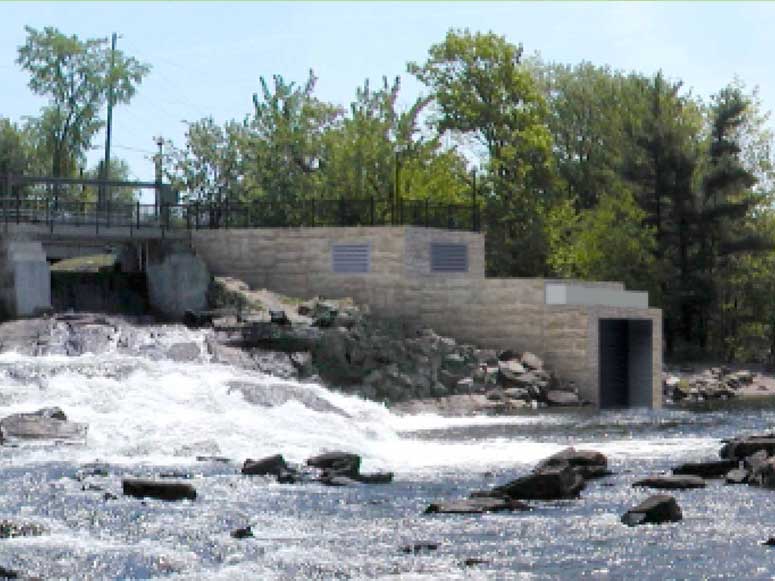
They have always claimed their building would be attractive and would have a public look-out, but looking at their technical drawings shows otherwise. For example, for their Public Information Centre during the summer of 2007 they provided the graphic below (you can click on all images below for a larger view). Note they show:

  • The roof of their building would be the same height as the deck of the Bala north dam, and a few feet below Muskoka Road 169.
  • The public’s view down the Moon River would be unobstructed.
In the proponent’s 2009 Environmental Screening/Review report, they provided the rendering below.
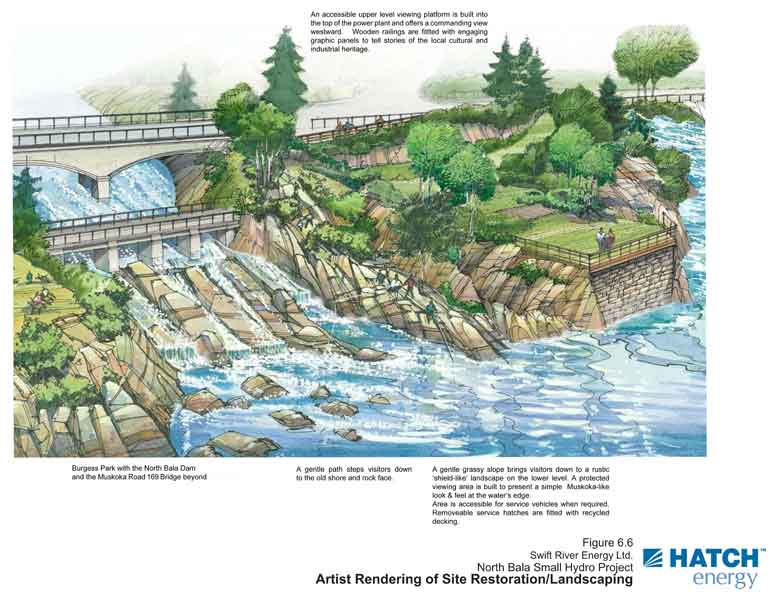
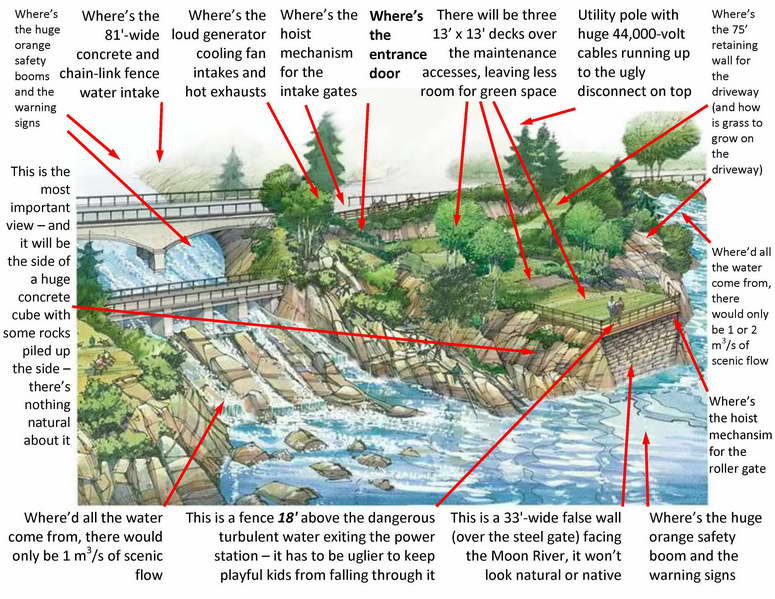
This rendering was so absurdly incorrect and incomplete that it was wilful deception by the proponent of the public. In late 2009 we publicized our marked-up version below to highlight some of our concerns.
In their 2009 Environmental Screening/Review report, the proponent also provided the drawing below. It shows one of the problems, which is that a hydro-electric generating station has equipment below water level and to service this requires “dewatering”, which means theymust have huge steel water-tight gates that can be lowered over the water intake and exit tailrace. These would be like massive garage doors; for the proposed Bala station, there would be two gates, each approximately 21′-high and 26′-wide. Together these gates would be six times as wide, and three times as high as a standard single residential garage door. During operation these gates would need to be hoisted above the proposed station’s intake and exit tailrace, and large motors and mechanisms are needed for this.
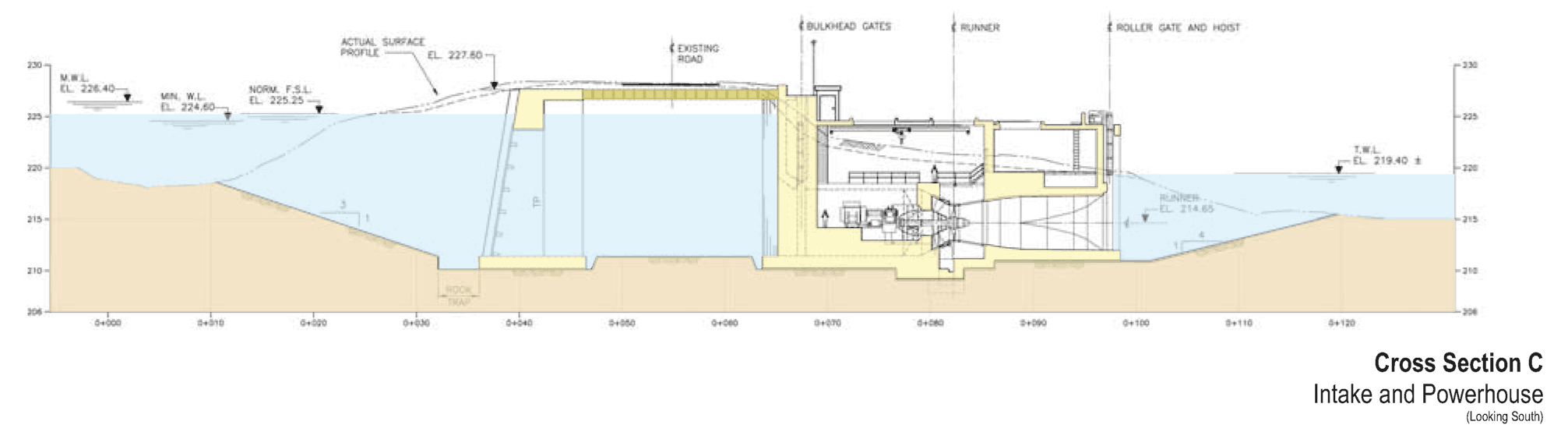
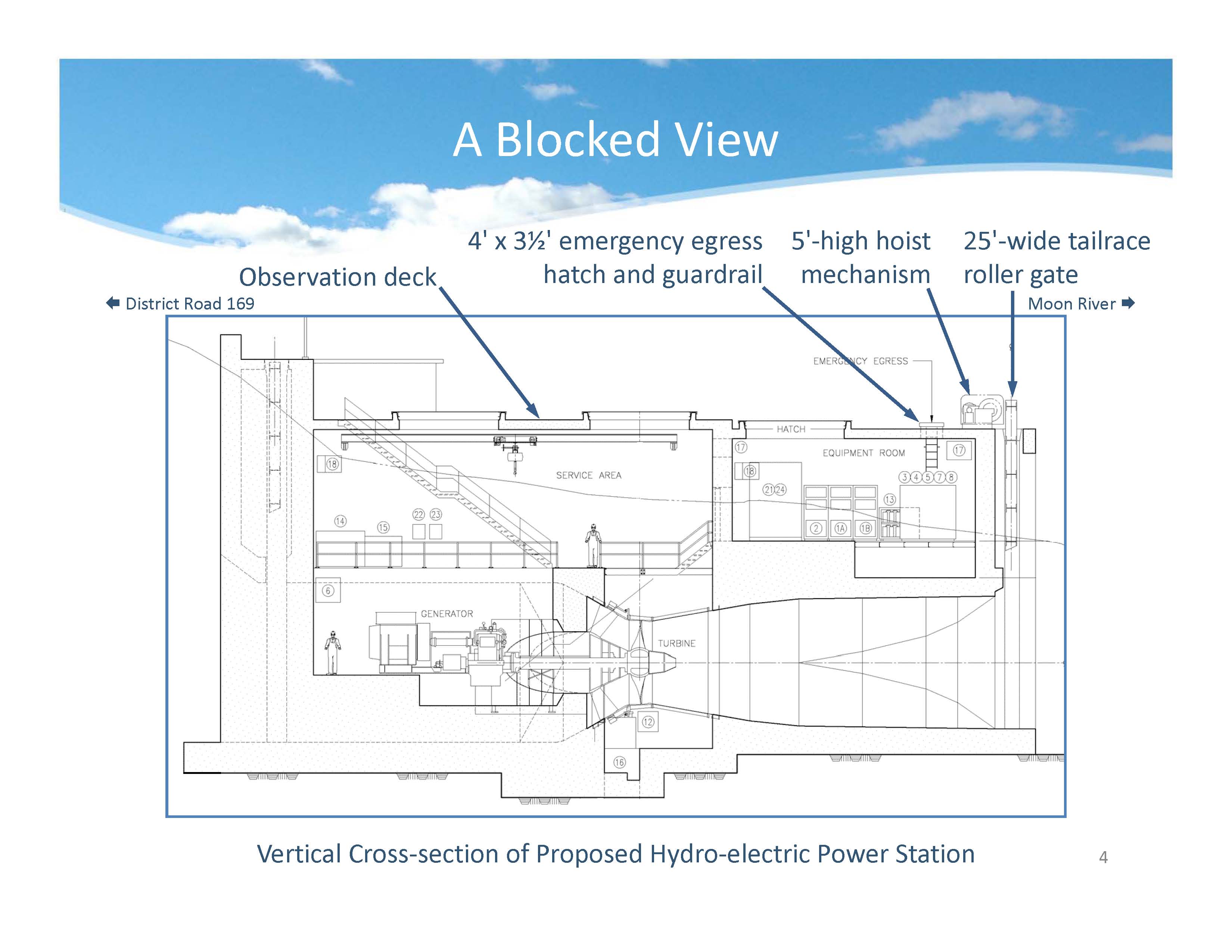
As shown in the drawing above, and more easily seen in a later version of the proponent’s drawing which we marked-up for a 2011 presentation to the Township of Muskoka Lakes Council, this hoist mechanism would be 5′ high, preventing people from seeing down the Moon River from the proposed generating station’s public look-out.
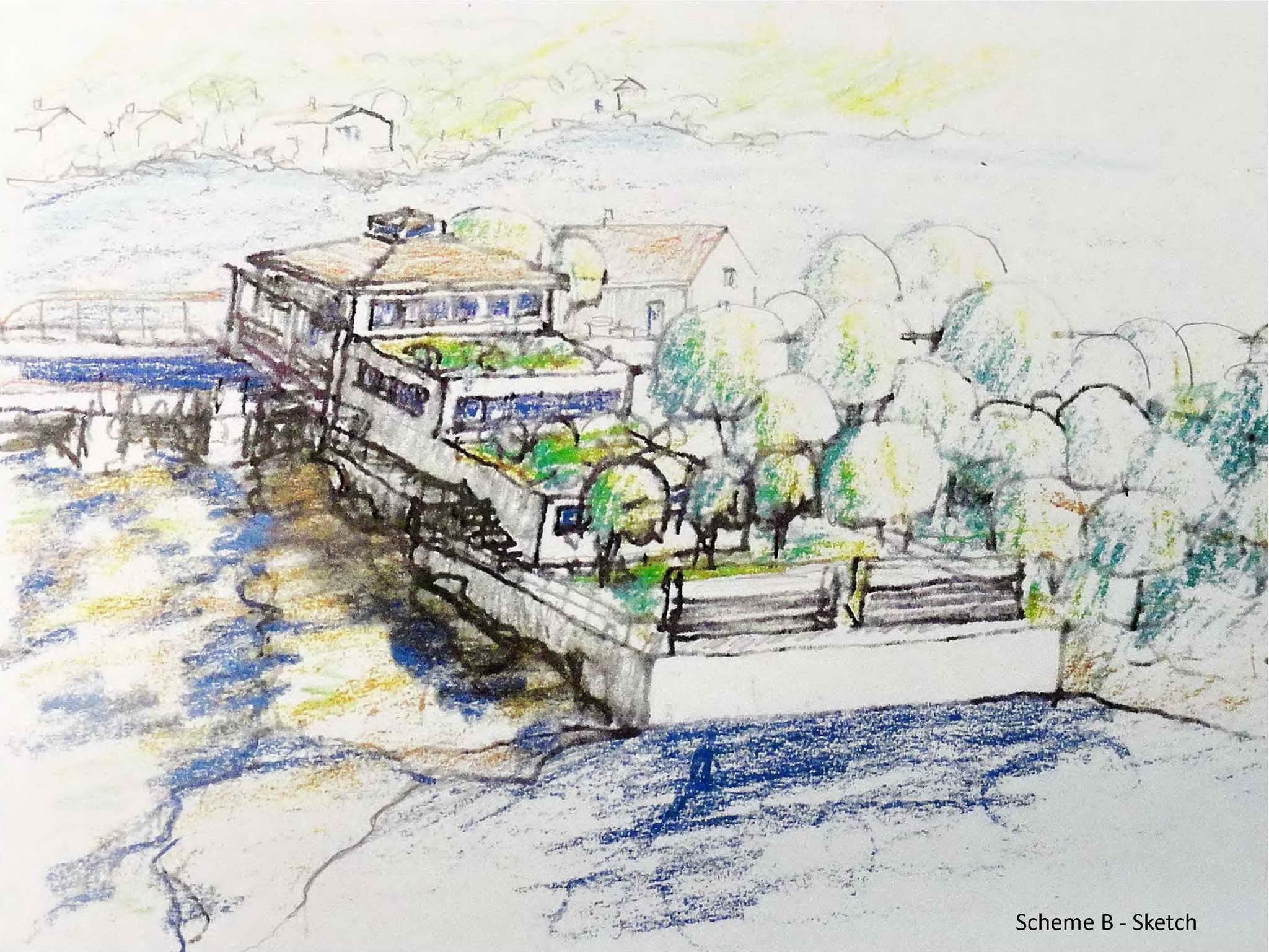
In a December 16, 2014 presentation to the Council of the Township of Muskoka Lakes the proponent’s architect provided the rendering below which (in addition to trees growing out of concrete) shows these huge steel tailrace gates as somehow transparent.

Over the years, other drawings from the proponent have shown the need for these gates and hoists, never figuring out how to keep them from obstructing the view from their proposed public look-out. For example this from a February 2011 presentation, and this rendering from their 2012 Addendum showing a rendering of their current Alternative 1A proposal.
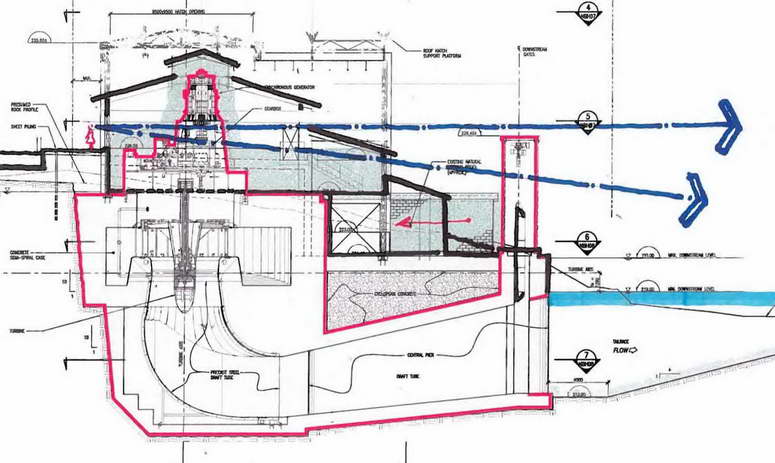
Also in the December 16, 2014 presentation, the proponent’s architect included a marked-up a vertical cross-section of the proposed generating station, this time showing that a person on Muskoka Road 169 (pink, wearing a dress) could somehow see through the proposed generating station (the dark blue lines) to see down the Moon River (as if the building was all glass and had no equipment in it).
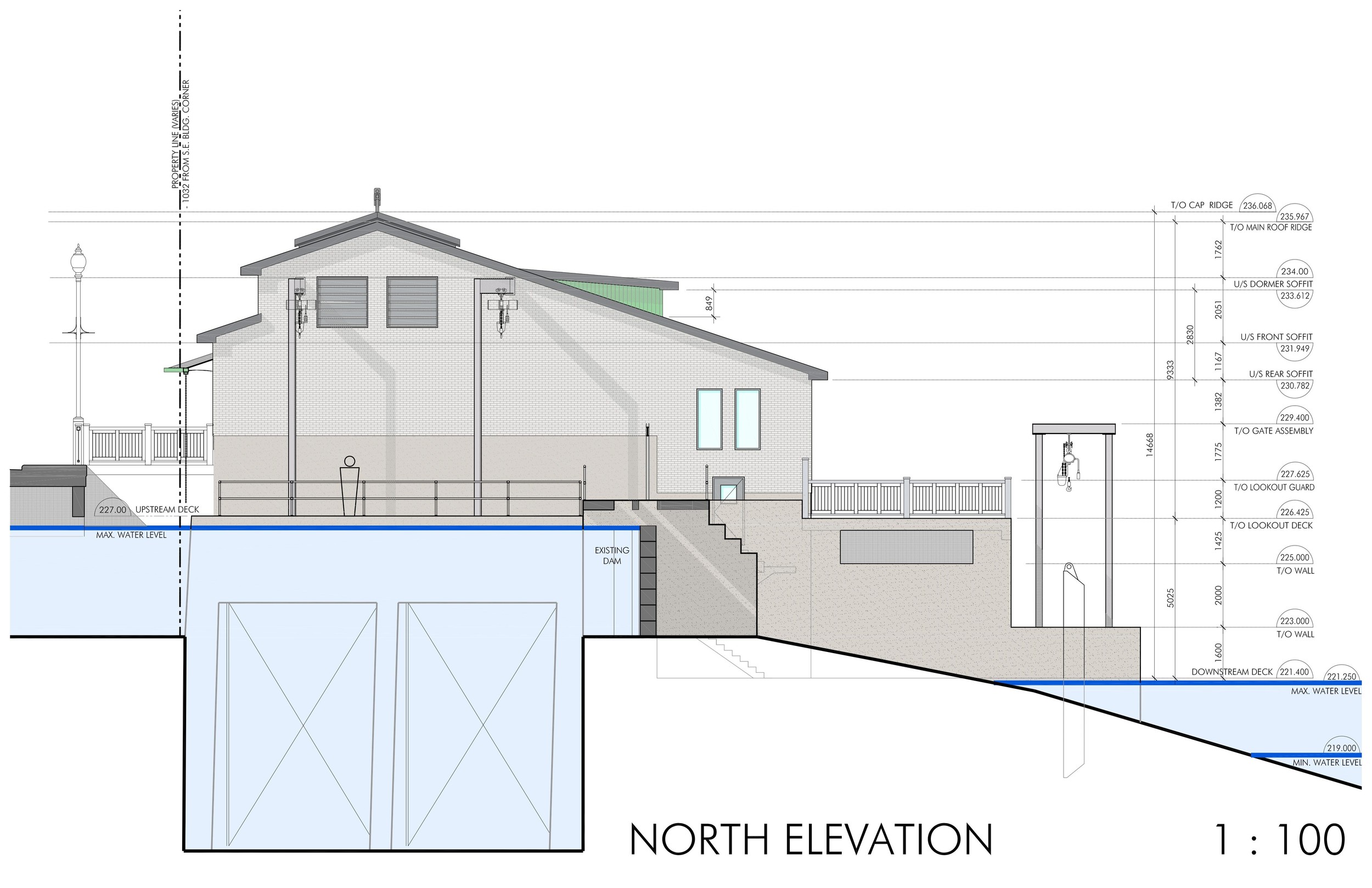
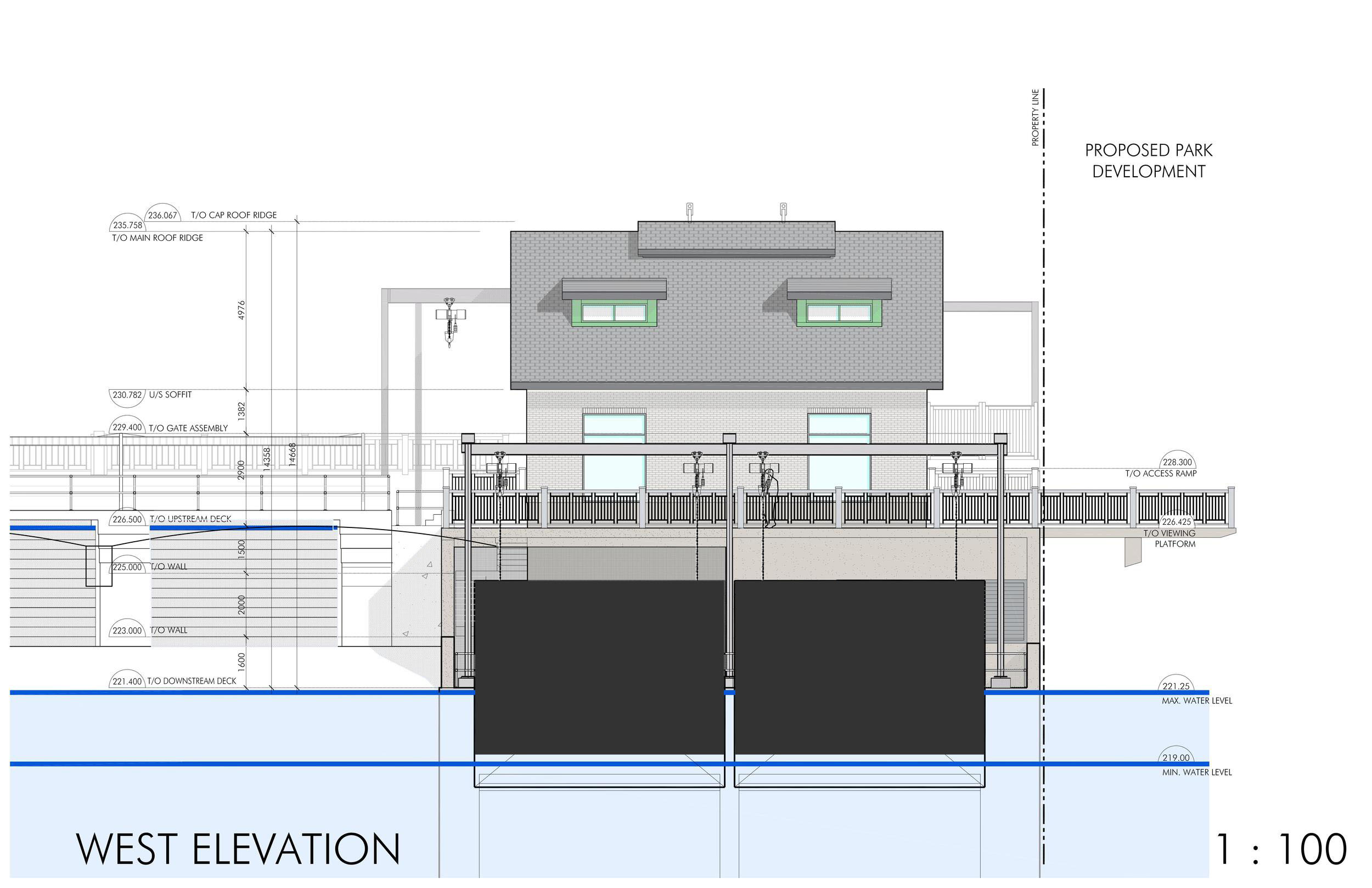
In November 2015 the proponent posted some drawings on their web site which we understand were still current in August 2016 when this article was posted. Their North Elevation drawing below would apparently show the view from Margaret Burgess Park, so Muskoka Road 169 would be on the left, and the Moon River to the right. The thing that looks like a gallows on the right is the end-view of the huge steel structure needed to hoist the tailrace gates. While the hoist would not be the type shown in this drawing, there would certainly be some powerful mechanism needed, and it would need to actually be connected to the gates, which are shown as somehow floating below.
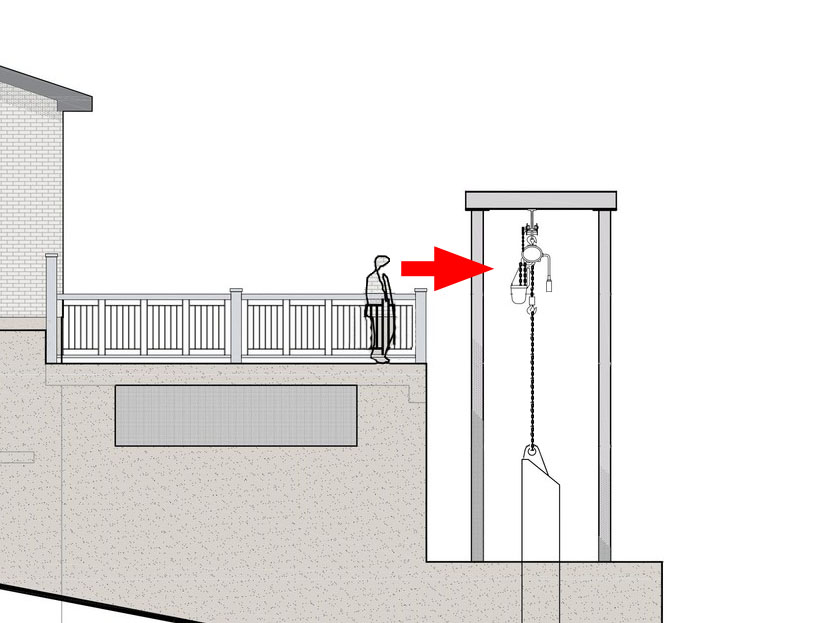
Below is a section of the proponent’s above diagram, showing many problems, for example:

  • The vertical supports would be about 30″ away from the proposed look-out platform, and being part of a hoist mechanism would be too close to the public.
  • The 8″-thick vertical columns, 1′-high horizontal beam, and hoist mechanism, cables, limit switches, electrical cables and conduit and everything else needed would be obstructing the view down the Moon River,  would be industrial and ugly.
The proponent’s drawing below shows the view of their proposed generating station from the Moon River, so the Bala north dam and Margaret Burgess Park would be on the left, and the Township’s Portage Landing would be on the right. During operation the two steel gates would be raised, so would be mostly out of the water.
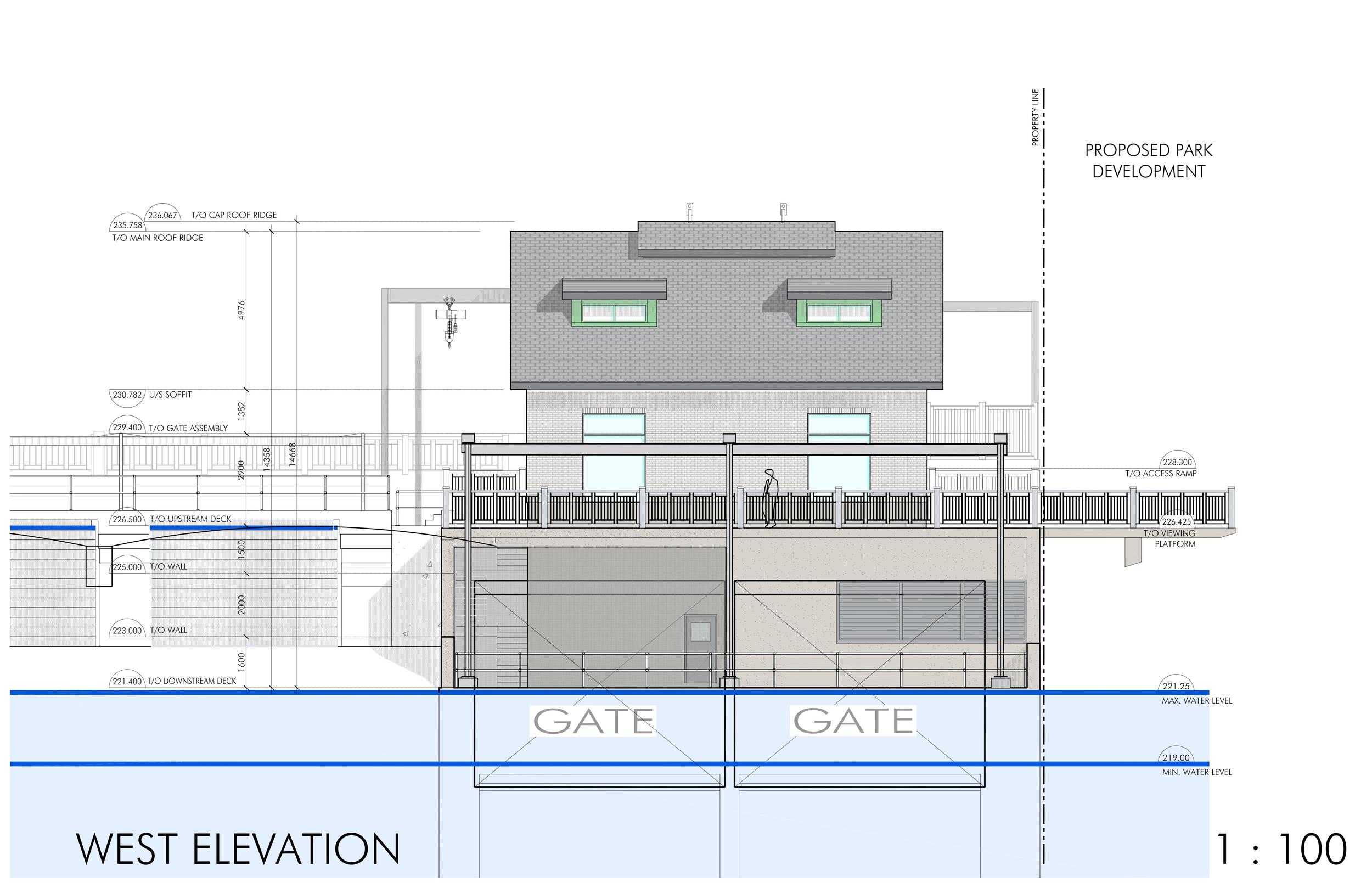
So here is a more complete view, showing the hoist mechanisms, huge steel structure to support them, and the tailrace gates (the normal Moon River summer water level is close to the lower blue line, which is the minimum typical water level).

While this is ugly enough, it would need to be worse. Power generating stations are classified as “Post-Disaster” buildings by the Ontario Building Code, and therefore have more requirements to withstand earthquakes than most other buildings. The steel structure shown would need cross-bracing or other means to prevent collapse from the lateral forces of an earthquake.
The summary is that either through wilful deceit or incompetence the proponent continues to misrepresent both the appearance of their proposed generating station, and the view the public would have from their proposed look-out.
Aug 062016
 

Summary

In responding to the concerns about public safety that the proposed hydro-electric generating station at the Bala falls would create, the proponent  and the Ministry of Natrual Resources and Forestry (MNR) both claim that people shouldn’t be in the water in the area. As shown below, this is incorrect and unjustified for the areas which would be made dangerous.

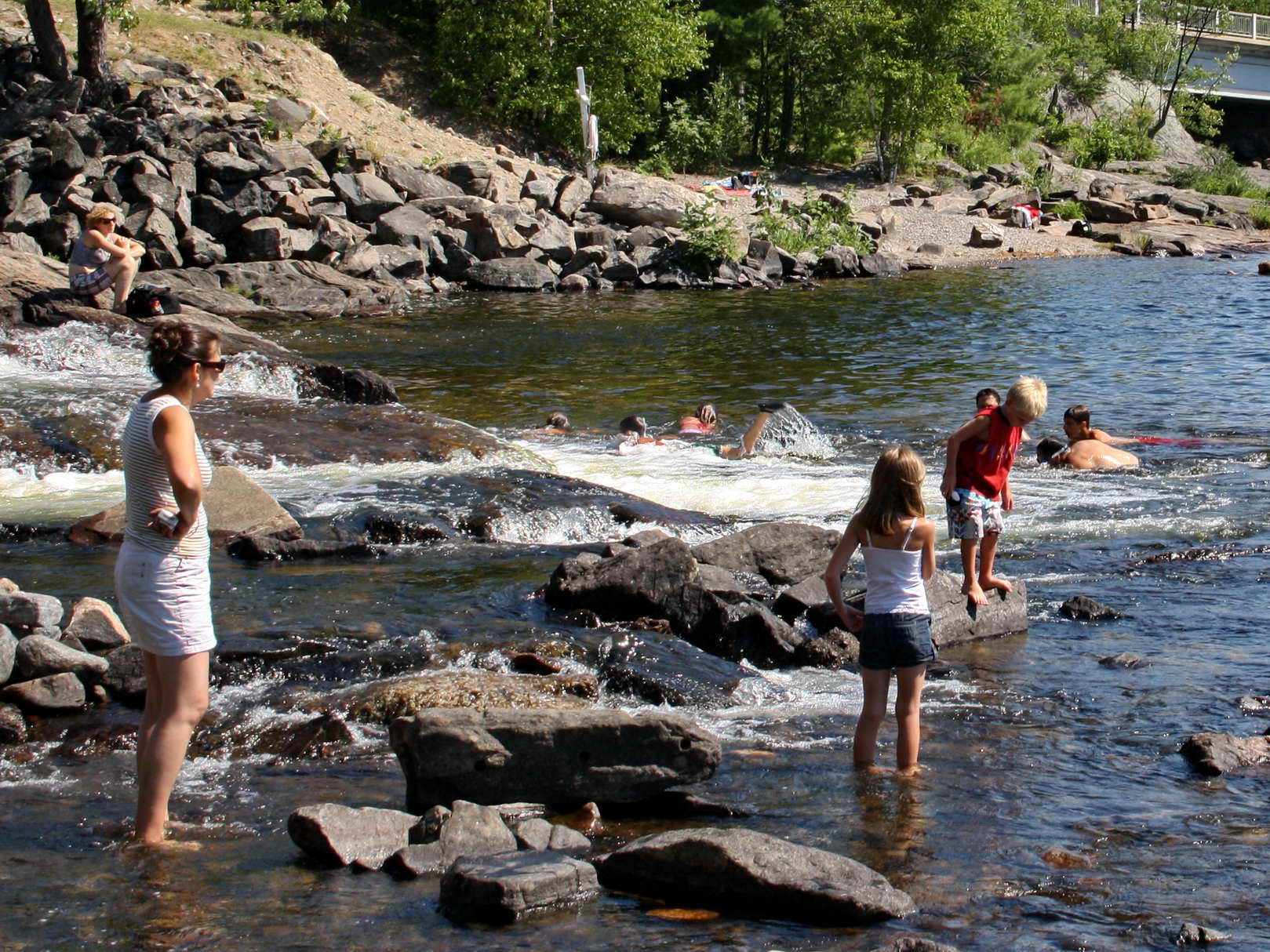
The fact is, the Moon River and this specific area of concern is a navigable waterway, so people have the right to be in the water. There is a warning sign on the Bala north dam, but as shown by the photographs below, extremely-popular in-water recreational activities are far from that warning sign, so we ask; how would unsuspecting visitors be informed exactly when and where the dangers are.

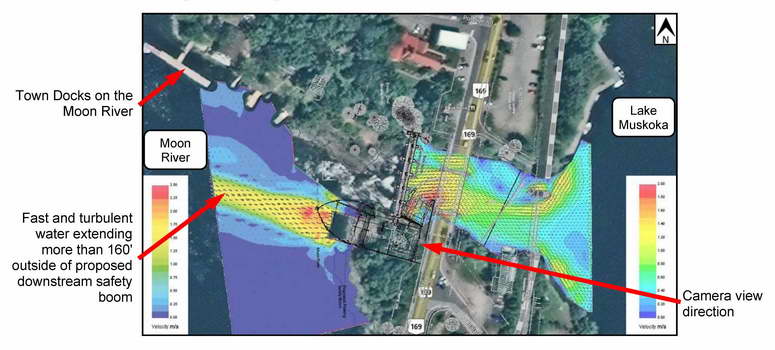
The proponent received environmental approval on the commitment that the water would only be dangerous within their proposed safety booms, but as shown in the image below (click on any image for a larger view), in-water recreation outside of the proposed safety booms would be unacceptably dangerous.

We request that before providing any further approvals, the MNRF require the proponent provide an acceptable Public Safety Plan.
 

Detail

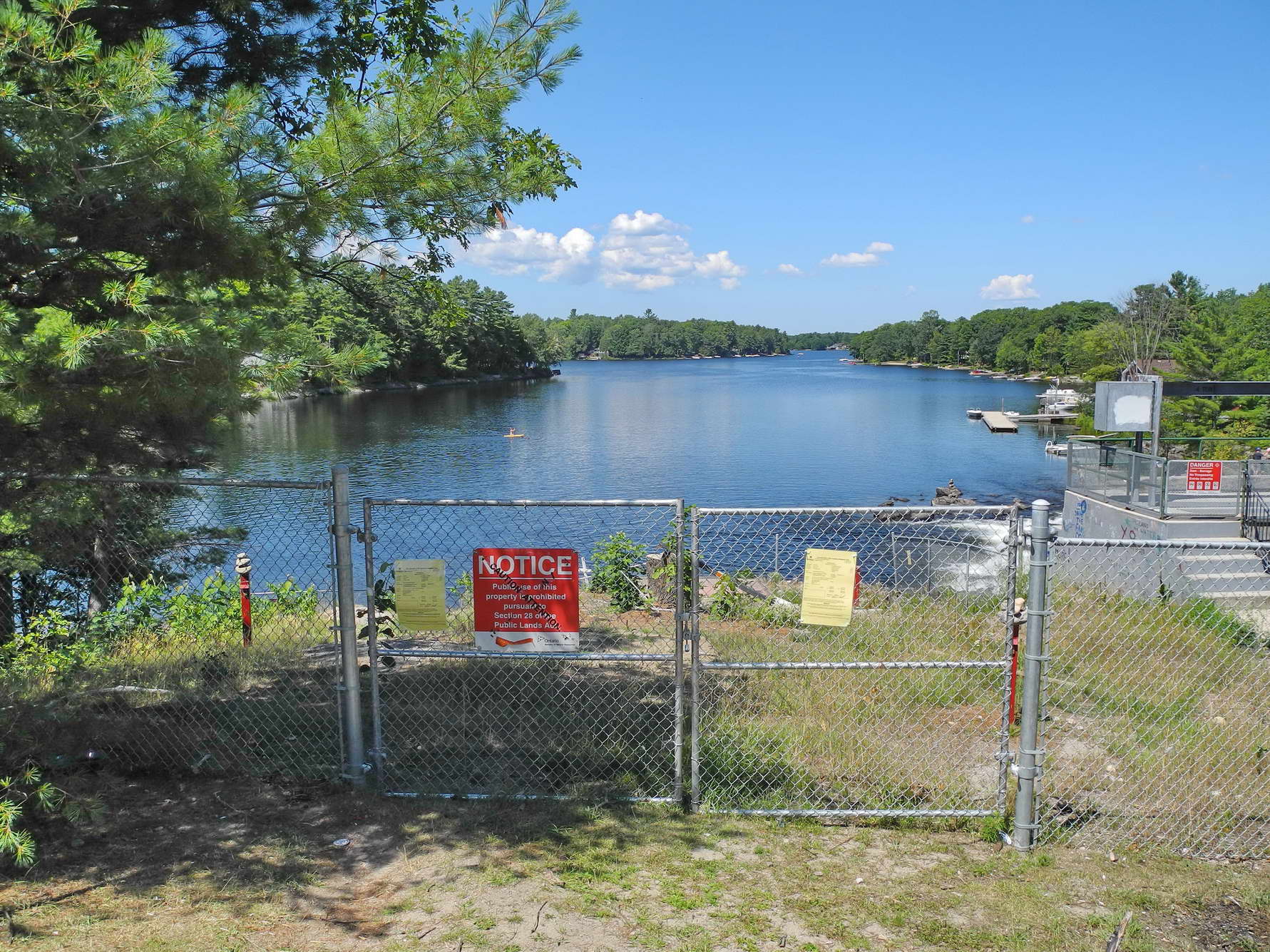
The photographs below were:

  • All taken looking down the Moon River (westward), looking over the fenced-in site for the proposed hydro-electric generating station at the Bala falls. The tailrace flow would then be directed down the centre of the photographs, as shown below.
  • Not staged or arranged, this is what happens all summer.


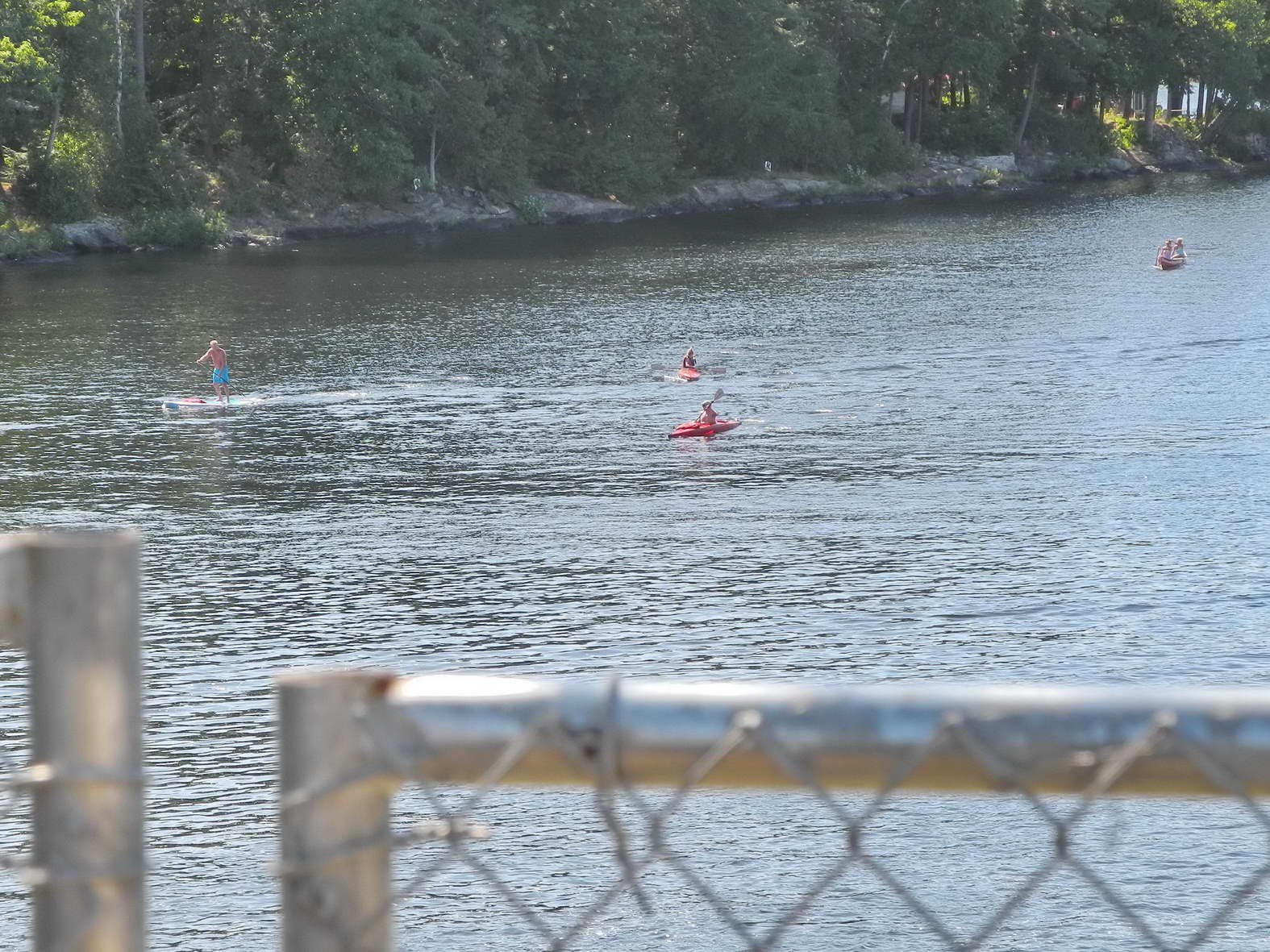
Photograph 1a: At the right are the Town Docks on the Moon River, which are the only public docks on the Moon River. Closer on the right are three private residences and their docks. At the left is at least one red kayak.

Photograph 1b: Zooming-in to the left shows that actually there are two red kayaks and a canoe, plus someone on a stand-up paddleboard. These people are; on a navigable waterway, far from the MNR’s warning sign on the Bala north dam, well outside of the proposed downstream safety boom, yet would be endangered by the flow from the fast and turbulent water exiting the proposed generating station. These people have every right to be where they are and to be safe where they are. Yet they would have no warning or way to know where this dangerous water would be, or when the proposed generating station would begin operation.


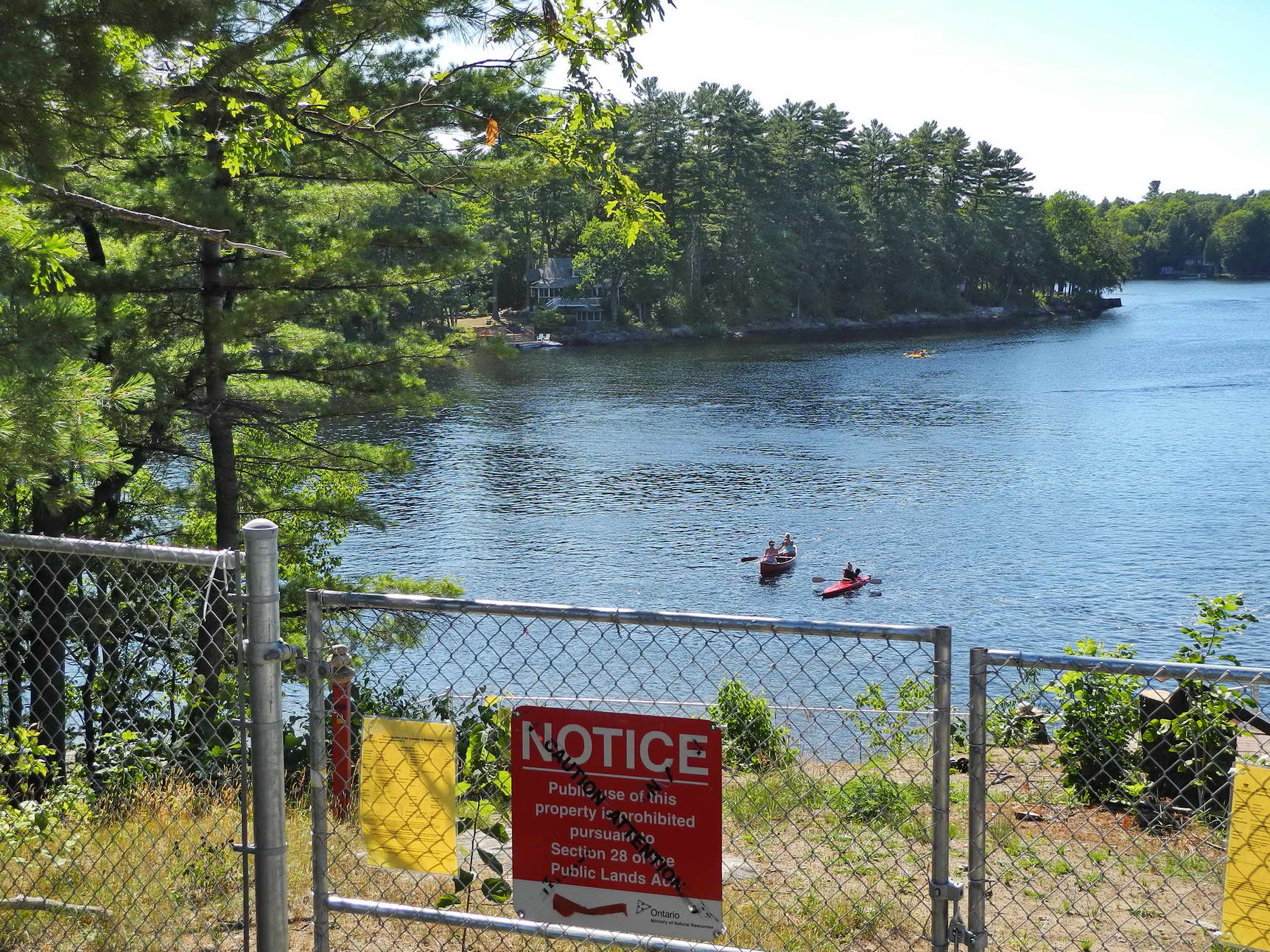
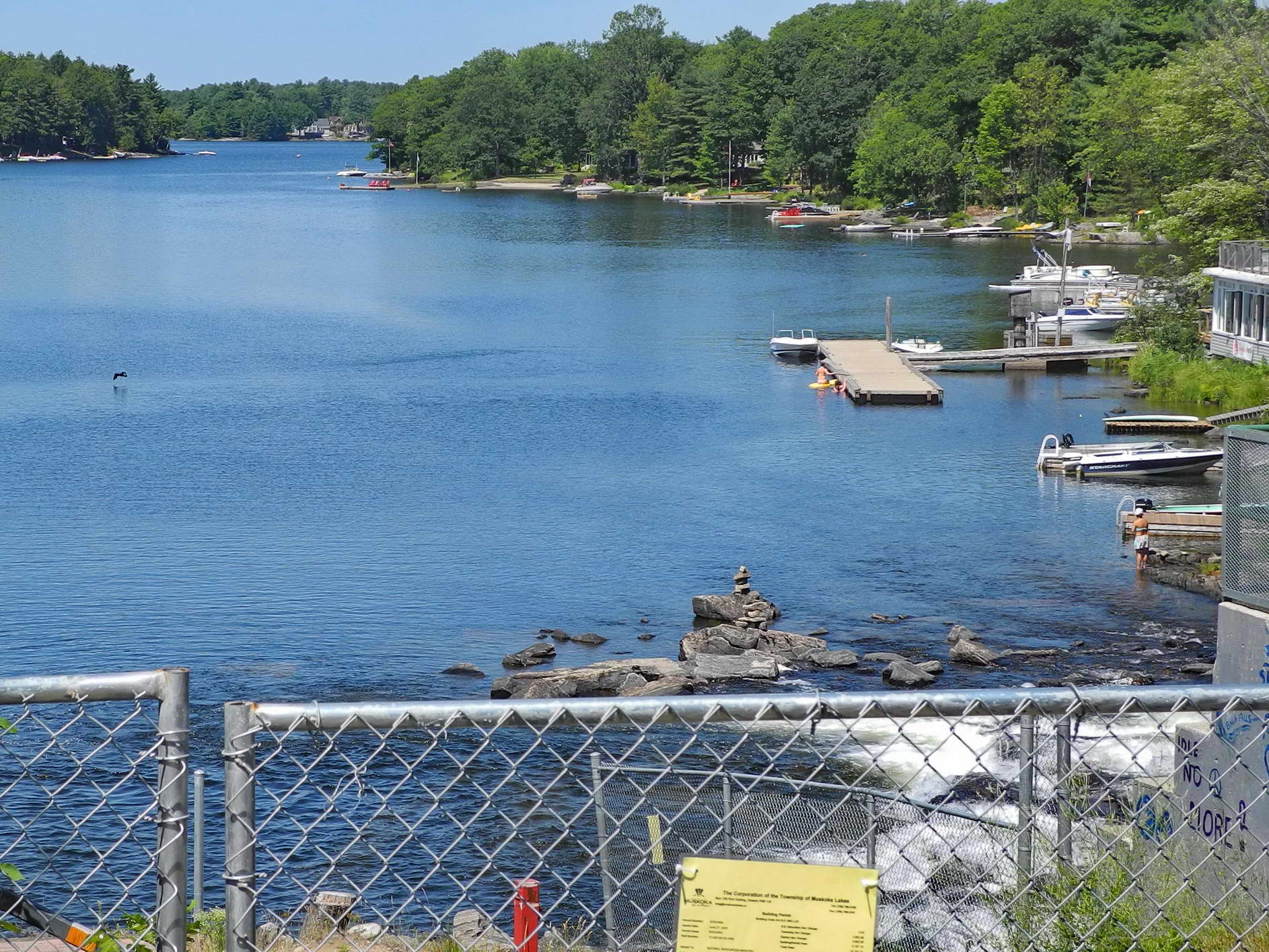
Photograph 2a: The canoe and kayak are approaching Township of Muskoka Lakes’ Portage Landing, which is to the south of the proposed site, and to the left of this chain-link fence. The proponent has provided a drawing showing they would create a portage access at this location as part of their restoration of this Township land.

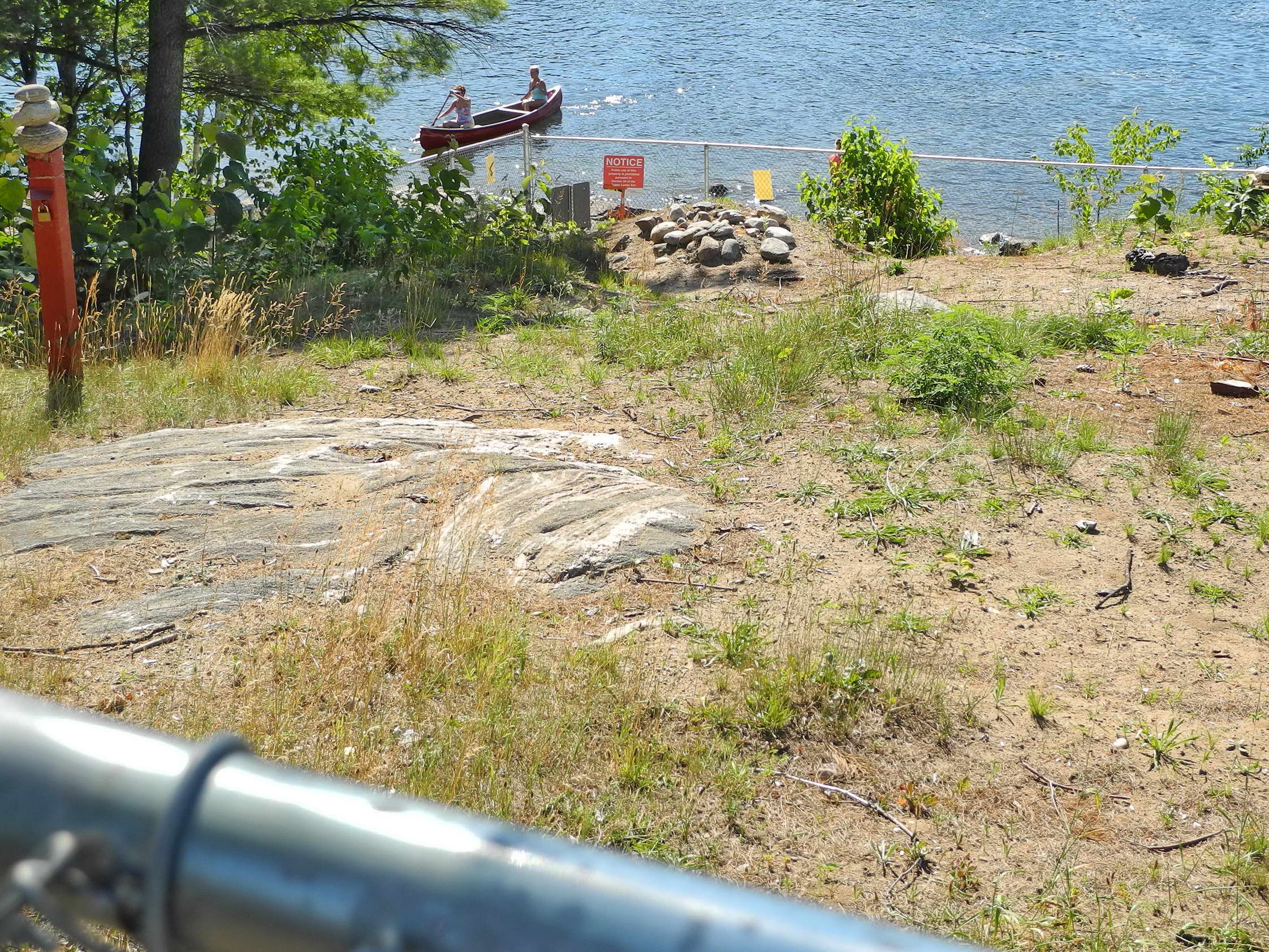
Photograph 2b: The canoe is now to the south of the proposed construction site, and would therefore be outside of the proposed downstream safety boom. Yet it would be just a few feet from the treacherously turbulent and aerated water (in which people – even with life jackets – can sink and drown) would exit the proposed generating station. These people would have no way to know they would be risking their lives by simply approaching a portage from a navigable waterway.


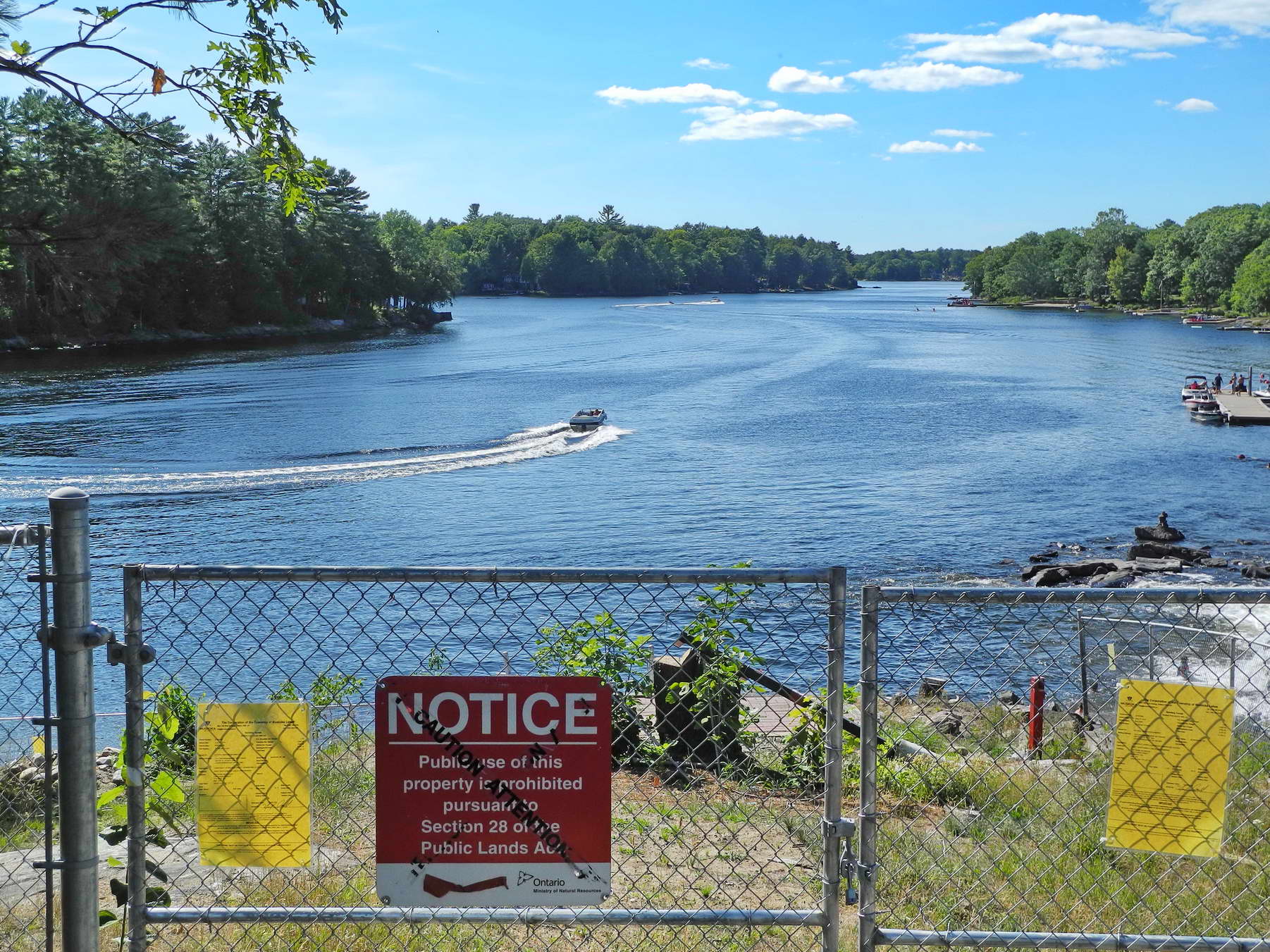
Photograph 3: Boats make wide sweeping turns, and had this motorboat been docking at the Town Docks on the Moon River, it would have travelled through the fast and turbulent water exiting the proposed generating station. Also, water-skiing and wakeboarding are extremely popular in this location. The proponent’s downstream safety boom would not delimit the water they would make dangerous, so people using this navigable waterway would have no way to know where the dangerous water would be, or when it would be dangerous.
 

Photograph 4: This is a section of a marked-up aerial photograph from a 2010 presentation made by the owner/operator of the Wilson’s Falls generating station. Their lower yellow arrow shows the location where a 16 year-old-boy drowned in 2008 due to the turbulent water exiting their generating station. Note this location is to the side of the tailrace flow, and is 75′ downstream from the generating station. This shows the need to clearly identify to the public the large area made dangerous. And note, the proposed hydro-electric generating station at the Bala falls would have ten times the flow of the Wilson’s Falls generating station.


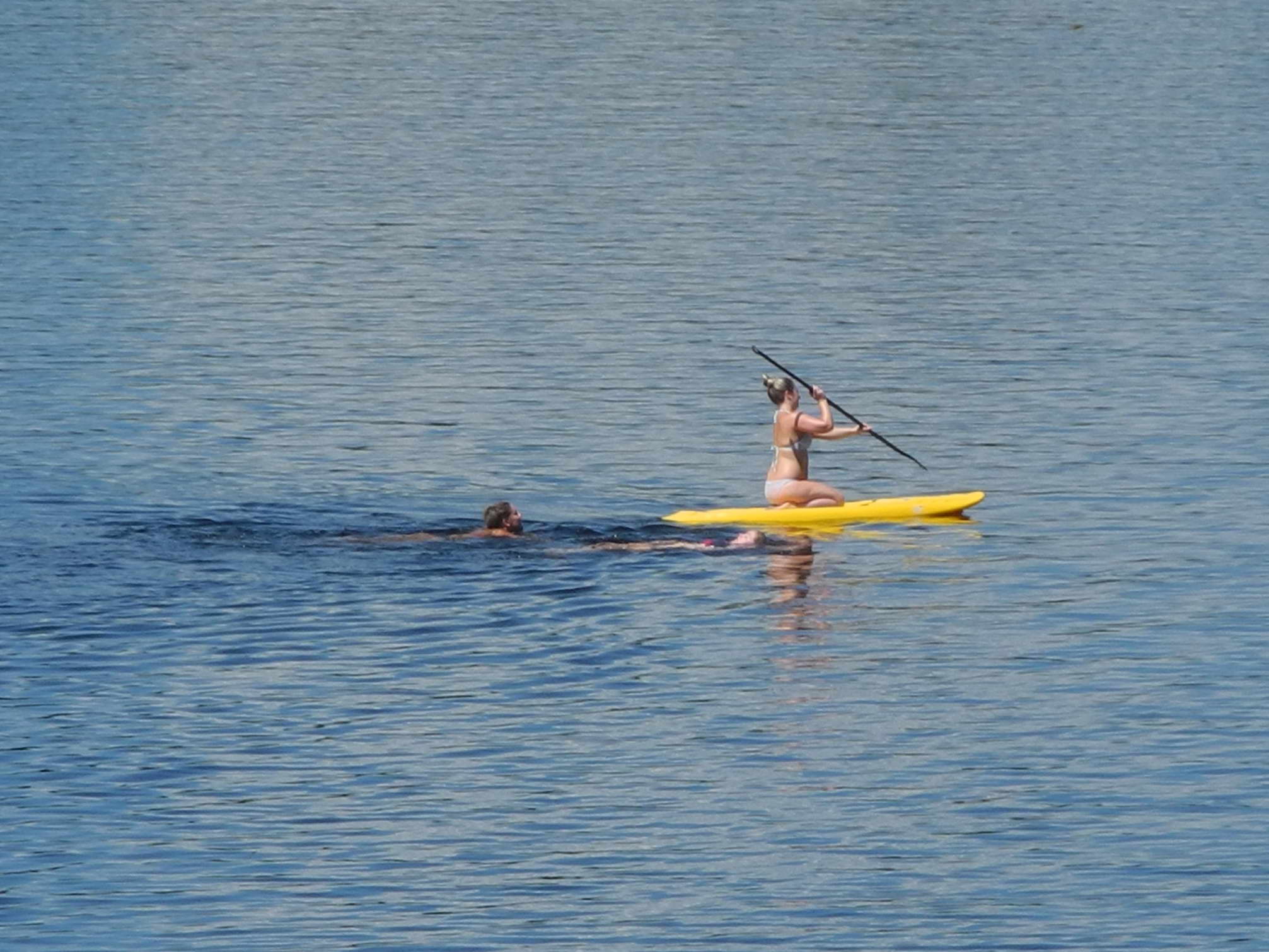
Photograph 5a: Here a yellow kayak is crossing the Moon River, and would be passing through the fast water exiting the proposed generating station.

Photograph 5b: Zooming-in shows this person is actually crouching on a stand-up paddleboard, and there are two people swimming alongside. Such informal and varied in-water recreation is extremely popular in this location. It would be unprecedented to locate a hydro-electric generating station in the middle of such an area, yet the proponent has not shown they could operate the proposed station safely. How would these unsuspecting people be informed of the extreme dangers the proposed hydro-electric generating station would create.

Photograph 5c: This shows that the above people were crossing the Moon River to get to the Town Docks on the Moon River. Given these are the only public docks on the Moon River, and that there are three private docks even closer to the Bala north falls, they would rightfully be expecting to be safe and expecting that the path they took was safe. But they would have directly passed through the fast and treacherously-turbulent water exiting the proposed generating station, outside of the proposed downstream safety boom. The proponent has not shown how they would inform such people of the dangers the proposed generating station would create.


 Conclusion

These photographs show that:

  1. These people were far from any warning signs, and so had every right to be doing these in-water recreational activities where they were in this navigable waterway.
     
  2. They were outside of the proponent’s proposed downstream safety boom, so would have no way to know they were passing through the dangerously fast and turbulent water which would be created by the proposed hydro-electric generating station at the Bala falls.
     
  3. People can learn to judge natural dangers, such as the water entering the Moon River through the Bala south channel. But the water from a hydro-electric generating station would be much more dangerous, as it would:
    • Be turbulent – from the rapidly spinning turbine.
    • Be aerated – the result is that even people wearing a life jacket can sink and drown.
    • Start – without warning – at about noon on summer days, exactly when people would most likely be in the water nearby.
    • Be hundreds of feet closer to the popular in-water recreational areas than the Bala south channel which has always been the main flow of water into the Moon River.

Note that the only two drownings in Bala were due to people that did not know how to swim jumping in the water, at least one still wearing his shirt. This tragedy only showed that people that don’t know how to swim should not jump in the water, and therefore has no bearing on in-water recreation in the area.

Jul 202016
 

Recent Development Summary

  • Queen’s Park meeting: Earlier this month we were able to directly meet with both the proponent and senior staff from the Ministry of Natural Resources and Forestry (MNR) to discuss the public safety and flooding concerns of the proposed project to build a hydro-electric generating station at the Bala falls.
    • The proponent has made some changes which may address the flooding concerns during the proposed construction. However, they are relying solely on Transport Canada’s approval that the public safety concerns have been addressed, which is a misunderstanding of Transport Canada’s mandate, expertise, and responsibilities.
       
  • E-mails to send: For their environmental assessment, the proponent stated the water outside of their safety booms would be safe, but their own flow simulation shows water three times the velocity Transport Canada says is safe outside of their proposed safety boom, and extending more than 160′ down the Moon River. The proponent’s planned project therefore would not comply with their environmental approval.

    Also, as the MNR has not required the proponent to provide a Public Safety Plan, the MNR does not know if the proposed project could be operated safely. The MNR’s Ministry Engineer therefore has a personal and professional obligation to inform the public of these potential hazards and risks.

Additional detail is provided below, along with updates on the Township’s controversial land lease which enables this proposed construction, and the District’s Muskoka Road 169 bridge maintenance work.
 

The Current Situation

We haven’t been able to send out much information lately as we have been very busy determining what the responses are to the public safety concerns. We now have the following to report.
 

  1. Approvals still needed
    In addition to several municipal approvals, to build their proposed generating station the proponent still requires approvals from both the MNR and the Ministry of the Environment and Climate Change (MOECC).
     
  2. Queen’s Park meeting with MNR and proponent
    After raising our concerns about public safety and flooding Lake Muskoka with senior provincial political staff, we had the opportunity to meet directly with both the proponent and senior staff at the Ministry of Natural Resources and Forestry.

    While the proponent showed some drawings indicating they may have addressed the flooding issue, we were surprised they are depending solely on the approval they have received from Transport Canada to show they have addressed the public safety concerns. We therefore sent this follow-up letter to the MNR, more detail is provided below.
     

  3. Non-compliance with Environmental Assessment
    Both in their original proposal and for their environmental approval the proponent acknowledged the many in-water recreational activities at the Bala falls and stated these could safely continue outside of their proposed safety booms.

    However, reviewing information from the proponent and Transport Canada, and the situation of the 2008 drowning at the nearby and much-smaller Wilson’s Falls generating station shows that the proposed hydro-electric generating station at the Bala falls would make the water extremely dangerous outside – and on all three sides – of the proposed downstream safety boom.

    The proposed project would therefore not comply with the environmental approval. More detail is in this article.
     

  4. Proponent’s Incorrect Statements
    As noted above, while the proponent’s environmental assessment showed that in-water recreational activities could continue outside of their proposed safety booms, the facts show this would not be true. Even worse, the public would not know where the dangerous water would be, nor would there be warning before it would start.

    Instead of working to address these public safety concerns, the proponent is making incorrect statements. Some of these, and our responses, are in this article.
     

  5. Misinterpretation of Transport Canada Approval and Ministry Engineer’s Professional Responsibility
    The proponent has claimed that as they have an approval from Transport Canada, the public safety concerns have been addressed.

    The public safety concerns are for; the in-water recreation both upstream and downstream of the proposed generating station, and boating in the Moon River. Transport Canada has no mandate or responsibility for either. The proponent has therefore not provided, and the Ministry of Natural Resources and Forestry (MNR) does not have, any authoritative assessment of what the impacts would be for these in-water recreational activities.

    The MNR’s publication Public Safety Around Dams advises that Operators provide a Public Safety Plan to identify the risks and their mitigation, this is even more important as it would be unprecedented to build a hydro-electric generating station in the middle of an extremely popular in-water recreational area. However, the proponent has stated they will only consider providing safe operating plans after their final Plans and Specifications are assessed and they receive approval for construction.

    This is ridiculous. Safety must not be an after-thought. Public safety requirements must be included as part of the design, and the MNR must be able to consider this as part of their assessment of the proponent’s final Plans and Specificatons. Without an acceptable Public Safety Plan, the MNR would not know if it would even be possible to operate the proposed generating station safely.

    The required final Plans and Specifications approval must be issued by a "Ministry Engineer" – who is a Professional Engineer licensed to practice in the province of Ontario. This person therefore has professional and personal due diligence obligations beyond the MNR’s policies and procedures. For example, if the MNR has no information that the proposed project could be operated safely, then the Ministry Engineer must communicate to the public the potential hazards and risks the proposed project would create.

    Transport Canada has not addressed the public safety concerns. Therefore either the proponent must provide an acceptable Public Safety Plan before any further approvals are issued, or the Ministry Engineer must ensure that the public is informed of the potential hazards and risks the proposed project would create. More detail is in this article.
     

  6. A Public Safety Plan is Required
    As it would be unprecedented to build a hydro-electric generating station in the middle of an extremely popular in-water recreational area, the proponent should be required to provide a Public Safety Plan, as is specified in the MNR’s Best Management Practices, Public Safety Around Dams.

    To address the concerns, we request that this Public Safety Plan:

    • Be required before any further approvals are provided, in case any design changes are necessary.
    • Must be approved by an organization with in-water recreation expertise, such as the Royal Life Saving Society Canada.
       

What you can do

Within the next week, send e-mails summarizing your concerns, for example:

  1. To the Minister of the Environment and Climate Change, the Honourable Glenn Murray, GMurray.mpp@liberal.ola.org :
    • For their environmental assessment, the proponent both acknowledged the current in-water recreation and clearly showed that the only dangerous areas would be within their proposed safety booms. However, the proponent’s own flow simulation shows the dangerously-fast water would extend more than 160′ outside of their safety boom, so their proposed project would not comply with the environmental approval. As a result, people would not know where the dangerous areas would be, or when this danger would start.

      The proposed project must either comply with the environmental approval, or the MOECC must require the proponent to follow the required Addendum provisions.
       

  2. To the Minister of Natural Resources and Forestry, the Honourable Kathryn McGarry, KMcGarry.mpp.co@liberal.ola.org and Minister.MNRF@ontario.ca :
    • Transport Canada’s approval does not show that the dangers to in-water recreation and to boating in the Moon River have been addressed.
    • The MNR’s Best Management Practices requires that a Public Safety Plan be provided. For the proposed Bala project, this is even more important as it would be unprecedented to build a hydro-electric generating station in the middle of a popular in-water recreational area. The MNR must either require an acceptable Public Safety Plan be submitted before any further approvals are issued, or the MNR must inform the public of the potential hazards and risks that would be created.
    • To be meaningful, the Public Safety Plan must be approved by an organization with experience with in-water recreation, such as the Royal Life Saving Society Canada.

It is best if letters ask for a reply.
 

Township leases land to proponent
At a special Township of Muskoka Lakes Council meeting on January 26, 2016 it was voted to authorize the Mayor and Clerk to execute the lease providing three parcels of Township land to the proponent to facilitate their proposed construction. This lease was executed (signed) on July 13, 2016, though the Mayor chose to selectively inform only those Councillors who voted that this lease be executed, causing much anger and concern from both the public and other Councillors when this became known at the Council meeting July 15, 2016. Gravenhurst Banner articles reporting this are here and here.

You can see a copy of the Lease here. It has some surprising provisions, for example that the Township "immediately upon execution of this Lease arrange for its Council to pass By-Laws" to exempt the proponent from the Noise by-law, both the Heritage Designation and Heritage Conservation District By-Laws, the Tree Preservation By-Law, and payment of all taxes.
 

Proponent providing conflicting information to the Township and MOECC
Provisions of the above lease include the requirement that the proponent not use Margaret Burgess Park for construction purposes and that they only locate sedimentation settling tanks in the Precambrian Shield parking lot. However, the proponent has provided a drawing to the MOECC showing they would use Margaret Burgess Park for construction purposes, and at the Township of Muskoka Lakes Council meeting on July 15, 2016 the proponent claimed they could locate sedimentation settling tanks in Portage Landing. Our presentation to the Council meeting July 15, 2016 is here.
 

MOECC approval needed
As both groundwater and lake/river water would leak into the excavation for the proposed construction, this water would need to be pumped out. The proponent’s plan for this pumping and subsequent storage, treatment, and testing requires approval from the MOECC. The MOECC initially provided a 45-day public comment period on these plans, which were only available by making an appointment to view them in Toronto. Then they extended this by a week. Then we found that the proponent has completely changed their plans. Then as noted here, the MOECC decided: "that the instrument was posted in error". We have asked the MOECC that this entire process be re-started, and will report when we have an update.
 

Bridge maintenance work
The District Municipality of Muskoka owns and maintains the two Muskoka Road 169 bridges in Bala, over the Bala north channel and Bala south channel. They have determined that bridge maintenance work is required, and this is scheduled to begin later this summer. It is not known whether or how this might affect the proposed project to build a hydro-electric generating station at the Bala falls. A Gravenhurst Banner article is here.

Jul 182016
 

The proponent has stated their approval from Transport Canada under the Navigation Protection Act  shows that public safety has been addressed.

This is incorrect, as Transport Canada has no mandate or expertise to assess in-water recreation, and has no responsibility to assess boating in the Moon River. Therefore these dangers remain unaddressed.

These and other concerns are detailed in this July 12, 2016 letter we have sent to the Ministry of Natural Resources and Forestry. This letter has links to the following documents:

Jul 182016
 

In attempting to show they have addressed public safety, the proponent is making incorrect statements, such as these four, our responses follow each.

  1. The MNR’s Section 28 Notice means it is illegal for people to be in the water at the Bala falls.

    This is completely incorrect …

    • Firstly while the MNR did issue a notice under Section 28 of the Public Lands Act, this only applies to the land of the proposed construction site, it does not have any impact on the public’s rights to be in the water.
    • Secondly, as the Moon River is a navigable waterway, the public has a right to use the water, for boating or swimming as they wish.


  2. People should not be in the water anywhere near the Bala dams.

    People have a right to be in the water, as it is a navigable waterway. Just 100 m away are the only public docks on the Moon River, and even closer are are three private residences and their docks. The proponent has even proposed portage points between the Bala dams. This is an in-water recreational area.

    • The MNR stated this is an in-water recreational area in the 2005 Request for Proposals which started this entire process. The proponent acknowledged this in their 2005 proposal and again in their 2009 environmental assessment.
    • The proponent stated their proposed project would: “… not generally diminish the public’s enjoyment of the area for swimming, boating, fishing, picnicking and hiking”. It is the proponent’s responsibility to honour their commitments.
    • The MNR does have a red sign on each of the Bala dams, which reads: “Danger, Fast Water, Keep Away”, with four pictographs that are unreadable from any distance (at least one if which could not be interpreted by most everyone). But this sign refers to dangers caused by the dam, not the fast water that would exit the proposed generating station and extend hundreds of feet down the Moon River.
    • People can judge natural dangers such as from waterfalls. That is part of growing up and being Canadian. But this would be a remotely- and automatically-operated danger. How would people be informed of the extent of the fast water which would exit the proposed generating station, and would start without warning.


  3. The same amount water would be flowing into the Moon River even if the proposed generating station was built.

    The concern is where does this water enter the Moon River, and would there be warning before it starts.

    • In Bala, the MNR’s “primary water control structure” is the Bala south dam, so most water currently enters the Moon River through the Bala south channel. When stop-logs are removed from the Bala north dam to increase the flow through it, the MNR’s Public Safety Measures Plan for the Bala dams requires: “visual surveillance to ensure no persons are in the dangerous water area and to warn persons to stay clear while changes affecting water flow and level are made.”
       
    •  What the proponent has therefore not addressed is that:
      • Instead of flowing through the Bala south channel, most of the water entering the Moon River would instead be through their proposed generating station, so this fast water would be more than 200′ closer, and be directly adjacent to the very popular in-water recreational area at the base of the Bala north falls.
      • This fast water would start, without warning or local Operator, at about noon on summer days, even though the MNR’s Public Safety Measures Plan requires first warning those in the water.


  4. The remote Operator would have video cameras to see if there were people in the water, and the station would slowly ramp-up operation so people could get away.

    These would be nice extra features, but would be completely inadequate as the core of a Public Safety Plan, for example:

    • It would be unacceptably optimistic to trust people’s lives; that some busy and distracted multi-tasking remote Operator would be attentive every station start-up, for the duration of the proposed station’s ramp-up and afterwards, that the cameras would be aimed where people may be, and that the cameras would all be operational and unaffected by sunlight and dirt.
    • And what if people were in an area that would become dangerous, would the Operator wait hours for them to leave.
    • The proposed station’s mininum flow would be twice the flow that caused the 2008 drowning due to the tailrace flow of the nearby Wilson’s Falls generating station. If people who would be endangered by the tailrace flow of the proposed Bala generating station could even figure out what was happening, they would suddenly find themselves in grave danger, and could panic or be unable to escape. Starting the deadly machine in the hopes this would warn unsuspecting people to get away is a ridiculous idea.


  5. Transport Canada’s approval confirms the public safety issues have been addressed.

    While Transport Canada did provide approval under the Navigation Protection Act, Transport Canada …

    • Has no mandate or expertise for in-water recreation such as swimming, wading, or Scuba diving. So there has been no assessment of the impact on these activities either upstream or downstream of the proposed project, so all in-water recreation public safety concerns remain unaddressed.
    • Has no responsibility for boating in the Moon River, so all boating concerns in the Moon River remain unaddressed.

     
     More detail is provided in this article.

Before any construction is allowed to begin, the proponent needs to provide a complete Public Safety Plan, including showing that areas outside of their proposed safety booms would be safe for in-water recreation – as is required by their environmental approvals.

Jul 182016
 

Summary
The proposed project would not comply with the proponent’s environmental approval, as the water on all three sides outside of the downstream safety boom would be too dangerous for in-water recreation …

  1. Downstream, as water three times as fast as considered safe by Transport Canada would extend over 160′ outside of the proposed safety boom.
  2. To the north of the proposed safety boom, as this would allow those recreating at the base of the Bala north falls to be just ten feet from extremely dangerous water.
  3. To the south of the proposed safety boom, which would be directly at the extremely dangerous water as it would exit the proposed generating station’s tailrace.
     

Detail

  1. The MNR’s 2005 requirements:
    In 2005, the MNR required that proposals for the proposed hydro-electric generating station at the Bala falls: “demonstrate consideration of the extensive aesthetic, recreational, social and economic (i.e. tourism) values in the area of the proposed development.”

    • Summary; the MNR required that recreation in the area must bascially continue.
       
  2. The proponent’s 2005 Proposal
    The proponent’s 2005 Proposal stated that their proposed project: “incorporates the safe public use and enjoyment of the site”, that they are: “keenly aware of the importance of the site as an outdoor recreation area for tourists” and would: “… not generally diminish the public’s enjoyment of the area for swimming, boating, fishing, picnicking and hiking”.

    • Summary; proponent’s proposal acknowledged the extensive in-water recreation in the area, and said they would not “generally diminish” this.
       
  3. The proponent’s 2009 Environmental Screening/Review report showed the proponent understood the prevalence and importance of in-water recreation, for example:
    1. Section 2.2, Socioeconomic Environment, Local Land Use: “A variety of activities occur within the vicinity of the proposed project site. These include a range of recreational activities such as aquatic sports (boating, fishing, swimming) and snowmobiling.”
    2. Section 2.2.5.10,
      • Recreation: “Lake Muskoka (upstream of North Bala Dam) and Moon River (downstream of North Bala Dam) are popular boating, swimming, scuba diving and recreational fishing areas. …  Many of these recreational uses take place at the base of Bala Falls. Additional details are described below.”
      • Scuba Diving: “Scuba divers reportedly practise below the base of Bala Falls, and there is an area in Lake Muskoka, upstream of the North Bala Dam which also is popular among divers and referred to as Divers’ Point.”
    • Summary; proponent’s 2009 enviromental assessment acknowledged the extensive in-water recreation in the area.
       
  4. The proponent’s 2009 Environmental Screening/Review report committed that in-water recreational actitities could safely continue outside of the proposed safety booms, for example:
    1. Section 6.3.6.1, Tourism and Recreation, Effect on Areas for Public Use:
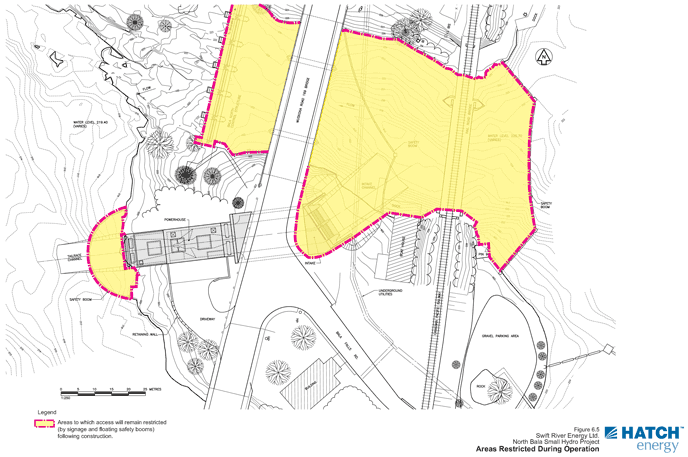
      • “Areas restricted from public access will be clearly marked by safety booms and appropriate signage. Recreational activities identified in Section 2.2.5.10 are noted to occur in the vicinity, and will be prohibited in the immediate vicinity of the tailrace and intake channels. These in-water activities include boating, canoeing, kayaking, fishing, swimming, water skiing, scuba diving, and snorkelling. Areas restricted from public access are illustrated in Figure 6.5.”
      • “Flow velocities will increase within the North Channel; however these will be within the boomed areas, restricted from public access (see Section 6.3.1). Velocities at the Bala town docks will not be affected by the Project. This will allow the continued use of the public docks for all present activities including the Bala Bay Regatta.”
      • “The effect of operation of the project on tourism and recreational activities is a reduction in area available for in-water activities within boomed areas.”
    2. Figure 6.5, Areas Restricted During Operation, shaded area legend: “Areas to which access will remain restricted (by signage and floating safety booms) following construction.“, this is shown in the Figure below (click on it for a larger view).
    3. For their 2012 Addendum, the proponent provided a similar diagram (Figure 6.4), again showing the only restricted and dangerous areas would be within their safety booms.
    • Summary; proponent’s environmental assessments committed that only areas within their safety booms would be dangerous.
       

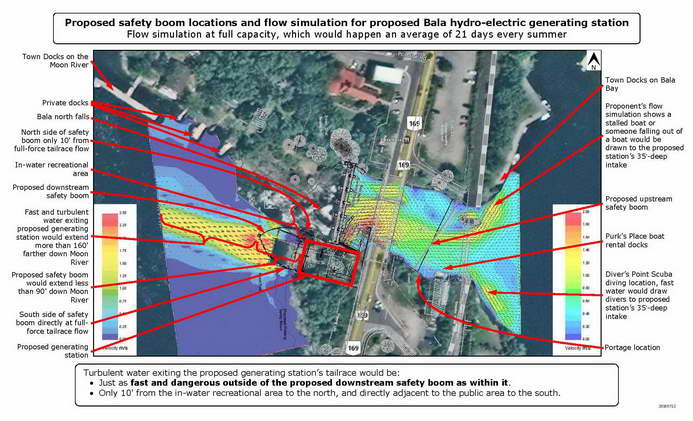
But the proponent would not meet this requirement of their environmental assessment. For example, the figure below (click on it for a larger view) superimposes the proponent’s flow simulation and safety boom locations on an aerial photograph.

The figure above shows:

  • While Transport Canada has stated that the maximum safe surface water velocity is 0.5 m/s, the proposed generating station would create flows three times this velocity, and this would extend downstream more than least 160′ outside of their proposed downstream safety boom.
     
  • The side of the proposed downstream safety boom would be only 10′ from the extremely turbulent water exiting right at the proposed generating station’s tailrace. Therefore;
    • People recreating in the water at the base of the Bala north falls would be allowed far too close to the proposed generating station, whose minimum flow would be twice that which caused the 2008 drowning of a 16-year-old boy at the nearby Wilson’s Falls generating station.
    • And about 21 days each summer, the proposed Bala generating station would operate at full capacity, so would have ten times the deadly Wilson’s Falls station’s flow – just ten feet from the in-water recreational area.
       
  • And at the south side of the proposed downstream safety boom would allow people to be directly at this tailrace flow, and this is where the proponent would encourage canoing as they would build a portage at this location.
     

Conclusion
The proponent’s environmental approval requires that the water be safe outside of their proposed safety booms, but it would not be. The proposed project to build a hydro-electric generating station at the Bala falls would therefore be too dangerous to operate.

Jun 302016
 

Current status
The proposed project to build a hydro-electric generating station at the Bala falls still requires at least the following approvals:

  1. Phase 2, Permanent Works, Plans and Specifications, under the Lakes and Rivers Improvement Act, from the Ministry of Natural Resources and Forestry (MNR). Required for construction of proposed structure, so is needed before construction could begin.
     
  2. Environmental Compliance Approval from the Ministry of the Environment and Climate Change. Required for the handling, treatment, and testing of the water pumped from the excavation for the proposed structure, so is needed before contruction could begin.
     
  3. Driveway entrance permit from the District Municipality of Muskoka. Required to access Township’s Portage Landing, which they hope to lease to facilitate the proposed construction.
     
  4. Approval to proceed with widening the shoulder of Muskoka Road 169 fronting Township’s Portage Landing. Requires proponent submit detailed engineering drawings, a Heritage Impact Assessment, and a $2M Letter of Credit before construction could begin. Complicated by required maintenance work on the Muskoka Road 169 bridges over the Bala north channel and Bala south channel, as reported here.
     
  5. Lease for three parcels of land owned or controlled by the Township of Muskoka Lakes (Portage Landing, south half of Don’s Bakery / Portage Landing parking lot, north half of Precambrian Shield parking lot). Required before construction could begin. Approved by the Council of the Township of Muskoka Lakes on January 26, 2016, but not yet signed.

We continue to pursue the unaddressed public safety and environmental concerns and will have more to report in the coming weeks.

The MNR is attempting to claim their only responsibility is that the structure of the proposed generating station would be sound, and that any dangers created by the operation of the proposed generating station would only be the responsibility of the proponent. However, history has shown that if safe operation is not possible, then the operational dangers are the responsibility of the designers and those that approved the design. Some examples are presented in this article.
 

Canadian Motorcyle Cruisers, Drone Video, and Photographs
To show their support, the Canadian Motorcycle Cruisers had a multi-chapter ride to Bala on June 25, 2016. We had water and items from Don’s Bakery for them, walking tours to show the concerns, and they now all have a Save the Bala Falls button. A great event and day.

  • Bala resident Al Kent has shared with us a fantastic drone video he’s made from that day, you can see it here.
  • Long-time supporter and photographer Bob Macfarlane has shared with us the photographs he took, you can see them here.
Jun 182016
 

1986 Space Shuttle Challenger Disaster
For the last 30 years of his life, Bob Ebeling never recovered from his feelings of guilt for the 1986 disaster in which seven crew members of the Space Shuttle Challenger died. He was an engineer working for Morton Thiokol Incorporated, who provided the Solid Rocket Boosters for the Space Shuttles. He knew that the O-rings sealing the Solid Rocket Booster segments would not adequately seal after the unusally cold night before the January 28, 1986 launch. He did everything he could to have the launch cancelled but was overruled by the decision-makers both within his company and in NASA.

The next year he told an interviewer: “I have headaches. I cry. I have bad dreams. I go into a hypnotic trance almost every day”. Earlier this year, recounting that he couldn’t get the launch cancelled, he told an interviewer: “I think this was one of the mistakes that God made. He shouldn’t have picked me for that job.” You can read his obituary, as published April 12, 2016 in the Globe and Mail here.

Disasters would be prevented by decision-makers acting on the warnings they  receive.
Unfortunately, there are many good-intentioned people who refuse to accept the extreme dangers the proposed generating station would create. These people are the bureaucrats and political staff in both the Ministry of Natural Resources and the Ministry of the Environment, the Councillors of the Township of Muskoka Lakes who are facilitating the proposed construction, and the proponent and those that would finance them.
These people now have the choice to act on the responsibility we all have to do what we can to make the world safer for others. Or they can be troubled for the rest of their lives knowing that they could and should have done more to prevent a tragedy.


On-going Takata Air Bag Crisis

To reduce the cost of the propellant used to inflate their automotive air bags, in 1999 the Takata Corporation changed to using ammonium nitrate – despite warnings from their internal design staff. More detail is in the cover story of the June 12, 2016 issue of Bloomberg Businessweek magazine (click for graphic pdf, text text pdf, or video summary, or click below to hear an interview with the author). A graphic showing the increasing quantity and models of cars recalled over the past eight years is here.

The result has been deaths, lawsuits, and a recall of more than 60,000,000 cars worldwide – the largest recall ever, which will take years to complete, so until then these people’s own cars could kill them due to a minor collision where the air bag inflates (Transport Canada’s response is here).

One of the complexities is that the situation is worse for cars; used in high humidity areas (such as the southern US) and which are exposed to greater temperature fluctuations – as after several years these factors cause the propellant to break into a powder, which has more surface area and therefore reacts faster, causing too great an explosion and the air bag’s metal inflator tube fractures into shards that slice into the people in the car as a bomb’s shrapnel would. That is, the inflator design is too dangerous for the environment in which it would be used. While the danger is during the operation of the car, the fault and liability rests with those that approved the design.

The US National Highway Traffic Safety Administration found that: “Takata provided inaccurate, incomplete, and misleading information to regulators for nearly a decade. Had they told the truth, Takata could have prevented this from becoming a global crisis.”  Shigehisa Takada, after becoming CEO due to his father passing away, in 2015 said: “The company that should be offering the safety to the users ended up hurting them. It grieves me most deeply.”  The recall will cost much more than the 80-year-old company has.

Trying to save lives using air bags can kill people if the design is not suitable for the environment.
Trying to reduce the cost of a design can bankrupt a company if the design is too dangerous.
Trying to reduce global warming using hydro-electric power generation will drown nearby people.
In all cases, the intention was good. But in the complex world we live in, ignoring important details can kill people.


Design Approval Includes Confirming Safe Operation is Possible

Safe operation is only possible if the design considers the operating environment. In Bala, the operating environment is that people have and will continue to be in the water:

  • That is their right as it is a navigable waterway.
  • As required by Section 3 of the Public Lands Act, this public access must be maintained.
  • There are both public and private docks, directly adjacent and both upstream and downstream, to the area to facilitate this access.

This public access is important to the area’s economy. Indeed part of the MNR’s mandate is “supporting outdoor recreation opportunities”.

We simply ask, how would the public be informed of the extreme dangers that would be created by the proposed generating station – which would:

  • Start without warning at about noon on summer days.
  • Have more than ten times the flow of the nearby Wilson’s Falls generating station and the treacherously turbulent water from its tailrace caused the drowning of a 16-year-old boy in 2008.

The MNR’s Best Management Practices publication Public Safety Around Dams states:

  • On the second page that the MNR’s legislative authority includes governing the operation of hydro-electric generating stations.
  • That the proponent must prepare a Public Safety Plan and this: “requires addressing both the physical structure and the dam’s operation, particularly as it relates to discharging water” and must include the: “operating practices and control measures that will be taken to either eliminate or mitigate the public exposure to the hazard”.

Unfortunately the MNR is attempting to claim they have no responsibility to ensure that the proposed Bala generating station could be operated safely, as they state: “SREL will be responsible for ensuring appropriate public safety measures are in place as they relate to the structures and resulting flows and levels. MNRF has no regulatory approval role related to public safety measures on dams.”

This is unacceptable since the approval from the MNR which the proponent still needs before constructing their proposed generating station (Plans and Specifications approval, under the Lakes and Rivers Improvement Act) must be issued by the Ministry Engineer who must be a Professional Engineer and licenced to practice in the province of Ontario. Professional Engineers have an obligation to the public, including to: “take all reasonable steps to protect the interests of parties that might be affected … before an incident occurs.” And it is required they will have: “identified all actual or potential hazards to the interests of the client, employer or public associated with the work” and “communicated the risks to all affected parties.” (PEO Professional Engineering Practice Guideline, January 2012).


Summary

The facts are:

  1. The proponent has committed in their Environmental Assessment that swimming and boating could safely continue outside of their safety boom area.
  2. The MNR has not yet approved the design of the proposed Bala generating station.
  3. The MNR has a direct responsibility to identify potential hazards and risks to the public.
  4. The proponent must provide a Public Safety Plan.

Before any further approvals are provided, we request that the MNR require the proponent provide an acceptable Public Safety Plan.

Apr 282016
 

A supporter writes …

Tell me again why Ontario’s Liberal government is essentially forcing Bala to accept an unwanted and unnecessary power plant at its precious falls.

This article is saying nothing new, but it serves as a reminder of what I have been saying for years – i.e., how badly they have handled the hydro portfolio!  Even though this article did not mention the impact on the cost of hydro in Ontario as a result of all the small private generating stations, like the one they are pushing upon Bala, or the billion dollars thrown away to cancel the Mississauga gas plant (just so they could win seats there), it is nevertheless a scathing indictment.

Surely Ontario deserves better!

Our thoughts …

The problem is the challenge of fighting politics with logic.

  1. The provincial Liberals have made a political decision that:
    1. Power demand will increase in the future.
    2. Renewable energy is better.
    3. Jobs can be created by subsidizing renewable energy projects (see this article, which shows the government’s continuing belief that letting self-serving private industry make policy will have a good outcome).
       

    Unfortunately the result is the government doesn’t look at individual projects to determine if they make sense, they leave this to the private developers. Everything is “proponent driven” and the government doesn’t have the technical resources or confidence to question the private developers – who are only in this for private profit, not the overall benefit of Ontario.
     

  2. The government has made a policy which applies for all situations, and doesn’t want to lose even one proposed project for fear that would begin:
    • A cascade of cancellations or embarrassments of cancellation costs, so …
    • Investors would lose trust in the government and no longer propose to finance and build generating stations (the government doesn’t want to fund such construction any more as costs always overrun).
       

    Therefore the government desperately wants to maintain good relations with private developers so the developers and their financiers feel confident in such opportunities being good investments, and will keep offering to finance and build generating stations – so the government doesn’t have to do this.
     

  3. Other huge issues are:
    1. People say that there is already a dam in Bala and motor boats, so the area isn’t pristine. But they don’t realize that at the dam in Bala is at the only publically-accessible shoreline in the area and this shoreline continuing to be beautiful and natural is key to the the area’s economy.
       
    2. There was already a generating station in Bala, so building a new one wouldn’t be a significant impact. But they don’t realize that the proposed generating station would:
      • Have 25 times the footprint (this is the difference between a small garden shed and a five-bedroom house).
      • Would rise 55’ – that’s five storeys – above the Moon River (the proponent said it would only be five feet).
      • Present a 25’-wall of concrete (which would attract graffiti) above the falls and Bala north dam instead of the trees currently seen.
      • Have over ten times the flow, which crosses the threshold to being deadly dangerous (a ten times increase is the difference between a summer breeze and a hurricane).
         
    3.  That there is a generating station at the Bracebridge falls, and Bracebridge is doing just fine. But they don’t realize that people don’t touch the water at the Bracebridge, they look at it while standing on a concrete platform from behind a chain-link fence. And Bracebridge has a 110’-long concrete breakwater protecting their municipal docks. And Bracebridge has a diversified economy, but Bala is all about tourism and people coming to visit the falls.
       
    4. The proponent hasn’t been required to present a plan of how they would operate this proposed generating station safely, or not cause flooding of Lake Muskoka.

This appears to be the “root cause” of the situation.