Oct 192013
 

Summary
Our October 18, 2013 presentation to the Township of Muskoka Lakes Council detailed dangers to in-water recreation of the proposed project, and showed that other hydro-electric generating stations do not have nearby in-water recreation so they do not have the public safety problems the proposed Bala project would have.

The proponent’s only answer is; people shouldn’t be swimming at the base of the Bala North Falls anyways. That is, the proponent refuses to accept that people always have, and always will enjoy summers in the water at the Bala North Falls.

So the proponent has a big public safety problem – as would any organization facilitating this mess of a proposed project.

Now the proponent is requesting to use valuable Township land during construction. We therefore ask “What would the municipality’s liability be for facilitating the construction of this dangerous proposed project”.

Given that the public’s continued access to this Township land is important to the area’s economy, it is clearly best that the Township refuse to help this dangerous proposed project along in any way.

Detail
On October 18, 2013 we had the opportunity to delegate to the Township of Muskoka Lakes Council on the topic of public safety. As detailed in our presentation;

  1. The operation of the proposed Bala generating station would be particularly dangerous because:
    1. It would operate in cycled operation an average of 46 days every summer. This means it would start operation at a required flow rate of about 24 m³/s at about noon on more than ⅓ of summer days. It is important to note that during cycled operation, the proposed station would run at about the same flow rate as the full capacity of the Bracebridge Falls Generating Station – which has a large warning sign: Extreme Danger, Keep Out, Swift Currents & Undertow May Occur At Any Time.
       
    2. The proposed Bala generating station would run at full capacity (which would be 96 m³/s – 3½ times that of the Bracebridge Generating Station) an average of 21 days every summer. And note that while most of the flow from Lake Muskoka now enters the Moon River through the Bala South Channel, if the proposed generating station was built, this fast water would be brought 250′ closer to the very popular in-water recreation area at the base of the Bala North Falls.
       
  2. Clearly, these are both extremely dangerous conditions, but would only be a risk to public safety if there were people nearby. As shown in our presentation, other hydro-electric generating stations simply do not have people, residences, docks, and boats nearby. But the Bala Falls are unique as they are popular, accessible, and people have always been and will always be nearby in the water.

That is, the Bala Falls are different, and simply not a safe place for a hydro-electric generating station. So our message to Township Council is, protect yourself and the public; don’t let the proponent’s public safety problems become your problems, don’t get involved with this proposed project by facilitating it in any way.

Our previous presentation on public safety is here.
Oct 152013
 

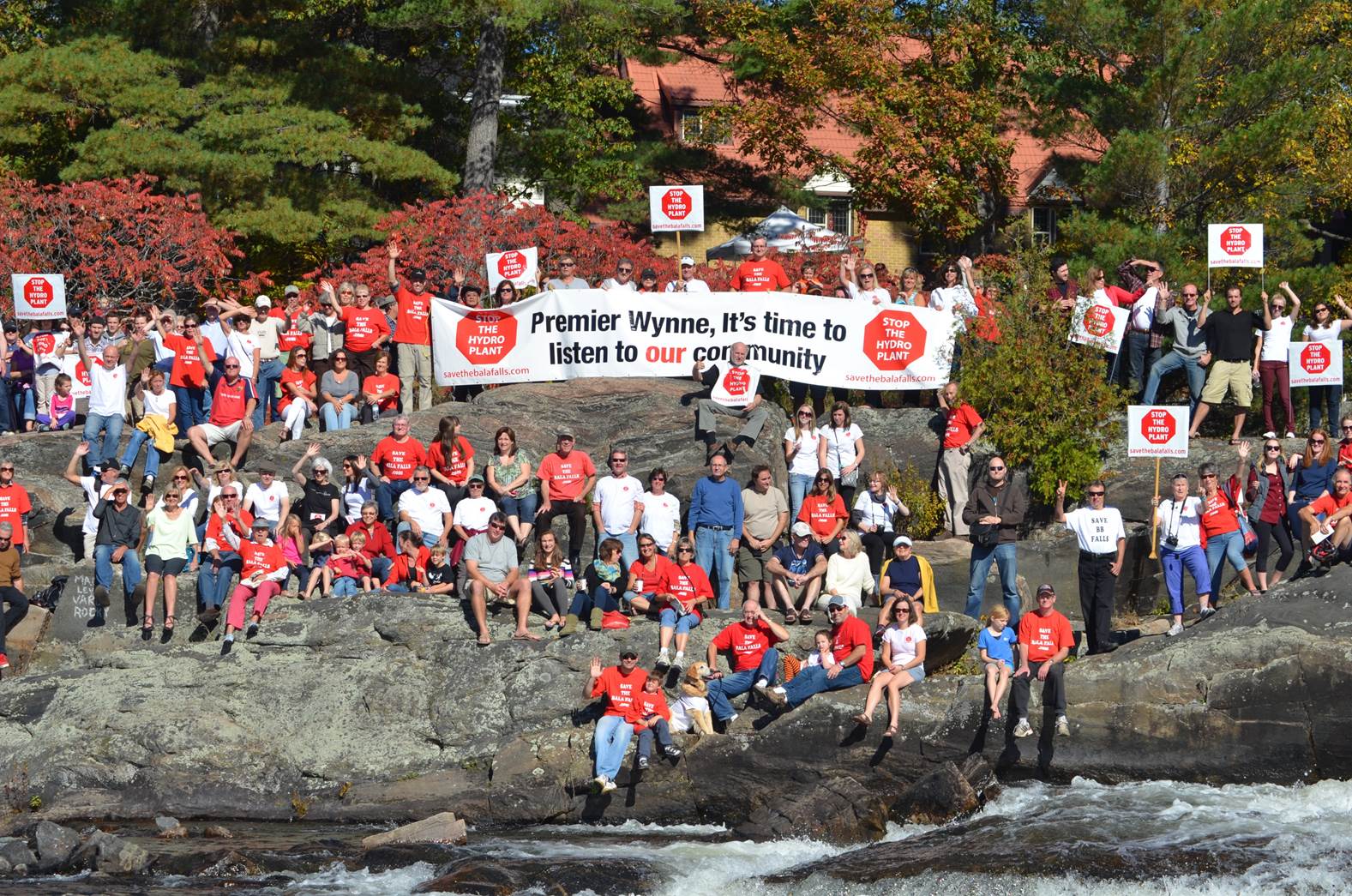
What a fantastic day, what a fantastic demonstration that the community is united in opposition to this outrageously dangerous proposed hydro-electric generating station at the Bala Falls.

October 12, 2013, Margaret Burgess Park

CTV News was there from Barrie, their article is here – if you have an Apple computer and that video won’t play, click below …

Sep 162013
 

On September 13, 2013, SaveTheBalaFalls.com had the opportunity to present an update to the Township of Muskoka Lakes Council.

The presentation is here.

Additional information provided subsequently follows:

Summary

  • The insurance cost cited is from this MNR report.
  • The proponent’s dangerous flow simulation shown would occur throughout the year, including many times each summer.
  • The required cycling operation would both amplify the lower flows of the summer, and would result in the proposed station’s operation beginning – silently and without warning – just when people would already be in the water. The result would be extreme danger and drownings.
  • Despite repeated requests, the proponent has not had an organization competent in swimming safety provide comments or suggestions on their current proposal.

 Detail

1) Concerning the insurance cost cited in this article:

  • This information is from this Ministry of Natural Resources’ recent study entitled “Economic Impact of Waterpower Projects on Crown Lands in Ontario”. Section 3.11 Costs, Table 2 (page 5) provides annual operating costs per MW of station capacity, where of the Total Operating Expenditures of $134,000, the Insurance Premium is $75,000.
  • I might add that this report carefully tallies economic benefits, but does not present any negative economic impacts, and therefore provides an incomplete and deceptive conclusion. Last year, I therefore sent this letter to the MNR, and received this response. Remarkably, the MNR simply replies that providing a balanced view of the economic impact was “beyond the scope of this project”.


2) Concerning how often the high flow used in the proponent’s flow simulation presented here would actually occur:

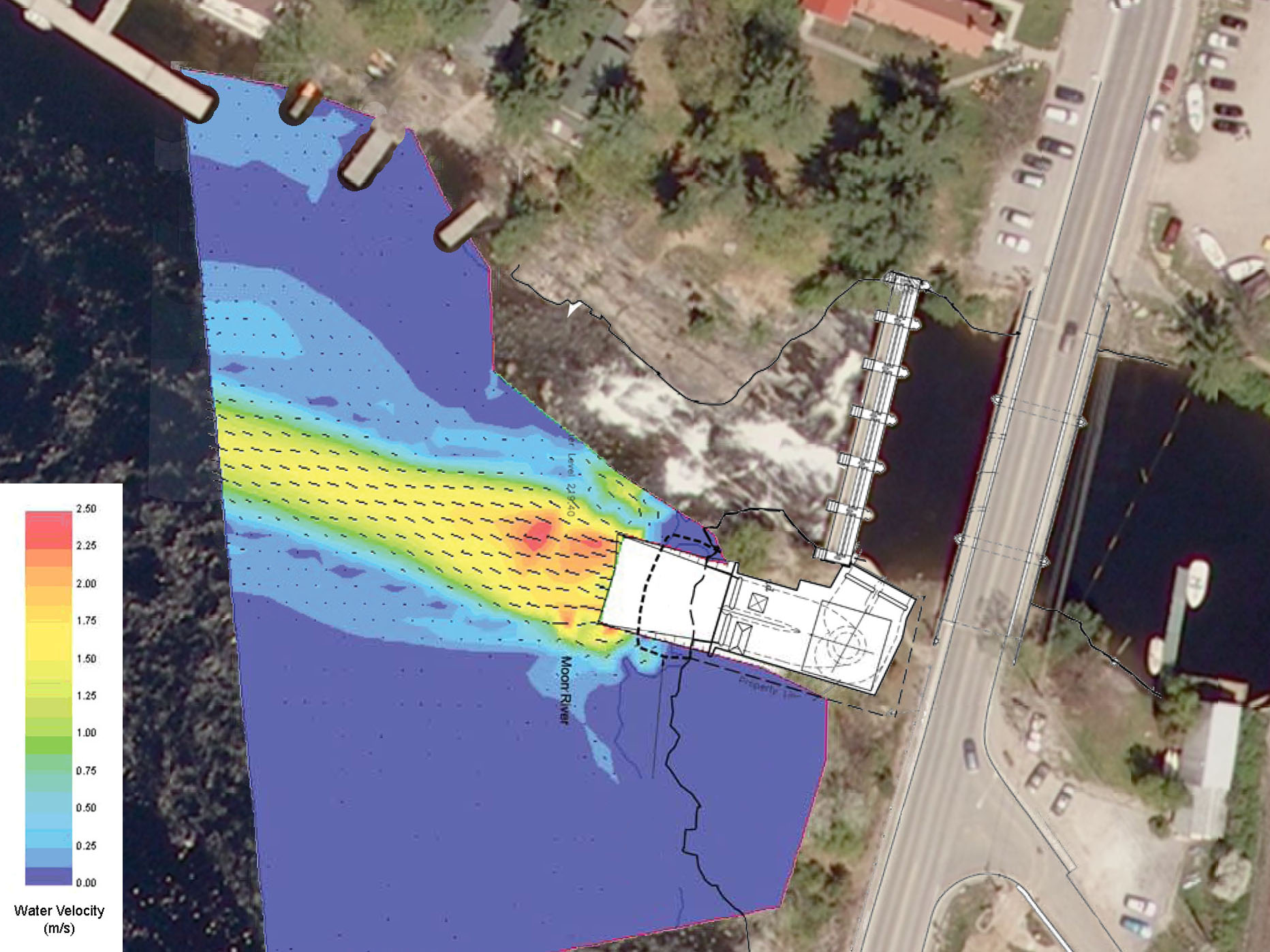
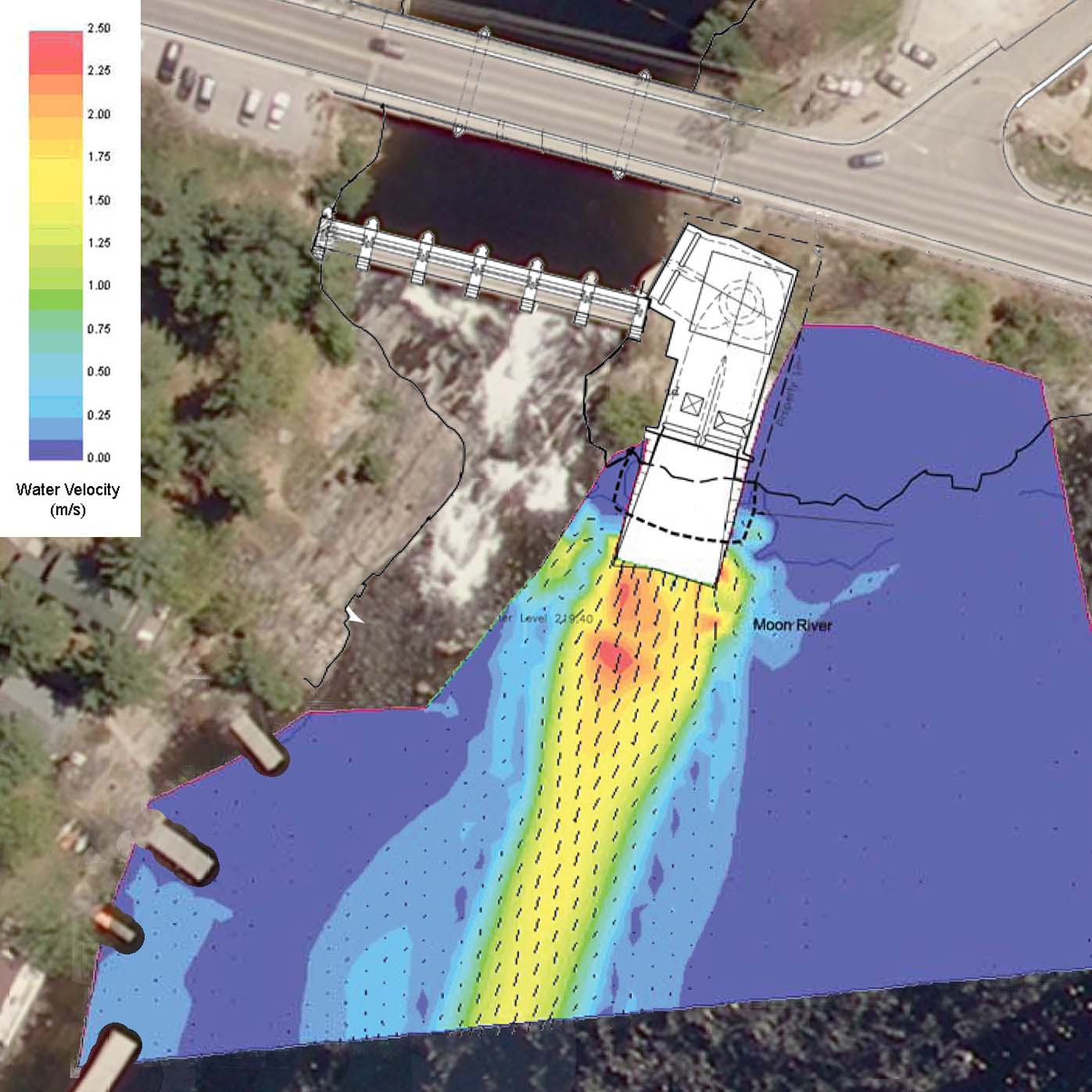
Firstly, this flow simulation is from the proponent’s Environmental Screening Report Addendum, released July 20, 2012, and this last page is entitled “Flow Velocity Field, Downstream Channel, Post Development, Q=98 cms”. This flow therefore represents the proposed generating station operating at full capacity, as confirmed by Section 2.1.2 of this Addendum.

Since February 2013, SaveTheBalaFalls.com has had an analysis of the Moon River water flow posted here, some conclusions from this and the proponent’s information provided are as follows:

a) While the average flow through the generating station in the summer months is typically low, it would be amplified by the required cycling operation:

  • For example, Section 2.1.6.1 (page 2-5) and Figure 2.4 of the proponent’s 2009 Environmental Screening Report shows that the flow through the Bala North Falls is typically less than 10 m³/s during the summer months (as any excess water now flows through the Bala South channel). However, the proponent would be required to operate the proposed generating station in a cycling mode operation during low flow periods “such that its operating discharge is 26 cms or more” (according to the December 15, 2010 signed agreement with Ontario Power Generation). Therefore, the flow at the base of the Bala North Falls would be increased during plant operation from less than 10 m³/s to more than 25 m³/s – an increase by a factor of more than 2½.
  • And shown in “Detail – Cycling Operation” here, this cycling operation would occur for about ⅓ of summer days, with operation beginning soon after 11:00 am on those days (which would be the most likely time for people to be in the water near the tailrace of the proposed station).

Therefore, this substantial increase in flow would occur often enough to be significantly dangerous.

b) Operation at the station’s full capacity is shown in “Detail – Running at Full Capacity” here:

  • It shows that during the 44 years of historical water flow data available, the station would have run at full capacity at least ten times during most every week of the year – even the summer weeks.
  • Specific analysis is provided for the most recent years the data was available, including that the station would have run at full capacity in 2009 both until May 25 and from July 31 to August 3. In 2008 the station would have run at full capacity; to May 26, from June 10 to June 25, from July 4 to 6, from August 12 to 20, and from September 16 to 22. And in 2007 the station would have run at full capacity to May 6, and from July 21 to 22.

That is, the station would operate at full capacity, as shown in the proponent’s flow simulation, many times each summer. So the drowning danger would be present often enough to be significant.

As noted, this information has been posted on the SaveTheBalaFalls.com website for over six months and we have not received any concerns about its accuracy. As always, contact us at info@SaveTheBalaFalls.com to discuss this data, the calculations, or anything else on the website.


3) Concerning our claim that drowning would result from the proposed station’s tailrace being so close to the in-water recreational area at the base of the Bala North Falls:

To begin with an example, I don’t think one needs any particular qualification other than some common sense to say that children should not play on the shoulder beside a busy highway.

  1. Further, when the proposed station is operating at full capacity (often enough, as noted above) the speed of the water from the tailrace would be faster than an Olympic swimmer can swim – as is noted here. Given the water exiting the station’s tailrace would be churning and turbulent due to the station’s turbine rotation, I think it is common sense that even when operating at less than full capacity, for example at the 26% for the required cycling operation, people would still drown in this fast water which would be just feet from where people would be swimming.
  2. I should note that despite repeated requests, the proponent has never had an organization competent in swimming safety provide any suggestions, concerns or advice about their proposals. I would be happy to defer to such input.
  3. Given the proponent’s extremely biased view, unsubstantiated assurances of safety from them should be ignored.
  4. I should also note that as provided by the example of the Moon River Property Owners Association’s concerns that known rocks and shoals in the Moon River are not marked, there is no organization responsible for public safety. As the Township of Muskoka Lakes would be the most affected by drownings due to the proposed station, it would be in the Township’s interest to pursue their own confirmation of public safety independent of the proponent.
Sep 152013
 

Olympic swimmer Michael Phelps has won 22 olympic medals, more than any other olympic athlete in history – including 18 gold medals, which is double the number of gold medals held by the next most-decorated Olympic athletes.

In Michael Phelps’ career-best olympic races he travelled at up to 2.1 m/s (2008 Olympics, 100 m freestyle, in 47.51 seconds). In the proponent’s flow simulation below (click for a larger view), you’ll note that in several locations, the water speed would be even faster than this (the orange and red colours). And for some reason, this flow simulation doesn’t even show the water speed closer to the tailrace, where this treacherously turbulent water would be:

  • Even more concentrated and therefore faster.
  • Even closer to the in-water recreational area at the base of the north falls – yet still outside of the floating “safety boom” where one would expect it would be safe to swim.

Also, what this simulation doesn’t show is that since the turbine of a hydro-electric generating station turns at hundreds of revolutions per minute, the water exiting the tailrace would be a churning and agitated boil – impossible for anyone to swim in.

That is, anyone getting near this fast water exiting the proposed generating station would be sure to drown.

The proponent has refused to have this extreme danger evaluated by an organization competent in swimming safety.

Apparently due to political and lobbyist pressure, the Ministry of the Environment did not question this grievous omission. As the Ministry of Natural Resources has specific responsibility to determine that a particular location is suitable for a particular use, we request and expect that the required Location Approval of the Lakes and Rivers Improvement Act not be granted, otherwise, it would appear that the government is trying to drown visitors to Bala.

Aug 272013
 

It is clear that the proponent’s current proposal (“Alternative 1A”) would:

  1. Be more difficult, and cost more, to build
    • Would require a temporary construction bridge over the north falls, construction materials would need to be stored farther away, site excavation and hauling more difficult
  2. Produce less power
    • Because of the constricted intake, which also has more bends
  3. Cost more to operate
    • Maintenance access, driveway access, and intake gate implementation would be more difficult, transformer location and ventilation more difficult
  4. Impinge on riparian rights and right of navigation
    • For at least the three private property owners and for the Township of Muskoka Lakes dock, just downstream
  5. Create massive dangers to the public
    • Due to the long-time and very popular in-water recreation within 50′ both upstream and downstream

So if it would cost more to build and operate, produce less power, and have operational risks, why did this happen.

Firstly, the proponent simply would not actually provide answers to the public’s fair and relevant questions, so the Township of Muskoka Lakes could not proceed with land lease negotiations, so the proponent could not proceed with their proposed Option 2. As the proponent chose to not answer the questions, presumably they knew the public would not like the answers.

As to why such an unworkable proposal is now being considered, it appears the government’s attitude is “if you want to build such a ridiculous thing, we’ll rubber-stamp the approval”.

Finally, the Ontario Liberal government’s process is backwards in that they first select an “Applicant of Record” and the government then considers they have an obligation to approve whatever the proponent then proposes, even if it is then found that there are environmental or other problems. The government apparently feels they have a committment that once a proponent starts spending money on environmental assessment and other design and approval work, the proposed project must be approved, both so:

  • The government has no liability for money spent by the proponent (which would be wasted if approvals are not granted).
  • That private developers will continue to finance and build generating stations in the future.

The end result is that the environmental assessment process becomes a meaningless farce. So here we are, with a proponent trying to build something that shouldn’t be built.

Aug 242013
 

Currently, before Ministry of Natural Resources staff remove stop-logs from the Bala dams they first look to see that the resulting increased flow will not endanger people playing in or beside the water below.

But the proposed hydro-electric generating station would be automatically operated, with nobody checking for scuba divers or others that would be in the path of the suddenly and treacherously turbulent water exiting the tailrace.

Did you know that the proposed hydro-electric generating station’s cycling operation would begin at about noon most days of the summer, just when people would be in the seemingly safe water at the tailrace.  The suddenly treacherously turbulent water would be almost impossible to swim out of and would push people out to the middle of the Moon River.

Seems to be an automated drowning machine.

Did you know that the MNR and proponent are nonetheless proceding with this insanity.

Aug 242013
 

Did you know that insurance is the largest operating cost of hydro-electric generating stations – larger than all other operating costs combined, including maintenance, administration, depreciation, and taxes.

Visiting the nearby hydro-electric generating stations; Hanna Chute (Bracebridge), Matthias Falls (Bracebridge), Minden, Muskoka South Falls (Bracebridge), Trethewey Falls (Bracebridge), Bracebridge Falls, Wilson’s Falls (Bracebridge), High Falls (Bracebridge), Big Eddy (Bala), Ragged Rapids (Bala), Wasdell Falls (Severn Bridge, planned), Fenelon Falls, Auburn (Peterborough), London Street (Peterborough), Shand Dam (Fergus), Elliot Falls (Norland), and Heywood (St. Catherines) shows that:

  • NONE have in-water recreation both upstream and downstream within 50′ – but Bala does.
  • NONE have public and private boat docks within 200′ – but Bala does.
  • NONE have private residences within 200′ – but Bala does.
  • NONE are the focal point for visitors – but it is in Bala.

That is, the Bala Falls is a different situation than all others. It is accessible and constantly visited by loads of people.

The Ministry of Natural Resources is not accepting that the Bala Falls is different. Not only the proximity to in-water recreation, but also the required – and treacherous – cycling operation. This proposed hydro-electric generating station would be an accident waiting to happen again and again.

For over 100 years, families have splashed and played at the base of the Bala Falls. This proposed project would bring the fast water that currently enters the Moon River through the South Channel 250′ closer to this. As a result, people will drown. And the proponent building this ill-advised project would be complicit in these deaths.

Aug 232013
 

What else can we conclude …

  • The massive jet of treacherously turbulent water from the turbine would be just feet from where for over 100 years families splash and play in the water.
     
  • And this torrent of fast water from the tailrace would be just as deadly outside of the “safety boom” as inside (see the proponent’s own flow simulation below). Such deception should be illegal.
     
  • Even worse, as the proposed hydro-electric generating station would use cycling operation, at about noon most days of the summer – and without warning – the torrent of fast water would unexpectedly start and push people out to the middle of the Moon River.
     
  • The proponent’s own 2009 Environmental Screening Report stated the generating station this close to the falls “could cause safety concerns“.
     
  • The environmental assessment was a farce. Serious concerns about public safety were simply not addressed. Politics have trumped reason and public safety. The Ontario Liberals’ legislation for such proposals is backwards in that it assures proponents environmental assessment approval once they are selected.

The proponent’s colour-coded flow simulation below shows how close this deadly stream of water would be to the long-time recreational and scuba-diving area at the base of the north falls.

Aug 222013
 

We sent the letter below to Premier Wynne on September 11, 2013 …


Hello Premier Wynne,

Since I met with you last year concerning the proposed hydro-electric generating station at the Bala Falls, the proponent has presented a new proposal which would:

  • Be outrageously dangerous to vacationing families
  • Result in drownings, and therefore lawsuits and liability to the province

 Further details are in the attached letter, please respond with what actions you will take.

——————————————————————————————
Mitchell Shnier, on behalf of SaveTheBalaFalls.com
℅ Box 346
1038 Bala Falls Road
Bala, ON  P0C 1A0

Jul 072013
 

Summary

While the proponent has received environmental assessment approval from the Ontario Ministry of the Environment, another approval they would need to construct their proposed hydro-electric generating station at the Bala falls is “Location Approval” under the Lakes and Rivers Improvement Act, which is administered by the Ministry of Natural Resources.

One reason we’re so lucky to live in Canada is that we have the Judicial Review Procedure Act. This enables government decisions to be reviewed by learned judges – who have the power to “set aside” decisions for which there is an absence of evidence or they otherwise find to be invalid. As shown below, it appears that:

  • The MNR providing Location Approval would contravene the Public Lands Act.
  • There may be inadequate evidence supporting the MNR’s recent declaration that the Crown land south of the north falls is too dangerous for public use.

Accordingly, the Township of Muskoka Lakes has filed an application for Judicial Review.

Detail

The Environmental Commissioner of Ontario has frequently documented concerns that the Ministry of Natural Resources makes decisions without allowing public comment or consultation.

The proponent’s current proposal (which they refer to as “Alternative 1A”) would block the traditional and historic portage over the Crown land south of the north falls, and this is not allowed by Section 65(4) of the Public Lands Act – which states that where a “portage has existed or exists”, a “person who obstructs, hinders, delays or interferes with the exercise of such right of passage is guilty of an offence”. That is, if the proposed generating station was built it would contravene the Public Lands Act.

For years, the public and the Township have noted the concern about not obstructing this portage and otherwise maintaining public access to the south side of Bala’s north falls. For example, we have noted our concern about this portage in Section 2.1.4 of our response to the proponent’s Environmental Screening Report (2009) and again in Section 2.2.2 of our response to the proponent’s Addendum (2012).

This concern has been more recently brought to the attention of the MNR, and their initial response was that they needed written historical evidence that the portage existed “prior to the initial Crown patent”. Even though we see no justification for this addtional requirement of when the portage was first used, we provided this written historical evidence that this portage has been in use since before the initial Crown land patent was granted. Also, we note that the:

Also, we note that the current portage route over the Crown land is now the only route possible due to actions by the Crown (construction of the dams, blasting of the channels, construction of the Highway bypass).

Nonetheless, the MNR, and based on this response, the MoE, have repeatedly denied that this portage exists, despite the above.

In May 2013, the MNR unilaterally declared (photograph here) that using the power they have under Section 28 of the Public Lands Act that the Crown land south of the Bala north falls is suddenly somehow dangerous (the terribly tragic two drownings in 2009 had nothing to do with the use of the Crown land, would not have been prevented by the Crown land being restricted from public use, and were not mentioned in the MNR’s Bala Public Safety Measures Plan which was released two years later, in 2011).

We note that the MNR’s 2011 Public Safety Measures Plan made many recommendations, for example, about safety booms and signage. But even though it acknowledged the path of the portage through both a map and a photograph, the Plan made no mention of a safety concern for the public using this portage or for any use of the Crown land. We can only assume the MNR has now determined that they must agree that there is a portage which would be subject to protection by the Public Lands Act, so the MNR reasons that if the public is not allowed to walk on that land, then one could not portage, so there isn’t a portage, so the Public Lands Act would no longer apply. However, the Public Lands Act protects the portage whether the “portage has existed or exists” (underlining added), so we do not see how this Section 28 declaration would relieve the MNR of their obligation to continue to ensure this portage route is not obstructed. Furthermore, we do not see any evidence of why this declaration is justified or valid, such as a study showing such an access restriction would improve public safety.

That is, it appears that the MNR is proceeding with allowing the portage to be obstructed by the construction of the proposed generating station, even though this would contravene the Public Lands Act. This is one reason why the Township of Muskoka Lakes has filed an application for Judicial Review.

The court date set for the judges to hear this case is in late August 2013, and we will be eagerly awaiting their reasoned decision, perhaps as early as this September. We are pleased that such recourse to the courts is possible, given the appearance of political and lobbyist interference in the Ministries’ previous decisions. We are also very pleased at the Township of Muskoka Lakes Council following-through on the 2010 municipal election campaign committments that most of them made to take effective steps to help save the Bala falls.