Apr 212012
 

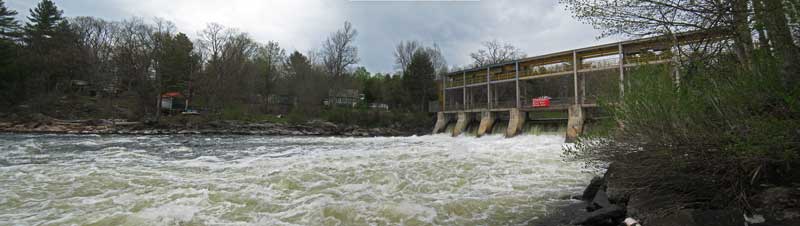
We have been fighting a proposed hydro-electric generating station at the Bala falls in Bala, Ontario (in Muskoka) for over four years. For the proposed station:

  • The province’s taxpayers would pay the private developer the hugely subsidized rate of 17.685 ¢/kW•h (the base FIT rate of 13.1 ¢/kW•h plus the 35% peak adder for electricity generated between 11:00 am and 7:00 pm) whether the electricity was needed or not, even though just downstream there is an older existing hydro-electric generating station owned by OPG which generates electricity for which OPG is paid the standard 3 ¢/kW•h to 4 ¢/kW•h (for comparison, typical residential home owners in Ontario pay about 11 ¢/kW•h, as this includes the cost of transmission and distribution to homes – that is, the transformers, utility poles, and wires between us and the generators).
  • Being hydro-electric, these stations would generate the most electricity in the spring and fall (that is, when there is the most water). Unfortunately the demand is lowest at these times, yet the province would still be obligated to pay this private developer the hugely subsidized rate even when the electricty isn’t needed and must be sold to the U.S. at a much lower rate, and even when “negative pricing” occurs and Ontario must pay the U.S. to take our surplus power.
  • So when the electricity isn’t needed, the province (us taxpayers) would still be paying the 17.685 ¢/kW•h to the private developer for energy from the proposed station (the FIT contract requires this), and the OPG station downstream would need to spill the water bypassing their station (the Moon River cannot be used to store water), wasting the resource of the station that is already there and paid for, and wasting the water too.

 But this isn’t just a temporary shame due to a political decision, the proposed station would permanently:

  • Make the in-water recreation (swimming, scuba diving, floating on inflatable toys, canoeing … that has been drawing tourists and supporting the local economy for 100 years) too dangerous to continue.
  • Make over 500′ of the only publically-accessible shoreline in the area too dangerous to access.
  • Require a poured-concrete building over 100′ long in direct view from the most popular vantage point.
  • Take 94% of the water over the falls throughout most of the year, leaving only a trickle — nobody will come to see where the falls used to be. The Bala falls are the only attraction that draws tourists to Bala, the area’s economy depends on it.
  • And for this, the proponent would receive a subsidy from us taxpayers of $100 million – just for this one 4 MW station – over the 40-year life of the contract.
  • Eliminate a historical portage that is part of the cultural heritage landscape of the area. And the daily water level fluctuations due to the cycling operation would affect the fish and shoreline habitat, the siren sounded each day would be annoying. And the barbed-wire fencing would be ugly.

And more crazy than that, over six months ago, the proponent withdrew their “Option 2” proposal (which is the subject of all the environmental assessment information they have provided to date) and yet the Ontario Ministry of the Environment continues to spend staff resources considering approving this abandoned proposal, as they have been for over a year.

And the Ministry of the Environment has said they will accept this Option 2 environmental assessment as a foundation for whatever new proposal the proponent may put forth, even though the existing environmental assessment would have over 133 Sections, Tables, and Figures factually-incorrect as a result of their decision to change the location and orientation of their proposal.
More detail is here and here.

Apr 022012
 

Summary

Please write an e-mail to the Ministry of the Environment if you agree with us that their environmental assessment of the proposed hydro-electric generating station at the Bala Falls must be restarted as:

  • The project proposed has been completely changed.
  • Much of the information the proponent has submitted is now incorrect, contradictory or superceded.
  • There has been no public consultation – meaningful or otherwise – on the proponent’s “new proposal” which is to replace their proposed and now abandoned Option 2. All that we know of this new proposal is that it apparently could be built solely on Crown land and that the process followed has not yet shown us any details.
  • The proponent’s government lobbyist was apparently allowed to meet with senior staff at the Ministry of the Environment – the same staff deeply involved with this proposed project – during this crucial decision time.

Over the years of developments and changes for this proposed project, adherance to the required process has gone from marginal to unacceptable. There is now a complete lack of fairness and transparency. The environmental assessment process requires better.

Additional details are below. If you wish, e-mail the Minister of the Environment, The Honourable James J. Bradley, at JBradley.mpp@liberal.ola.org noting the government requires an “accountable, logical and reproducible process of decision making” but for this particular environmental assessment there is an  unacceptable lack of due process.

And as always, if you have any questions or comments, or to copy us on any e-mails you send, we are at info@SaveTheBalaFalls.com


Detail

In our democratic society, government due process and transparency are important, and in fact specified to be required for enironmental assessments, yet we find:

  • In 2009 the proponent submitted an environmental screening report for their Option 2 proposal, and even though they have announced their abandoning of this Option 2 proposal, the proponent has not withdrawn their environmental screening report and in fact the Ministry of the Environment staff continue to spend time on it, determined to confirm their approval of it.
  • As shown by the additional documents the proponent was required to submit, the environmental screening report was deficient. Some information in the additional documents supercedes that in previous additional documents and also in the environmental screening report, yet it is not clear to most everyone what currently applies and what does not. It is a confusing mess.
  • Then on top of this, the proponent changed to cycling operation, and then they changed the site, location, orientation, and technology – making even more of the confusing mess of documents obsolete and out-of-date. For example, we have itemized 133 Sections, Tables, and Figures in the environmental screening report which are now factually incorrect and require rewriting.
  • The public has never been presented with information on the proponent’s as-yet-undescribed “new proposal” other than it could apparently be built solely on Crown land. Such a proposal has never been presented to the public:
    • Not at either of the public information centres (in 2007 and 2008).
    • Nor in the environmental screening report.
    • As all of the drawings presented showed that both Crown and municipal land would be required for all options (even for “Option 1”). Whatever the proponent may next propose would be a new proposal for which there has been no public consultation. Meaningful public consultation is a fundamental aspect of the required environmental assessment process.
  • While the public has not been able to get any feedback from the Ministry of the Environment on what issues are delaying their decision (or what information may be helpful to provide to assist with this decision), we understand that not only is the proponent able to meet with senior staff at the Ministry of the Environment, but the proponent’s hired lobbyist was also able to meet directly with senior staff at the Ministry of the Environment. Obviously, this would not be to discuss technical and science issues. This political interference alone should be cause to declare that the environmental assessment process has been corrupted and must be restarted. This is not a democratic and transparent process, this is wrong. As documented in Section 3.2.3 of the Ministry of the Environment’s Preparing and Reviewing Environmental Assessments in Ontario, it is required that the process be “open and transparent”, and the process be “clear, rational and logical”.

The environmental assessment process for this proposed project is dictated by the Guide to Environmental Assessment Requirements for Electricity Projects, which notes this is to be “an accountable, logical and reproducible process of decision making”. The only way this could now be achieved would start with the Ministry of the Environment rejecting the environmental screening report and subsequent documents, and restarting this environmental assessment, beginning with a public information centre for the project actually being proposed.


Background

The proponent for this proposed hydro-electric generating station at the Bala Falls released their environmental screening report on October 14, 2009 and by the public comment deadline of November 27, 2009, the public noted many significant deficiences and therefore requested that this proposed project be elevated to require an individual environmental assessment. On March 28, 2011 (that is, 16 months later) the Director of the Environmental Assessment and Approvals Branch informed us of her decision to deny these requests for elevation.

By the required deadline of April 18, 2011, a large number of requests were sent by the public to the Minister of the Environment to review the Director’s decision (this is somewhat like an appeal process).

While there is a goal that the Minister will make a decision on these requests within 45 days (which was June 20, 2011), this appeal decision is still under review by the Minister. One complexity was that the October 6, 2011 Ontario provincial election resulted in a new Minister of the Environment.

During the last 18 months the proponent has made two particularly significant decisions which have fundamentally changed the proposed project, as follows:

  1. In December 2010, the proponent agreed to change the operating regime of the proposed project to use a cycling operation; at least during the summer months, and at least up to 1/3 of the proposed station’s capacity. The many negative environmental and public safety impacts of this major change have still not been addressed by the proponent.
  2. In the October 19, 2011 edition of the Gravenhurst Banner, the proponent placed an advertisement announcing they were abandoning pursuing their proposed Option 2 (our comments are here), and would instead be pursuing some new proposal which they claim could be built solely on the Crown land directly south of the north dam. Note that the public has not been presented with information on a proposal that would fit solely on Crown land – not in the environmental screening report, and not in either of the public information centres the proponent held in 2007 and 2008.

The current status is that the proponent hopes their environmental screening report and other submissions for their proposed Option 2 will be accepted and the proponent hopes that by submitting an Addendum, they could fulfill their environmental assessment obligations for their new proposal. However, environmental assessment would be based on the following:

  1. An environmental screening report which is over 600 pages in length and for which we have detailed over 50 pages of deficiences. And as a result of the above two changes, as detailed here, 133 Sections, Tables, and Figures of the environmental screening report are now incorrect and require rewriting.
  2. The proponent then issued a Letter of Intent replacing some of the fish habitat information. We did not find this adequate, but in any case, this has been made obsolete by the proponent’s subsequent decision to use cycling operation (see d. below).
  3. The proponent then provided an economic impact study which was found to be completely deficient (more here) by a peer review.
  4. The proponent then released a brief letter concerning their proposed cycling operation, this replaces some of the replaced fish habitat and other information. This document was completely deficient (more here and here).

And on top of this mess of deficient documents from which nobody could figure out which information is superceded, augmented, incorrect, or obsolete, the proponent expects to layer on an Addendum for some new proposal which would have a different:

  1. Site (rather than building the powerhouse, driveway, and retaining wall on municipal land, it would all be built solely on Crown land).
  2. Location (rather than the construction being more than 65′ from the north dam, they would need to blast down into the Muskoka bedrock a 60′-deep intake channel directly adjacent to both; the north dam – which is over 100 years old, and the support piers for the highway bridge – which have been there for 57 years).
  3. Orientation (the dangerously fast and turbulent water exiting the tailrace would be directed directly past the recreational area at the bottom of the north falls, and towards the public docks on the Moon River – making marine navigation there difficult and dangerous).
  4. Technology (while the environmental screening report only analyzed fish mortality and other negative environmental impacts for a single horizontal turbine, the proponent has stated they may instead use two vertical turbines – which would substantially increase fish mortality, also there would be a signficant risk of flooding Lake Muskoka during construction).
  5. Operating regime (the proponent would now operate the proposed station in a cycling operation, and they have not analyzed the many public safety, fish and shoreline habitat, and marine navigational impacts of this – for example, just downstream in Gaunt Bay there is an officially-desginated area of natural and scientific interest, as confirmed in Section 2.1.8 and Figure 2.6 of the environmental screening report, yet the proponent has not provided information on how their proposed cycling operation would affect this).


Conclusion

Therefore, as detailed here, in the links above, and in the other items posted at SaveTheBalaFalls.com, due process has not been followed. A science- and fact-based environmental assessment of the proponent’s new proposal cannot be based on the information submitted and process followed to date.

The only way forward is to reject the proponent’s information submitted and require that the environmental assessment process be restarted, beginning with a public information centre which would present – for the first time – the proponent’s new proposal.

If you are as concerned about this apparent disregard for procedure, you may wish to e-mail your concerns to:

The Honourable James J. Bradley
Minister of the Environment
77 Wellesley Street West
11th Floor, Ferguson Block
Toronto, ON  M7A 2T5
JBradley.mpp@liberal.ola.org

If you have any questions or comments, please contact us at info@SaveTheBalaFalls.com

Apr 022012
 

Summary

The proponent has always told the public that their Option 1 proposal could be built solely on Crown land, but we have marked-up the proponent’s Option 1 drawings from their 2007 public information centre and from their 2009 environmental screening report showing the Crown land property boundary – this clearly shows that Option 1 could not be built solely on Crown land.

Also significant is that one reason the proponent rejected Option 1 was that it would be too dangerous for people playing in the water at the base of the north falls. The proponent has stated they have abandoned their proposed Option 2 and will announce some new proposal, and while all we know so far is that this new proposal would apparently be built solely on Crown land, the new proposal would need to be angled towards the base of the north falls and the town docks on the Moon River – and the dangerously fast and turbulent water exiting the tailrace would be even more dangerous to those at the base of the north falls and would also make docking boats at the town docks on the Moon River difficult and dangerous.

For these and many other reasons, whatever the proponent’s new proposal turns out to be, it is not Option 1, and we have never been shown a drawing of it.

The environmental assessment process requires the proponent to conduct meaningful public consultation, and this includes showing the public; in-person, at a public information centre, the main aspects of their plans. This has not been done for the proponent’s new proposal.

Therefore, the proponent should be required to restart the environmental assessment process, beginning with a public information centre showing the actual plans and property boundaries and how public safety and marine navigation would be addressed.

If you agree that the public has never been shown a proposal for a hydro-electric generating station at the Bala Falls that could be built solely on Crown land, please send an e-mail to the Minister of the Environment stating there has been no meaningful public consultation and that the envrionmental assessment must therefore be restarted, beginning with a public information centre.


Detail

A fundamental requirement of the environmental assessment process is meaningful public consultation.

For example:

  • The Province of Ontario’s Environmental Assessment Act notes the Obligation to Consult in Section 5.1. This has not happened, since the public has never been shown plans that could be built solely on Crown land.
  • The Ministry of the Environment’s Guide to Environmental Assessment Requirements for Electricity Projects notes in Section A.6.2.1 that “The applicant’s public consultation program should … describe how the project may affect the environment” and “Failure to carry out adequate public consultation or to address public issues or concerns may result in requests to elevate the project”. There has been no such public consultation for the proponent’s new proposal. The document notes that the Environmental Assessment Act provides for an “… accountable, logical and reproducible process of decision making”.
  • The Ministry of the Environment’s Preparing and Reviewing Environmental Assessments in Ontario notes in Section 2.1 that “Proponents are required to … Engage in meaningful consultation with all interested persons …” . And in Section 3.2.2 it is noted “The environmental assessment process should be clear and consistent” and “The Environmental Assessment Act should be applied consistently to similar undertakings …”. We understand that all other environmental assessments have begun with a public information centre at which the public could view and ask questions of the plans. However, for this proposed project the public has never been shown any plans that could be built solely on Crown land. In Section 3.2.3 it is noted “The environmental assessment process should be open and transparent. This will enable all interested persons to follow the process through its various stages of planning and decision-making …”. We understand senior staff at the Ministry of the Environment have directly met with the proponent’s hired government lobbyist, yet we have no information on what was discussed. This is not open or transparent.
  • For Renewable Energy Projects, as noted in Section 3 (page 24) of the Ministry of the Environment’s Provincial Approvals for Renewable Energy Projects, “Applicants must also hold at least two community consultation meetings …”. This has not occurred for the proponent’s new proposal.
  • The Ministry of the Environment’s Consultation in Ontario’s Environmental Assessment Process notes in Section 5.1 (page 43) that “Proponents are responsible for … Initiating meaningful consultation with interested persons …”. This has not occurred for the proponent’s new proposal.
  • The Class Environmental Assessment for Waterpower Projects notes Section 6.2.2 (page 63) that “Provision of good quality background information regarding the project is essential”. This has not occurred for the proponent’s new proposal.

Given that it is well-established and accepted that meaningful public consultation is required, let’s look at the information the proponent has presented to the public for their proposed hydro-electric generating station at the Bala Falls:

  1. On August 29, 2007 the proponent held their first of the only two public information centres. As the proponent had not yet proposed their Option 2, this public information centre was presenting what has come to be known as Option 1  (which was the original proposal provided by the proponent in their site release program application, which was submitted in July 2005).
    1. The material presented (as reproduced in Appendix D5 of the proponent’s environmental screening report) is here. The main characteristics of Option 1 are that the intake was directly upstream of the north dam (and downstream of the highway bridge) and that the powerhouse would be directly adjacent to the north dam.
    2. Of note is the drawing on page 8 (“Plan and General Arrangement”) where a top view of the area and the proposed powerhouse is shown. What should have been shown on page 8, but was not, is the boundary between the Crown land (owned by the Ministry of Natural Resources) and the municipal land (owned by the District Municipality of Muskoka and by the Township of Muskoka Lakes) – this boundary is shown in Figure 2.12 of the proponent’s environmental screening report, and also in this official surveyor’s drawing.
    3. We have marked-up page 8 here with the property boundary, and this clearly shows what the proponent has never told us; that Option 1 could not be built solely on Crown land.
       
  2. On August 13, 2008 the proponent held their second (and last) public information centre.
    1. The material presented (as reproduced in Appendix D15 of the proponent’s environmental screening report) is here.
    2. Note on page 3 they announce plans to “Move the power station a considerable distance further south …”, and this came to be known as Option 2. And on page 4 indeed Option 2 is shown to require municipal land (but as we have shown above, Option 1 also needed municipal land).
       
  3. Finally, in October of 2009 the proponent released their environmental screening report. Option 1 (which they here refer to as Alternative 1) was described in Section 1.5.1.1 (where they note “Alternative 1 was presented during the Public Information Centre of 2007”) and shown in page 2 of Appendix A (entitled “Alternative 1, General Arrangement”).
    1. Note that even though this shows the proposed Option 1 powerhouse angled away from the base of the north falls, in Section 1.5.1.1 the proponent notes “The tailrace of the powerhouse would be located in close proximity to the falls which could cause safety issues and public concern”. That is, one of the reasons why the proponent rejected Option 1 is that it would be too dangerous to the public recreating at the base of the north falls. Obviously, if the proposed generating station would be located closer to the north falls, this public safety issue would need to be addressed.
    2. We have here marked-up page 2 of Appendix A of the environmental screening report, showing again, that Option 1 could not be built solely on Crown land. That is, the proponent has never shown the public a proposal which could be built solely on Crown land.
    3. All we know of any new proposal which the proponent may next present is that it could apparently be built solely on Crown land, and as shown in this diagram the dangerously fast and turbulent water exiting the tailrace would be angled towards, and even closer to those recreating at the base of the north falls – and this would adversely affect maring navigation as docking at the town docks on the Moon River would be more difficult and dangerous.


Conclusion

The proponent’s new proposal, which would apparently be built solely on Crown land, has never been shown to the public, and has shown above, such a proposal would have significant public safety concerns.

As there has been no public consultation for the proponent’s new proposal, the environmental assessment process must be restarted, beginning with a public information centre.

Feb 082012
 

After being rated by National Geographic as the best of the 10 Best Trips of Summer 2011, National Geographic Traveler magazine has ranked Muskoka as one of the 20 Best of the World 2012 travel destinations.

This is a world-wide rating – Muskoka is rated with Central Africa’s Virunga Volcanoes, Guatemala, and Peru.

That is, Muskoka is special. And protecting the natural beauty is a responsibility, and something worth fighting for.

The proposed hydro-electric generating station would blast away the Muskoka bedrock and put a 100′-long poured-concrete building in direct view of the most popular place from which to view the falls. Both the north and south falls would just a trickle throughout most of the year. Over 500′ of the only publically-accessible shoreline in the area would become restricted as too dangerous for the public.

This would be as shameful as burning down rain-forests or killing elephants for their tusks. We need to protect Muskoka.


Jan 272012
 

Summary
Through many communication channels, the proponent continues to provide incorrect information to the public, to the media, and to the Ministry of the Environment.

Detail
The proponent continues to make statements such as:

  • “the flow during the tourist season, which is in the summer, will not change over those falls” (Toronto Star, January 26, 2012).
  • “The typical summer flow through Bala’s North Dam will be maintained” (FAQs, BalaFalls.ca, January 27, 2012).
  • “flows during the majority of the tourist/summer season (June to October) will not experience any change” (Environmental Screening Report, Section 6.3.5.1).

These statements are simply not true, which we show below in five different ways (and using the proponent’s own information).

1) The proponent’s Environmental Screening Report shows in Table 2.1 that the lowest mean monthly water flow through Bala (which is in August) is 23.1 m3/s. Allowing for the 4 m3/s allocated for the Burgess Creek power station, this shows there currently is a mean flow of over 19 m3/s for the Bala North and South Falls – even in August. Yet, the proponent offers only a total of 2 m3/s or 3 m3/s. Obviously the proponent is “mis-stating” something when they say the flow won’t change.

2) Table 5.2 of the Muskoka River Water Management Plan notes that for the Bala North and South Dams “Minimum outflow of 3.0 m3/s from each dam is to be maintained by leakage or log removal to maintain downstream water quality” and “Burgess Power Station provides an additional minimum flow of 4 cms” . Providing a minimum of 6 m3/s of water flow is not the same as the proponent’s proposal to provide only 2 m3/s or 3 m3/s, even though they are claiming there would be no change.

3) In fact, the proponent’s misinformation even has the Ministry of the Environment contradicting itself. In the MoE’s March 25, 2011 elevation decision letter to all requesters, the Director of the Environmental Assessment and Approvals Branch states “Any incoming flows of 20 m3/s or less (which may occur during the summer season) will be distributed entirely over the two Dams and the Project will shut down until the flow increases to operating conditions, i.e. water flows over 20 m3/s.”

However, on the same date, the same MoE Director sent the same requesters this letter which informed us of the cycling agreement the proponent had signed months earlier. And this agreement requires the proposed plant’s operation be cycled (that is, turned off and on, with no additional water over the falls) during these low-flow times, rather than shut down.

So the MoE is providing mis-information to the public, based on either a misunderstanding or mis-information from the proponent. You can be sure the public is equally flummoxed by this confusing information received.

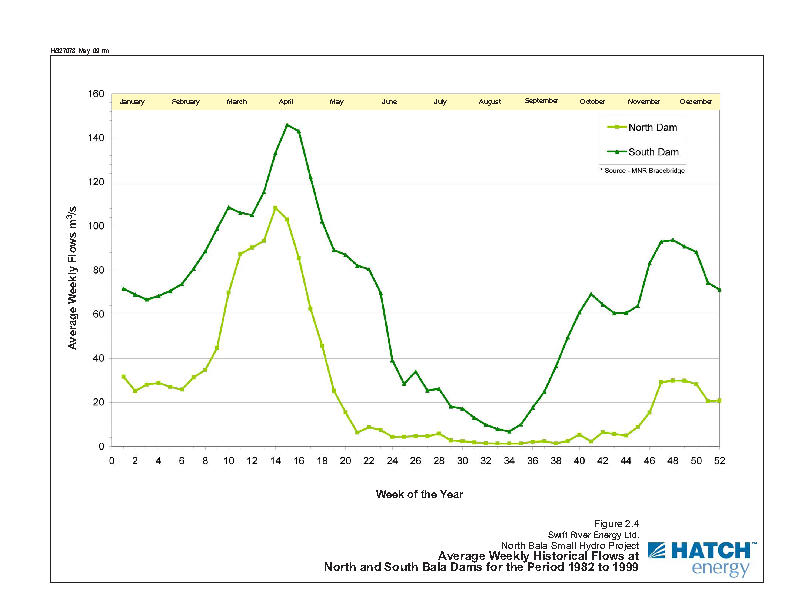
4) The proposed flow can be examined in more detail. As shown in Figure 2.4 of the proponent’s Environmental Screening Report (below, and click for a larger view – and the information is in tabular form in the “Existing” columns here), even during the driest four weeks of the year (weeks 32 through 35 inclusive), the average flow through the Bala North and South Falls is a total of 10 m3/s. Yet the proponent is offering only a total of 3 m3/s (combined for both Falls). This would be a reduction of 70%.

Again, the water flow through Bala would not be maintained, in the summer or any other time of the year. The proponent is making completely incorrect statements about fundamental issues.

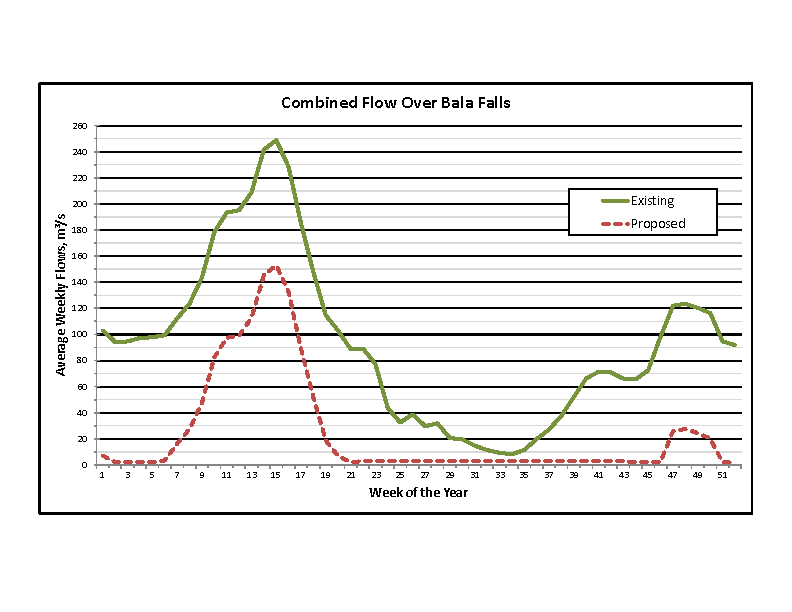
5) We can examine the proposed flow graphically by using the following information:

  • The existing weekly flows from the proponent’s Figure 2.4 above.
  • In Section 6.3.5.1 and 6.3.5.2 of the Environmental Screening Report the proponent states that the flow over the North and South Falls would usually be 1 m3/s each, with 2 m3/s over the South Falls from the May 24 long weekend to the weekend after Thanksgiving.
  • In their Letter of Intent, November 30, 2010, the proponent states that the flow over the North Falls would be increased to 9.5 m3/s for two weeks in the spring for Walleye spawning, and to 2 m3/s for two weeks following this for the Walleye incubation period. Further, their letter states that the maximum capacity of the proposed powerhouse is 96 m3/s, so any flows in excess would be over the Falls.
  • Finally, in a letter from the proponent to the Township of Muskoka Lakes, March 18, 2010, the capacity of the south channel is given as 252 m3/s. Adding this to the 96 m3/s capacity of the proposed powerhouse shows the combined flow capacity of the proposed powerhouse and the South Falls to be (96 + 252 =) 348 m3/s. So given the maximum monthly flow of 317 m3/s (April, Table 2.1, Environmental Screening Report), even during the spring freshet, it would not be expected that the North Falls would have any more than leakage flow.

The above information is entered in the “Proposed” columns here, and the resulting proposed weekly flows, are shown below (click for a larger view).

As is clearly shown in the above graph, despite what the proponent says, the flows would be substantially reduced, even in the summer – to a trickle in most all months that people typically visit Bala:

  • From mid-December through January, when snowmobiling is common
  • From May through October, when most tourists typically visit.

Conclusion
So again we say, the proponent continues to make statements – such as “the flow during the tourist season, which is in the summer, will not change over those falls” – these statements about the most fundamentally important issues of their proposed project, which are simply not true.

Dec 292011
 

The proponent claims they have attempted to compromise (for example, in their advertisement in the October 19, 2011 Gravenhurst Banner), and somehow, even the media believes this (here, and here, for example).

The fact is, the  proponent has not offered anything in compromise.

For example, the community has always been very concerned about the flow of water over Bala’s north and south falls. To receive public input, the proponent proposed a flow distribution committee. For this, the proponent insisted on, and received complete control over “membership, mandate, agenda, and presentation material for this group and inviting guest speaker(s)”, and yet the proponent chose to completely ignore the work done by this committee. The proponent has never offered to reduce the 94% of the water they would take year-round – leaving only a trickle which would not provide any tourist draw.

The proponent is only greedy, inisisting on wringing most every drop out of the falls for themselves, with no care about the area’s economy or tourist draw.

The community has been asking the same questions about public safety, barbed-wire fencing, warning sirens, aesthetics, noise, economic impact, and traffic congestion for years, yet the proponent continues to refuse to actually answer the questions asked.

The proponent won’t work with or listen to the community. The proponent doesn’t answer questions or provide information. There have not been any offers of compromise. The proponent’s “take it or leave it” and “my way or the highway” stance has resulted in the delays and costs they are encountering.

The proponent apparently believes that compromise simply means “give me what I want”.

Dec 062011
 

Summary
As noted in many recent articles such as this and this, Ontario taxpayers would be paying massive subsidies to private developers so that renewable energy projects would be profitable – hugely profitable. As detailed below, for just the one proposed Bala Falls hydro-electric generating station, the subsidies to the private developer would be over $100,000,000 over the 40-year duration of the supply contract.

So we would be paying a hundred million dollars to a private developer so they can;

  • Ruin the Bala Falls and the area’s economy.
  • Make in-water recreation that has been going on for over a hundred years too dangerous to continue.
  • Make over 500′ of the only publically-accessible shoreline too dangerous to access (plus putting up with the sirens sounded daily throughout the summer and having to look at barbed-wire fencing instead of Muskoka’s natural beauty).

In these times of government cut-backs for libraries, public transit, infrastructure repair and so many other services, we do not want our tax dollars going to a private developer. This project should not be allowed to proceed.

Detail – Run-of-river Regime
In their 2005 proposal (which was for a smaller-capacity station than they are currently proposing), the proponent estimated their proposed station would generate 20.77 GW•h/year of energy (which would be 20,770,000 kW•h per year).

Ontario Power Generation financial reports show that existing hydro-electric generating stations (such as at Ragged Rapids and Niagara Falls – that do not receive the Feed-In Tariff subsidized price) receive between 2.0 ¢/kW•h and 3.6 ¢/kW•h for the power they generate.

When the proponent signed their contract with the Ontario Power Authority in 2010 the guaranteed price for the power to be generated was 13.1 ¢/kW•h (FIT 1 2010 rates are here, IESO/OPA FIT document archives are here). Being very conservative and comparing this to 4 ¢/kW•h for existing stations, would be a subsidy of 9.1 ¢/kW•h, which would be a subsidy of ($0.091 /kW•h x 20,770,000 kW•h =) $1,890,070 per year, and $75,602,800 over the 40-year life of the contract.

However, the actual subsidy would be greater, as the proponent intends to operate the generating station in a cycling mode (as detailed below), which creates additional dangers to the public and impacts on fish habatit which they have not assessed.

Detail – Cycling Regime
We note that in their environmental screening report, the proponent proposed a “Best Management Zone” which would allow them a tolerance of 4 cm to 6 cm in water height in all the months when the proposed station would not have enough water to run at full capacity. And running their station at full capacity for 24 hours with only 10 m3/s of flow into Lake Muskoka would change the water level of Lake Muskoka by about ((69 m3/s x 86,400 s/day) / 120 km2 =) 4.97 cm. That is, their requested change to the Muskoka River Water Management Plan would permit them to run their proposed station at full capacity during the daily peak demand period throughout the year.

The proponent has already requested to cycle operation of their proposed generating station during the peak demand period during at least the summer months. If the proponent therefore generated ¾ of their power during the daily peak period of 11:00 am to 7:00 pm, then they would receive the following subsidy per year:

  • (0.25 x 20.77 GW•h) at a subsidy of (0.9 x 13.1) – 4 ¢/kW•h, which is $404,495 for the non-peak periods.
  • (0.75 x 20.77 GW•h) at a subsidy of (1.35 x 13.1) – 4 ¢/kW•h, which is $2,131,780 for the peak periods.

This would be a total annual subsidy of $2,536,276. Over the 40-year FIT contract, this would be a subsidy of $101,451,065 (that’s over a hundred million dollars). And for the larger-capacity station currently being proposed, the subsidy would be even greater.

But what about the discounted cash flow
And yes, an accountant could talk about the discounted cash flow / net present value of this subsidy. And an environmentalist could talk about the cost of CO2 emissions that may not be eliminated. But then maybe we should estimate the loss in the area’s residential property values or the lost revenue to local businesses. Or find out if Ontario Power Generation’s Big Eddy and Ragged Rapids hydro-electric generating stations just downstream (which generate electricity for less than 4 ¢/kW•h) would need to shut down in the spring and fall because the government has committed to paying (1.35 x 13.1 ¢/kW•h =) 17.685 ¢/kW•h for the proposed generating station at peak times whether the power is needed or not. So let’s just agree that indeed Ontario taxpayers would be massively subsidizing this proposed  project.

Nov 272011
 

Summary
While other hydro-electric generating stations in Muskoka may be “in the middle of nowhere”, so do not create public safety concerns and don’t affect the local area’s economy, Bala is different.

The Bala Falls are more accessible, more visible, and more visited than most others. And there is more in-water recreation both upstream and downstream of the Bala Falls than at other falls, and there are more retail stores, restaurants, and residences nearby than at other falls. And Bala depends on the tourist draw of the falls more than other areas. That is, unlike other places in Muskoka, Bala needs the falls to have enough water to draw tourists, and we need in-water recreation to be safe.

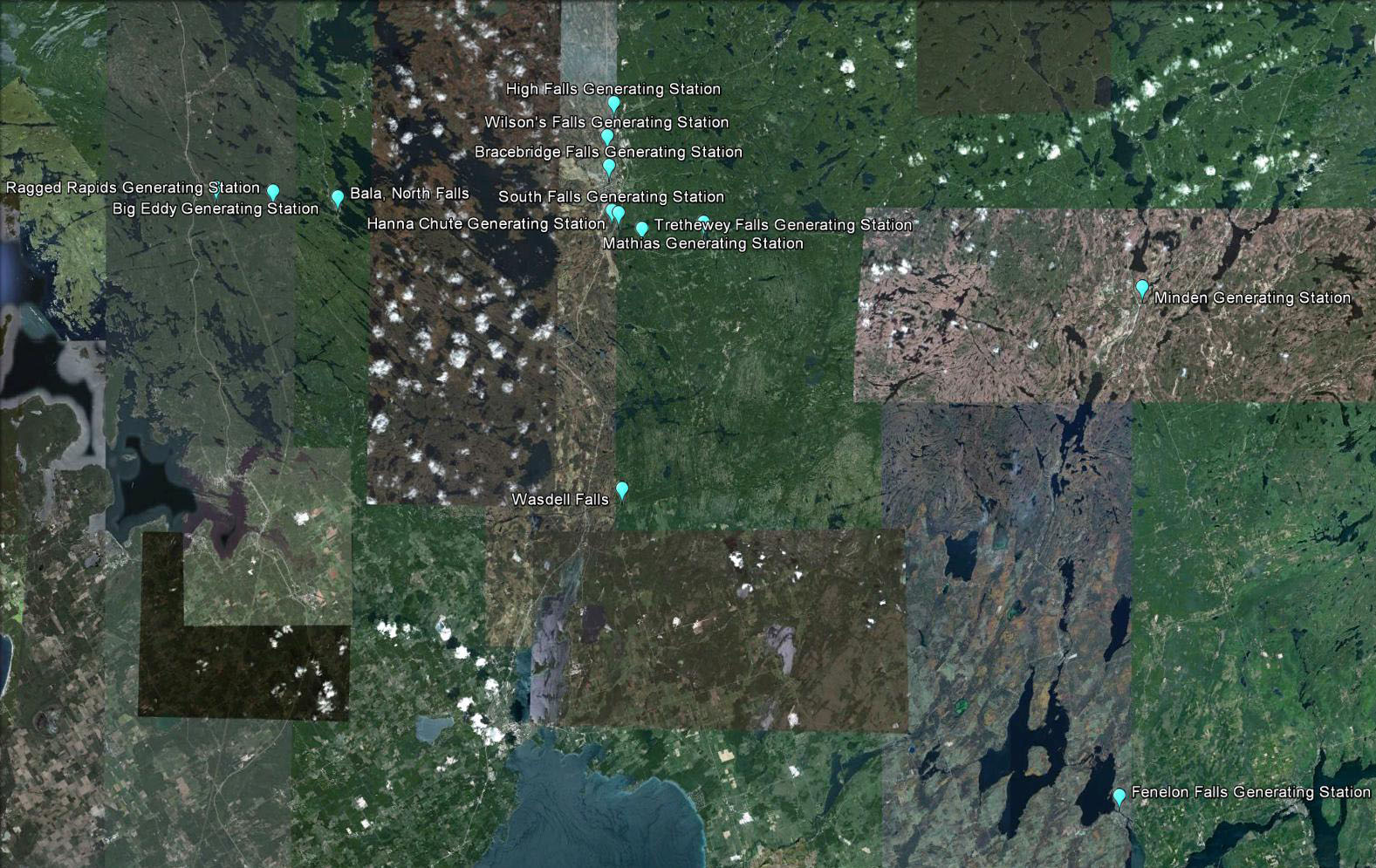
This conclusion is through visiting and hiking all around 12 dams and hydro-electric generating stations nearby. Some of the hundreds of photographs taken of and around these are below.


Detail
While there are many hydro-electric generating stations in Muskoka, Bala is unique. For example at the Bala Falls:

  • In-water recreation (swimming, scuba diving, floating on inflatable toys …) is very popular, throughout the summer, both upstream and downstream of the falls.
  • Boating (motorboats, as well as canoes and kayaks) are very popular, throughout the summer, both upstream and downstream of the falls.
  • Fishing is common, especially adjacent to the outflow of the south channel.
  • The falls are very visible and accessible from the nearby road. And there is parking (and retail stores) nearby.
  • The shoreline and water are very accessible. Some with gentle slopes (upstream of the north and south falls), some with rocks on which many visitors enjoy climbing (downstream of the north falls), and some wheelchair accessible (south falls accessed from the Precambrian Shield parking lot). There are benches to sit on, many places to view the falls and take pictures. People go to the Bala Falls for their wedding photographs. Tour buses stop. The view of the sunset down the Moon River is world-class.
  • The shoreline upstream and downstream of both the north and south falls are public lands, and are interesting and themselves an attraction.

The situation is very different for other generating stations in Muskoka.

Firstly, an overview of the many Muskoka generating stations and falls visited.

As can be seen above (click on that image for a higher-resolution view, or if you have Google Earth installed, click here for an interactive view, and click on each below to zoom in to see the land use upstream and downstream of the stations):


The shorelines upstream and downstream of most of the existing generating stations in Muskoka are inaccessible, most of the shorelines are privately owned, and there is no in-water recreation nearby. There is no parking, there are no retail stores, and only the local population would even know where these facilities are. Some examples are shown below.

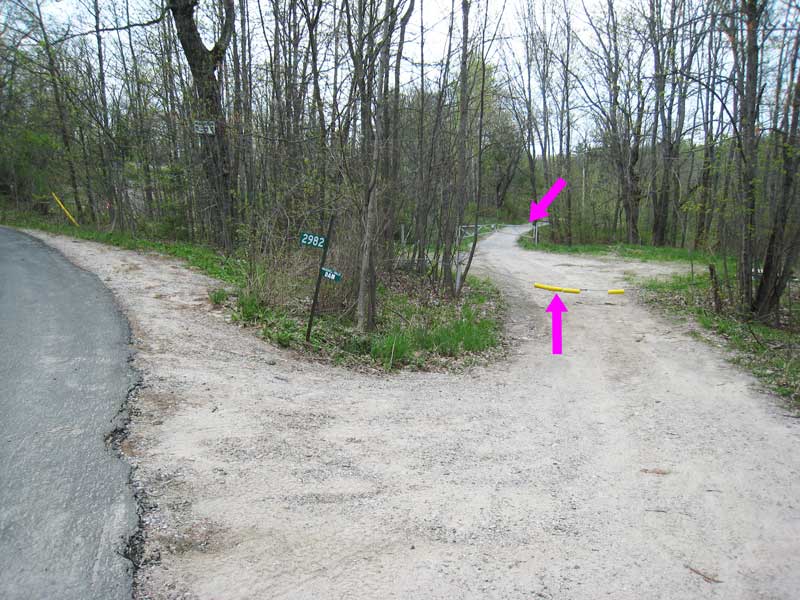
The virtually unmarked side road of a side road to Wasdell Falls is blocked by both a locked cable and a galvanized pipe gate.


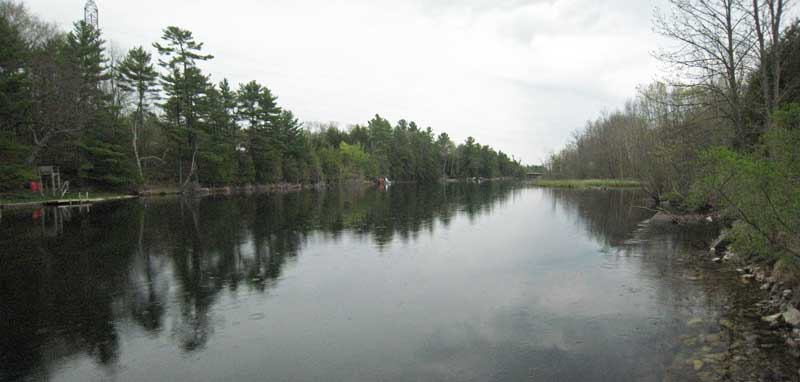
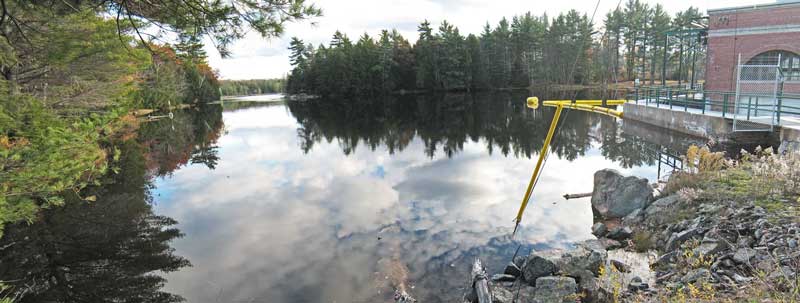
The river upstream of Wasdell Falls has steep banks with trees and brush right to the shoreline. Not many people care or know about the dam here.


It is a hike down a steep rocky slope to get to the downstream side of the dam.


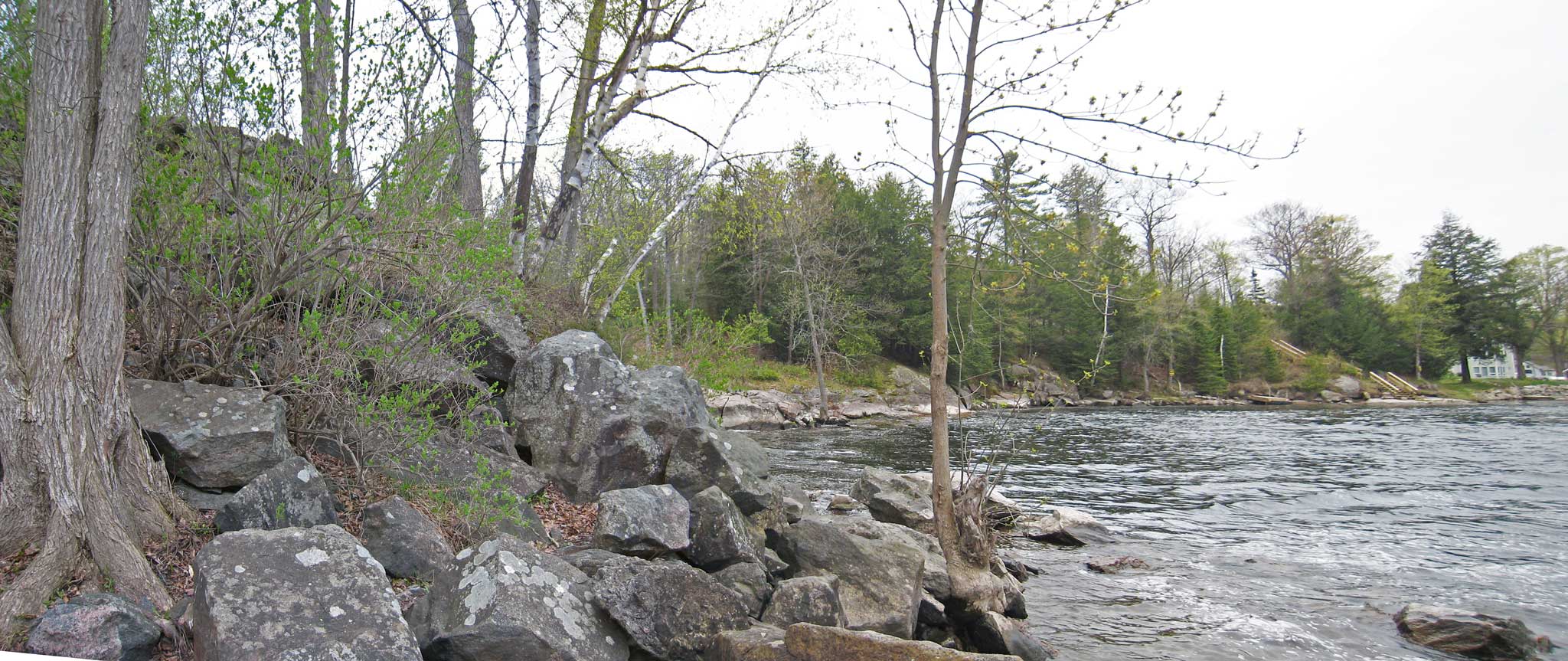
Downstream of Wasdell falls shows that the shoreline is steep and the far side is all private property.


Parking beside Highway 21 and climbing through the brush to Gull River, and looking upstream from the Minden dam shows that the shore is muddy and inaccessible. There are no people and there is no in-water recreation.


Looking downstream at the Minden dam shows again, the area is unused and inaccessible.


The entrance to the Minden generating station is off of Highway 20, and has a locked gate (again, this is inaccessible, few would even notice this).


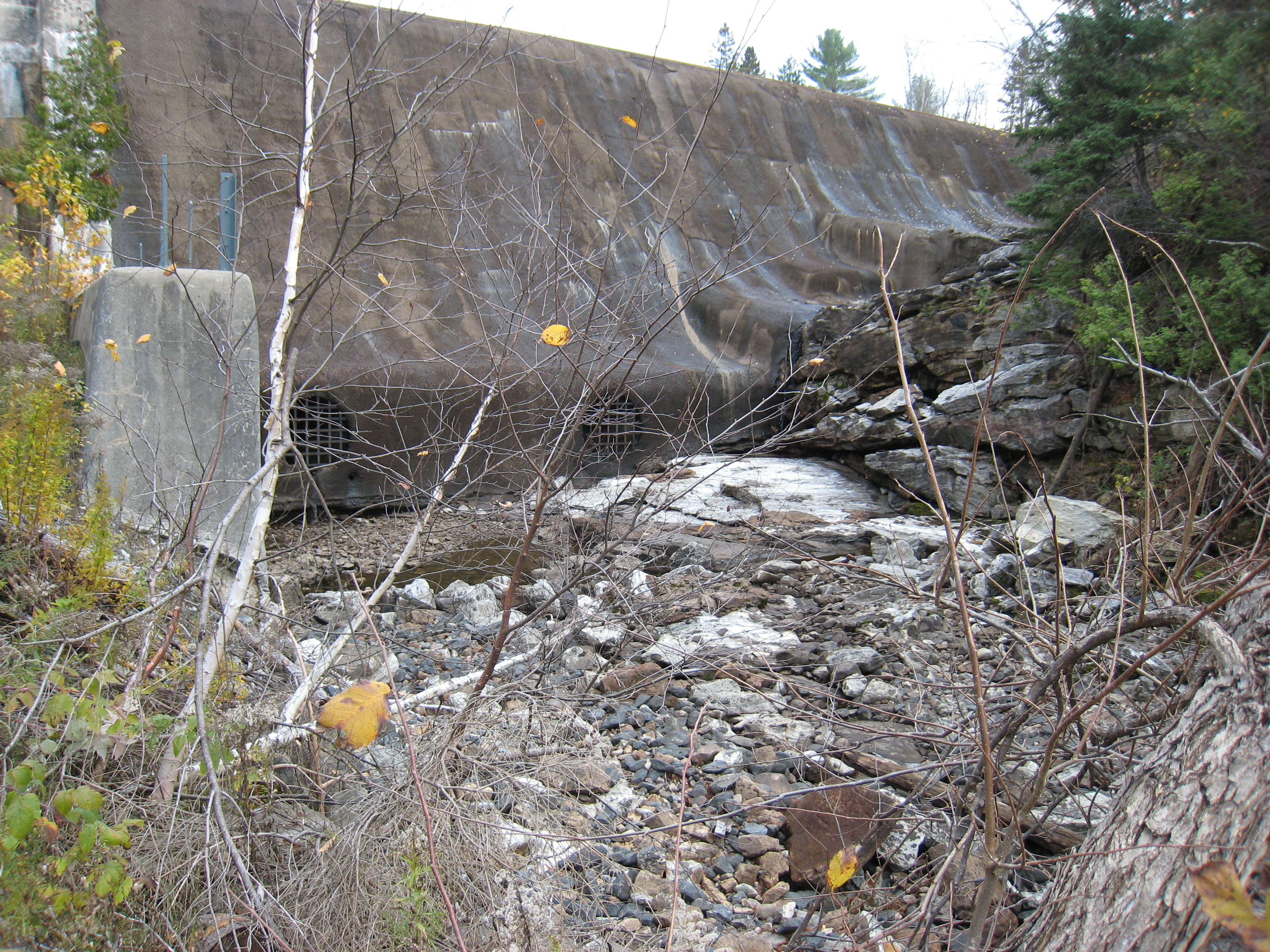
The falls in Minden may have been beautiful once, but there’s just a dry riverbed now.


Looking “downstream” along the dry riverbed shows one of the two penstocks bringing the water into the upstream side of the Minden generating station.


Looking down from the Highway 35 bridge over the Gull River a few hundred metres downstream from the Minden generating station shows how inaccessible this river is. That is, the dam isn’t affecting the town or the non-existent in-water recreation.


Looking upstream from the Mathias generating station shows the penstock (bringing the water from behind the dam to the generating station) on the left, and on the right is the dry riverbed where the falls used to be.


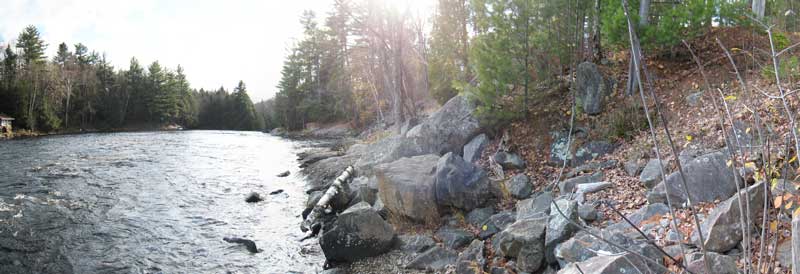
Looking downstream from the Mathias generating station again shows a steep inaccessible shoreline, and no in-water recreation.


Looking upstream from the Hanna Chute generating station shows nobody using the shoreline. No cottages, no docks, no boats.


There are many more pictures like these, and as you can confirm by using Google Earth to pan and zoom around these and other Muskoka generating stations, they are inaccessible, there aren’t any towns or retail stores nearby, there isn’t even any parking nearby. Nobody sees the barbed-wire fencing, and there isn’t any in-water recreation, so no significant public safety concerns.

That is, the other hydro-electric generating stations in Muskoka are different than Bala. The situation at Bala is unique, which is why the proposed generating station at the Bala Falls has significant unaddressed public safety and economic impact issues.


Nov 192011
 

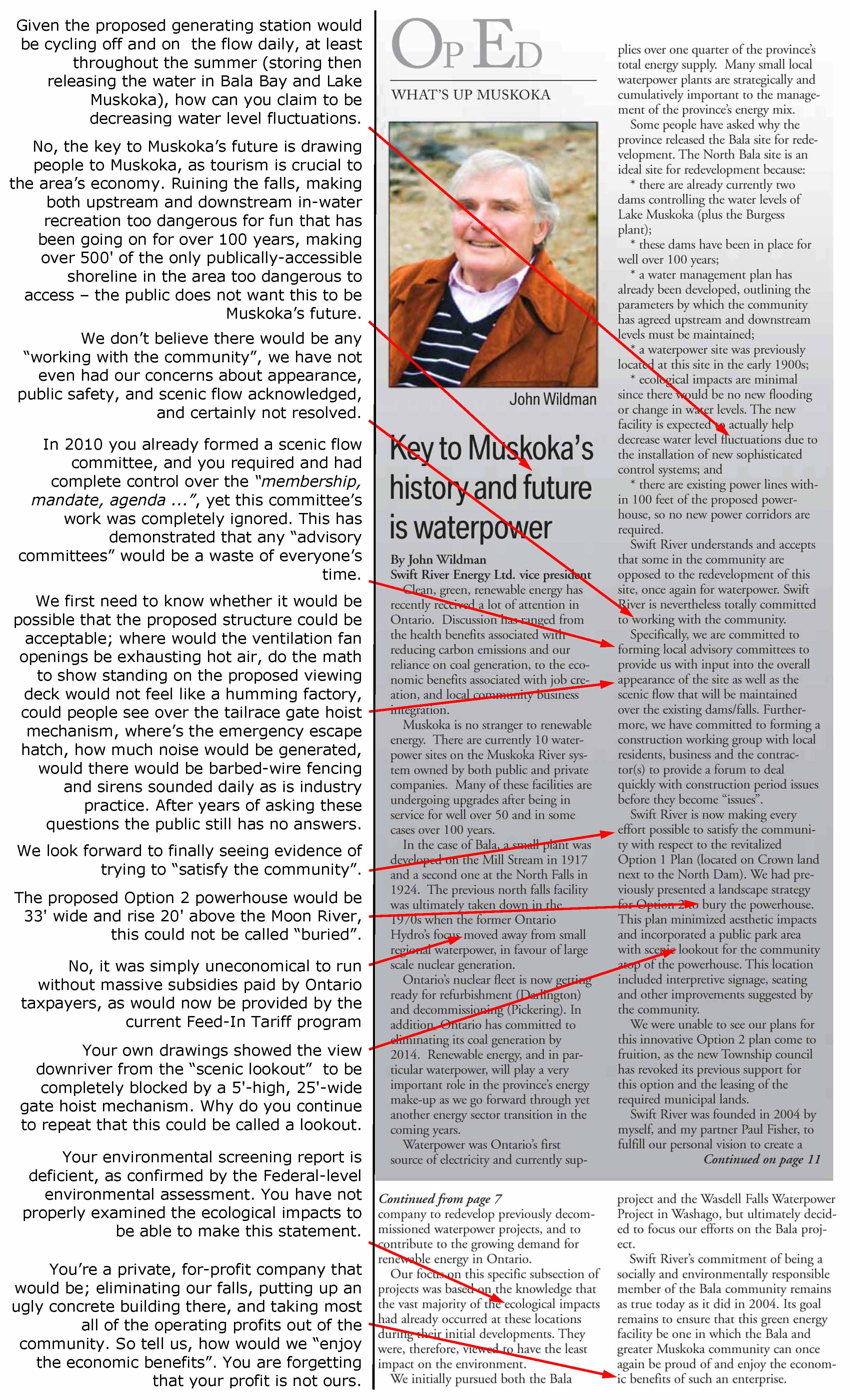
In an opinion piece published in the November 16, 2011 edition of What’s Up Muskoka, the proponent continues to repeat their self-serving mis-information, apparently in the hope that we’ve all gone stupid and will somehow start believing it because we keep hearing it so often.

We are apparently to believe:

  • Water-level fluctuations would be reduced even though they now would be cycling the plant off and on daily, at least during the summer.
  • That the “Key to Muskoka’s history and future is waterpower”, even though they would ruin the falls (as 94% of the water would instead go through their proposed power station), make over 500′ of the only publically-accessible shoreline in the area too dangerous to access, and make in-water recreational activities that have been going on for over 100 years too dangerous to continue.
  • That they would “work with the community”, when we have seen that they completely ignored the work done by the scenic flow committee – this being a committe which they required and had complete control over the membership, mandate, and agenda.

Read it for yourself below, or click here for a higher-resolution version.