Jun 292017
 

We’ll be in Bala and Port Carling this Saturday morning
This Saturday morning July 1, 2017 from 9:00 am to noon we’ll be set up in both:

Stop by and:

  • Have your photograph taken for our collage.
     
  • We’ll have Canada 150 cookies and a Canada Sesquicentennial and proponent Duodecennial anniversary cake from Don’s Bakery.
     
  • Check out our fine assortment of SaveTheBalaFalls.com T-shirts and get a lawn sign.
     
  • Find out that the proponent has leeched off the Township of Muskoka Lakes who used our taxpayer dollars to remove a damaged tree from Margaret Burgess Park. This work should have been paid for by the proponent who has claimed they have responsibility for Margaret Burgess Park and that if the public enters it "the Ontario Provincial Police (‘OPP’) will be contacted and instructed to arrest you and to charge you with an offence".
     

Recent posts
Updates on the current situation are in our articles A sad anniversary and the Liberal’s Fair Drowning Plan and The stumbling zombie.

Jun 292017
 

It has now been more than 12 years that the proponent has been pursuing constructing a hydro-electric generating station at the Bala falls. In those 12 years all they’ve been able to do is cut down some trees and put up a chain-link fence. The proponent still does not have the construction approvals needed from; the Ministry of Natural Resources and Forestry, the Ministry of the Environment and Climate Change, and the District Municipality of Muskoka.

The proponent has not replied to the last ten letters we’ve sent to them, the MNRF has not replied to our letters concerning risk to private property and public safety and infrastructure, and the Premier’s office has not replied to the hundreds of letters we all sent to them in January 2017 concerning public safety. Clearly all are too embarrassed that they have no acceptable answers to the many unaddressed public safety concerns.

This mess continues to be a shameful waste of everyone’s time, and is yet another example that the provincial Liberal government’s political direction is misguided and makes no sense. The provincial election will be within the next year, and the provincial Liberals are desperately rolling out changes they tell us are “fair” – their Fair Housing Plan, their Fair Hydro Plan, and the Fair Workplaces and Better Jobs Plan.

So the Liberal’s Fair Drowning Plan for Unsuspecting Tourists seems to be that the politicians …

  • Don’t care that the proponent would deceive the public as the water made dangerous by the proposed station would extend hundreds of feet outside of the downstream safety boom (which would not comply with the Canadian Dam Association’s public safety guidelines).
     
  • Won’t take action even though the proposed generating station would start operation – without warning – at about noon on summer days, even though the MNRF’s public safety guidelines require warning the public before flow is increased to the Moon River.
     
  • Won’t require the proponent to submit an Addendum to their environmental assessment even though the proponent continues to make environmentally-significant changes to their plans, for example they have recently (yet again) changed their upstream cofferdam plan.

The provincial Liberals need to be reminded that we vote, and we have family, friends, and neighbours in ridings throughout southern Ontario and we’ll be loudly asking embarrassing questions during the upcoming election campaign.

Then-Premier Dalton McGuinty said in 2013 of his decision to support cancelling the Mississauga and Oakville generating stations: “For me, it was about doing the right thing.” The billion-dollar-difference is that our politicians can now make the decision to do the right thing, knowing the proponent would have no basis to claim any costs or penalty as:

  • The provincial government would not have to cancel anything, they simply need to inform the proponent that the requirements for further approvals have not been met due to the unacceptably negative impacts of the many environmentally-significant changes the proponent has made (and continues to make) after receiving their 2013 environmental approval.
     
  • The proponent has provided inaccurate and misleading information, and by submitting their 2005 Proposal, the proponent agreed that the government could therefore rescind any contracts and the proponent could not claim that any costs or penalty is payable.
Jun 292017
 

Swift River Energy Limited is the living dead, as they; can’t proceed with the approvals they have, don’t deserve to get any further approvals, and shouldn’t be allowed to cause the drowning of unsuspecting tourists.

But so long as SREL thinks the approvals they’ve bullied the government into giving them are progress, they won’t go away and let us be.

It is time for the Ontario government to decisively put an end to Swift River Energy Limited, so we can all stop wasting our time and resources.

Jun 052017
 

Here is an update on the current situation for the proposed hydro-electric generating station at the Bala falls:

  1. We understand that the proponent still does not have construction approvals they need from the; Ministry of Natural Resources and Forestry (MNRF), Ministry of the Environment and Climate Change (MOECC), and Municipality.
     
  2. Concerning their “anticipated start date”, in a recent newspaper article the proponent stated: “We are hopeful we are able to make our target of July 15 or soon after” to allow for the completion of the regional fish spawning season “That has always been a restriction in our environmental assessments”.
     
    That is a surprising – and incorrect – statement since in 2014 the proponent requested permission and in 2015 (that is, more than two years ago) the proponent received permission from the MNRF to start in-water work on June 1 rather than July 15. The proponent would desperately need to start work on this earlier date of June 1 in the hope that they could finish all work requiring their proposed temporary cofferdams in the ten months available, as they must remove their cofferdams before April 1 to allow unrestricted flow from Lake Muskoka, for the spring freshet.

    Their current delay of not starting until July 15 would likely result in their having to install their proposed cofferdams a second time   and not until June 1, 2018. This would extend their proposed construction by up to a year. So in addition to this proposed project being a public safety disaster for the public, it would also be a financial disaster for their investors.
     
    The summary is that the proponent hasn’t started work because they don’t have their approvals, and they don’t have their approvals because after more than 11 years of struggling, they still haven’t met the conditions required of them. They appear to be trying to hide their incompetence from their potential investors by making up fictitious dates for their environmental restrictions.
     

  3. The proponent has still not shown how or if they could safely operate their proposed generating station even though this is a requirement of the Environmental Assessment process. This loophole happened because the proponent did not disclose their dangerous design decisions until after they received their 2013 environmental approval.
     
    For example, we now know:

    1. During the proposed operation:
      • The dangerously turbulent water due to the proposed generating station would extend far outside the proponent’s proposed downstream safety boom. This would deceive the public into believing they would be safe when they would be in danger. And this would not comply with the Canadian Dam Association’s public safety guidelines.
      • The proponent would not warn the public before starting operation. This too would be extremely dangerous, and would not comply with the MNRF’s public safety guidelines.
      • The proponent would build a large concrete deflection wall in the Bala north channel. This would restrict flow from Lake Muskoka and therefore increase the risk of flooding Lake Muskoka throughout the year.
         
    2. During the proposed construction:
      • The excavation for the proposed upstream cofferdam would risk damage to the District’s highway bridge. These plans have not been disclosed to the District.
         

    The proper procedure for this situation of making environmentally-significant changes to approved plans is for the MOECC to inform the proponent that their plans do not conform to their approval. The proponent then must submit an Addendum to their environmental assessment, and this would detail the mitigation for the proposed changes so all stakeholders can be informed and have an opportunity to provide comment.
     

  4. We understand that most of you have not received a response to the e-mails you sent to the Premier last January. This shows that the government does not have acceptable answers to the serious public safety questions asked.
     
  5. The recent and major provincial government’s political decisions to make substantial changes to; electricity prices, Tarion, the Ontario Municipal Board, and beer and wine distribution shows that the Ontario Liberal government realizes they must make major changes before next summer’s provincial election.
     

Recent articles

  1. Continuing our public service work to educate prospective investors about the unaddressed risks for this proposed project, we have posted this article about the value of what an investor/purchaser would get for their money, and this article about the much greater liabilities the Bala proponent would have compared to the situation for the 2008 drowning caused by the Wilson’s Falls generating station.
     
  2. While the spring flooding wasn’t as bad this year as last, the MNRF could have reduced the flooding by lowering the water levels more than they did. Articles on this are posted here and here.
     

Our e-Newsletters
Let your friends and family know they can sign themselves up to receive these e-Newsletters using the link at the top-right at SaveTheBalaFalls.com

May 192017
 

Summary
The operation of hydro-electric generating stations can and has drowned those nearby. The unprecedented situation for the proposed hydro-electric generating station at the Bala falls would create similarly unprecedented liability for both the proponent and province of Ontario as they have failed to address the dangers the proposed project would create. For example:

  1. Both the intake and tailrace flow of hydro-electric generating stations create deadly currents and turbulence. Yet the proponent has stated they would not provide warning upon starting (which would often be at about noon on summer days), even though the Ontario Ministry of Natural Resources and Forestry (MNRF) requires warning before flow is increased to the Moon River. This would demonstrate negligence and incompetence, which are two important tests for liability.
     
  2. The proponent would not be able to provide adequate warning through signage as they would have no authority to post signs on the private and municipal shoreline both upstream and downstream. This would leave most points of entry to the area without warning signage.
     
  3. The MNRF and proponent know that access to the Moon River could not be restricted due to the requirements of Section 3 of the Public Lands Act.
     
  4. The general public, including local shoreline property owners and their guests and those using the municipal docks would be accessing the Moon River, which is a navigable waterway, by exercising their riparian right of access. That is, people would be accessing the waters made dangerous by the proposed project without trespassing. The public can legally access and be in these waters, and have a right to expect that others would not purposefully make these navigable waterways dangerous.
     
  5. In fact, the proponent would be encouraging in-water recreation directly adjacent to their proposed project as they would build a portage directly south of the proposed facility.
     
  6. The proposed facility would create dangerous currents and turbulence outside of the proponent’s proposed downstream safety boom. The dangers created by the operation of the proposed facility would therefore be undetectable by the public. Such deception would not comply with the Canadian Dam Association’s public safety guidelines.
     
  7. The Lifesaving Society has recommended a safety plan be presented to stakeholders before any further approvals are issued, but the proponent refuses to do this. In fact, the proponent has not replied to the last ten letters we have sent or hand-delivered to their offices.
     
  8. The proponent would have liability as they would have exclusive control of the situation; they would be the owner of the facility, have Occupier status for the land on which it would be located, and would be solely responsible for the design, construction, operation, and maintenance of the facility.
     
  9. The provincial Crown would have liability as they are the owner of the land, and the MNRF has refused to require that the proponent show how or if they could safely operate the proposed facility.
     
  10. As provided by the Lakes and Rivers Improvement Act, the Crown has responsibility for;
    • Approving both the location, and the plans and specifications of the proposed facility.
    • The safe operation of the proposed facility.

    The Crown therefore owes a duty to the public that they would be safe around this proposed facility.

  11. The dangers created by the operation of the proposed facility would be to all users of the nearby areas in both Lake Muskoka and the Moon River, as;
    • The existing flows would be brought hundreds of feet closer to the known in-water recreational areas
    • These flows would start without warning.
    • Rather than being natural flows down water falls which can be easily observed and judged, the flows from the proposed facility would be unexpected as they would be extend outside of the proposed safety boom, and they would be undetectable by the public because the flow would be released underwater.

Clearly, the construction of this proposed facility would create a foreseeable risk, yet the required care has not been taken, given the known circumstances.
 

Detail
In 2008 the tailrace flow from the Wilson’s Falls generating station caused the drowning of a 16-year-old boy. This confirms that hydro-electric generating stations are deadly to nearby in-water recreational activities.

But compared to the Wilson’s Falls generating station, the proposed hydro-electric generating station at the Bala falls would create much more risk to the public and liability to; Swift River Energy Limited, their investors, and to the province (that is, to us taxpayers). Here are some reasons why:

  1. It would be unprecedented to construct a hydro-electric generating station in the middle of an existing, accepted, and very popular in-water recreational area. Trains, and before that, steamships, have brought tourists to the Bala falls for at least 150 years. Yet the proponent has not taken any corresponding extra steps to determine whether or how such a facility could be safely operated.
    • In contrast, the Wilson’s Falls generating station has been in place for over 105 years, in an area not very accessible to the public and which has never been popular for in-water recreation, so minimal public safety measures are expected and are more acceptable.
       
  2. The water made dangerous by the proposed generating station would extend outside of the proponent’s proposed downstream safety boom. That is, the proponent would intentionally misinform the public of the extent of the water they would make dangerous. This would create liability to the proponent and to those that would facilitate the proposed generating station’s construction.
    • Even now, more than eight years after the Wilson’s Falls drowning, there is no downstream safety boom at the Wilson’s Falls generating station, so the extent of the danger there is not conveyed.
       
  3. The proponent would:
    • Not comply with the MNRF’s Public Safety Measures Plan requirement that the public be warned before increasing flow to the Moon River.
    • Not comply with the Canadian Dam Association’s guidelines for public safety around dams.
    • Ignore the recommendation of the Lifesaving Society that a safety plan be presented to the public before any further approvals are issued.

    This would create liability for the proponent and for those that facilitate the construction of this proposed project.

    • We are not aware of any such safety requirements for the Wilson’s Falls generating station.
       
  4. The proposed generating station would have over ten times the flow of the Wilson’s Falls generating station, so would be far more dangerous.
     
  5. The proposed generating station would often start at about noon on summer days. This would suddenly, and without warning, create an extreme danger, just when it would be most likely that people would be nearby in the water.
    • The Wilson’s Falls generating station operates in a run-of-river mode, so its operation typically changes only by incremental amounts.
       
  6. Due to; the many private shoreline land-owners in close proximity, the many legal points of entry to the water, the popularity of the Moon River for all types of in-water recreation, and the greater distance away from the proposed generating station at which the water would be made dangerous, it would not be possible to install warning signs in enough locations to adequately inform visitors of the dangers.
    • In contrast, the area surrounding Wilson’s Falls is much less accessible, with much less private land ownership, so that the approaching public could be adequately warned.
       
  7. The proponent plans to build a portage. This would encourage in-water recreation directly adjacent to the fastest and most turbulent and dangerous water their proposed generating station would create.
    • There is no such encouragement for in-water recreation near the Wilson’s Falls generating station.
       
  8. Bala is a popular tourist destination, as literally bus-loads of foreign tourists regularly visit, and there are many amenities and attractions for visitors. Also, the only through road for 50 km around is right on top of the Bala falls so even more people visit Bala because they have to pass through. Many foreign tourists would not be able to comprehend warning signs. The problem is even greater as hydro-electric generating stations create hidden and unnatural dangers not obvious or detectable by the public, and these would begin without warning.
    • Being difficult to access, tourists rarely go to Wilson’s Falls, so there is less need to warn those unfamiliar with the area.
       
  9. The downstream end of the proposed generating station’s tailrace excavation be approximately 75′ from the structure, so the water would be especially turbulent there. This area, far from the proposed generating station and outside of the proposed downstream safety boom, would therefore be especially dangerous.
    • The end of the Wilson’s Falls generating station’s tailrace excavation is less than 14′ from the building, so the danger would be more easily associated with the building.
       
  10. The province is facilitating this proposed project being built on land owned by the province of Ontario, without any knowledge or plans that this proposed project could be operated safely. This would result in the province also having liability.
    • The province does not own the land at or surrounding the Wilson’s Falls generating station.
Apr 242017
 

Summary
While flooding of Lake Muskoka could be reduced if the MNRF began earlier to draw-down the water level of Lake Muskoka, the MNRF’s ability to do this is constrained as the downstream flow is controlled by Ontario Power Generation. It appears that any flow down the Moon River greater than about 72 m³/s requires that OPG direct this excess flow to bypass their generating stations. Therefore, OPG would not earn any revenue from this excess flow.

Detail
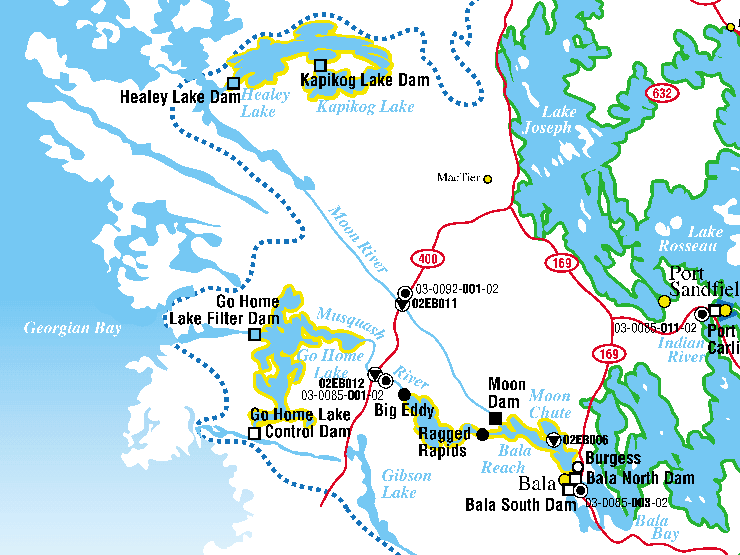
After passing through Bala, the water from Lake Muskoka gets to Lake Huron either through the Moon River (the north branch) or the Musquash River (the south branch). Ontario Power Generation’s Ragged Rapids and Big Eddy generating stations are both on the south branch, so water flowing down the Musquash River earns OPG money twice, first by going through the Ragged Rapids generating station, then a few km later, through the Big Eddy generating station.

This is shown on the map below, which is a section of Figure 2.2 from the Muskoka River Water Management Plan (click on it to see the entire map).

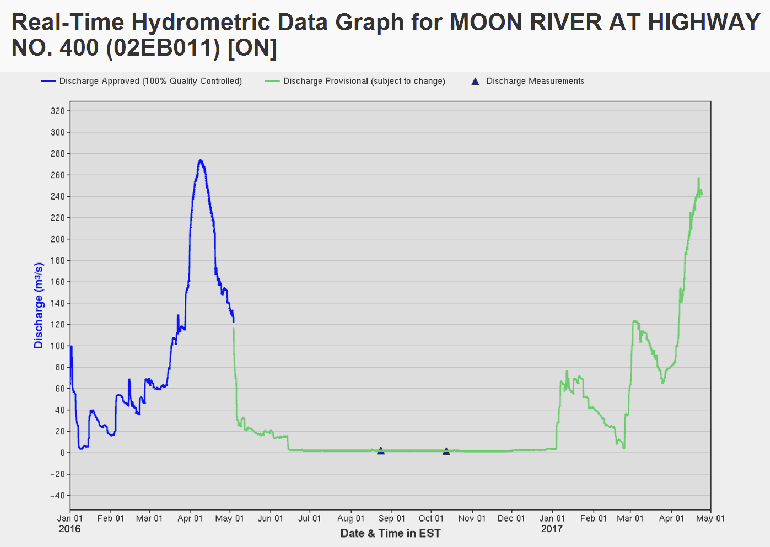
OPG controls the flow through the Musquash River by the amount of water they pass through their generating stations. OPG also owns and operates the Moon Dam, which controls the flow through the north branch of the Moon River. Any water OPG allows through their Moon Dam is money lost, as this water gets to Lake Huron without going through OPG’s two generating stations. OPG desperately needs money to pay their employees’ high salaries, so OPG is incentivized to open their Moon Dam as late as possible and only as much as they feel absolutely necessary. The winter is a peak electrical demand time, so OPG would not want to waste the power generation opportunity, or the revenue.

As shown below (click on it for a larger view), this year OPG opened their Moon dam about January 1. Unfortunately we don’t know when OPG removed all the stop-logs from the Moon Dam, as the flow through it also depends on the upstream water level.

Therefore, the MNRF’s ability to draw-down the water level of Lake Muskoka in preparation for the spring freshet depends on when OPG removes stop-logs from the Moon Dam.

Apr 232017
 

As Britney Spears would say: “Oops!… I Did It Again”.

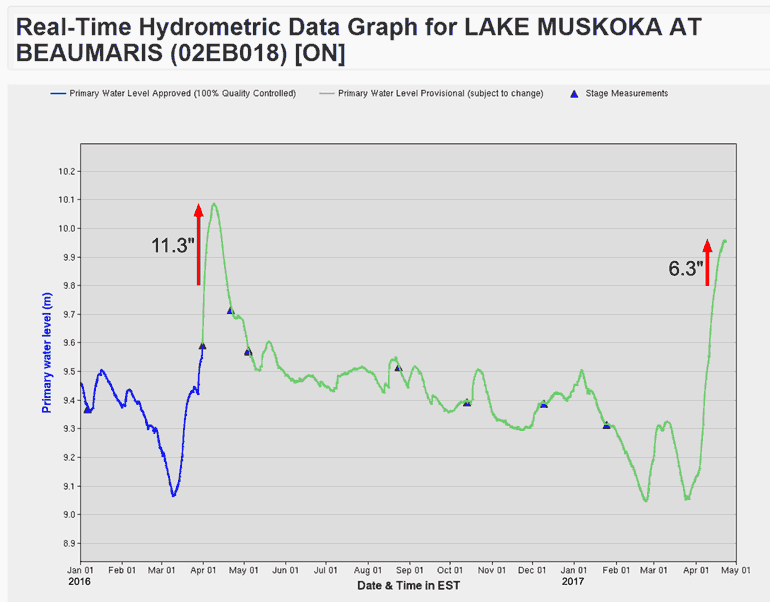
Again this year, the MNRF have not done all they could to prevent flooding Lake Muskoka. As shown by the graph below (click on it for a larger view), this spring 2017 the water level of Lake Muskoka reached 6.3″ above the Normal Operating Zone (NOZ).

Lake Muskoka water level, January 1, 2016 to April 23, 2017, showing draw-down in advance of peak water level, which was 11.3″ of flooding in 2016 and 6.3″ of flooding in 2017

The Muskoka River Water Management Plan (MRWMP) specifies the range of acceptable water levels for Lake Muskoka. This is called the Normal Operating Zone, and is between the two blue horizonal lines in the graph below. If the water level is below the NOZ, there are problems such as disruption to shoreline wildlife habitat and boat propellers hitting rocks. And if the water level is above the NOZ, there is flooding.

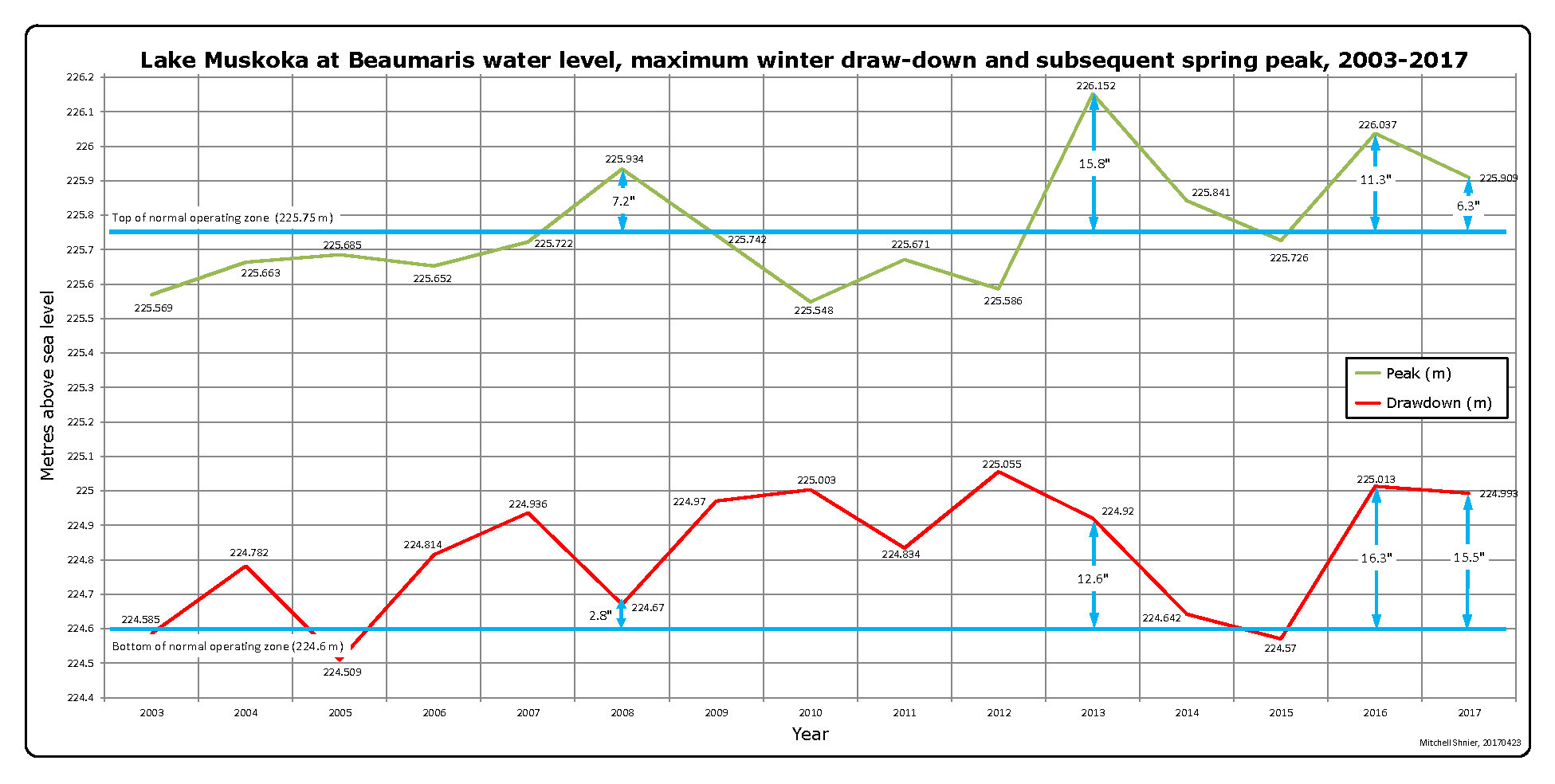
To prepare for the spring freshet, the MNRF draws down the water level of Lake Muskoka during the winter. As shown in the graph above, the MNRF began the winter draw-down about January 1 this year, reaching the maximum draw-down on February 22, 2017. As shown in the graph below (click on it for a larger view), the MRWMP allowed the MNRF to draw down the water level of Lake Muskoka 15.5″ more than they did this year. The end result of this inadequate draw-down is that on April 22, 2017 the water level of Lake Muskoka reached a peak of 6.3″ above the NOZ, causing flooding.

It is very disappointing that after the significant flooding last year (article from spring 2016 is here), the MNRF did about the same inadequate draw-down this year as last.

We know there are complexities such as how much snow is on the ground and its water content, and that the inches of inadequate draw-down does not directly correspond to inches of flooding. But the facts are:

  • Flooding would be reduced if there was greater draw-down.
  • The existing MRWMP allowed the MNRF to draw down the water level of Lake Muskoka much more than they did this past winter (and the winter before that as well).

A huge unknown factor is whether the winter draw-down could not be started sooner due to Ontario Power Generation not agreeing to open their Moon Dam sooner, more detail about this is here. If OPG is a cause of flooding Lake Muskoka, then it would be MNRF’s responsibility of representing and balancing the needs of the public to work with OPG on this issue.

We know that the MNRF cannot always prevent flooding due the constraints in the watershed, the MRWMP, and in working with OPG. But it appears that the MNRF could do more within the existing MRWMP, and could certainly be more open with the public about the draw-down constraints and decisions made.

As Britney Spears said (perhaps of the MNRF): “I’m not that innocent”.

Apr 222017
 

Normally when a company is bought there is a premium paid over the value of the physical assets such as the desks and computers. The accounting term for this premium paid is “goodwill”, which includes the company’s reputation, employees, relationships, plans, and industry knowledge.

For the proponent Swift River Energy Limited, this goodwill is so impaired that it is a liability. The company has no employees, the work is all done by outside contractors and hired companies so it has no industry knowledge, the relationship with the community is two-way contempt, and the proposed construction and operation plans have major unaddressed issues that have proven to have no acceptable solution. As the company has no employees, assets, income or operations, it appears to have a negative net worth.

Here are some examples of the value of these plans, and of how the proponent has earned this reputation (that is, by being bullying jerks, they have royally and permanently pissed-off the community, but here are some more business-like statements):

  1. The Ministry of the Environment and Climate Change (MOECC) required the proponent to conduct an Economic Impact Study. For this, the proponent stated that: “local businesses will be surveyed regarding project impacts on the local economy both during the construction period and after”, and the Township of Muskoka Lakes was informed the study would assess the: “positive and negative economic impacts of the construction phase of the project” as well as the: “positive and negative impacts of the operating phase of the project”.
     
    When the study was completed, the proponent concluded from it that: “the project’s economic impacts will be positive”. This is an infuriating and deceptive fabrication, as the study did not examine or even solicit negative impacts. Local businesses were not asked about negative impacts, and tourists were not interviewed.
     
  2. The proponent committed for their 2012 Addendum to their Environmental Assessment that their current Alternative 1A proposal would not rise above street level. But we now know the proponent’s ugly concrete building would rise more than 25′ above the street, blocking passers-by’s view down the Moon River.
     
  3. Also in their 2012 Addendum the proponent stated: “The footprint and elevation of the Alternative 1A plan presented in this Addendum illustrates the largest building size required for both configurations. Therefore, this size may indeed be reduced following detailed design prior to construction.” However instead of the same or smaller, we now know that their building’s footprint would be 50% larger.
     
  4. After convening and controlling a series of farce “Flow Distribution Committee” meetings and committing in writing there would be more scenic flow down the Bala falls on long weekends, they secretly changed this to only allow such flow when there is enough water to run their proposed turbine.
     
  5. After stating for their 2009 Environmental Assessment that the minimum flow through the proposed generating station would be 14 m³/s, the proponent increased this by more than 40% to 20 m³/s without informing the public. This substantially increases the danger to the public.
     
  6. After stating for their 2009 Environmental Assessment that their proposed generating station would operate run-of-river (as fluctuations may “pose problems related to boating and other aquatic activities along the Bala Reach”) the proponent changed to a cycling mode of operation where their proposed generating station would often begin operation, without warning, at about noon on summer days. This would be extremely dangerous to the in-water recreation in the area.
     
  7. After stating in their proposal that their proposed project “will not generally diminish the public’s enjoyment of the area for swimming, boating …”, we now know they would make the water in front of people’s private docks and in front of the only public docks on the Moon River too dangerous.
     
  8. Even more unacceptable is that the proponent would deceive the public as this dangerous water would extend outside of the proponent’s downstream safety boom, so the public would have no way of knowing the extent of the water which the proponent’s proposed generating station would make dangerous.
     
  9. After stating for their 2012 Environmental Assessment that their “Alternative 1A will not impact any of the listed properties”, we now find they would cut down all the trees in the heritage-listed Portage Landing.
     
  10. After agreeing that they would not locate settling tanks in either Margaret Burgess Park or the Don’s Bakery parking lot, plans they provided to the MOECC showed they would do both. The self-serving proponent providing conflicting information or selectively withholding information has happened before. For example it appears they have not disclosed to the District Municipality of Muskoka that the proposed cofferdam could damage the Muskoka Road 169 bridge.
     
  11. The proponent does not respond to e-mailed questions and has not updated their web site in over a year.
     
  12. The proponent refuses to provide any information on how they would operate their proposed project safely. All we know is that the proposed project would:
    • Create dangerous water extending outside of the proposed downstream safety boom. This would not comply with the Canadian Dam Association’s public safety guidelines.
    • Often start operation at about noon on summer days, without warning. This would not comply with the MNRF’s public safety measures.
       
  13. In a pre-election speech on September 22, 2014, the current Mayor Furniss of the Township of Muskoka Lakes stated the proponent had all required permits to begin construction. Clearly he was deceived by the proponent as more than 2½ years later the proponent still needs many approvals from the; municipality, Ministry of Natural Resources and Forestry, and Ministry of the Environment and Climate Change, before they could construct their proposed project.
     
  14. The Moon River Property Owners’ Association planned their 5th annual family-oriented free cake, music, and ice cream Canada Day celebration in 2015 but were informed a few days before it that the proponent would instruct the Ontario Provincial Police to arrest anyone attending this event. 
     
  15. Over a year ago, apparently because they were frustrated and embarrassed at not being able to show any visible progress after 11 years of bumbling around, the proponent cut down all the trees on their proposed construction site and put up a chain link fence. This unnecessary ugliness is still what greets visitors to Bala, and is a monument to Swift River Energy’s mismanagement and ineptitude.

If the proponent had any assets more desirable that the above well-deserved rotten reputation, they might be worth something, but instead of crucial construction approvals they have problems:

  1. Municipal:
    1. The proponent does not have the needed driveway entrance permit to Portage Landing.
    2. The proponent does not have approval for the required tie-backs for the shoring needed to prevent Muskoka Road 169 from collapsing into their proposed excavation.
    3. During the proposed construction, their upstream cofferdam would risk damaging the Muskoka Road 169 bridge over the Bala north channel.
    4. After the proposed construction, when the proposed station is not operating, the concrete deflector wall would cause erosion and would undermine and damage the bridge’s abutments.
       
  2. Provincial, MOECC:
    1. The proponent’s environmental assessment approval will soon expire and due to the many environmentally-significant changes to it they would require, it isn’t clear how they could receive environmental approval for their current plans.
    2. The proponent does not have the required Environmental Compliance Approval for the construction process. Instead they developed and submitted to the MOECC plans which could not be implemented as the proposed settling tanks could not be put in the locations shown.
       
  3. Provincial, MNRF:
    1. The proponent does not have the required approval for construction under the Lakes and Rivers Improvement Act as the plans and specifications they developed and submitted to the MNRF had too many deficiencies, such as for the upstream cofferdam.
    2. The proposed generating station requires that a concrete deflector wall be constructed in the Bala north channel, but the MNRF cannot allow such an obstruction to flow as it would result in flooding Lake Muskoka during high-flow events.

Summary
Instead of dealing with risks, Swift River has left them unknown and outstanding. Instead of communicating with the public, Swift River does not provide updates and does not respond. Instead of honouring commitments made, Swift River makes self-serving changes without disclosing these to stakeholders.

Swift River Energy has had more than 11 years to figure this out and has shown they cannot. This proposed project is a mismanaged and intractable mess, ready to be a liability to any group or organization that wishes to get involved.

Apr 082017
 

The proponent’s 2005 proposal for this proposed project stated: “The financial support comes from three high net worth individuals plus the substantial resources of the Horizon Legacy Group, a Toronto based commercial real estate firm.” These individuals were John Wildman, Paul Fisher, and Anthony Zwig, and were joined by Ian Baines a year or two later. The proponent’s 2007 Public Information Centre referred to these “four founders” and stated that the proponent “is providing the necessary financing for this project”.

Well, the proponent has now been bumbling around for more than 11 years, and:

  • Ian Baines (the only one that claimed to have any experience with developing hydro-electric generating stations) ceased all involvement about 2011.
  • John Wildman and Paul Fisher ceased all involvement in 2015.
  • It appears the proposed project is now stopped, while Anthony Zwig attempts to either raise construction financing or sell the entire company to some entity that has the money needed to continue.

So the “high net worth individuals” have abandoned this sinking ship. They have shown the financial assurances and promises they made in their 2005 proposal were as worthless as their other important commitments, for example that their proposed project “will not generally diminish the public’s enjoyment of the area for swimming, boating …” and that their building – even for their current Alternative 1A – would not rise above the level of the road. This continues the reputation of this proponent of empty promises, deception, and lies.

The proponent is apparently now hunting for a bigger fool who will believe this proposed project is almost “shovel ready”. We know that the only shovel this proposed project is ready for is for the manure the proponent will spew to such suckers.

A few years ago, a subsidiary of Oakville Hydro considered investing in this proposed project, thinking that all they needed to get the proposed project built was to get community support, which they would address by hiring a public relations firm. Good for them for not blundering into this mess.

But interest rates have been so low for so long that there will be endless investors that will consider this proposed project. So far, the smart money has stayed away. To help the others, we present the following examples of why this proposed project couldn’t, wouldn’t, and shouldn’t be built as it would; be too expensive to build, have too many operational problems, produce too little power to be viable, and be too dangerous to operate.

Deflector wall
A concrete deflector wall, the full height of the water in the Bala north channel, would need to be constructed to evenly direct the water around the 90° turn at the proposed generating station’s intake. This deflector wall would be unacceptable for many reasons:

  • The Ministry of Natural Resources and Forestry (MNRF) requires that flow through the Bala north dam not be obstructed, as the full capacity of the Bala north dam is needed during spring freshet and other times, even if the proposed generating station is not operating. However, this deflector wall would obstruct approximately half the flow through the Bala north channel, so would not be allowed.
  • When the proposed generating station is not operating, the deflector wall would cause the water to be directed towards the south support for the District Municipality of Muskoka’s Muskoka Road 169 bridge (the Highway Bridge) over the Bala north channel. The resulting erosion and undermining of the Highway Bridge’s south abutment would damage it.

Increased flow in the Bala north channel
When the proposed generating station is operating, the flow into it:

  • Would add to the flow through the Bala north channel, with the result that the flow past the Highway Bridge and CP Rail bridge could be higher than it has ever been before.
  • Would change the direction of flow past the support piers for the Highway Bridge.

These structures; may not have been designed for such a flow, may not be able to handle such a flow in their current condition, and could be damaged or need reinforcement.

Proposed upstream cofferdam
During the proposed construction, the proponent would need to build an upstream cofferdam and there are many unresolved issues, apparently with no acceptable solution so far.

As flow through the Bala north channel may be needed during the proposed construction, the MNRF requires the proponent be able to lower the upstream cofferdam on short notice, such as a day or two.

  1. Therefore, the cofferdam design must enable it to be both lowered, and later raised. The proponent’s initial design of a rock-fill cofferdam would therefore not be acceptable to the MNRF.
     
  2. The proponent’s next suggestion of a soldier-pile cofferdam would require deep and wide holes be bored directly adjacent to both the Bala north dam and the Highway Bridge support piers. As there would be huge forces on these holes from the I-beams in them holding back up to 20′ of water, and there have been no subsurface investigations at these locations, this design is not currently acceptable either. Therefore, the costs and time to implement this cofferdam design, and whether it is even feasible, are not known.
     
  3. The proponent’s environmental approval from the Ministry of the Environment and Climate Change (MOECC) does not permit any fine particulate matter, hydraulic fluids, or other deleterious materials to be washed into the Moon River. Therefore, the cofferdam lowering plan could not be implemented as it would flood the proposed construction site, washing everything into the Moon River.
     
  4. During the time period after the proposed intake is excavated and before the proposed intermediate cofferdam is in place, lowering the upstream cofferdam would result in uncontrolled flooding of the Moon River. Therefore, the cofferdam could not be lowered during this time period, which is unacceptable.

Therefore, the proponent’s proposed upstream cofferdam designs would not comply with the requirements of the MNRF and MOECC.

Approvals – proposed construction
There are issues with the three main approvals the proponent needs before starting their proposed construction:

  1. Municipal
    1. The proponent’s driveway entrance permit is for the wrong location, as it is for Margaret Burgess Park rather than Portage Landing (which is the municipal land south of the proposed construction site). For the required location, guardrail would need to be removed, and this would create dangers to the public and liability to the District. It is not known what time, costs, or design would be required to implement this driveway entrance. For example, it may require the shoulder to be widened to create a new lane, isolated by concrete “Jersey barriers”. In any case, the current approval would not apply.
       
    2. The proponent has not met the conditions for this driveway entrance permit to be valid (including the $2,000,000 Letter of Credit, Heritage Impact Assessment, and detailed engineering drawings).
       
    3. The proponent requires other municipal approvals, such as for the tie-backs which would be required to secure the shoring to support the District Municipality of Muskoka’s Muskoka Road 169 due to the 60′-deep excavation they would need directly adjacent to it.
       
  2. MNRF
    1. While the proponent has received Phase 1 Temporary Works approval, this was only for the rock-fill cofferdam design submitted for that approval. As the proponent would not use this upstream cofferdam design, this approval is no longer valid.
       
    2. There are other problems we’ve seen for their Phase 2 plans, such as their gate hoist mechanism did not appear to be suitable for a “post-disaster building” as required by the Ontario Building Code, the gate hoist mechanism was too close to the public look-out, and their plans would require modifying the Bala north dam, which we understand would not be acceptable to the MNRF.
       
  3. MOECC
    1. While the proponent does have environmental approval, this approval expires on January 23, 2018 and it is unlikely construction could begin by then, given the requirements such as the $2,000,000 Letter of Credit and other approvals required before construction could begin.
       
    2. Since the proponent was issued environmental approval in 2013, many other environmental issues have become known, and which would therefore need to be addressed. During the proposed construction, these include the:
      • Cofferdam lowering plan would not comply with the environmental obligations.
      • Additional investigation required as a result of the contaminated groundwater found, such as drilling exploratory boreholes downstream of the likely source so the problem can be understood and acceptably mitigated.
      • Routing over others’ property of the pipes and hoses to the settling tanks, and the inspection and insurance needed for this.
         
    3. The following negative environmental impacts during the proposed operation would need to be addressed:
      • The dangers to the public, as the proposed downstream safety boom would not delineate the dangerous water. Therefore, it would not comply with the Canadian Dam Association’s guidelines.
      • The proponent’s proposed portage would encourage people to canoe through dangerous waters.
      • The obstructed view and the danger of the proposed public look-out being too close to the gate hoist mechanism.
      • The proponent has stated they would not warn the public before increasing flow to the Moon River. This would not comply with the MNRF’s Public Safety Measures Plan for the Bala dams.
         
    4. The proponent does not have Environmental Compliance Approval (ECA) for the settling tanks that would be required during the proposed construction. The proponent’s plans they submitted previously for their ECA applications could not be implemented as these showed settling tanks on locations for which they do not have such permission.

Approvals – proposed operation
Before the proposed operation would be allowed, the proponent is required to obtain several additional approvals, such as the Permit to take water for operation, Amendment to the Muskoka River Water Management Plan, and the ECA for noise.

Bad situation
This proposed location is not suitable for this proposed project, for example:

  1. There would be head losses and therefore reduced power generation due to the:
    • 90° change of direction of water before entering the proposed intake.
    • The deflector wall required for this change of direction, as well as due to the support piers for both the Highway Bridge and CP Rail bridge.
    • Restricted intake excavation allowed, as the District would not permit excavation of their land under their Highway Bridge.
       
  2. The Mill Stream generating station apparently has first rights to take additional water from Lake Muskoka, this would reduce the profitability of the proposed project.
     
  3. Fishing is very popular in the area, and if one of these fishing noodles was to get accidentally drawn into the proposed intake, the section of construction rebar in it could cause months of downtime and millions of dollars of damage to the turbine.
    • Attempting to protect against such accidents by utilizing a trash rack with more closely spaced bars would result in greater head losses due to both the bars and the additional flotsam that would accumulate.
    • The proponent has spent years ignoring, alienating, and infuriating the community. Smart operators know you need to have good community relations to operate expensive machinery unattended.
    • The intake for the proposed generating station would be directly beside the sidewalk on the Highway Bridge.
       
  4. In 2015 the Township of Muskoka Lakes passed a resolution stating they are an unwilling host for this proposed project.
     
  5. In 2013 the proponent initiated a $3,000,000 lawsuit against the Township of Muskoka Lakes, the MNRF, and others, claiming defamation. The proponent has not done anything to substantiate or advance this legal action in the four years since, leaving it outstanding apparently as a threat.

    Nobody wants to work with those that initiate and prolong legal action against them.

  6. It would be unprecedented to locate a hydro-electric generating station in the middle of a very popular in-water recreational area and so close to pubic and private docks. As noted by the Lifesaving Society in their Aquatic Safety Audit Report for the Bala North Falls, plans to safely operate this proposed project should be presented to stakeholders and approved before any further approvals are provided, both to ensure they could be implemented and in case any design changes would be required.
     
  7. In 2011, Ontario Power Generating (the owner/operator of the two downstream hydro-electric generating stations) required the proponent sign an agreement that the proposed Bala generating station’s operation would be stopped and started to coordinate with the requirements of OPG’s downstream generating stations. The result is the proposed Bala generating station would need to be started at about noon on more than ⅓ summer days, and such cycling would be extremely dangerous to the nearby in-water recreational activities.
     
  8. In 2008 a 16-year-old boy drowned at the Wilson’s Falls generating station, which is about 40 km from the proposed Bala project. At an industry conference, Bracebridge Generation Ltd., the owner and operator of the Wilson’s Falls generating station reported that the drowning was due to the boy attempting to swim across the tailrace flow from their generating station.
     
    The proposed Bala generating station would:

    • Have more than ten times the flow of the Wilson’s Falls generating station.
    • Start, without warning, at about noon on summer days.
    • Be in an area far more popular for in-water recreation.
       

    As it appears that adequate safety measures could not be implemented in Bala, the location is not suitable for a hydro-electric generating station.

  9. The next provincial and municipal and elections are next year, which could create delays and uncertainty. In September 2016 the Ontario government cancelled the procurement of additional renewable energy generation.
     
  10. Private citizens do initiate lawsuits, as shown by current the action against the MNRF for the 2016 flooding of Lake Muskoka. Some residents of the Moon River may need to do the same if the dangerous situation which would be created is not properly addressed.
     
  11. According to Transport Canada’s method of calculating the required distance upstream of a hazard to locate a safety boom, the proponent’s proposed upstream safety boom would need to be relocated farther upstream. This would prevent the only boat rental business in the area from renting boats.
     
  12. Even if investors had limited liability, lawsuits due to the unaddressed dangers or injuries would result in long-term operating losses as the proposed generating station may not be allowed to operate while costs would continue; for the operation and maintenance of the Bala dams, for the insurance and maintenance of the equipment in the proposed generating station, and for the legal costs.

In summary, the construction of this proposed project would be a disaster for all involved.

Contact us
This article presents our observations and facts known to us. We would be pleased to answer questions and provide additional details. Contact us at info@SaveTheBalaFalls.com
Feb 252017
 

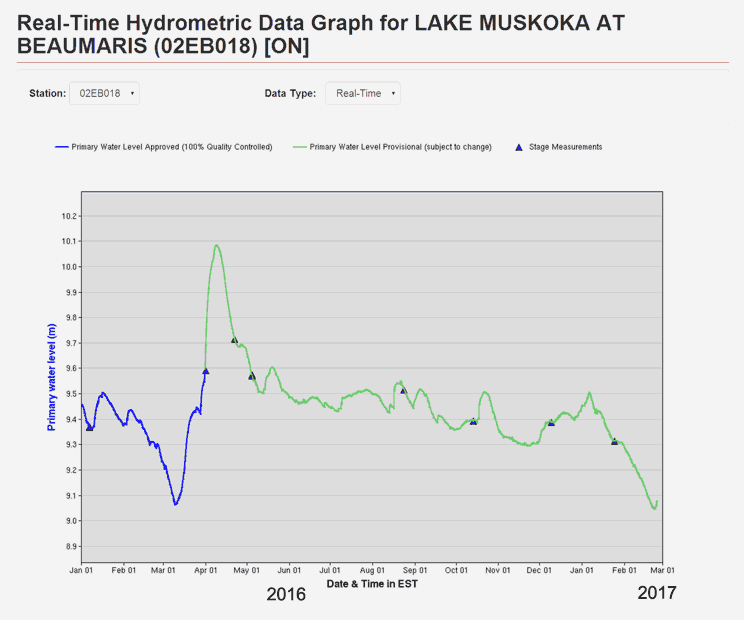
Through Environment Canada, the federal government provides water level information to the public, including for Lake Muskoka.

The Muskoka River Water Management Plan (MRWMP) specifies the Normal Operating Zone (NOZ) for all major waterbodies in the Muskoka River’s watershed. Water levels above the NOZ can cause flooding and water levels below the NOZ can cause problems such as boats hitting rocks.

In the weeks and months in advance of the spring freshet, the Ministry of Natural Resources and Forestry (MNRF) removes stop-logs from their dams to draw down the water level as allowed by the MRWMP with the intention that once the snow and ice melt, water levels will not rise above the NOZ. As described in this article and presented in this graphic, both from last year, in 2013 and 2016 there was significant flooding of Lake Muskoka, and in those years, the MNRF could have drawn-down the water levels in advance much more than they did.

So here we are, it is February 25, 2017, there is snow on the frozen ground, temperatures often above freezing, and rain, all of which contribute to rising water levels. Let’s look at the current situation compared to last year.

The above graph is from Environment Canada’s web site, showing the water level of Lake Muskoka for the 14 months from January 1, 2016 to February 24, 2017 (click on it for a larger view). So far, it appears that the situation is about the same as last year – that the MNRF has not drawn-down the water level as much as they could. This could be due to there being less snow on the ground than this time last year so the MNRF does not expect that the Lake Muskoka water level needs to be drawn-down further.

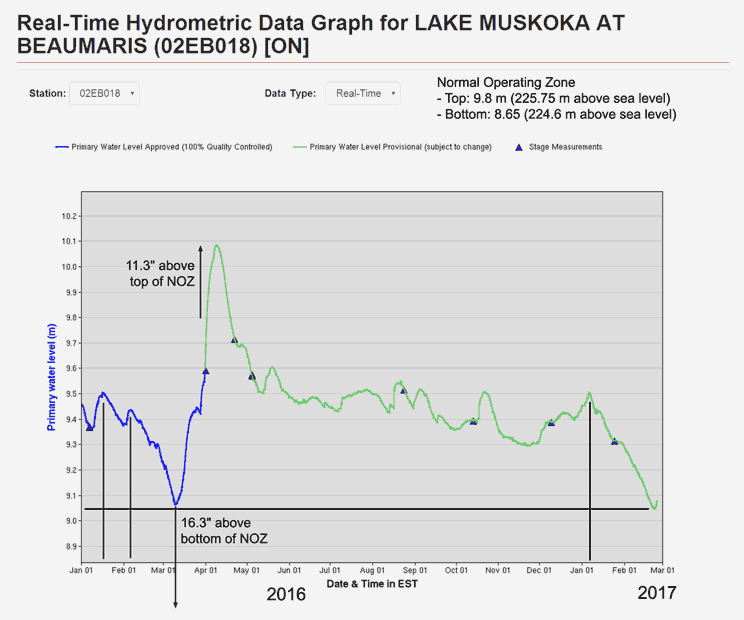
As shown below, some lines and and additional information have been added to this graph.

The above graph shows that:

  • The NOZ for Lake Muskoka is between 224.6 and 225.75 metres above sea level, which corresponds to 8.65 to 9.8 m as shown in this graph (click on it for a larger view).
  • Last year, the MNRF began drawing-down the Lake Muskoka water level in mid-January 2016, and was more successful at this after the first week of February 2016. The minimum water level was before mid-March and was 9.06 m on this graph, which was still 16.3″ higher than the bottom of the NOZ (that is, the MRWMP allowed the MNRF to lower the Lake Muskoka water level by 16.3″ more than they did last year).
  • The peak of the 2016 spring freshet was in early April 2016, when the maximum water level was 10.08 m. This is 11.3″ above the NOZ and was the cause of much flooding and damage.
  • This year the MNRF began the draw-down slightly sooner, about the first week of January 2017 and the minimum water level so far (on February 23, 2017) is very slightly lower than last year (by less than an inch). As for last year, the MNRF could have started the draw-down sooner, or done it more rapidly as the MRWMP allows the water level to be drawn-down by 16″ more than they have so far.

Observations:

  • So far the MNRF has drawn-down the water level of Lake Muskoka about the same as last year.
  • If the proposed hydro-electric generating station was built at the Bala falls, the water level of Lake Muskoka would be controlled by the developer, and the developer would receive a financial incentive for keeping water levels as high as possible. For example, if the Lake Muskoka water level was 5% higher (compared to the Moon River), then the developer would receive 5% more for the additional power generated. Since most all of their costs would be fixed (construction financing debt, operation staff, insurance, maintenance …), this would result in much higher profits. And if these intentional higher water levels cause flooding, the developer could always blame it on the weather, as the MNRF already does.