Nov 222010
 

At 1:00 pm on Thursday October 7, 2010, Ontario’s Energy Minister Brad Duguid announced that the controversial power station proposed for the Town of Oakville would not be built.

Thus ended a multi-year, extremely well-organized fight against this power station – which was to be built too close to a residential area, despite the proponent’s assertions that it would be safe.

While there are many differences in situation, we can benefit from their experience.

The main lesson is that they were successful not only because the community was united against the project, but the local municipal government – the Mayor and the Councillors – were also united against the project.

The Oakville municipal government didn’t just say they were opposed the project, they passed bylaws and went to the Ontario Municipal Board to delay and stop the proposed power station. Their Committee of Adjustment didn’t allow variances requested by the proponent and the municipal government even amended their Official Plan to prohibit the proposed power station. The municipal government had no problem with going to court against an extremely well-financed private developer. That is, the local government used every power they had to protect the health and safety of their electorate. Even the local MPP introduced a private member’s bill to stop the proposed power plant.

Our provincial and federal politicians take their lead from our municipal politicians. The tipping point to get the crucial political support in our fight against the proposed project in Bala begins with our newly-elected municipal representatives – we look forward to public consultation and transparency in their decision-making.

Nov 212010
 

Summary

As noted here, the Ministry of the Environment has requested that the proponent “…conduct further study with respect to navigation matters and economic impacts…”. As a result, the proponent commissioned an economic impact study. You can read it yourself here.

The study shows that the proponent has no idea whether the net effect on Bala’s local economy would be positive or negative.

The study did not get any information on; the number of people employed in Bala, the number of seasonal residents, how many tourists visit every year, how long they stay, how much they spend, nor how many cottages or cottagers there are, so the study reports it is “unable to quantify the size of the Bala Community economy in either employment or dollar terms“.

Knowing this, the study still did not attempt to interview any tourists, nor survey locals to find out what impact they expect to their businesses due to this construction, even though “60 to 75 percent expect the construction phase … to impact their business.”

So the study notes they were “unable to quantify the negative impacts of the construction phase of the project on economic activity in Bala.” Well of course, if you don’t ask, you won’t know.

While the study acknowledges that no estimate of the construction impact on local businesses is provided, the study does not even acknowledge there could be an impact on tourism because people won’t visit Bala to see where the falls used to be, or because most of the public shoreline around the falls will be too dangerous to access or fenced-in, or because there will be a 20′-high, 33′-wide concrete building looming above the Moon River instead of the natural beauty there now. The study authors didn’t even visit the site during the summer.

Yet these professionals can find the ethics to conclude “It is our collective judgment that the operation of the project over the long-term will not negatively impact local business activity“. Hey, we can make up words too. What is the value of all the work done for this study if it does not even attempt to quantify the negative.

If I buy an expensive car, am I suddenly worth more. No, because I have to pay for it.

Can I be an accountant looking only at the credits and not the debits. No, that is completely stupid and wrong.

But this study only quantifies the benefits and none of the costs and negative impacts (it is like a George Carlin newscast where there was only time to report partial sports scores – just the score for one of the two teams).

The result is the unsubstantiated and completely misleading rubbish in the deceitful press release and the proponent’s economic impact study.

Finally, while power generation facilities don’t pay property taxes, they do pay a “gross revenue charge” to the provincial government, and this is based on a combination of the annual gross revenue and the volume of water which passes through the facility. As an incentive for new construction, the provincial government typically grants a “10-year tax holiday”, so this gross revenue charge is not payable for the first ten years of operation.

And one last point about any “economic benefits”. The economic impact study notes that the annual revenue to the proposed power station would be $2.7M – but consider this:

  • Existing hydro-electric power stations in Ontario receive about 3¢/kW•h for the electricity they generate, but the Ontario government would actually pay about 13¢/kW•h for the electricity generated by this proposed station.
  • Which means that about 75% of the revenue is actually government subsidy, which, of course, is our tax dollars.
  • Crazier than that, Ontario has been a net exporter of electricity for the past five years. So we would likely be selling this power to the United States for about 5¢/kW•h, while paying the private developer 13¢/kW•h for it.
  • So most of the stated benefits would actually be taking provincial government money that should be paying for health care, public education, public transportation and everything ELSE our tax dollars should be funding.

Accordingly, we have sent this letter to the Ministry of the Environment.


Detail

After carefully reading the proponent’s 57-page economic impact study, we find that it does not provide any useful information on the economic impact of the proposed hydro-electric generating station project at the Bala Falls. The report completely ignores the negative impacts, and these are precisely the concerns which need to be addressed. Even the positive impacts are not known for the area local to Bala, the only economic information offered is for the larger District and Provincial levels.

Some of our concerns about the study are below.

  1. The study attempted to survey about 119 area businesses (110 of these by e-mail), however they “were disappointed” to receive only 47 replies (page 5).
    • The study notes that e-mail reminders were sent out, but they made no attempt to actually phone or visit the businesses to determine why responses were not received. Hey, you think maybe the e-mails (and reminders) ended up in the recipient’s spam folder, maybe the e-mail address was one that isn’t being read, maybe some weren’t familiar with on-line surveys.  Somehow the study concludes “One reasonable interpretation of the low response rate is that opponents to the project among Bala business owners are in the minority“. Huh? If they truly were disappointed at the low response rate, they should have picked up a telephone and phoned a few businesses to see what the problem is.
       
  2. Next, read the survey questions. You’ll see the survey spends more words soliciting business than actually describing the project or actually asking businesses what impact the project could have on their business.
    • The only negative impact or project description noted in the survey questions was traffic disruption, yet the study is surprised at respondents perception of the project, noting “This misunderstanding is especially evident with respect to their concerns regarding potential disruptions to traffic during the construction period.” If the survey questions only mention traffic disruption, then of course respondents are going to think about that.
    • Perhaps the survey results would have been more accurate if the survey actually described the construction site; a rock and plastic coffer dam hundreds of feet long leaving the head of the Moon River dry to the dead fish on the riverbed, construction safety fencing and construction equipment and a construction crane with a 100′ boom, all the trees on Burgess Island west of the highway clear-cut, blasting and hauling away 1,700 tuckloads of rock, construction trailers and porta-potties, pumps and settling ponds, and traffic disruptions.
    • In fact, the negative impacts are referred to as “inconvenience” (page 33). It is likely the study avoids assigning costs to the acknowledged negative impacts so these cannot be used as justification for local businesses claiming compensation from the proponent for lost business.
       
  3. The study makes no attempt to assign a value to the negative impacts on local businesses during construction – “… impacts to local business from anticipated disruptions due to road closures, reduced access to the Falls adjacent to the site, and general construction interruptions have not been estimated” (page 29).
     
  4. The study did not examine the possible impact on local residential property values. For example:
    • It is likely chain-link fencing will be required (as was recently installed at the Mill Stream power station in Bala – and barbed-wire fencing is installed at all three power plant at and upstream of Bracebridge).
    • It is also possible that sirens and strobe lights will need to be used to warn each time the plant begins operation, as is required for OPG-owned stations (and the proponent has stated that OPG would require the proposed plant’s operation to be cycled – such as every four to eight hours – to coordinate with the OPG plant downstream).
       
  5. Significantly, the study made no attempt to understand the importance to the local area, uniqueness in the area, or tourism draw of the Bala Falls, and how this would be affected by the proposed project. Apparently, only one of the study’s three authors visited the falls (and this on a Tuesday in late September, when it would not be possible to observe how the public recreates in the area), and instead that it required “climbing down a pebble-strewn include.” Perhaps it would have been enlightening for the author to actually talk to a tourist or two (the study does acknowledge the importance of tourists to the area – page 24) to see if they’d prefer a “professionally landscaped” (page 2) stairway, or the natural beauty of the area.
     
  6. The proponent “anticipates a 10-year holiday” (page 30) on taxes (which would have been a gross revenue charge of about $130,000 per year), as the provincial government typically allows this to encourage new construction of hydro-electric power stations. So in addition to receiving about 13¢/kw•h for generated electricity (when existing hydro-electric power stations in Ontario receive about 3¢/kW•h), the owners of this facility would not have to pay any taxes for the first ten years.
     
  7. Many numbers are offered without any background or justification, they are just stated as fact:
    • The number of jobs to be created (page 29 and 30).
    • That $10.8M will be spent in the District (page 29).
    • The many input values to a very complicated economic model they developed. For example, the default input rate to the model for a Government of Canada 3-month T-Bill for 2010 is 4.65% where it is actually less than 1%, no information is provided on the actual input values used to generate the values presented in the study (page 31).
    • That the proposed power station could supply 4,000 homes (page 32). It should be noted that any hydro-electric power station often produces much less power than its “nameplate capacity” simply because there isn’t enough water to run the station at full power all the time. Using the proponent’s own estimated revenue of $2.7M (page 30) at an average of 13¢/kW•h indicates an annual power output of 20.7 GW•h. My somewhat average house used 14.8 MW•h last year, so the power station would only produce enough for 1,500 homes, which less than 40% of the cited number of 4,000 homes which could be powered, and also less than their reported number of 2,675 permanent resident households in Muskoka Lakes in 2006. I’m just not getting a good feeling about the numbers spouted by the proponent and this study.
    • The study is called “independent”, yet an unknown number of the costs and numbers were provided by the proponent (Appendix).
    • We look forward to the opportunity to review the assumptions and numbers used to generate the claimed results. Until this validation is provided, this entire report is just garbage in, garbage out.
       
  8. Strangely, the study notes “We would expect, for example, that local businesses and residents likely want tourism development but that local cottagers likely oppose it.” (page 6 and 34) even though the study notes their own survey of business owners showed that
    • The single largest suggestion to dealing with traffic restrictions was “Cancel the project” (page 13).
    • 60 to 75 percent expect the construction phase … to impact their business” (page 21).
    • The study’s authors should read their own report. Such editorializing has no place in a report which is supposed to be factual.
       
  9. The report continues to repeat the vague bribe attempts of the local government “SREL will assist with the Township’s pedestrian / snowmobile bridge project, while SREL’s contractor is on site” (whatever “assist” means), and now a new one “the possibility of SREL installing new docks at Bala’s Wharf for the Township” (page 2).
     
  10. The report is self-servingly vague when necessary, such as reporting that “More than half the respondents expect the project to have a permanent impact” (page 21), leaving the reader to wonder if respondents reported a negative or positive impact. The survey results should be reported accurately and completely.
     
  11. The study does note that “the costs of the project – the loss of business and the inconvenience costs – will all be borne by the Bala Community” (page 33), as most of even the cited benefits would be to the District and Province. The study then notes “This inequality of benefits and costs could be a reason behind local opposition to the project”, showing complete ignorance of the many public safety and tourism issues concerning the proposed project.
     
  12. Finally, one last absolutely absurd comment (in fact, the last sentence of the study) concerning a possibly one-time payment for the use of the proposed District lands: “the District ought to earmark a significant portion of those funds to the funding of Bala Community projects that its businesses and residents feel will benefit them in achieving whatever future they choose for themselves for the decades ahead”. The people of Bala have already decided this, and it includes keeping the Bala Falls.
Nov 212010
 

It is the evening of November 19, 2010 and we are at the annual awards dinner of the Architectural Conservancy of Ontario, this year held at the Arts and Letters Club on Elm Street in Toronto.


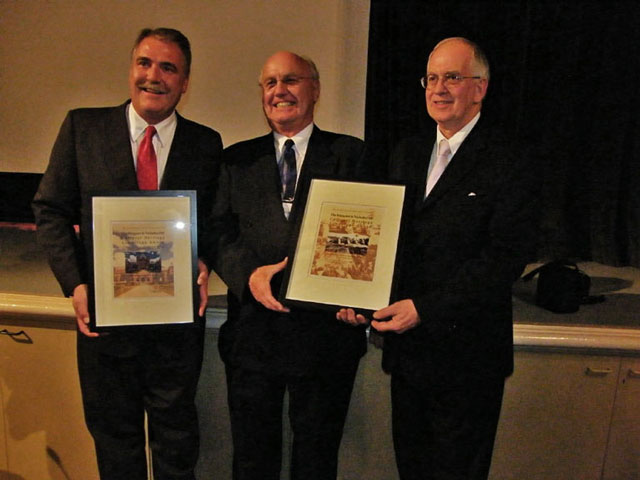
SaveTheBalaFalls.com is being honoured with the prestigious Margaret and Nicholas Hill Cultural Heritage Landscape Award which “recognizes individuals or groups and their projects that have led to a heightened level of awareness and appreciation of Ontario’s significant landscapes.”

Present to receive the award are Ruth-Ellen Nishikawa, Mark Gidley, Linda Jackson-Hutton, Tom Millar, Patricia Gidley, and Brad Burgess.


It was a very classy evening.


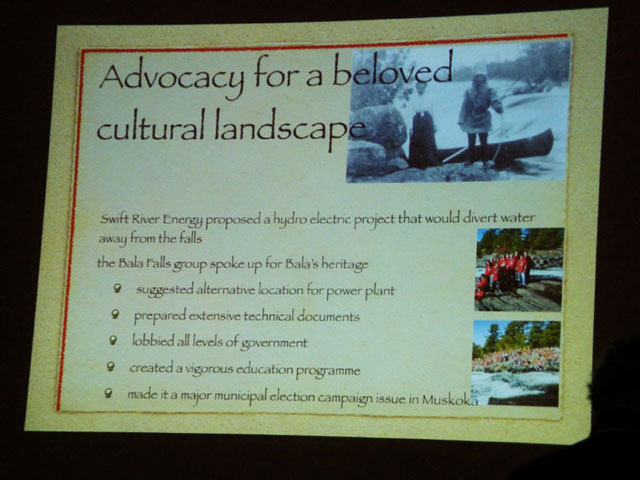
The presentation noted that we have:

  • Suggested an alternative location for the proposed power plant
  • Prepared extensive technical documents
  • Lobbied all levels of government
  • Created a vigorous education programme
  • Made it a major municipal election campaign issue in Muskoka


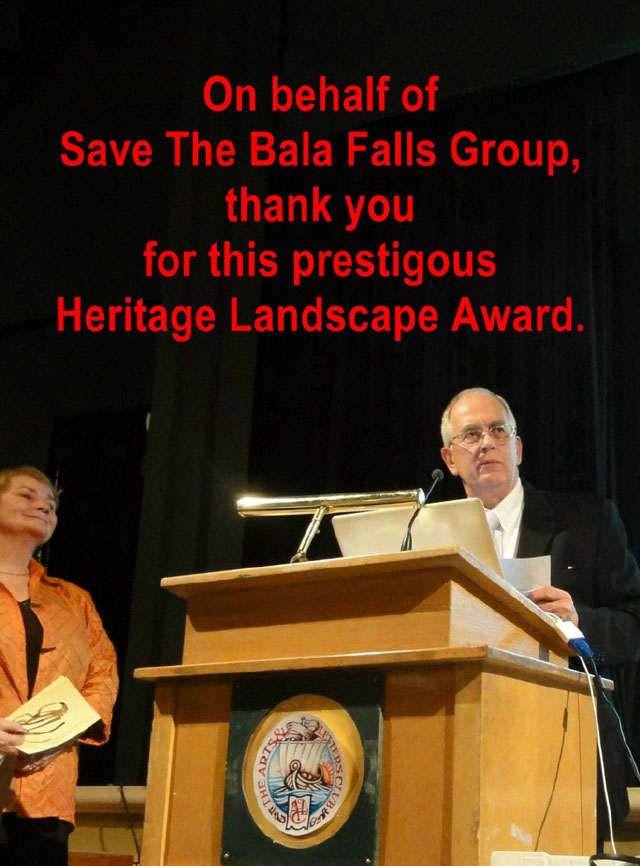
Brad Burgess accepted the award on behalf of SaveTheBalaFalls.com

The awards dinner program noted:

Save the Bala Falls, a West Muskoka community group with a deep understanding of the area, was formed three years ago to protect the falls and adjacent town where a new hydroelectric project is slated to be built. The group contends the project would drastically alter both the landscape and the historical use of Bala Falls.

Bala is a small town and virtually the entire local economy is based on tourism – visitors who are drawn to its natural beauty, accessible water, and small town charm. The falls are its most distinctive feature, and the primary reason people visit the area. The proposed hydroelectric project would channel almost all water away from the falls, and eliminate most of the publicly accessible shoreline, destroying not only the landscape, but the town’s economy.

Save the Bala falls has suggested an alternative location for the power plant, prepared extensive technical documents, lobbied all levels of government, and undertaken a vigorous education program that has made protecting the falls for future generations a topic of widespread interest and discussion throughout the district and as far south as Barrie. It’s advocacy put heritage – both natural and manmade – front and center as a major campaign issue throughout Muskoka.


An award was also presented to the Honourable Speaker of the Legislative Assembly of Ontario, MPP Steve Peters, for his efforts to protect the dignity of the views of the Legislative Assembly building in Queen’s Park in Toronto.


It was a fine evening.


The award.

Nov 042010
 

SaveTheBalaFalls.com was nominated for, and is the winner of the Margaret and Nicholas Hill Cultural Heritage Landscape Award from the Architectural Conservancy of Ontario.

The Architectural Conservancy of Ontario was formed more than 75 years ago to preserve buildings and structures of architectural merit and places of natural beauty or interest.

This award therefore acknowledges that the Bala Falls are an important part of Ontario’s environmental heritage, that the Bala Falls would be ruined by the proposed project, and that the work of SaveTheBalaFalls.com is aligned with the Architectural Conservancy of Ontario’s mission of preserving our cultural landscape.

Oct 022010
 

As a result of a process initiated by Ontario’s Ministry of Natural Resources, there has been a proposal to build a hydro-electric generating station at the north Bala falls.

While we all agree that water power is an excellent source of energy for generating electricity, the proposal would:

  • Make hundreds of feet of the only public shoreline in the area too dangerous for existing recreational activities, this would be a terrible loss to locals and visitors.
  • Locate the power station’s 50′-deep, 40′-wide water intake just downstream from the town docks, this would create a huge danger to all users of the town docks, as well as the recreational activities upstream.
  • Reduce the falls to a trickle year-round, which would destroy what makes Bala unique.
  • Require a 33′-wide, 128′-long poured-concrete building which would rise 20′ above the Moon River, and this would be right at the falls, directly in the line of sight from where most people view the falls. And the proponent refuses to provide a rendering of the structure showing the required components such as the facility’s entrance door or exhaust fan openings.
  • Negatively affect tourism and therefore the local economy, yet the proponent has not seriously investigated this.

We have detailed our concerns, yet in response the proponent only repeats the evasive information in their environmental screening report.

Oct 012010
 

The week before the municipal election ballots are to be received, the proponent has placed this advertisement in local newspapers.

They continue to:

  • Ignore crucial details (such as that they would make hundreds of feet of the only public shoreline in the area too dangerous for public access).
  • Use their deceiving fantasy rendering.
  • Claim economic benefits even before their fatally-flawed economic impact study is written.

Our comments on their advertisement are here.

Sep 302010
 

While the proponent is trying to get us to believe they have proposed Option 2 to quell the public outcry they orchestrated against Option 1, in fact, they proposed Option 2 for their own benefit.

Here are some reasons why the proponent would prefer to build Option 2 rather than Option 1 (the $25,000,000 question is whether these are significant enough that the proponent would give up and go away if Option 1 was their only choice):

  1. The water intake to the proposed power station would be restricted by the support for the highway bridge (this limits the power which could be generated), excavating the bedrock down 38′ directly adjacent to the north dam and the supports for the highway bridge for the water intake “would be difficult and could threaten the bridge or dam”, and the fast water exiting the power station would be very close to the base of the north falls “and this could cause safety issues and public concern”. Note that all these points were noted by the proponent in (and the quotes are from) Section 1.5.1.1 of their Environmental Screening Report.
  2. The excavation for the proposed power plant would need to be all of the MNR land directly south of the north dam, to a depth of 67′ deep. This would need to be a hole, with vertical sides, straight down, directly adjacent to the highway. That would be really difficult.
  3. There wouldn’t be anywhere for the dump trucks to queue up waiting for the more than 1,000 truck-loads of blasted rock to be hauled away.
  4. The fast water exiting the tailrace would make it difficult or dangerous to use the town docks on the Moon River as well as the private docks which are even closer.
  5. The coffer dam required during construction of the intake would obstruct approximately 85% of the north channel (it is more than the expected 66% due to blocking four of the six north dam sluices because the north channel is very shallow north of the north support pier of the highway).
    • This is much more than the 40% obstruction needed for Option 2, and this would need to be in place for much longer than for Option 2 (especially the construction crane could not be located on the District land to the south), creating a significant risk of flooding at least the Lake Muskoka watershed if this capacity was needed due to a high-flow event.
    • Because of the construction equipment (such as a crane with a 150′ boom), and the highway bridge support and Bala Falls north dam sections within the coffer dam not yet being ready to handle water flow, the coffer dam could not simply be quickly removed if necessary.
    • The MNR would therefore not approve Option 1.
  6. While the proponent has shown a driveway for the site, it would be extremely difficult to use (it is narrow, and with their powerhouse on one side and an 18′ drop on the other side). Maintenance access to the structure would be difficult (truck access to the equipment hatches, crane access blocking the highway …). If the entire power station was difficult enough to operate, then the proponent would have difficulty raising construction financing.
  7. The water path would have three 90° bends (at the intake, at the turbine, and exiting the turbine), and this reduces the power which could be generated, and therefore the profitability, and therefore the difficulty of getting construction financing.
  8. They would need permission from the District/Township for a coffer dam in the Moon River during construction, and to anchor the required downstream safety boom for operation.
  9. The environmental screening report would require re-writing, review by government agencies, public comment, and evaluation by the Ministry of the Environment because the following would be significantly changed so new study and analysis would be required:
    • The water flow patterns in the north channel and in the Moon River (since both the intake and tailrace would be different sizes and angled differently).
    • Noise analysis (since a different turbine design and generator location is proposed).
    • Shadow study (since the powerhouse would be closer to the falls and could be taller).
    • Construction impacts on traffic (since blasting would need to be directly adjacent to the highway).
    • Restricted areas where it would be too dangerous for the public to be at the shore (since the water flow patterns and building location would be changed), and location and design of the upstream and downstream safety booms (since the locations of the intake and tailrace would be different).
    • Coffer dam locations and flood risk (since the north channel would need much more of its width to be blocked, and for much longer). And if the construction crane is located within the coffer dam area, then it would be even more unlikely the coffer dam could be quickly removed due to a high-flow event.
    • Risk of damage to the north dam and highway bridge (since the bedrock on which the north dam and highway bridge supports are built would need to be excavated to a depth of 38′ directly adjacent to the footings).
    • Portage alternatives (since the locations of the intake and powerhouse would change).
    • Upstream and downstream effect on fish habitat (since the locations of the intake and tailrace would be different).
    • Fish entrainment and mortality (since the size of the intake and type of turbine would be different).
    • Construction vehicle requirements (where would dump trucks queue) and materials staging locations (this would be extremely difficult if the District land was not available) and effect on traffic and pedestrians (since the locations are different).
Sep 302010
 

We can argue about whether Option 1 or Option 2 is the “lesser of the evils”, but keep in mind that the beauty of the falls would be completely ruined either way.

For both Option 1 and Option 2:

  • The proponent will take 94% of the water, leaving only a trickle for both the north falls and the south falls ALL YEAR (except for a bit they couldn’t stuff through their proposed power station in April and May).
  • The plant would operate for at least 40 YEARS – this is basically forever and for our children.
  • There will be a huge reinforced concrete structure within 20 m of the falls, which rises at least 20′ above the Moon River, and is at least 33′ wide at the Moon River. And anyone looking at the falls from the north side will see the side of this concrete cube with rocks piled up the side.
  • For over a year, there will be an ugly construction site, with a rock and plastic coffer dam hundreds of feet long leaving the head of the Moon River dry to the riverbed, there will be safety fencing, construction equipment and a construction crane with a 100′ boom, all the trees on Burgess Island west of the highway will be clear-cut, blasting and hauling away 1,700 tuckloads of rock, construction trailers and porta-potties, pumps and settling ponds, traffic disruptions, and on and on.
  • During operation, there would be a dangerous water intake, no local operator to shut the plant down if there was an emergency, the flow into the plant would be remotely controlled so recreation activities nearby would get no warning when this changes, loss of the portage locations, the creation of new dangers, the loss of hundreds of feet of public shoreline, and on and on.
  • The proponent refuses to post a completion bond, so if they run into business, financing, or technical problems, they could leave a much uglier and expensive mess than Port Carling has.
  • The proponent would have control of Margaret Burgess Park (the land north of the north falls) and Diver’s Point (the land west of the south dam) FOR 40 YEARS. And the proponent won’t confirm that they would never, during the term of the lease, apply to build on these lands. So who knows, maybe they would try to put up high-rise condominiums (apparently being crown-owned, municipal zoning by-laws don’t apply to these lands).

So let’s not argue about which is worse, they would both be a disaster.

Sep 302010
 

Rather than arguing with a child who does not want to get dressed, a proven strategy is to change the question.

The trick is that rather than saying “will you get dressed now“, you say “would you rather wear the blue shirt or the green shirt“, and the child will feel empowered to take charge and choose their favourite.

The proponent is trying to trick us the same way. We should not be arguing about Option 1 or Option 2, we must “just say no”.

The current Councillors; have demonstrated that their actions to stop this project have been ineffective, and have confirmed they will not take any stronger actions. We therefore do not support any encumbent politicians.

Sep 292010
 

On September 29, 2010 the Gravenhurst Banner published this letter to the editor. Our responses to the quotes are below in blue.


Leaders of the Save the Bala Falls (STF) group have done an excellent job of rallying their cause to anyone who will listen…

The only reason why the “rallying” is working is because the public demands it. You can’t make people rally. This is a huge wrong that needs to be righted.


… tried to achieve their objectives by bullying their opposition …

The only “bullying” is to the proponent (and we’re sorry this reply needs to be terse, it would be delightful if we had the time and opportunity to interactively discuss this in a more friendly forum). The proponent has hired consultants, government lobbyists, and technical experts. We must be strong to meet this well-financed challenge. Given that most people don’t have the time to follow this issue closely, we must show the side of the story which the politicians and the proponent neglect to mention.


… innuendos about potential bad outcomes.

What innuendo is required to point out the danger of a 45′-deep, 30′-wide water intake just downstream of where inexperienced people dock their boat or people displaying poor judgement illegally jump off the railway bridge. What innuendo is required to point out the concern of approving a power station at the Bala Falls when all three of the power stations at and north of Bracebridge have barbed-wire fencing and the Mill Stream power station in Bala recently had sharp-tipped chain-link fencing installed. No, these are well-founded and real concerns. There is no need to exaggerate the concerns or spread rumours, we have documented them.


They tell us that the project will ruin the town and the Bala Falls.

Well yes, taking 94% of the water from the falls would ruin them. People won’t come to Bala to see where the falls used to be or to see a concrete power station with rocks piled up the side, even if there are a few shrubs planted on top.


In reality, the island where Swift River hopes to build the generating plant is not a beautiful “sight”.

… could be designed and landscaped in such a manner as to draw more tourists …

People come to Bala to see the natural beauty of Muskoka, even if it is just bedrock and trees. Hauling away 1,700 dump trucks loads of blasted rock, and cutting down every tree west of the highway on Burgess Island can’t be the start of a good thing. People can see artificial landscaping on top of the condominium parking garages in Toronto.


Unless the MNR and Swift River are fabricating what they are telling us, which I do not believe, the final outcome will be an acceptable one and, in fact, if we all work together with a positive vision, could leave the area in much better shape than it is now.

As detailed in our technical report and elsewhere at SaveTheBalafalls.com, the proponent’s lack of information and evasive responses, do not provide any justification for optimism. This is business and money, plain and simple. Just like signing any contract, the time to get answers is before any approval to proceed, and we don’t have the answers.


The economic impact study is not yet completed, but it is possible that this project could be a plus for the area – not negative or neutral.

The questions in the Economic Impact Study’s survey shows it is unlikely to actually consider the short- or long-term impact of the project on the businesses of the area, so the information gained from it will not be of much value. The “questions” spend more words soliciting business than presenting what the situation would be during and after construction and asking useful questions so businesses could actually provide meaningful information. The information requested on this topic had to fit into one small text box, there was no opportunity to save and later return to this after one thought about it, and once the survey was submitted there was no way to review, print, or re-read one’s responses, nor warning that clicking “Done” was the end of the survey and was final.


They ignore the fact that neither the township nor the district has a formal say in the project

The Township (that recommended the District consider providing District land to the private developer), and the District (that acted on this recommendation) have a very formal say in this – they can say no.


…creating revenue for the district.

The time to negotiate this is before there is any committment to proceed, but we understand this hasn’t even been initiated yet. This process is out of control and needs to be stopped.


… wants the District to rescind this offer to lease.

The district councillors did what they could …

By our District council agreeing to provide District land for the project, all agencies and higher levels of government get the clear message that we want the project, and they take their lead from that. We need to send a clear message that we don’t want this project. This is the opposite of what has been happening, and that is why we need different politicians.


Let’s work together to make the Bala Falls area more beautiful …

We tried to work with the proponent and agencies to investigate how the project could be done in a less dangerous and damaging way, such as the south channel. But we are told that the way the process works is that the only decision being asked of the Ministry of the Environment is whether Option 2, as currently proposed should proceed. So our only option is to say no.