Jun 072018
 

Summary
Industry information shows that insurance coverage is the greatest operating cost for hydro-electric generating stations – more than all other operating costs combined. The only explanation we can think of is to cover the legal and settlement costs for drownings and other injuries to the public.

Detail
AECOM is multinational engineering services company with over 87,000 employees, and more than 450 offices in more than 60 countries. They have 53 offices in Canada alone.

The Ontario Ministry of Natural Resources requested AECOM Canada Ltd. to assess the economic impact of 41 proposed hydro-electric generating stations in Ontario. The result was this report.

While most of these 41 proposed projects were never developed, we have provided some analysis; of the report in this article, and of industry response to drownings in this article.  But what we wanted to highlight for this article are the operating costs presented on page 5. This shows that insurance for hydro-electric generating stations costs more than all other operating costs combined, including the generating station’s costs for; staff, maintenance, water use, land use, and administration.

As hydro-electric generating stations operate unattended and are automatically monitored for mechanical and other problems, there are very low risks to employees. Other conventional risks such as fire and theft would also be quite low. So it appears the reason for such high insurance costs is the insurance company’s costs of defending or settling lawsuits resulting from drownings and other personal injuries due to the operation of hydro-electric generating stations.

So one of the uses of the $100,000,000 subsidy from Ontarians to this private developer for power that isn’t needed would be to pay for their insurance to protect them from losses due to their drowning unsuspecting tourists.

Jun 052018
 

The proponent for the proposed hydro-electric generating station at the Bala falls is now showing that by ignoring their environmental commitments and by spending a lot of money, they can make a big mess.

But what they have not shown is how, or if, they could adequately warn and inform the public of the extreme dangers their proposed project would create.

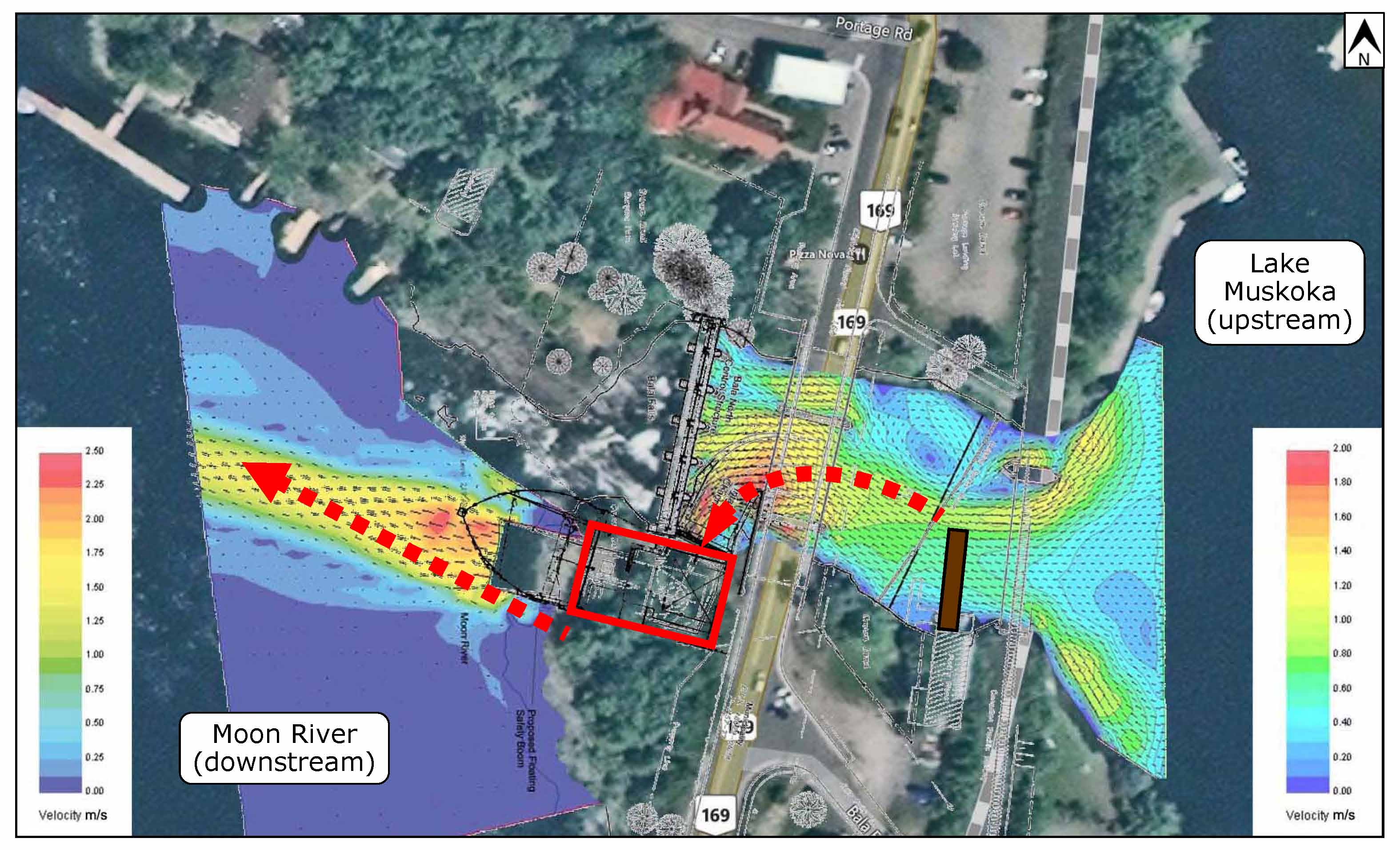
The proponent does not have rights to land in locations where warning signs would need to be. And as shown by the graphic below, people participating in upstream in-water recreation such as renting a canoe at Purk’s Place, Scuba diving off Diver’s Point, or using the municipal docks on Bala Bay would be just seconds away from being drawn to the proposed intake trash-racks and drowned. More detail is here.

As noted here, hydro-electric generating stations too close to in-water recreation are deadly. Analysing the aftermath of such drownings shows; the station owner blames the victim, the owner’s lawyers pile on the chargeable hours and threaten the grieving family with these costs if legal action is pursued, and the owner’s insurance company wears down the grieving family with years of legal proceedings.

The mandate of the Ministry of the Environment and Climate Change includes protecting human life, but they refuse to do so. Instead the MOECC enabled this hazard by granting approvals and now attempt to free themselves of any responsibility by claiming that only the proponent has responsibility for public safety – even though it would be unprecedented to build such a dangerous facility in the middle of an extremely popular in-water recreational area. This would be like the government granting a Driver’s License to anyone that requests one, and if you are maimed by some idiot that can’t drive their car safely, then the government will stand back while you (or your estate) tries to sue the idiot.

The proponent apparently plans on using tourists and visitors as “crash test dummies”, to figure out on opening day if the public safety measures are workable in the real world.

What if it isn’t possible to operate this particular proposed project safely. Does the proponent, or whatever nameless/faceless corporation they hope to sell this mess to, expect to be protected by their lawyers and Darwinism – so those that do not display an abundance of caution won’t survive so are no threat.

The proponent refuses to disclose their safety plans or to acknowledge this issue publically, their parent company is apparently so ashamed and embarrassed about all this risk that months ago they took down their web site off-line to hide the names of those involved, and the owner has never even shown his face in Bala. Avoiding the public is no way to address public safety.

We don’t want to see Bala become the drowning capital of Muskoka due to tourists being deceived by inadequate public safety measures.

May 232018
 

Summary

  1. We have learned from information received through the provincial government’s Freedom of Information process that contrary to commitments the proponent made for their environmental approval, the minimum flow through their proposed hydro-electric generating station at the Bala falls would be more than double the flow that caused the 2008 drowning of a 16-year-old boy at the nearby Wilson’s Falls Generating Station.

    This minimum flow through the proposed Bala generating station would begin, without warning at about noon, on about one-third of summer days – just when people would be most likely to be in the water.
     

  2. To fool the government into believing there was meaningful consultation with the public on the trickle of flow the proponent would allow to continue to flow down the Bala falls, the proponent convened a farce of a “Flow Distribution Committee” process.

    At the same time the proponent was making flow commitments to their Flow Distribution Committee, the proponent was telling the Ministry of Natural Resources and Forestry there would be less flow and more danger than they were telling the Committee. That is, the proponent lied to the Flow Distribution Committee, and at the same time they lied to the government on what they told the Flow Distribution Committee.
     

Detail
To prevent the public from having any meaningful say in how much flow would remain over the Bala north and south falls, in 2010 the proponent convened a Flow Distribution Committee. Flow Distribution means determining for various times of the year and available flows, how much water would continue to flow over the Bala north and south falls, the remainder of the flow being directed through the proponent’s proposed hydro-electric generating station at the Bala falls.

The proponent:

  • Determined the Committee’s members, speakers, and agenda.
  • Used the meetings to unilaterally tell the Committee what the Flow Distribution would be.
  • Produced the minutes without regard to disagreement from the committee on what was actually said.
  • Claimed this meaningless farce was consultation.

As background, the flow over the Bala falls is sometimes called “Scenic Flow”, which denigrates its importance to the area’s tourist-driven economy.

  • Did you know that by international agreement, half of the flow through the Niagara River must go over the Niagara Falls (rather than being through the Canada and US hydro-electric generating stations there) as it is is widely accepted how important tourism is to that area’s economy. The Bala proponent would allow only 6% of the flow to remain over the Bala falls.

Here is the problem …

  1. The proponent’s commitments. As you can see from the proponent’s presentation at the final meeting of their Flow Distribution Committee, which was September 17, 2014:
    • Page 5: The proposed generating station’s minimum flow would be 14 m3/s (just as they committed in Section 6.2.2.1 of their 2009 Environmental Screening/Review report).
    • Page 9: They would provide greater “Concession Flows” over both Bala falls on six long weekends (such as the Canada Day long weekend) – as if these are the only important tourist times in Bala (what a misunderstanding of the local situation).
       
  2. These commitments were final. As you can see from their September 30, 2014 Press Release, this is the “Final Scenic Flow Plan”, and they almost break their arm patting themselves on the back for these few days of Concession Flows.
     
  3. But at the same time the proponent was providing conflicting information to the MNRF. On August 15, 2014 the proponent submitted this Water Management Plan Amendment to the MNRF. Note that:
    • Page 5: The new statement: “Concession Flows to be provided only when in-flows are available i.e. > 26 m3/s”.
      • The problem is that less than a third of summer days have flows of greater than 26 m3/s, so they usually would not actually provide these Concession Flows.
    • Pages 6 and 7: The new statement that the generating station’s minimum flow would be between 26 and 30 m3/s.
      • Note that the nearby Wilson’s Falls Generating Station caused the drowning of a 16-year-old boy in 2008, that station’s maximum flow was 10 m3/s.

So we now know that the proponent lied, as they told their Flow Distribution Committee:

  1. They would provide additional flow over the Bala falls on long weekends, but at the same time they were telling the MNRF they would do this less than a third of the time.
  2. Their generating station would have a minimum flow of 14 m3/s , but at the same time they were telling the MNRF the minimum flow would be between 26 and 30 m3/s.
    • So on the one-third of summer days when the proposed Bala generating station would start, without warning at about noon, the flow would be more than double that which is already known to have caused a drowning.
       

The Freedom of Information process
One of the few ways we have of knowing when the proponent lies is through the Freedom of Information process, where any member of the public can request internal government e-mails and other documents. There are two problems. Firstly, the process is expensive, often costing more than $1,000, depending on the number of documents and the time the government estimates it will take to gather them.

But the bigger problem is the proponent doing everything they can, at any expense, to delay and frustrate the process. Here’s the timeline of one request:

  1. June 5, 2015. Submitted an FoI request for MNRF documents concerning this proposed project, from January 6, 2015 to June 2015.
  2. June 17, 2015. Received fee estimate from MNRF of $1,420.
  3. January and August 2016, received some documents. Some the MNRF reported they could not release for various privacy reasons.
    March 2016, proponent objected to the release of many documents which the MNRF had agreed could be released. This initiates a Mediation process through the Information and Privacy Commissioner of Ontario to determine whether these Contested Records should be released.
  4. December 1, 2016. Proponent still objects to the release of the Contested Records. This initiates an IPC Adjudication process.
  5. January 31, 2017. Proponent’s two lawyers at Loopstra Nixon LLP, Barristers & Solicitors submitted 55 pages of Representations to the IPC Adjudicator on why they claim the Contested Records should not be released, including a threat that the proponent will initiate legal action if the IPC orders these Contested Records be released and noting: “This would inevitably involve a significant expenditure in terms of legal fees and court resources.” The proponent even discloses they contemplated legal action in their communications with the MNRF. Threats, threats, threats.
  6. February 24, 2017. IPC provides SaveTheBalaFalls.com with 47 pages of questions, instruction, and precedent giving us the opportunity to dispute the proponent’s claims.
  7. March 7, 2017. SaveTheBalaFalls.com provides 84 pages of Representations (with some follow-up in May 2017) citing examples and precedents of why the proponent’s claims are not valid.
  8. May 16, 2018. IPC Adjudicator provides 56-page Decision agreeing with us and the MNRF, and rejecting all of the proponent’s claims. The Decision orders that all the Contested Records be released no earlier than June 15, 2018 (giving the proponent a few weeks to initiate their threatened legal action) and no later than June 20, 2018 (as the MNRF sometimes takes months to get documents released).
  9. Of special note is that the Adjudicator agreed to apply the “Public Interest Override”, finding that the benefit to the public of receiving the documents was more important than the need for secrecy claimed by the proponent.

The result is the documents requested through the Freedom of Information process are now more than three years old and we still don’t have all of them.

If this is how Tony Zwig wants to waste his daddy’s money, so be it. We’ll keep at it.

May 222018
 

Our Letter to the Editor, published by MuskokaRegion.com on May 15, 2018:

Holding the government to account over Muskoka issues

I loved your strongly-worded article Provincial candidates making lots of promises in Parry Sound Muskoka riding,” it is refreshing to see.

But I think you make it sound too challenging that the proposed hydroelectric generating station at the Bala Falls be stopped. As we have often noted on our website, for example at https://savethebalafalls.com/?p=8670 under “the costs of cancellation,” all we’re asking is for the Ministry of the Environment and Climate Change to do its job and protect human life, and hold the proponent to the commitments they made for their current approvals.

If this requires a new government that does not interfere with the environmental assessment process, then we look forward to that.

May 032018
 

The proponent for the proposed hydro-electric generating station at the Bala falls committed for their environmental approval that: “any road closures be kept to a minimum and occur at times of least impact to the surrounding community.” For their final 2013 environmental approval, the proponent then updated this to state that even these closures would not be required.

Despite this, the proponent recently announced over 100 closures of Muskoka Road 169, and that these would be during daytime, twice a day, from at 9 am and 6 pm, for a half-hour duration each.

Now it gets even worse, the proponent is now blasting outside of those twice a day times, without any advance notification to the public.

The MOECC won’t enforce their environmental approval – apparently, if you’re building a generating station, anything goes.

  • So next time you feel like blocking Muskoka Road 169, just say you’re building a generating station.
  • While the proponent stated for their environmental approval they would not dump sand into the Moon River, they did this anyways and the MOECC wouldn’t stop it. So if you’d like to dump sand into lake, go ahead, just say you’re building a generating station.
  • The proponent checked in the wrong place at their construction site for contamination, even though Polychlorinated Biphenyls (PCBs) would be expected to be found abandoned from the Bala #2 generating station which was demolished over 45 years ago, yet the MOECC allowed dumping all this excavated material and also dropping insecticide-laden shipping containers from China into the Moon River. So apparently, if you have some hazardous waste you’d like to get rid of, just dig a hole somewhere else and show there’s no pollution there, then dump whatever you’d like into the river. Just say you’re building a generating station.

Apparently we’re paying civil servants to cater to developers who have no respect or regard for the community or the environment.

The provincial government is demonstrating that we can abandon all common sense and that anarchy prevails. So encroach on other’s rights, harm the environment, anything goes, have at it.

Apr 092018
 

In Muskoka we all know you can’t dump sand into a river to make a beach as it is bad for the fish habitat.

We also know from the Ministry of Natural Resources and Forestry’s notices (such as this and this) that we must always be careful to not introduce any invasive species. But we now see that apparently none of these environmental obligations apply to the proponent attempting to build a proposed hydro-electric generating station at the Bala falls.

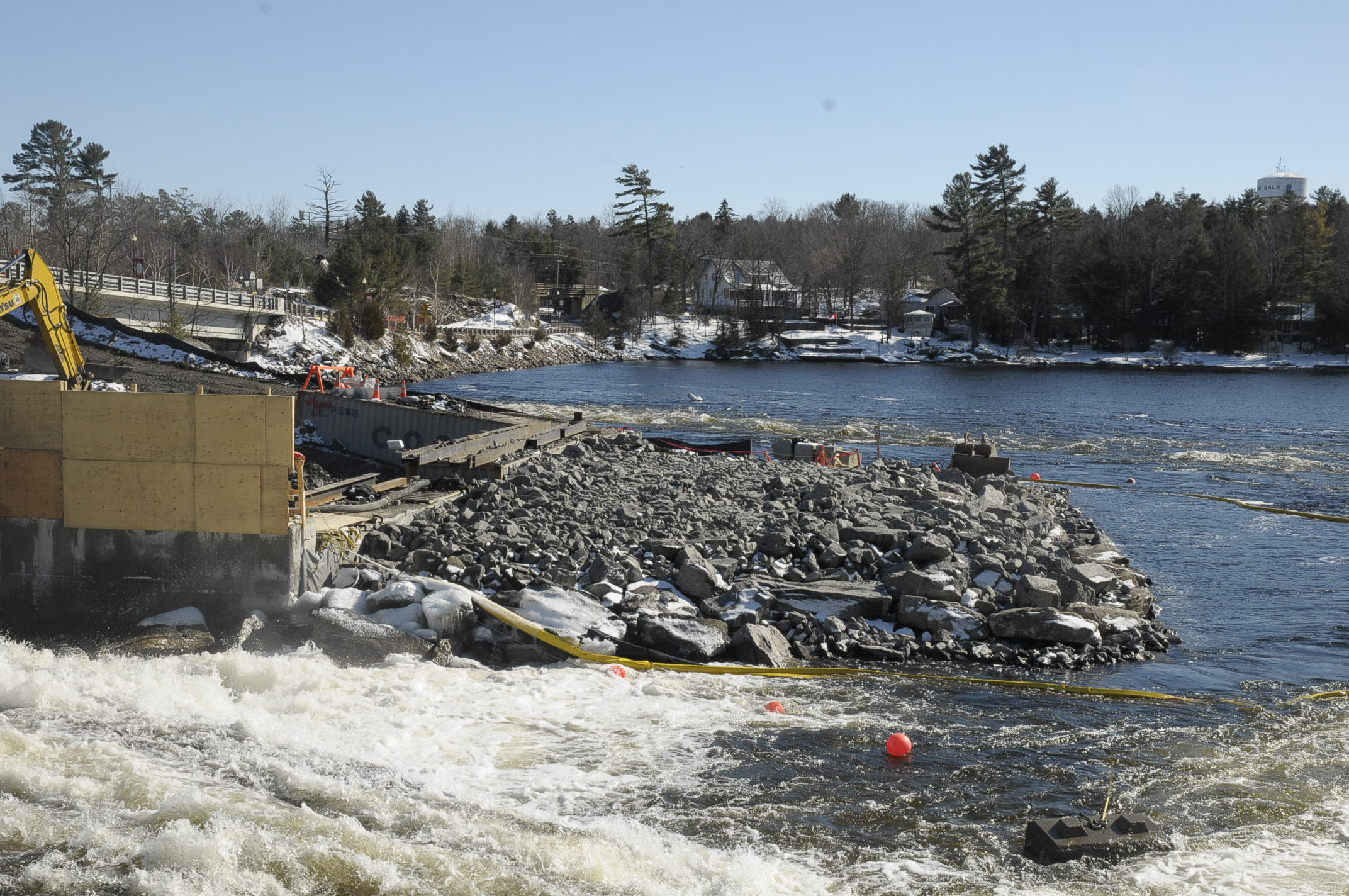
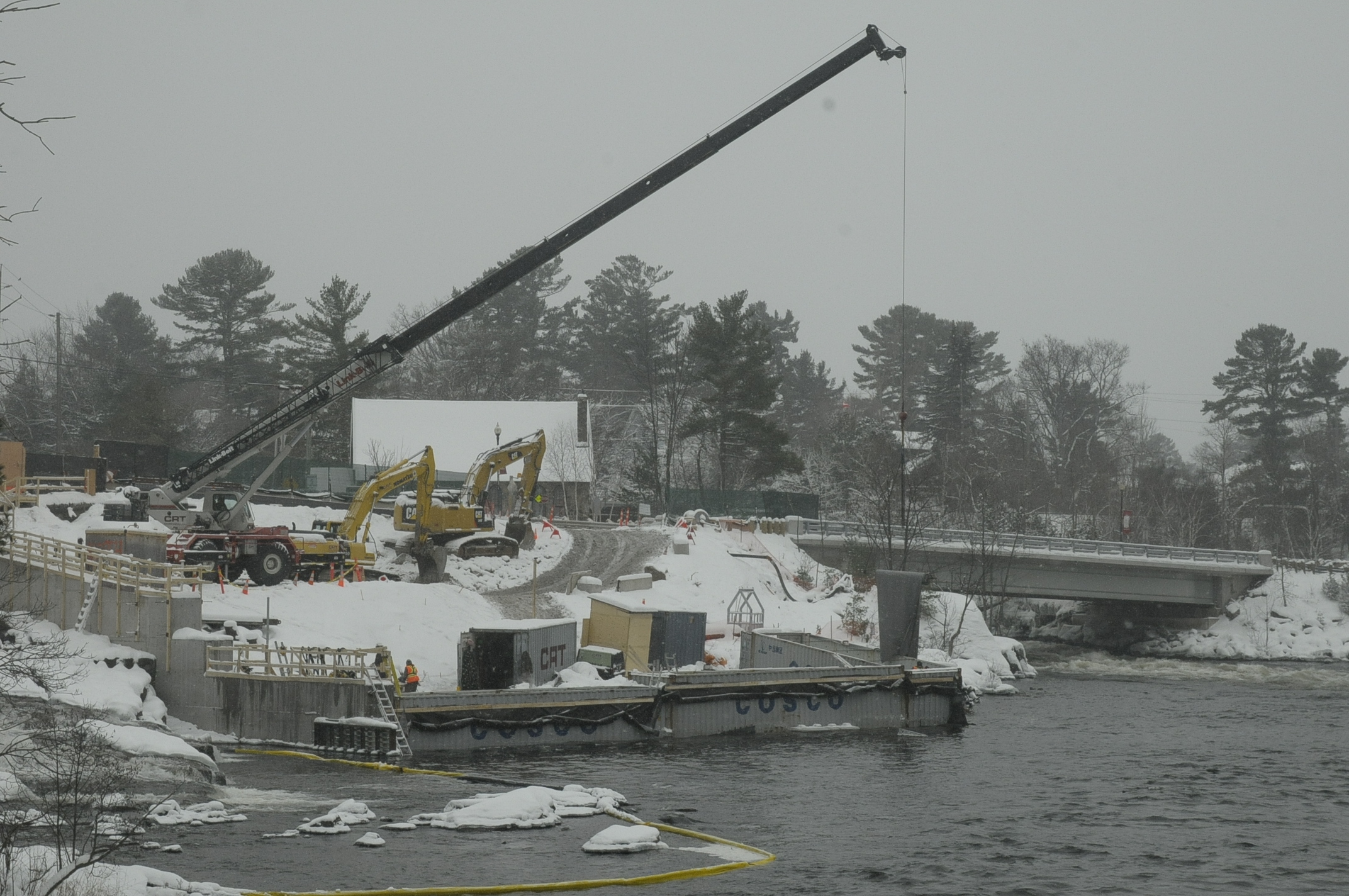
The photograph below (click on it for a larger view) was taken in December 2017 and shows the proponent has placed three overseas shipping containers into the Moon River (these were manufactured in China with insecticides harmful to fish applied to the wood floors). It isn’t known where these were most recently stored and what might have attached itself there. And we understand there were no precautions taken to ensure invasive species were not introduced into the Moon River.


The photograph below was taken in April 2018 and shows that the proponent has dumped blasted rock extending about 50′ into the Moon River. This blasted rock would include:

  • Fine particulate matter – this is harmful to fish habitat.
  • Residues from the chemicals used for blasting.
  • Anything else left when the Bala #2 Generating Station was demolished in 1972, such as Polychlorinated Biphenyls (PCBs), lubricants and whatever else that was buried at the time (the proponent’s excavation did uncover industrial heritage remnants from the Bala #2 Generating Station, but the proponent did not honour their commitments and obligations for this event).


The proponent did not disclose such destruction of fish habitat for their 2013 environmental approval from the Ministry of the Environment and Climate Change (MOECC). Therefore, the MOECC should not permit such harm to the environment as the public has not been notified of these negative impacts and any mitigation measures.

The Environmental Bill of Rights, and the MOECC’s Statement of Environmental Values requires the MOECC demonstrate transparency and consistency in their decision-making and enforcement actions, but this clearly has not been done.

As you see from this article, we have written many letters to the MOECC on this and other serious environmental issues, but the MOECC does not respond or reply.

Despite two reminders, the MOECC has still not replied to our January 23, 2018 letter “Murdered in 45 Seconds”. To not even have a response to this most serious issue of drowning unsuspecting tourists is inexcusable.

The fact that the MOECC has repeatedly ignored letters violates the Ontario government service standards.

We continue to be disappointed and frustrated that the MOECC bureaucrats accept their pay cheques but not their responsibility to protect the environment.

Mar 272018
 

Summary

The proponent for the proposed hydro-electric generating station at the Bala falls has no employees, no operations, and no income. This limits the proponent’s options to provide collateral for the construction financing they need.

The proponent considers their leases of land from both the Township of Muskoka Lakes and the Ontario Ministry of Natural Resources and Forestry as an asset they could pledge as collateral for their construction financing from lenders (which include the National Bank of Canada). The mechanism utilized to create this asset is a Demand Debenture which specifies the proponent’s leasehold interests as the Secured Property.

This Demand Debenture provides that if the proponent is in default of their construction loan payments, the lenders can demand payment of up to $60,000,000 with compound interest of 25% per annum. This remarkably high principal amount and interest rate seem to have been chosen to quickly deplete whatever equity the proponent claims they have in the proposed project, so that the lenders could gain full control of the proposed project within perhaps a year of the proponent defaulting on their financing obligations.

Ontario PC Party leader Doug Ford has recently stated that if elected Premier of Ontario, this proposed  project would be stopped (and we believe this could be done without cost or penalty to the province). It is therefore a real possibility the proponent could default on their financing obligations while they get busy suing everyone they can think of, we note the following:

  • Articles on the proponent’s parent company’s 2015 lawsuit against the province of Ontario for their controversial and rightly-cancelled proposed wind turbine project near Thunder Bay are here and here (that lawsuit is actually for $60,000,000; as $10,000,000 for claimed development costs incurred and $50,000,000 for lost future profits).
  • The proponent continues to maintain the $3,000,000 lawsuit they initiated in 2013 claiming defamation against the Township of Muskoka Lakes and others.

If the proponent went bankrupt or otherwise defaulted on their construction loan payments or other financing obligations, it is a valid concern whether the Township of Muskoka Lakes could incur legal or other costs or risks either due to this Demand Debenture or due to the Township’s lease of land to the proponent. For example, if construction was stopped, the Township’s Portage Landing would need much work to make the site safe, also the proponent’s lenders could sue the Township. The Township’s response to this liability concern that the proponent’s construction financing includes a Demand Debenture specifying Township land as Secured Property is: “the Township’s liability exposure is no different than that anticipated in the lease”.

While some may be comforted by the Township’s claim that the proponent’s Demand Debenture does not increase the Township’s liability, apparently the Township increased their liability exposure by leasing land to the proponent. This is certainly new information to the public, and likely to the Township Councillors as well. The Township Councillors apparently had extremely limited time and opportunity to review the Township’s land lease document before the Township Council vote that authorized the Township to execute the land lease. Apparently there was no advice provided to the Councillors that the Township would increase their liability exposure by signing this land lease.

This is a complex issue, and much depends on the exact wording of the relevant documents. For those interested in learning more and in seeing the relevant documents, the following is provided.
 

Detail

For their proposed project to construct a hydro-electric generating station at the Bala falls, the proponent obtained two land leases:

  • For five parcels of land, from the Ontario Ministry of Natural Resources and Forestry.
  • For three parcels of land, from the Township of Muskoka Lakes.

As the proponent pledging these land leases as collateral for their construction financing could create liability or other risk to the public, each of these land leases are discussed below.
 

MNRF Lease
From the Ontario Ministry of Natural Resources and Forestry, the proponent required a Construction Lease for their proposed construction site. This parcel of land is directly south of the Bala north falls, and was assigned Property Identification Number 48029-0635 by Ontario’s Land Titles system. Part of the MNRF’s strong motivation to facilitate this proposed project in every way possible is that for this Construction Lease, the MNRF are requiring the proponent to also lease three other parcels of nearby MNRF land, which are:

  • Margaret Burgess Park (directly north of the Bala north falls, PIN was 48154-0623).
  • The land between Purk’s Place and Muskoka Road 169 (PIN was 48029-0624).
  • Diver’s Point (PIN was 48029-0630).

The MNRF also owns the strip of land to the west of Margaret Burgess Park and the Bala United Church, but the MNRF forgot to include this land in the Construction Lease, so the proponent has no rights to this parcel of land.

As presented here, the MNRF can provide several types of Crown land tenure; for a time the proponent had a Land Use Permit, and after that a Licence of Occupation, but what the proponent really wanted was a Construction Lease as that can be used as collateral for the proponent’s construction financing needs.

The reason why the MNRF is so eager to lease these parcels of Crown land is that the proponent would then become responsible for the following:

  • Cutting the grass and cleaning up litter (though the Township of Muskoka Lakes currently does this).
  • Evicting trespassers – as demonstrated by the proponent stating they would instruct the Ontario Provincial Police to arrest anyone using Margaret Burgess Park in 2015, including those attending the the Moon River Property Owners’ Association’s annual family-oriented Canada Day music, ice cream and fireworks event on this public land.
  • Doing “minor” maintenance on the Bala north and south dams. The MNRF has spent years trying to “negotiate” this agreement, which is a farce as the MNRF has been desperately facilitating this proposed project in every way they can, and the proponent knows this, which doesn’t give the MNRF any negotiating strength. For example, while the proponent for the nearby Wasdell Falls generating station is responsible for all maintenance of that dam, the MNRF has proposed the Bala proponent only be responsible for “minor” maintenance, and the MNRF would remain responsible for “major” maintenance, with we taxpayers funding this. The definition of what constitutes “minor” and “major” is part of the MNRF’s negotiation.
  • Operating the Bala north and south dams, so MNRF staff do not need to do this water level control.

The proponent spent years pursuing this Construction Lease from the MNRF. One reason this took so long is it required the proponent providing an official survey of the area, and this required resolving some historic property boundary and ownership issues (for example, the boundary of CP Rail’s property at the north shore of the Bala north channel included some of the riverbed as this land was flooded when the Bala dams were built in 1873, raising the water level of Lake Muskoka). There were also some property easements and infringements to be documented (such as the District Municipality of Muskoka’s buried water and sewer pipes that traverse the MNRF’s Diver’s Point, and the sidewalk on the south side of the Bala United Church which infringes on the MNRF’s Margaret Burgess Park to the south).

In 2017 these issues were apparently resolved to the satisfaction of the MNRF’s Office of the Surveyor General, and you can see the resulting extremely complex official Plan of Survey here, which is registered as Plan 35R-25482. The Survey defines 26 “Parts”, so that each easement and infringement can be separately documented. There’s a reason for every Part, for example, Part 1 includes the easement for the Bala United Church’s sidewalk, Parts 4 and 11 are the Bala north dam, Parts 7 and 14 include the easements for the District Municipality of Muskoka’s water and sewer lines buried across the Bala north channel, Part 16 is the proposed construction site, and Part 9 is the proposed tailrace excavation in the Moon River.

Apparently to extinguish some public rights and MNRF obligations, and for the Construction Lease, in 2013 the MNRF depatented the above four parcels of MNRF land. As shown in this Property Index Map, when the Survey was completed the MNRF grouped some of the Parts and created five new PINs, as follows:

  • 48154-1188: Margaret Burgess Park and the north half of the Bala north falls to the south of it, including the north half of the Bala north dam.
  • 48154-1189: The north half of the Bala north channel.
  • 48029-0690: The proposed construction site, the proposed tailrace, and the south half of the Bala north falls to the north of this, including the south half of the Bala north dam.
  • 48029-0691: The MNRF land to the west of Purk’s Place and the south half of the Bala north channel to the north.
  • 48029-0692: Diver’s Point and the Bala south dam.

Ontario’s Land Registry system documents land ownership of every PIN through a land Parcel Register, and the printed version of this is called the Abstract. The Parcel Register Abstract for PIN 48029-0690 (which is the proposed construction site) is here. Of note:

  • It is quite brief, as this PIN was created quite recently (November 23, 2017).
  • The boundaries of the property are shown to be Parts 9, 10, 11, 12, and 16 on plan 35R25482, which is the Survey noted above.
  • The Plan of Survey for this PIN was registered on August 11, 2017.
  • A Crown Lease, with duration of five years and four months, beginning on September 1, 2017, for this land was registered to Swift River Energy Limited on November 24, 2017, and this is documented in Instrument MT192658. This is the Construction Lease from the MNRF, and it can be viewed here.
  • On January 9, 2018, this Crown Lease was pledged (“charged”), with stated value of $60,000,000, as collateral towards construction financing arranged by the National Bank of Canada. This is documented in Instrument MT194353, which is a Demand Debenture for the Crown land, which can be viewed here.
  • The “No Dealings Indicator” is set, which means that the property is not to be leased or sold, as there is already a lease registered against it.

Concerning the MNRF’s Construction Lease:

  • It is for all five of the new PINs (48154-1188, 48154-1189, 48029-069, 48029-0691, and 48029-0692, as listed above, and shown on the Property Index Map above).
  • This Construction Lease provides the proponent with the land tenure needed for the construction of the proposed project, up to the end of December 2022, or until a Waterpower Lease Agreement (WPLA)  is executed. A draft WPLA is included as Appendix A to this Construction Lease, and as noted in Section 13. of the Construction Lease, the WPLA would provide the proponent with land tenure for the operation of the proposed facility for an initial 30-year term with extensions in 10-year increments. The expectation is that the WPLA would be finalized and executed sometime before the proposed construction is complete.
  • Section 2. (g) (iii) of the Construction Lease requires that the operation of the facility comply with legislation related to safety and the environment. This is of interest as we have not seen any evidence that the proponent could safely operate this facility.
  • Section 2. (n) of the Construction Lease requires that heritage artifacts be: “identified, documented and preserved in accordance with Ministry of Tourism, Culture and Sport protocols”, however the proponent apparently has not done this for remnants of the Bala #2 generating station which their excavations have recently uncovered.
  • Section 23. of the Construction Lease reserves the MNRF’s right to flood the leased land.

Concerning the Demand Debenture for the five parcels of leased MNRF land:

  • The proponent, Swift River Energy Limited, has no employees, no operations, and no income. This Demand Debenture is the proponent’s method to use their lease for the five parcels of MNRF land as collateral for the loan they need to finance the proposed construction.
  • Section 1.2 refers to an October 11, 2017 Credit Agreement between the proponent, the National Bank of Canada and other unnamed lenders. 
  • Section 3.4 states that the payments specified by this Demand Debenture are only enforceable if the proponent does not fulfill the terms of that Credit Agreement.
  • Schedule B identifies that the leases pledged as collateral are for both the five parcels of leased Crown land and the three parcels of leased land from the Township of Muskoka Lakes.
  • Section 1.1 states that Swift River Energy will pay the National Bank of Canada and the other Secured Creditors up to $60,000,000 plus compound interest at the rate of 25% per annum. The purpose of this appears to be to quickly deplete the proponent’s claimed equity in the proposed project if the proponent defaults on their construction loan payments.
     

Township of Muskoka Lakes lease
To enable their proposed construction, the proponent leased three parcels of land from the Township of Muskoka Lakes (you can view the Township’s lease here):

  • Portage Landing, which is the land directly south of the proposed construction site (PIN 48029-0679).
  • The south half of the Don’s Bakery parking lot, also called the south half of the Portage Landing parking lot (PIN 48154-1077).
  • The north part of the Precambrian Shield parking lot, this land is actually owned by the MNRF as it was created when the highway bypass was built in 1965, but the Township of Muskoka Lakes has a License of Occupation to use this as a parking lot (PIN 48029-0634).

The Parcel Register Abstract for the south half of the Don’s Bakery parking lot is here, this shows:

  • The Township of Muskoka Lakes purchased this land for $160,000 on May 4, 2012.
  • On December 14, 2017 the proponent registered a lease against this property, as Instrument MT193543, you can view this Notice of Lease here.
  • Also on December 14, 2017 this lease of Township land was pledged, with a stated value of $60,000,000, as collateral towards construction financing arranged by the National Bank of Canada. This is documented in Instrument MT193544, which is a Demand Debenture for the Township land, which can be viewed here.

This Demand Debenture for Township land is identical to the Demand Debenture for the Crown land, the only differences are in the first two pages, due to the durations of the leases and the property descriptions.
Mar 212018
 

Updated April 27, 2018

Below are 16 letters of the letters we have sent to the Ministry of the Environment and Climate Change (click on each date to see the letter) over the past months detailing environmental concerns and risks to public safety.

Our main concern is that unsuspecting tourists would be drowned, as they could not be adequately warned. A recent decision by the Environmental Review Tribunal confirmed that the MOECC does have responsibility; for human life, and to obtain the required expert input even if it is not available from their usual sources (which include Transport Canada and the Ministry of Natural Resources and Forestry).

As you can see below, the MOECC; carefully avoids answering the actual questions asked, repeats unsubstantiated claims from the proponent, and bases their decisions on deficient and erroneous reports from the proponent.

  1. August 22, 2017, to Minister of MOECC. Notes unaddressed public safety issues and proponent’s unapproved changes. Requests to meet with the Minister.
    • No response received.
     
  2. September 1, 2017, to Minister of MOECC. Requests to meet with the Minister.
    • No response received.
     
  3. September 18, 2017,  to Premier Wynne. Requests the proponent’s safety plan be disclosed to the public before any further approvals are issued to the proponent.
    • No response received.
     
  4. September 28, 2017, to Premier Wynne. Proponent has not addressed public safety, requests no further approvals be issued.
    • No response received.
     
  5. October 10, 2017, to Minister of MOECC. Recent decision by the Environmental Review Tribunal has confirmed that the MOECC does have responsibility for public safety, and that MOECC needs to see external expertise in situations, such as for the proposed Bala project. Requests to meet.
    • No response received.
     
  6. November 12, 2017, to MOECC. Concerns include that proponent’s water treatment does not conform to approval, and does not allow discharged water to be sampled for testing.
    November 15, 2017 response does not address these concerns.
     
  7. November 23, 2017, to MOECC. Proponent’s water treatment system does not conform to Environmental Compliance Approval, has inadequate capacity, has caused an unauthorized spill, proponent did not report this spill, previous use of this land results in Polychlorinated Biphenyls (PCBs) being expected but the proponent’s Environmental Site Assessment (ESA) was deficient so PCBs could be present and directly released to the Moon River. 
    December 1, 2017 response received claims non-compliant water treatment system has been informally accepted by the MOECC (this makes no sense since this non-complaint system was clearly inadequate as it caused an unauthorized spill. Response claims if PCBs are released the proponent will clean it up (this makes no sense as PCBs released to the Moon River could not be cleaned up).
     
  8. December 5, 2017, to MOECC. Proponent’s water treatment system does not provide access to discharged water for testing, and the water treatment system has inadequate capacity as proven by the unauthorized spill that occurred.
    • MOECC’s response just repeats the nonsense answer provided by the proponent (therefore, these issues remain unaddressed).
     
  9. December 6, 2017, to Minister of MOECC responding to the MOECC’s December 1, 2017 letter above. The MOECC did not follow proper procedure in informally accepting the proponent’s non-compliant water treatment system, which subsequently caused an unauthorized spill of untreated water which was not contained on-site. The proponent should have, but did not report this. Such erroneous and informal acceptance of a water treatment system does not comply with the MOECC’s Statement of Environmental Values. The proponent’s Environmental Site Assessment was deficient and non-compliant, and therefore the proponent risks releasing PCBs to the Moon River. 
    February 22, 2018 claims the water treatment system is acceptable (even though it has been shown to be inadequate). Claims the water sampling is acceptable, even though this is not of the actual discharge water. Accepts proponent’s ESA even though I have shown how and why it is deficient. Claims PCBs could be cleaned up even though this would be impossible, and does not even require testing for them.
     
  10. December 11, 2017, to MOECC. In addition to concerns about insecticides in the used overseas shipping contains, putting these directly into the Moon River was never disclosed to the public and the proponent never received approval for this from the MOECC. Risks include introducing contaminants and invasive species directly to the Moon River. This is an environmentally-significant change, and the proponent should be required to follow the proper process for such a change.
    December 21, 2017 states the MOECC has no interest in these used shipping containers (which is ridiculous since they create risks to the environment). Does not provide any detail of how a sample was taken due to the toxicity concern. Assumes age of used shipping containers would preclude any possibility of environmental damage.
     
  11. January 9, 2018, to MOECC. Details new evidence which was not considered by the MOECC in their December 22, 2017 Decision as part of the October 25, 2017 Review requested of the ECA.  This includes that the MOECC has not acknowledged that the proponent’s testing for Polychlorinated Biphynels (PCBs) was deficient.
    January 16, 2018 Interim response received stated a follow-up would be sent “in the near future”, but nothing has been received despite a reminder e-mail sent February 20, 2018.
    April 12, 2018 Response received April 16, 2018 does not respond to the fact that the proponent’s exploratory boreholes were upstream of the likely source of PCB contamination, so the proponent’s Environmental Site Assessment is deficient. Perhaps the most ridiculous statement in the MOECC’s letter is that the proponent’s silt fence would protect the environment, apparently even from the release of PCBs. The MOECC’s response also accepts the proponent’s sewage treatment system even though it does not include the components required by the MOECC’s Environmental Compliance Approval and does not provide any evidence that the proponent’s system is adequately treating the water even though the proponent’s system does not permit drawing water samples from the actual discharged water.
     
  12. January 23, 2018, to MOECC. Notes that if someone tipped out a a canoe at the upstream boat rental, they would be drowned just 45 seconds later. Asks why the MOECC isn’t fulfilling its responsibility for human life by requiring the proponent to show the public how, or if, they could operate their proposed project safely.
    • No response received, despite reminder e-mails sent to the MOECC on February 20, 2018 and March 13, 2018.
    • Note that the Ontario government service standard is that e-mails will be answered within 15 business days.
     
  13. March 6, 2018, to MOECC. Notes that for their environmental approval the proponent stated they would close Muskoka Road 169 only two times, both overnight. But that the proponent now states they would close Muskoka Road 169 approximately 100 times, all during daylight hours. Asks what authority the proponent therefore has to request the OPP to enforce these road closures.
    March 22, 2018, the MOECC allows the proponent to cause environmental harm which the proponent did not disclose, or describe any mitigation, for their environmental approval.

    1. Even worse, the MOECC justifies this by claiming the proponent made statements in their Environmental Screening/Review report which the proponent never made. For example, the MOECC claims the proponent stated: “periodic traffic disruption on MR-169 will still be required”. The dictionary definition of “periodic” is: “happening or recurring at regular intervals”, whereas the ES/R only refers to “activities that require temporary disruption to traffic flow on Muskoka Road 169 including the delivery of large equipment to the site” and that “municipal and local emergency services, Ontario Provincial Police (OPP), ambulance, etc will be notified well in advance of the planned road closures. This will allow emergency services to plan emergency response contingencies and travel routes”. Clearly emergency services are not making any contingency plans for these closures.
    2. The proponent’s ES/R stated that as: “There are no feasible detours … It is therefore imperative to ensure that any road closures be kept to a minimum and occur at times of least impact to the surrounding community.”, so in their ES/R the proponent stated the two road closures would be overnight. They subsequently added for their Addendum that due to their change from their abandoned Alternative 2D design to their current Alternative 1A design for their current design: “Therefore, the lane and road closures anticipated for Alternative 2D will not be required for Alternative 1A.”
    3. Yet without environmental approval or explanation of how the negative impacts would be mitigated, the proponent announced there would be over 100 road closures, and these would be from 9:00 am to 9:30 am and 6:00 pm to 6:30 pm.
    4. Even worse, the proponent is now blasting outside of those times, without any notification to the public. Such complete greediness and selfishness shows complete disregard and disrespect for the community. That the MOECC refuses to enforce the commitments the proponent made for their environmental approval shows the farce of the environmental assessment process and will encourage others to ignore the MOECC, who apparently have no logic or consistency in what they do.
    5. The MOECC’s response also claims that if an emergency vehicle needs to pass that blasting operations could be suspended at any time. This is impossible, as there will always be unknown delays; to notify the Blaster, and for required post-blast inspections and clearing of debris.
       
  14. March 14, 2018, to MOECC. Notes proponent’s Archaeological Assessment for their 2009 Environmental Screening/Review report was deficient as the investigations did not look in the right places to locate remnants of the Bala #2 Generating Station or other industrial heritage resources or artifacts. Also notes that upon finding such materials, work is to be stopped and the Ministry of Tourism, Culture and Sport be notified. As these materials could be contaminated with PCBs, testing should be performed before these materials are moved.
    • No response received.
     
  15. March 20, 2018, to MOECC. Notes that the proponent is directly dumping blasted rock into the Moon River, without a silt fence. This would destroy fish habitat, and would introduce both fine particulate matter and chemical residues from the blasting directly into the Moon River – all of which are not permitted by the proponent’s 2013 environmental approval.
    April 25, 2018 Bizarrely, rather than taking responsibility for the environment and for ensuring that the proponent complies with the statements made for their environmental approval, the Ministry of the Environment and Climate Change replies that the MNRF can allow destruction of the environment by allowing non-compliant dumping of fine particulate matter into the Moon River.
     
  16. March 28, 2018, to MOECC. Notes that the proponent is not allowed to do in-water work between at least April 1 and May 31, including installing a cofferdam or dumping rock into the Moon River, asking whether this will be enforced.
    • No response received.

It is of great concern that the Ministry of the Environment and Climate Change is not fulfilling its mandate of protecting the environment, protecting human life, and for the past months is not even responding to these serious concerns.

The biggest concern is that the MOECC seems to consider this a game where all they have to do is to come up with some jumble of english words to respond to the environmental problems brought to their attention. The problem is these concerns include public safety and risks to human life, which are part of the MOECC’s responsibility, and avoiding responsibility to protect human life is not a game.

Mar 182018
 

Doug Ford has visited Bala to support us, it is now time for us to support Doug Ford
We have learned that the proposed project to build a hydro-electric generating station at the Bala falls is all about politics and not about what makes sense for Ontario, for example:

  • Our article here shows that proposed renewable energy projects in Liberal ridings get cancelled, but those in PC ridings don’t.
     
  • The environmental assessment process has been a farce, and after two months of waiting and after reminder e-mails, the Ministry of the Environment and Climate Change has still not responded to our letter noting that unsuspecting tourists would be “Murdered in 45 Seconds” (more detail in our article here).

As noted here, Doug Ford visited Bala on February 27, 2018 and stated if elected Premier, the proposed Bala project would be stopped. This doesn’t even have to cost Ontario, as all we need is for the MOECC to fulfill its mandate and protect human life by requiring the proponent to honour the commitments they made for their environmental assessment.

Last we checked:

  • It is still wrong to drown unsuspecting tourists (the proponent could not adequately warn the public of the extreme dangers their proposed project would create, and the proponent refuses to show how they would even attempt to provide such warning).
     
  • We still live in a democracy. It is time to use the power of our votes.

It is time to get political, and let the Progressive Conservative Party of Ontario know that if they’ll keep this commitment to stop the proposed Bala project, we’ll vote for them.

Your invitation is here for Doug Ford’s Unity Rally (a free event), which is this Monday March 19, 2018 at 7:00 pm to 8:00 pm (doors open at 6:00 pm), at the Toronto Congress Centre, 650 Dixon Road, Toronto, M9W 1J1 (you can listen Doug Ford’s invitation telephone call here).

Mar 042018
 

The current status
It has now been more than five weeks since we sent the Ministry of the Environment and Climate Change our letter with the graphic entitled: “Murdered in 45 Seconds” (more detail in our article here), and we still have not received a reply even though we have since sent a reminder to the provincial government. The provincial government also never responded to the hundreds of individually-written letters concerning this same issue of public safety which many of us sent the Premier in January 2017.

The root of the problem appears to be that the MOECC does not accept that they do have responsibility for protecting human life, as this responsibility is clearly stated in both the Environmental Assessment Act and the Environmental Protection Act.

This responsibility was also confirmed by the recent decision by the Environmental Review Tribunal which cancelled a proposed project which the MOECC had previously approved to build eight 45-storey-tall wind turbines too close to two Collingwood-area airports, as the Tribunal found:

  1. These proposed wind turbines would: “cause serious harm to human health”.
  2. It was unacceptable for the MOECC to assume that the proponent would or could later figure out how to operate their proposed wind turbine project safely so close to airports.
  3. The MOECC does not have, and did not seek, input from aviation experts, even though such input was required to adequately assess the public safety implications of the proposed project.

The above three points are very significant to us, as for the proposed hydro-electric generating station at the Bala falls, the MOECC:

  1. Approved an obviously dangerous project (some examples here).
  2. And the Ministry of Natural Resources and Forestry have stated repeatedly that it would be the proponent’s responsibility to operate the proposed Bala project safely. But both Ministries refuse to consider that this may not be possible, or that design changes may be required for this to be possible so the proponent’s public safety plan should be disclosed now so the public can comment on whether this safety plan is workable and could be implemented.
  3. Does not have, and did not seek, input from in-water recreation experts (we have, as noted here).

We have therefore filed a formal complaint with the Office of the Ombudsman of Ontario.

Also, we have posted some new articles at SaveTheBalaFalls.com, at the right, under Recent Articles.
 

Doug Ford
Doug Ford, who is a candidate to be the leader of the Progressive Conservative Party of Ontario, visited Bala on February 27, 2018. A photograph of him in Margaret Burgess Park is here, a Toronto Sun article is here (marked-up pdf version here), and a MuskokaRegion.com article is here. The statements Doug Ford made in Margaret Burgess park (video on Facebook here, video copy here) include:

“I’m here today in Bala, speaking with local residents, about the impact of this Liberal government’s disastrous plans to put a privately-owned green energy power plant. I’ve spoken to numerous residents, local residents, who have serious concerns with this development. Friends, what I’m seeing here today is extremely, extremely troubling…

I see this no matter where I go in Ontario, the local people, the grassroots people, don’t have a say. My government is going to listen to the local people, the grassroots people. It’s not about the political insiders and the establishment. The good people of this region do not want this project, and it’s not in the public interest. This is not about green energy, we can talk about this green energy file all day long. This is about the surplus energy being constructed on public land for private profit. Friends, we have a lot of smart people in this area right now, looking at these energy policies. Look into these policies, it’s about making money. That’s what this is all about. It’s not about getting more green energy, that’s a farce…

My friends, this project is another example of a long list of Liberal pet projects that would cost this province dearly. Projects like this are hurting our province and costing taxpayers billions of dollars, all to benefit the political insiders, the political elites, that have been running this province for years…

This tells me there’s a serious problem here. This project stinks of political interest and insider deals…

As Premier, I would conduct a full investigation into this project, and make sure the local residents are armed with the facts. As Premier I will get answers, and I can assure you, I will get answers. I will drill down and find out who is part of the big scam…

And as sure as I’m standing here, I’m going to come back, and each and every one of you can hold me accountable. I will be back here in the same spot, and we’re going to stop this project.

The comments we received from a huge range of people were remarkably similar – that:

  • People hadn’t considered voting for Doug Ford before, but here he’s got a very compelling point that resonates with us.
  • If the PC party makes this a campaign commitment, they’ll vote PC, as the provincial Liberal’s handling of the renewable energy file is a big mess that needs strong action to fix.
     

Our observations – the: “stringent approvals process”
We note in the MuskokaRegion.com article that the Ministry of Natural Resources and Forestry replied that: “When it comes to energy projects such as Bala Falls, there is a stringent approvals process in place.”

Clearly this process is inadequate as the public has not been shown this proposed project could be operated safely – even though it would be unprecedented to build a known-deadly hydro-electric generating station in the middle of a popular in-water recreational area and the proponent has never built a hydro-electric generating station. All we know now is that the public could not be adequately informed or warned of the extreme new dangers this proposed Bala project would create, due to:

  1. The land ownership in the area would not permit signs to be located where needed.
     
  2. The proponent has stated they would not use audible alarms to warn before the deadly operation would start, and even if they did these alarms would be inadequate as the alarms couldn’t be heard above the sound of the trains that frequently pass by.
     
  3. The proponent has stated that by starting operation “slowly”, people would be adequately warned. This is as stupid as telling someone not to worry as they’ll be pushed off the cliff “slowly”, or I’ll just warn these swimmers of my 200 horsepower motor boat by driving through them “slowly”. You can’t do something deadly “slowly” and expect it to be safe.
     
  4. Being a navigable waterway with many other users who have the riparian right of access, the safety booms could not be extended out far enough to provide adequate warning:
    • Upstream, people would be drowned just 45 seconds after tipping out of a canoe.
    • Downstream the proponent’s own flow simulations show the water outside the safety boom would be dangerous to both people using their own docks and people using the portage the proponent would build. The proponent does not have the authority to change the location or extent of these safety booms.
       

Our observations – the costs of cancellation
We also note several have questioned what costs the province would incur if they now cancelled this proposed Bala project. The answer is the province wouldn’t have to incur any costs, as it has been the proponent’s own business decision to begin construction without approval that they could actually operate this inexcusably and insanely dangerous thing (that’s all you can call it when a tourist would be drowned 45 seconds after falling out of a rental canoe). The proponent can spend all the money they want on construction, but there’s no evidence they could safely operate it.

Normally, a proponent couldn’t get project financing to start construction without knowing they have, or could get, approval for operation. But this apparently isn’t a normal proponent as Anthony Zwig seems to be financing this directly, using money he inherited from his well-respected and late father’s estate. If Anthony Zwig wants to build a project so dangerous that it could not be operated during the in-water recreational season, he can waste his money trying to build an embarrassing legacy.

So there doesn’t have to be any costs of cancellation, the MOECC just has to do its job and require that the proponent show the public exactly how this proposed Bala project would be safely operated.
 

What is going on now
The proponent’s work is months late from what they had previously announced:

  • Rather than finishing their proposed intake excavation by December 2017, they had to stop work on it in February 2018 for the spring freshet, and the earliest they can resume working in this intake excavation is June 2018.
  • Rather than blasting starting in January, it is March and not yet started.

The proponent doesn’t seem to be able to do anything themselves, they’ve been working on updating their parent-company website here for many months (note their graphic shows a river flooding the adjacent buildings). Once in a while they enable what they’ve got working so far, you can see some cached pages here and here (the links don’t work). That second page shows they have a CFO and a Controller – who would be busy writing cheques, for example to: WSP Canada (design), Stevens Burgess Architects (building shell), BBA Inc. (Quebec, nearby building surveys as required for blasting), CRT Construction (Quebec, contractors), Loopstra Nixon (legal), KGS Group (construction management), CTD Inc. (Quebec, cofferdam design), Hoelscher Dewatering Inc. (industrial sewage water treatment), and Tulloch Engineering (surveying).

The proponent has indicated that they expect to start blasting soon, and this would require their closing Muskoka Road 169, six days a week, for some time every morning and evening. During these road closures, fire and other emergency vehicles, delivery vehicles, pedestrians and everything else could not pass. The proponent has not indicated what provisions emergency responders have made to provide required services.