Save the Bala Falls and the Bala Falls Community Association made a joint presentation of our united position supporting Option 3, to the Township of Muskoka Lakes on February 3, 2009.
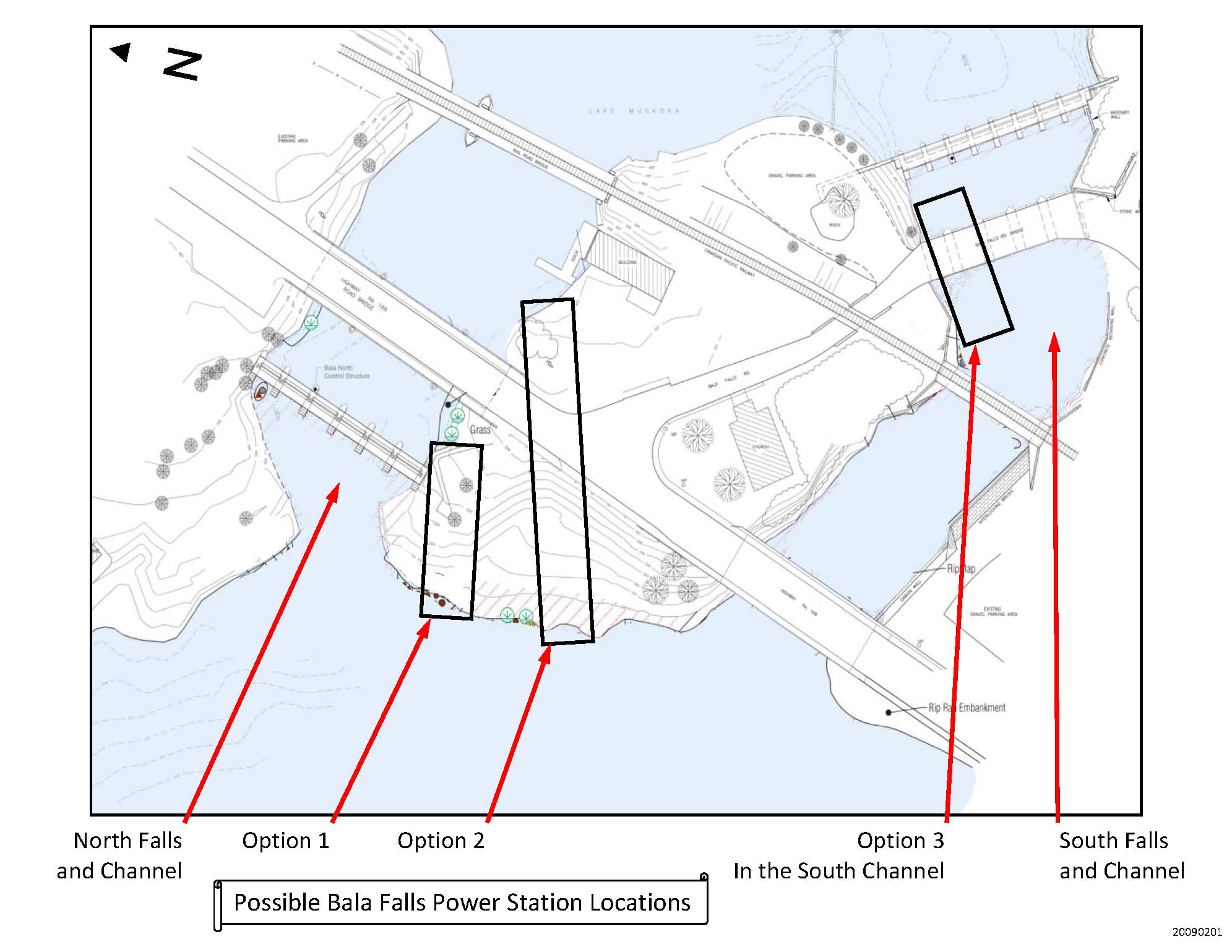
The presentation is here.
Save the Bala Falls and the Bala Falls Community Association made a joint presentation of our united position supporting Option 3, to the Township of Muskoka Lakes on February 3, 2009.
The presentation is here.
Swift River Energy Limited’s proposal, for which they were awarded the opportunity to pursue this proposed project, is here.
Note that the file is huge (42 Mbytes) and may take several minutes to download.
We are extremely concerned that Bala’s main fame and tourist attraction will become an industrial site, with:
By providing land for the power station, the district is exposing itself to the risks taken by the proponent – which is:
There are safer alternatives. As does most everyone, we believe that hydro power is one of the best ways to generate electricity. But there was no effort to ensure that the power station would be integrated with the town.
There may be still other alternatives, but the point is that these should be seriously evaluated, rather than proceeding with the most disruptive and dangerous plan without regard for the town’s economy and public safety.
We are extremely concerned about the new dangers that would be created by the proposed power station.
That is, people will drown and die. It has happened in Bracebridge – even just last summer, two young men in separate accidents the same day. And sadly, it too often happens at hydro generating stations. Attention to safety is required, and simply putting up some signs and a safety boom isn’t enough when the power station will be in the heart of a tourist destination. Trying to get every last kilowatt-hour of energy from the Bala Falls is just too dangerous, to the public, and to the town’s economy.
Dear Ms. Wynne
I am a property owner on Lake Rosseau, one of the Muskoka lakes. I recently received the following over the internet. I had not heard anything about it before, although this suggests that it has been going on for a couple of years. The information does not say what effect this development would have on Lake Rosseau, but it is quite clear that it would have a dramatic effect on Lake Muskoka.
I am all for “green” projects where the benefits are clear, and the detriments can be determined and proven to be a worthwhile tradeoff, and those who will suffer loss are compensated adequately. Such is now the case for hydro projects in Quebec, although it certainly was not so in past. Some of the most egregious examples of bad projects are the Three Gorges Dams in China and the Aswan Dam in Egypt. Silt which used to annually flow down the Nile and refresh the agricultural land of the Nile valley is filling up behind the Aswan dam and reducing its potential for generating power. The Three Gorges Dam is likely to do the same, and the displaced landowners have been very harshly and cavalierly treated by the Chinese government.
In the present case, having little information to go on, it is impossible for me to assess the benefits and disadvantages of this case. In my opinion, there is no human action that is totally benign or beneficial to the environment. In this case it is proposed to generate electrical power by “green” means, but the environmental damage that might be done to the lake may be far greater by destruction of wild life habitat. We would be trading off one environmental plus for another undetermined environmental minus.
I don’t know how much electricity might be generated by this project. If coal fired plants are shut down as planned, we will need electricity coming from somewhere. I suggest that an hour of output from the proposed nuclear plant will equal a whole year output from this project. I think that the nuclear plant effect on the environment will be much less than the probable effect of this Bala Falls project.
I remind you of the ethanol craze. It is just great to be thinking of how ethanol can displace gasoline. However ethanol has some nasty byproducts for humans to breath. In Canada (and the US) ethanol is made from corn. This use of corn has created a shortage of food around the world. And ethanol would not be economic if it was not subsidized by governments. And it is not clear just how friendly ethanol is considering that it takes somewhere between 80% to 130% of the ethanol energy created to make it, depending on the researcher doing the evaluation. The ethanol craze can be shut down when sanity returns. It would be much more difficult to return the Bala Falls area to its former state should the project prove to be uneconomic.
I cannot set myself up as a judge of this project. I am an electrical engineer, and I can make reports and judgements if I have the information to do so, but I do not have it, so what I say is that a project like this must be thoroughly examined to determine if there is any “net benefit” worth the negative impact which it will surely have. It must be seen that the real net benefit very clearly exceeds the cost by a wide margin.
I do not know how you might fit into this process, but I urge you to use your influence to make sure that a proper assessment is done and that nothing happens unless the benefits can be shown to the community to be clearly worth the REAL cost.
I propose the following questions:
It seems to DEB that if the water flow is 170 cubic meters per second for three months, and average of 36 cubic meters/second for 9 months, that the average flow is (170 x 3 + 36 x 9)/12 = 69.5 cubic meters per second or (170 x 1 + 44.6 x 11)/12 = 55 cubic meters/second. Which is correct? Swift River cannot run at 91 cubic meters/second year round. Someone is doing interesting math.
MESSAGE RECEIVED VIA INTERNET
Things that should concern you about the Swift River Energy plan to put a new hydro generating plant in the Bala Falls.
For the past several years, a quiet process has been undertaken by a private company to develop a new hydro plant in the North Bala Falls. If they are successful, there are a variety of things that will impact cottagers and homeowners on Lake Muskoka. In particular, the plan calls for 18 months of construction, somewhat generously proposed for mostly off season timelines. However, on season, traffic will be a problem and parking will be a problem, and many of the traditional activities in town will be a problem during the construction phase.
Swift River, the private company also plan to divert 96%, or practically all of the water flowing over the Falls to the hydro station, so anyone driving or walking by will no longer see a cascade of water at any time. Forget about scenic views and natural wonders.
Swift River also plan to create a large sluice that will draw the water into the turbine that will be approximately 50 feet across and will limit the town water activities and boating activities including those wishing to dock and go to Don’s Bakery.
But those things are small potatoes compared to the main concern that you should have about the Swift River plans.
In the height of the spring runoff in April, the average flow of water running over the Falls is 170 cubic meters per second, or about the equivalent of 2 tractor trailer loads of water every second going over the cascade. You may have seen it. The water is high, frothy and exciting to watch. For the rest of the year, the mean of the water flow is well below 100 cubic meters per second, or a little more than one tractor trailer worth per second. In fact, the average of the 9 other months is only 44.6 cubic meters per second, about the equivalent of less than half a tractor trailer load of water per second.
Swift River plan to run the plant at 91 cubic meters per second, or to overuse that example, one trailer load per second as much as possible. In order to do that, they will have to raise the level of Lake Muskoka significantly to create a large enough pool of water to maintain turbine flow because at the moment, the average of the flows in January, February, and June to the end of November is only 36 cubic meters per second, or a little more than one third of a trailer load per second.
The Muskoka River Water Management Plan allows for a maximum range in water levels of 4 feet, with an expectation that the norm will run around the middle ground or two feet. But with a range of 4 feet, and a need to boost the amount of water available to run these turbines, you can be sure that the water levels will be at the high end of the scale. That means that your water level ? in Bala, in Port Carling, in Bracebridge or in Gravenhurst could be 2 feet higher than your current typical level.
Can your docks withstand a level of water generally a foot or two feet higher than they have been for the past 5 or 6 years? What do you think will happen if Muskoka gets a rainy summer like 2008? Do you think that your docks could handle the combination of the higher water levels that Swift River will want – along with water levels blossoming from rainfall? Did your docks and other property suffer damage with the flash winter thaw in 2008? Since the average water flowing over the Falls in October, November, December, January, and February are generally one third of the level that Swift River will require, do you think that a 3x increase in water will contribute to continued damage?
The good news is that this does not have to happen. Waterfront homeowners like you on Lake Muskoka, and indeed Lake Rosseau and Lake Joseph can stop this project and eliminate the likelihood of damage to your property.
You have to take action. You have to get in touch with your M.P.P. and let them know that you are concerned. You need to contact the Minister of the Environment and the Minister of Natural Resources and request that they ensure that the project goes through a level 2 environmental assessment to make sure that your interests are taken into account and your property is safe.
For further information, go to https://www.savethebalafalls.com
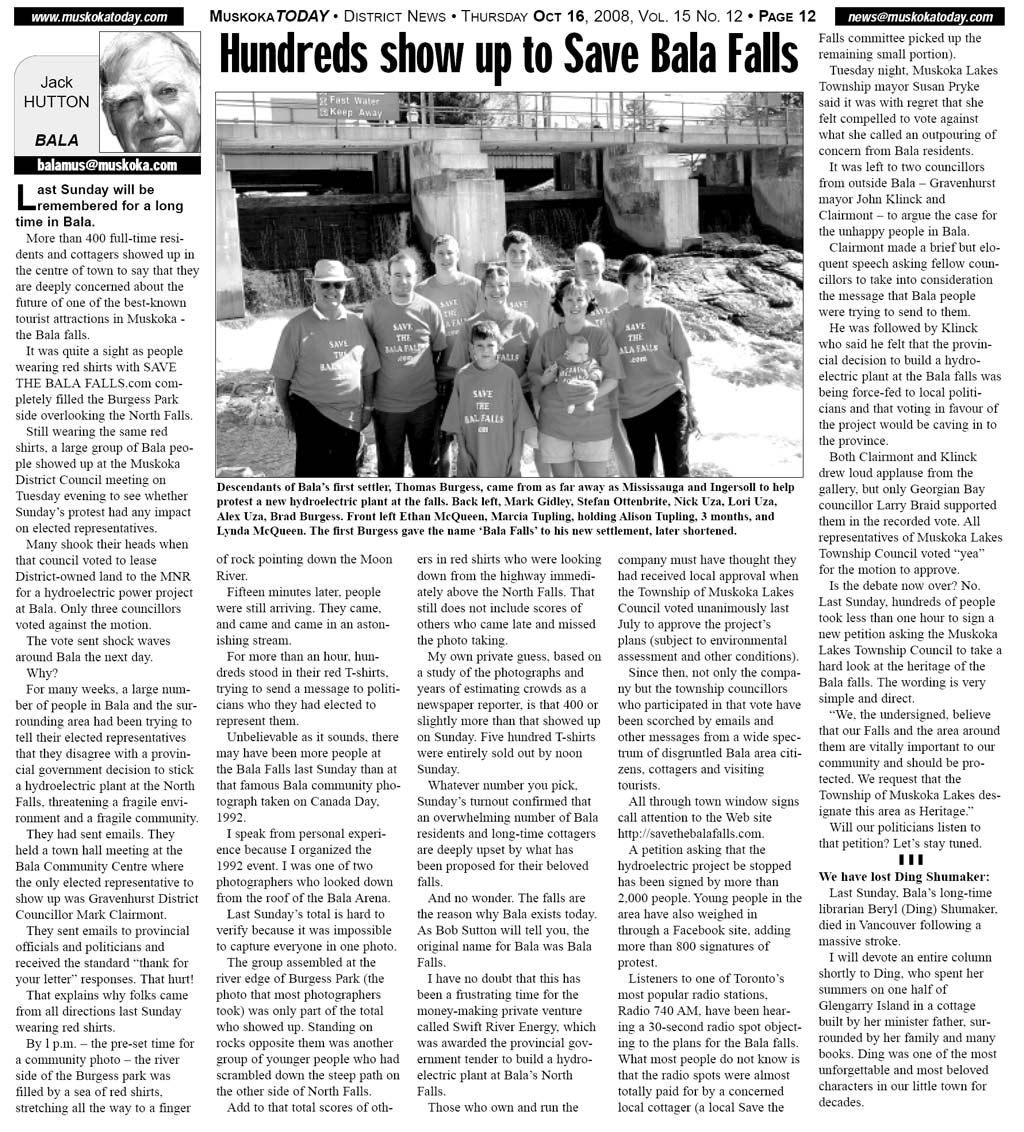
Here is an excellent article by Jack Hutton, from the October 16, 2008 issue of Muskoka Today (click on the image below).
Damage would occur to wetlands through disruption of natural seasonal patterns, and through unnatural flood and drought cycles.
While the proponent has committed to following The Muskoka Water Management Plan, during the summer months this allows daily fluctuations for the water level in Lake Muskoka of over 9 inches! – and this is the “Normal Operating Zone”. During other times of the year, much larger fluctuations are allowed. For example, in December a fluctuation of over 18 inches is allowed (this would make snowmobiling very dangerous). And these are the Normal Operating Zones. The high and low water operating zones are even more broad.
We now compete with many other tourism destinations, and this power station would be totally negative for all of Bala.